
AI Supply Chain Security for Enterprise AI Systems
Introduction
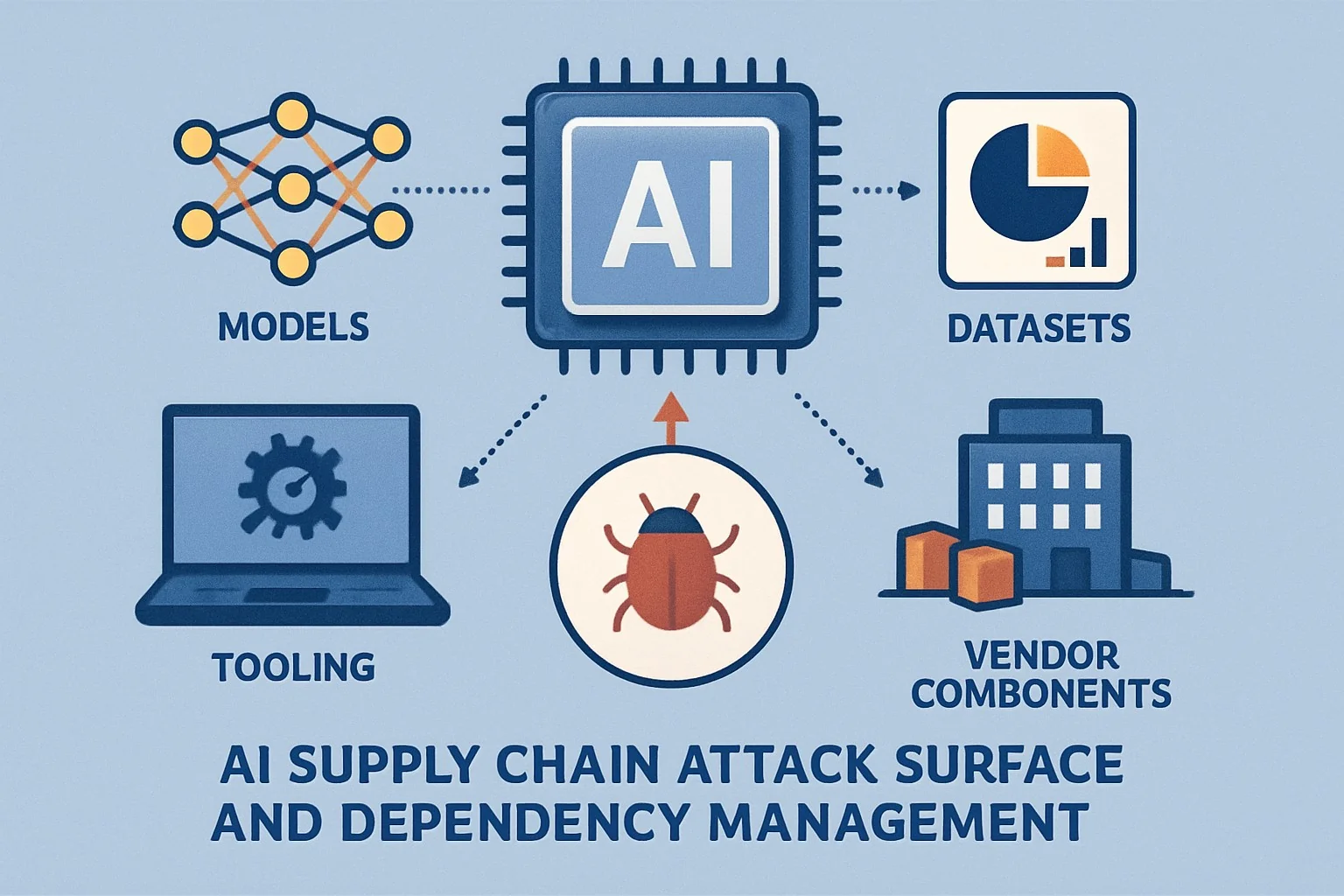
Production AI is rarely “just a model”—it’s a moving supply chain of models, datasets, fine-tunes, tooling, prompts, orchestration code, and vendor components whose integrity can fail at any boundary. This article delivers a practical playbook for AI supply chain security by mapping the AI supply chain attack surface and showing how to manage dependencies so you can prove what ran, detect tampering, and mitigate common poisoning and provenance failures.
News hook: Over the past year, public incidents and advisories have consistently pointed to one theme: attackers don’t need to “break” a model—compromise often happens upstream (artifacts, registries, build pipelines, dataset feeds, or vendor plugins). If you’re investing in enterprise AI dependency tracking now, you’ll get more leverage by hardening integrity, provenance, and pre-deployment controls than by adding more detectors after the fact.
Failure scenario (realistic): A team deploys an LLM-based agent. Weeks later, prompts begin returning policy-violating content and the system starts exfiltrating internal data. Postmortem reveals a subtle dependency drift: the model artifact in the model registry was silently replaced, and the tokenizer/model config pair no longer matched the expected checksums. In parallel, the retrieval layer ingested a poisoned document set via an untrusted ingestion job. No code changes were deployed—only artifacts moved. The incident cost months, because the team couldn’t prove which model weights, dataset version, and vendor tooling versions were used for each production response.
Executive Summary
TL;DR: Treat AI like compiled software: lock, sign, and track every artifact (models, datasets, configs, tooling) so you can verify integrity pre-deployment and detect dependency drift early.
- AI supply chain attack surface spans more than weights: dataset ingestion, fine-tuning pipelines, model registries, tokenizers/configs, vector stores, prompt templates, and vendor runtime components.
- Effective LLM dependency management requires a single source of truth for artifact identity (hashes, signatures), provenance metadata, and environment-attested execution.
- Implement AI component provenance checks at build time and pre-deployment AI integrity verification at deploy time; don’t rely solely on runtime monitoring.
- Model poisoning mitigation depends on controlling data provenance, validating training/eval datasets, and using canary tests and contamination scanning.
- Use an AI vendor risk assessment that includes SBOM/SLSA-style artifact lineage, update cadence, cryptographic guarantees, and operational isolation.
- Q→A 1: What is the AI supply chain attack surface? A: Every artifact and dependency that influences outputs—weights, tokenizers/configs, retrieval corpora, prompts/templates, tooling, and vendor components—plus the pipelines that move them into production.
- Q→A 2: What does “pre-deployment AI integrity” mean? A: Verifying cryptographic hashes/signatures and provenance metadata for the exact artifacts (model + tokenizer + configs + dataset versions + tooling versions) before rollout.
- Q→A 3: How do I mitigate model poisoning? A: Control dataset provenance, detect contamination and backdoors via targeted evaluation, and isolate training/ingestion pipelines with strict allowlists and integrity checks.
How AI supply chain attack surface and dependency management (models, datasets, tooling, and vendor components) Works Under the Hood
At a systems level, AI output integrity depends on input data + model parameters and configuration + runtime and orchestration. Attackers look for ways to change one of those without leaving clear traces. That’s why supply chain security is fundamentally about dependency identity and change control, not only about model “robustness.”
1) Core surfaces in the AI supply chain
- Model artifacts: weights/checkpoints, tokenizer files, model config, adapters (LoRA/IA3), quantization parameters, safety heads, and post-training deltas.
- Datasets and corpora: training data, fine-tuning datasets, retrieval corpora, embeddings inputs, document converters, and ingestion transforms (ETL).
- Tooling and pipelines: training code, feature extraction, augmentation scripts, evaluation harnesses, build scripts, and serialization tooling.
- Runtime and orchestration: prompt templates, tool-calling schemas, agent policies, function registries, routing logic, caching layers, and evaluation/guard pipelines.
- Vendor components: hosted model APIs, SDKs, inference servers, GPU kernels, vector DB plugins, and provenance tooling. Each introduces another dependency chain you must govern.
2) Trust boundaries and why “artifact identity” matters
In conventional software, you compile code into binaries, sign them, and deploy the signed artifact. AI parallels this, but the boundary is blurrier because the “binary” is often a bundle of files and metadata: weights + tokenizer + configs + adapters + sometimes even training recipe metadata. If any component changes without a corresponding identity record, you lose forensic capability and increase the probability of silent failure.
Practically, that means you need:
- Deterministic identity: compute cryptographic digests for every artifact you care about.
- Provenance metadata: where it came from (source, dataset version, training job, commit, builder identity).
- Attestation: a record that the artifact was produced by an approved workflow, ideally with signed build provenance.
3) A dependency graph model (mental diagram)
Think of deployment as a directed acyclic graph (DAG):
- Nodes: artifacts (model weights, tokenizer, dataset snapshot, embeddings, prompt templates, container images, Python deps), and processes (training job, conversion job, ingestion job, build job, packaging job).
- Edges: “produces” and “inputs.” Example: training job takes dataset snapshot + training code commit + hyperparameter config and produces a checkpoint bundle.
- Leaves at runtime: the inference server image + model bundle + retrieval store snapshot + prompt template version + agent policy bundle.
Security comes from ensuring every node is known, hashed, signed/attested, and recorded in an enterprise AI dependency tracker.
4) Where attackers succeed (common patterns)
- Registry compromise / artifact swap: a malicious model artifact replaces the expected one (by name/tag), often without triggering deploy-time checks.
- Config mismatch: tokenizer/config drift can lead to subtle behavior changes that evade simple regression tests.
- Poisoned dataset ingestion: adversaries introduce malicious triggers into training/fine-tune data or retrieval corpora.
- Supply chain tool tampering: compromised ETL or conversion scripts change output (e.g., injecting content into documents, altering embeddings inputs).
- Vendor update risk: SDKs or server versions update silently, changing preprocessing or safety layers.
5) Mapping to dependency management controls
To manage this, you should unify three control planes:
- Identity plane: hashes, signatures, and immutable artifact references.
- Provenance plane: training/ingestion/build job lineage and who/what produced the artifact.
- Governance plane: allowlists, approval workflows, change windows, and rollback guarantees.
If you build these into your process, AI supply chain attack surface becomes something you can measure (drift rate, unverified artifacts, provenance coverage) and reduce.
For LLM-focused security controls and how to structure a cybersecurity profile around LLM systems, see our breakdown of NIST IR 8596’s AI cybersecurity profile for LLMs—it’s useful for mapping these dependency concepts into implementable security controls.
Implementation: Production Patterns
This section moves from basic hardening to advanced pre-deployment integrity and governance. Use it as a checklist sequence; don’t attempt all controls on day one.
Step 1: Create an enterprise AI dependency inventory (the “bill of materials” for AI)
You need an AI component inventory that covers both ML artifacts and operational dependencies. Minimum recommended record fields:
- Artifact type: model_weights, tokenizer, model_config, adapters, training_code_commit, dataset_snapshot_id, prompt_template_version, embedding_model_version, vector_db_version, runtime_container_digest, SDK_version, etc.
- Immutable reference: content hash (SHA-256/512) and storage location (immutable URL/version).
- Provenance metadata: source system, owner, creator identity, producing job ID, time, and approvals.
- Policy tags: data sensitivity, allowed environments, and supported “expected behavior” test suite IDs.
Editorial discipline: If you can’t produce this inventory for the current deployed systems, start by generating it from what you already have (model registry logs, CI build metadata, and artifact manifests). Incomplete inventory is still actionable; it reveals where the blind spots are.
Step 2: Enforce immutable artifact references (no “latest”, no mutable tags)
In practice, the biggest operational cause of drift is tag mutation. Require that deploy manifests reference artifacts by digest (hash or content-addressable ID), not by names/tags alone.
- Models: use registry digests or signed artifact IDs.
- Containers: deploy by image digest (not tag).
- Python wheels: lock dependencies with hashes (pip-tools/uv lockfiles) and verify in CI.
Step 3: Add cryptographic integrity verification at build and deploy time
Adopt a two-stage model:
- Build-time checks: verify inputs are correct before producing outputs (fail fast).
- Deploy-time checks: verify the exact runtime artifact bundle matches the approved manifest.
Below is a small, production-sensible pattern for verifying a model bundle’s contents against an approved manifest file (you’d do similar for dataset snapshots, prompt bundles, etc.).
import hashlib
import json
import pathlib

def sha256_file(path: pathlib.Path) -> str:
    h = hashlib.sha256()
    with path.open('rb') as f:
        for chunk in iter(lambda: f.read(1024 * 1024), b''):
            h.update(chunk)
    return h.hexdigest()

def verify_bundle(bundle_dir: str, manifest_path: str) -> None:
    bundle_dir = pathlib.Path(bundle_dir)
    manifest = json.loads(pathlib.Path(manifest_path).read_text())

    # manifest format example:
    # {"files": [{"path":"model.bin","sha256":"..."}, ...]}
    expected = {f["path"]: f["sha256"] for f in manifest["files"]}

    for rel_path, exp_sha in expected.items():
        actual_sha = sha256_file(bundle_dir / rel_path)
        if actual_sha != exp_sha:
            raise RuntimeError(f"Integrity check failed for {rel_path}: expected {exp_sha}, got {actual_sha}")

    # Optional: enforce no extra/unexpected files
    actual_files = {str(p.relative_to(bundle_dir)) for p in bundle_dir.rglob('*') if p.is_file()}
    if set(expected.keys()) != actual_files:
        raise RuntimeError(f"Unexpected file set in bundle. expected={set(expected.keys())} actual={actual_files}")

# Example usage:
# verify_bundle('/opt/model_bundle', '/opt/approved_model_bundle_manifest.json')
Where signatures fit: hashes prove integrity relative to an approved manifest; signatures prove authenticity (who approved it). In mature environments, the manifest itself should be signed and stored in an immutable location.
Step 4: Model tokenizer/config coupling checks (prevent “silent mismatch”)
Tokenizer/config mismatch is a top source of unexpected behavior. Treat the model bundle as a unit: the approved manifest must include tokenizer and config digests, not only weights.
In your deploy checks, assert invariants such as:
- Tokenizer vocab size matches expected config.
- Special token IDs match expected mapping.
- Architecture metadata in config aligns with runtime server expectations.
Step 5: Dataset and retrieval dependency management
Supply chain security often fails at the data layer because dataset provenance gets treated as “operational.” Instead:
- Snapshot corpora: retrieval corpora and embedding inputs must be versioned as immutable snapshots.
- Hash transformed artifacts: embeddings outputs and document conversion results should be content-addressed or hashed.
- Ingestion allowlists: only ingest from trusted sources; validate schema and content constraints before indexing.
For advanced provenance approaches relevant to AI-generated content verification, see our provenance-focused guide to authenticating AI-generated video (with production C2PA-style ideas). While it targets media, the operational lesson generalizes: provenance metadata and verification need to be designed into the pipeline, not bolted on after incidents.
Step 6: Vendor risk assessment for AI vendor components
AI vendor risk assessment isn’t a spreadsheet exercise; it’s a control mapping exercise. At minimum, require vendors (or your platform vendor) to provide:
- Artifact supply guarantees: cryptographic signatures/digests for model artifacts and release packages.
- Change disclosure: documented release notes for preprocessing/tokenizer/safety changes.
- SBOM/SLSA posture: what can be provided about build lineage and dependency integrity.
- Update governance: whether updates are opt-in, and how you can pin to known-good versions.
- Isolation options: ability to sandbox tools/plugins and restrict network/file access.
Operationalize this into policy: if a vendor can’t provide pinning + integrity verification, treat their components as higher risk and isolate them more aggressively (network egress control, least privilege, limited tool execution).
Step 7: Pre-deployment AI integrity gates (the gate you should actually run)
Define a release gate that checks:
- Manifest match: deployed bundle digests match approved manifest for the release.
- Provenance completeness: every node in the dependency graph has provenance coverage above a threshold (e.g., >95% artifacts attested; the rest blocked or risk-accepted).
- Compatibility tests: tokenizer/config invariants and a quick inference sanity suite.
- Poisoning regression tests: canary prompts and contamination detectors relevant to your domain.
Implementation note: Keep the gate fast enough for continuous deployment. Heavyweight scanning can run asynchronously, but the integrity gate should be the one that blocks obvious tampering and drift.
Step 8: Model poisoning mitigation—practical controls
Poisoning mitigation is “defense in depth” across the data path and training evaluation. Typical enterprise controls:
- Source-of-truth data: require dataset snapshots with approvals and provenance metadata (who/when/why).
- Quarantine unknown sources: new data sources go to a quarantine index and are scanned before inclusion.
- Content and distribution checks: detect abnormal rates of specific patterns, duplicates, and unexpected token distributions.
- Backdoor canaries: maintain a set of trigger-based and behavior-based evaluation prompts that are run on candidate models before promotion.
- Human-in-the-loop review for high-impact sources: e.g., executive content, production logs, or privileged datasets.
Evidence-led note: There is no single “poisoning detector” that reliably catches all backdoors. The most effective approach in practice is to combine provenance controls (prevent untrusted data entry) with targeted evaluation (detect specific classes of malicious behavior) and robust rollback.
Reference implementation pattern: deployment manifest verification
Below is a simplified deployment-time pattern that compares expected artifact digests to runtime digests. In production you’d integrate with your artifact registry, secret management, and CI/CD signing keys.
import json
import os
from hashlib import sha256

def file_digest(path: str) -> str:
    h = sha256()
    with open(path, 'rb') as f:
        for chunk in iter(lambda: f.read(1024 * 1024), b''):
            h.update(chunk)
    return h.hexdigest()

def runtime_bundle_digests(bundle_root: str) -> dict:
    # Example: compute digests for known relative files only.
    files = [
        'model.bin',
        'tokenizer.json',
        'config.json',
    ]
    return {fname: file_digest(os.path.join(bundle_root, fname)) for fname in files}

def verify_deployment(bundle_root: str, approved_manifest_path: str) -> None:
    approved = json.loads(open(approved_manifest_path).read())  # {"files": {"model.bin": "sha", ...}}
    expected = approved["files"]
    actual = runtime_bundle_digests(bundle_root)

    missing = set(expected) - set(actual)
    if missing:
        raise RuntimeError(f"Missing expected files: {missing}")

    for k, exp_sha in expected.items():
        if actual[k] != exp_sha:
            raise RuntimeError(f"Digest mismatch for {k}: expected {exp_sha} got {actual[k]}")

# verify_deployment('/opt/model_bundle', '/opt/approved/manifest.json')
Comparisons & Decision Framework
You have multiple implementation paths. Choose based on your risk posture, maturity, and operational constraints.
Decision 1: Hash-only integrity vs signed provenance
- Hash-only (fast): You verify digests against an approved manifest you store internally. Good for initial rollout; you must secure the manifest itself.
- Signed provenance (mature): You verify signatures/attestations for artifacts and bind them to build jobs. Better against supply chain compromise, but requires key management and workflow instrumentation.
Recommendation: Start with hash-only if you’re already behind, then upgrade to signed provenance for release-critical artifacts (models, training code, dataset snapshots).
Decision 2: Central AI dependency tracker vs per-team scripts
- Central tracker: Enforces consistency, supports audits and automated drift detection.
- Per-team scripts: Faster to start, but tends to fragment provenance standards and breaks cross-team governance.
Recommendation: If you deploy more than a handful of AI services, invest in a central tracker early. Use strict schemas and automate ingestion from CI/CD and artifact registries.
Decision 3: Runtime detection vs pre-deployment blocking
- Runtime detection: Helps after the fact; can miss slow/low-frequency attacks and is expensive operationally.
- Pre-deployment blocking: Prevents known-bad or unknown artifacts from running; reduces blast radius and improves forensics.
Recommendation: Prefer pre-deployment integrity gates for “unknown artifact” classes (drift, unsigned changes, provenance gaps). Use runtime monitoring for anomaly detection and incident response, not as your primary integrity control.
Practical checklist (use this for each model release)
- Do you have an approved manifest containing digests for: weights + tokenizer + config + adapters + quantization artifacts?
- Is the manifest itself signed and stored immutably?
- Do you have dataset/retrieval snapshot IDs and digests for embedding inputs and retrieval corpora?
- Can you produce the dependency graph for the release (model bundle → dataset → training job → code commit → build pipeline → runtime image)?
- Did you run tokenizer/config compatibility checks and a minimal inference sanity suite?
- Did you run poisoning regression/canary evaluation relevant to your threat model?
- Have you performed an AI vendor risk assessment for any vendor runtime components or SDKs?
- Is rollback to the prior approved manifest possible within your deployment tooling?
Failure Modes & Edge Cases
Real systems fail in unintuitive places. Here are concrete failure modes to design for—plus diagnostics you can automate.
1) Artifact tag drift
Symptom: same model name/tag, different digests over time.
Diagnostics: compare registry digest history; alert on tag mutation events.
Mitigation: deploy by digest; block “latest” references; require signed manifests.
2) Tokenizer/config mismatch
Symptom: behavior changes without code changes; formatting/JSON tool calls degrade.
Diagnostics: validate vocab size/special token IDs; run golden prompt formatting tests.
Mitigation: treat model bundle as a unit with coupled digests and invariants.
3) Retrieval poisoning (vector store issues)
Symptom: targeted prompt injection or malicious retrieval results in sensitive contexts.
Diagnostics: audit document ingestion sources; sample near-neighbor sets for suspicious content; run retrieval canaries.
Mitigation: ingestion allowlists; quarantine + scan; hash embeddings inputs and versions; enforce reindex policies.
4) Training pipeline “works on my machine” drift
Symptom: new training job yields different outcomes due to dependency or preprocessing changes.
Diagnostics: diff training environment SBOM; validate preprocessing transform digests; check data schema versions.
Mitigation: lock training dependencies; store preprocessing code + configs as signed artifacts; record container digests used for training.
5) Vendor SDK changes preprocessing behavior
Symptom: subtle safety or formatting changes after dependency updates.
Diagnostics: detect SDK version drift; run differential tests across versions.
Mitigation: vendor update governance (pin versions); treat SDK changes like code changes with review gates.
6) Partial provenance coverage (the “unknown unknowns” zone)
Symptom: you can verify some artifacts but not all (e.g., prompt templates or adapter provenance missing).
Diagnostics: compute provenance coverage ratio and block releases below threshold.
Mitigation: define artifact classes (must-have vs best-effort); prioritize release-critical artifacts first.
Performance & Scaling
Security gates introduce overhead. The goal is to make verification inexpensive relative to deployment, and to push heavy scans into asynchronous lanes.
Verification cost guidance (p95/p99 oriented)
- Digest verification: hashing model files can be expensive for large weights. Use strategies like:
- Prefer registry-provided digests when available and trusted.
- Cache digests for immutable artifacts.
- Verify a Merkle-tree-style subset if your threat model allows (advanced; ensure strong integrity properties).
- Preflight integrity checks: tokenizer/config invariants and manifest comparisons should be <1s to preserve deployment velocity.
- Poisoning regression evaluation: keep a small canary suite for pre-deploy (minutes), run full eval suites asynchronously (hours/day) with automatic promotion only after passing.
KPIs to monitor (operational evidence)
- Provenance coverage (%): artifacts with verified provenance records in each release.
- Integrity gate reject rate: number of blocked deployments due to digest/signature mismatch.
- Drift rate: how often tag-based references change vs pinned digests.
- Poisoning canary pass/fail rate: and time-to-detection for retrieval anomalies.
- Mean time to rollback (MTTR): measure how quickly you can revert to prior approved manifests.
Production Best Practices
Security controls (what to operationalize)
- Least privilege: restrict CI/CD and ingestion jobs to only required sources and destinations; block write access to registries for unapproved identities.
- Network egress control: sandbox inference agents and tool-calling components; prevent tool execution from reaching sensitive networks by default.
- Signed approvals: maintain strict release approvals for model bundles, dataset snapshots, and vendor component versions.
- Runbooks for integrity incidents: define what to do when a manifest mismatch occurs (freeze rollout, rotate keys if needed, capture evidence, rollback).
Testing strategy (make it repeatable)
- Golden prompt suites: format correctness, tool-calling schema compliance, and policy-sensitive behaviors.
- Retrieval canaries: verify that the retrieval layer returns expected-safe documents for known queries.
- Cross-version differential tests: run a small suite on candidate artifacts and compare distributions of outputs/embeddings.
- Backdoor evaluation: maintain triggers relevant to your domain and threat model.
Rollout strategy
- Canary deployments: route a small traffic slice to newly released artifacts after integrity gates pass.
- Automated rollback triggers: rollback on policy violations, retrieval anomalies, or unexpected latency spikes.
- Audit logging: log the dependency graph identity (manifest IDs, digests) for every response so you can answer “what ran?” during incidents.
Further Reading & References
- NIST IR 8596: AI cybersecurity profile for LLMs (practical security control mapping)
- Provenance and authentication patterns: AI-generated video authentication: provenance and verification pipeline concepts
- Supply chain security foundations: SLSA (Supply-chain Levels for Software Artifacts) and SBOM concepts (use to structure attestations and component identity)
- Model risk and security research: surveys on data poisoning/backdoors and practical evaluation techniques (tie your canary suite to the documented failure modes)
Editorial closing: If you remember one thing, make it this: AI supply chain security is dependency management with cryptographic identity. When you can prove which artifacts ran, you can stop guessing, shorten incident response, and raise the attacker’s cost enough that your controls work.


