
LLM Observability Beyond Latency: Trace, Diff, Bill
Introduction
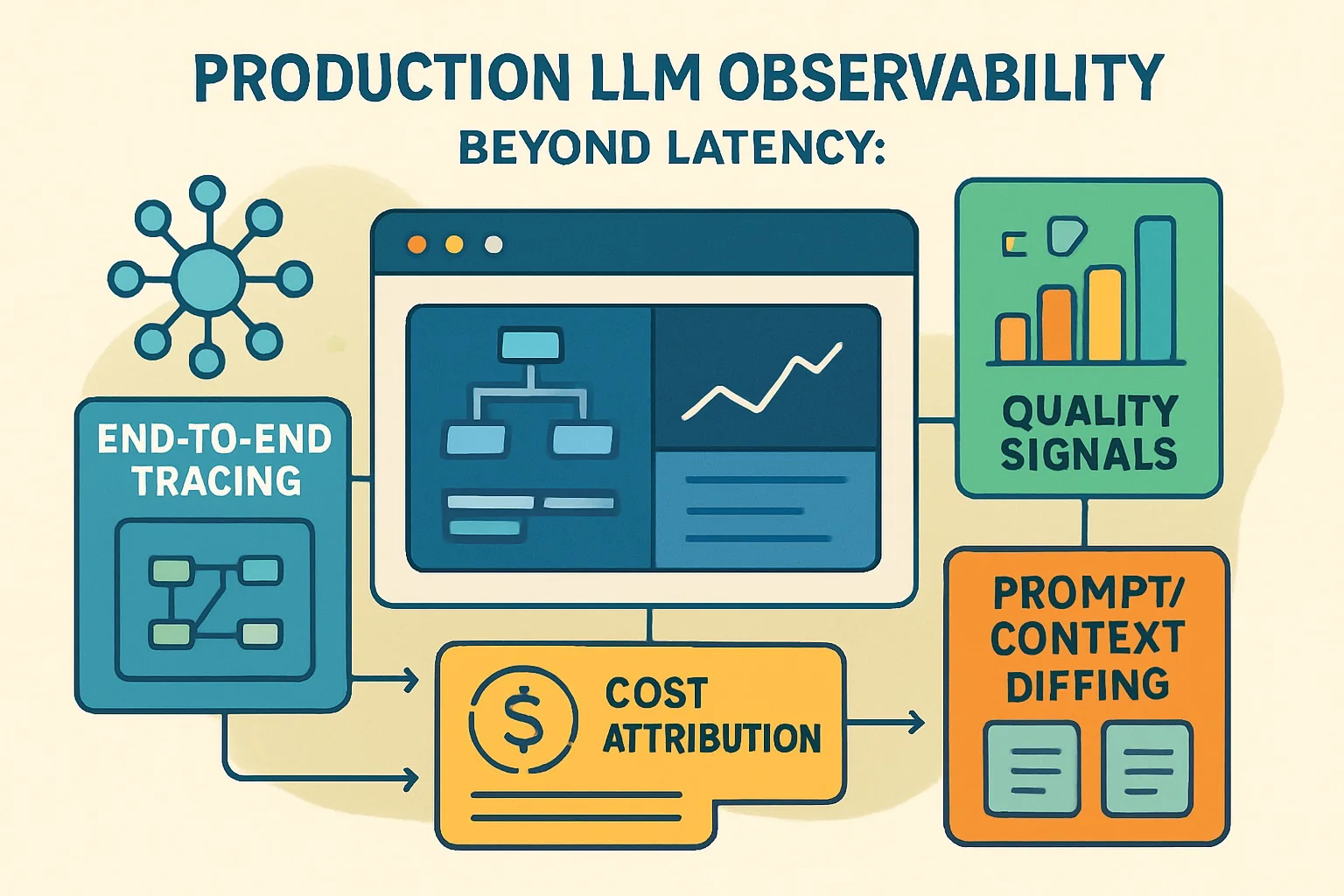
Production LLM observability can’t stop at “time to first token.” Teams need end-to-end LLM tracing that links retrieval, prompt assembly, model inference, and post-processing to LLM inference quality signals—and then attributes LLM cost to the exact user journey, not just the model call.
This article gives you an engineer-ready blueprint for LLM production observability that includes quality signals, prompt observability, context diffing (what changed and why), and cost attribution—with practical implementation patterns, diagnostics, and scaling guidance.
Failure scenario (what goes wrong in real systems): A chatbot starts “feeling dumber” after a prompt rollout. p95 latency stays flat because concurrency and batching are unchanged. Support reports irrelevant answers, but the logs only show request IDs and model name. You discover the retriever began returning a different embedding version, yet there’s no trace linking retrieval hits to the final prompt, no diff of the assembled context, and no cost-per-feature attribution. The team can’t isolate whether quality degraded due to retrieval changes, context truncation, or decoding settings—so you revert blindly, increasing downtime and wasted spend.
Executive Summary
TL;DR: Build an end-to-end LLM tracing pipeline that captures retrieval + prompt assembly + generation + judging signals, then diffs prompts/context across versions and attributes LLM cost to user journeys.
- Trace every stage (routing → retrieval → prompt assembly → tool calls → model inference → post-processing) with a shared trace_id.
- Emit LLM inference quality signals (structured outputs, self-consistency, refusal rate, judge scores, calibration) alongside latency.
- Implement prompt/context diffing so you can answer: “What changed between v12 and v13, and did quality move?”
- Attribute LLM cost at token-level and connect it to features, prompts, and user intents—then drive FinOps actions.
- Operationalize with runbooks: detect drift, isolate root causes, and quantify impact (p95/p99 + quality + cost).
Fast Q→A (likely direct questions)
- Q: What’s the minimum viable “end-to-end LLM tracing” payload?
A: A trace_id plus stage spans for retrieval, prompt assembly, inference, and post-processing, including token counts and a content hash of assembled prompt/context. - Q: How do I do prompt observability without storing sensitive prompts forever?
A: Store redacted/summarized artifacts, encrypted blobs with retention controls, and always store cryptographic hashes + diffs metadata for debugging. - Q: How can cost attribution drive better engineering decisions?
A: By tying token spend to features (retrieval depth, tool usage, context size) and measuring cost per successful outcome—not cost per request.
How Production LLM Observability Beyond Latency: End-to-End Tracing, Quality Signals, Prompt/Context Diffing, and Cost Attribution Works Under the Hood
Think of an LLM request as a distributed system with a deterministic “prompt build” step sandwiched between stochastic “generation” and “evaluation.” Observability must cover both: the deterministic parts (routing, retrieval, assembly) and the probabilistic parts (decoding and output quality).
1) End-to-end tracing: spans for every material step
Use a trace model similar to OpenTelemetry (OTel): create spans for each stage and attach structured attributes. For LLM workloads, the critical spans are:
- request.lifecycle: auth, user/session metadata (non-sensitive), feature flags.
- router.select_model: model/provider choice, temperature/top_p, max_tokens, stop sequences.
- retrieval.query: embedding model/version, query rewrite rules, top_k, filters.
- retrieval.rank: ranking model/version (if any), score distributions, and final hit IDs.
- context.assemble: prompt template version, system/developer/user messages, tool schemas, context truncation decisions.
- llm.inference: token counts in/out, sampling params, provider request IDs, retries.
- postprocess.validate: JSON schema validation, safety filters, output normalization.
- quality.judge: judge model/version, rubric version, calibration/thresholds.
- audit.persist: what you store (redacted artifacts/hashes) and retention policy.
Diagram (text): User request → Trace root span → Router span → Retrieval spans → Context assemble span (produces assembled prompt hash + token budget decisions) → Inference span (tokens + provider IDs) → Postprocess/validation span → Quality judge span (structured metrics) → Cost attribution pipeline (consumes token counts + metadata).
2) Quality signals: observable proxies for “is this answer good?”
In production, you typically don’t have ground truth for every query. So you combine output-based signals (deterministic) with evaluation-based signals (judgment) and behavioral signals (consistency/refusal/hedging).
Common LLM quality metrics you can emit per request:
- Format compliance: JSON schema pass/fail, tool call validity.
- Instruction adherence: presence/absence of required fields; refusal correctness.
- Faithfulness proxies: citation coverage (if RAG), overlap between cited snippets and generated claims.
- Calibration: if you produce confidence or probabilities (e.g., via logprobs or self-assessed confidence), track reliability curves.
- Consistency: self-consistency (N samples) and variance of key fields (when latency budget allows).
- Judge scores: LLM-as-judge with a rubric version; gate with thresholds and calibrate.
Key point: quality metrics must be versioned (judge rubric vX, prompt template vY, extraction code vZ) and emitted alongside tracing fields so you can attribute regressions to changes.
If you’re running RAG, align your quality signals with the retrieval evaluation approach—start from a production-aware checklist like this RAG evaluation checklist for production systems, and then operationalize what to measure continuously.
3) Prompt observability: treat prompt assembly as a compile step
Prompt observability is not “log the raw prompt.” It’s the ability to reconstruct why the model saw what it saw. That means:
- Template versioning (prompt_template_id + git SHA)
- Message-level provenance (source of each message: system policy, user text, retrieved chunks, tool outputs)
- Token budget decisions (what got truncated, ranking cutoffs, context window limits)
- Content hashing (sha256 of assembled prompt text after redaction/normalization)
In practice, store:
- metadata always (hashes, versions, token counts, hit IDs)
- payload artifacts selectively (redacted assembled prompt, or encrypted blobs with strict retention)
- diff metadata permanently (what changed, between which versions, and how quality moved)
This yields a system where debugging is fast and privacy risk is bounded.
4) Context diffing: what changed, where, and did it matter?
Context diffing answers questions like: “Between release 2026-05-02 and 2026-05-04, did we change retrieved context, truncate differently, or modify instructions?”
Design context diffing LLM as a deterministic first pass (hash + structural diff) and an optional second pass (LLM-assisted explanation when diffs are large or ambiguous).
Three-layer diff strategy:
- Layer A (structured): compare ordered lists of context blocks (hit IDs, doc IDs, chunk indices), and truncation boundaries.
- Layer B (semantic-ish): compute per-block embeddings or use BM25-like signatures, then cluster “changed blocks” vs “unchanged.”
- Layer C (LLM explanation): feed the diff to an explanation model with a strict instruction to output a compact change report (e.g., “removed citations 3–5; changed rubric to prefer direct answers; altered tool schema name”).
Store the LLM explanation as metadata tied to trace_id + prompt_template_id + retrieval_version_id so you can link quality regressions to specific context changes.
5) Cost attribution: token-level accounting tied to intent and feature flags
LLM cost attribution is easiest when you treat tokens as billable units and attach them to semantic features. A workable attribution model:
- Input tokens: tokens in system/developer messages + retrieved context + tool outputs.
- Output tokens: generated tokens (plus tool outputs if LLM call triggers them).
- Model routing: provider/model IDs and pricing tier.
- Feature mapping: retrieval depth (top_k), reranking enabled, tool usage, multi-turn strategy.
- Success outcomes: “passed validation,” “judge score ≥ threshold,” “user click/accept,” etc.
Then compute:
- cost_per_outcome (best for business ROI)
- marginal cost of quality (e.g., extra reranking vs quality gain)
- cost per trace (to detect outliers and runaway contexts)
For scaling and cost optimization patterns in containerized systems, you can complement this with Kubernetes cost optimization in multi-cloud environments—LLM cost controls often live at both the application and infra layers.
Implementation: Production Patterns
Below is a pragmatic build path: start with the minimum instrumentation, then add diffing + quality judging, then close the loop with automated diagnosis.
Step 1: Establish a trace contract (what must exist on every request)
Create a trace_id (and optionally span_id) at the API boundary. Every downstream component must propagate it. Define a “trace contract” schema so dashboards and quality pipelines don’t drift.
- Trace root attributes: tenant_id, user_intent_class, feature_flags, prompt_template_id
- Span attributes: stage-specific versions (retriever embedding model, judge rubric), token counts, truncation decisions
- Artifacts pointers: hashes + storage keys for redacted prompt/context
Step 2: Instrument spans with token and version attributes
Token counts and versions are the backbone of both quality and cost attribution. Ensure llm.inference spans record:
- prompt_tokens, completion_tokens (and optionally total_tokens)
- sampling params: temperature, top_p, max_tokens, stop_reason
- provider_request_id, retry_count, model_id
- logprob availability (if supported)
Step 3: Add prompt/context observability artifacts (hash + selective payload)
When you assemble the prompt, compute:
- assembled_prompt_hash after redaction/normalization
- context_blocks list with (doc_id, chunk_index, order, char/token length)
- truncation_plan (e.g., kept top N blocks until token budget reached)
Store the redacted prompt (or a summarized version) for limited retention. Always store the hash.
Step 4: Implement context diffing (A + optional B/C)
Layer A diff is usually enough to detect regressions: compare hit IDs/chunk indices and truncation boundaries between two runs.
If you need explanation for humans, add Layer C only when diffs exceed thresholds (e.g., > 30% blocks changed or truncation boundary moved).
Code example: trace + prompt hash + structured context blocks (Python)
import hashlib
import json
from dataclasses import dataclass

def sha256_text(s: str) -> str:
    return hashlib.sha256(s.encode('utf-8')).hexdigest()

@dataclass
class ContextBlock:
    doc_id: str
    chunk_index: int
    order: int
    token_count: int

def assemble_prompt_and_observe(messages, context_blocks, truncation_plan):
    # messages: list of {role:..., content:...}
    # context_blocks: list of ContextBlock
    # truncation_plan: dict (what was cut, boundaries, budgets)

    # Redaction/normalization is domain-specific.
    serialized = json.dumps(messages, ensure_ascii=False, separators=(',', ':'))
    normalized = serialized.replace("\n\n\n", "\n\n")

    prompt_hash = sha256_text(normalized)

    observation = {
        "assembled_prompt_hash": prompt_hash,
        "context_blocks": [b.__dict__ for b in sorted(context_blocks, key=lambda x: x.order)],
        "truncation_plan": truncation_plan,
        "context_block_signature": sha256_text(json.dumps(
            [b.__dict__ for b in context_blocks], ensure_ascii=False, separators=(',', ':')
        ))
    }

    return messages, observation
Step 5: Create a quality signal pipeline with versioned rubrics
Emit at least one deterministic validator signal and one evaluation signal.
- Deterministic: JSON schema validation, citation field presence, refusal correctness.
- Evaluation: LLM judge score using a rubric version; store the rubric_id and judge_model_id.
Do not overwrite; version everything. When a rubric changes, you must understand that your metric distribution may shift even if model behavior is unchanged.
Code example: structured output validation as a quality metric (TypeScript)
type Answer = { answer: string; citations?: string[]; confidence?: number };

function validateAnswer(jsonText: string): {
  ok: boolean;
  error?: string;
  parsed?: Answer;
} {
  try {
    const parsed = JSON.parse(jsonText);
    if (typeof parsed.answer !== 'string' || parsed.answer.length === 0) {
      return { ok: false, error: 'Missing/empty answer' };
    }
    if (parsed.citations !== undefined) {
      if (!Array.isArray(parsed.citations) || parsed.citations.some(c => typeof c !== 'string')) {
        return { ok: false, error: 'Invalid citations' };
      }
    }
    return { ok: true, parsed };
  } catch (e: any) {
    return { ok: false, error: String(e?.message || e) };
  }
}
Step 6: Cost attribution pipeline (tokens → dollars → outcomes)
Compute cost at inference-span completion. Then aggregate by trace_id and feature flags.
- Normalize pricing by provider/model and region.
- Include retries: cost attribution must include each attempt.
- Charge tool calls to the feature that triggered them.
Code example: cost per trace with retry accounting (pseudo-code)
# Each inference span emits: model_id, prompt_tokens, completion_tokens, attempt_cost
# Then you aggregate attempts under the trace_id.

def compute_trace_cost(inference_spans):
    return sum(span["attempt_cost"] for span in inference_spans)

def attribute_cost(trace, feature_flags, outcomes):
    return {
        "trace_id": trace["trace_id"],
        "feature_flags": feature_flags,
        "total_cost": trace["cost_total"],
        "outcome": outcomes.get("pass", None),
        "cost_per_outcome": (trace["cost_total"] if outcomes.get("pass") else None)
    }
Step 7: Connect traces to dashboards and automated triage
Dashboards should support three workflows:
- Regression detection: alert on quality drop and/or diff distribution shift (not just latency).
- Root-cause isolation: find traces where prompt/context hash differs across releases, and where judge scores dropped.
- Cost impact analysis: identify spikes from larger context windows, retries, or tool loops.
Comparisons & Decision Framework
There are multiple valid ways to implement observability. Use this decision framework to choose what to build first.
Choose a tracing depth level
- Level 0 (logs only): request_id + latency. Lowest effort; cannot explain quality regressions.
- Level 1 (spans + token counts): stage spans with versions and tokens. Best baseline.
- Level 2 (prompt/context hashes + truncation plan): enables context diffing and safe debugging. Strong recommended.
- Level 3 (LLM-assisted diff explanations + automated triage): best for fast root cause analysis at scale.
Quality signal strategy: prioritize reliability over cleverness
Pick your quality signals based on what you can validate safely:
- If you require strict schemas: use deterministic format compliance + tool validation as primary.
- If you need “answer quality”: add judge scores with rubric versioning and calibration.
- If you can afford extra calls: use consistency sampling for high-value intents; otherwise keep it cheap.
Decision checklist (use this before building)
- Can every trace map to a prompt_template_id, retriever_version_id, and judge_rubric_id?
- Do you store assembled prompt hashes so you can compare releases?
- Do you emit token counts for cost attribution (including retries)?
- Can you diff context blocks and truncation boundaries structurally?
- Are quality metrics versioned so you can interpret shifts correctly?
Failure Modes & Edge Cases
Instrumentation that isn’t robust becomes noise. Here are the common failure modes you should design around.
1) Diffing lies because normalization is inconsistent
If prompt assembly changes whitespace, ordering, or serialization, hashes/diffs will show false positives. Fix by defining a canonical prompt serialization format (including deterministic message ordering and whitespace normalization).
2) Quality metrics shift due to judge updates (not model changes)
If your judge model or rubric changes without version pinning, you’ll interpret metric movement incorrectly. Always store judge_model_id, rubric_id, and rubric timestamp in spans/attributes.
3) Hidden context truncation breaks faithfulness
Even if retrieval returns high-quality chunks, truncation can remove critical evidence. Ensure context.assemble spans record truncation boundaries and the number of removed blocks/tokens.
4) Retries cause double-billing and distorted outcomes
If retries aren’t included in token accounting, cost attribution will be wrong. Likewise, if you only judge the “final attempt,” you may miss earlier malformed outputs that triggered tool loops.
5) Privacy leakage through prompt logs
Never store raw prompts indefinitely. Use redaction, encryption, strict retention, and access controls. Prefer hashes + diff metadata for long-term debugging.
6) Multi-modal and tool-augmented pipelines complicate “context”
For multimodal models or vision-language prompts, “context” includes image descriptors, extracted text, and tool outputs. Treat them as first-class blocks with their own hashes. If you’re working on vision-language prompts, align your observability with production prompt patterns such as production multimodal prompt engineering best practices.
Performance & Scaling
Observability can become expensive. You need to measure overhead and keep it bounded—especially for high QPS chat systems.
What to watch (KPIs)
- Tracing overhead: added CPU/memory per request; target < 1–3% compute overhead.
- Payload size: average size of redacted prompt artifacts; target stable caps.
- Diff cost: how often you run Layer C (LLM explanation). Keep it event-driven (only when structural diffs exceed thresholds).
- Quality judge throughput: judge calls per request; use sampling (e.g., 5–20%) and stratify by intent.
- Cost attribution latency: time from inference completion to cost record availability.
p95/p99 guidance: treat observability endpoints like production deps
Any synchronous call to a logging/observability backend can inflate tail latency. Prefer:
- Asynchronous span export
- Local buffering + backpressure
- Fail-open behavior: do not block inference on tracing export
For teams already optimizing inference latency, make sure instrumentation does not regress batching or streaming. If you need a complementary performance engineering lens, see our production LLM inference latency SLO framework and apply the same SLO thinking to trace export reliability.
Benchmarks (how to structure your evaluation)
- Run a load test with tracing on/off; compare p95 latency delta.
- Validate that token counts and hashes remain correct under concurrency and retries.
- Sample N traces across releases and verify diff accuracy by spot-checking context blocks and truncation boundaries.
- Measure judge sampling strategy: confirm it correlates with known outcome rates and doesn’t dominate cost.
Production Best Practices
Here’s the MAKB-style operational discipline checklist: the goal is not to “collect data,” but to enable safe decisions.
Security and privacy
- Redact PII in prompt artifacts; store hashes and metadata.
- Encrypt any stored prompt/context payloads; use tenant-aware keying.
- Access control: limit who can view reconstructed prompts; log access.
- Prompt injection resilience: treat judge prompts and diff explanations as untrusted input.
If you’re extending observability into security testing, pair this with an explicit threat model: LLM security testing methodology and threat modeling.
Testing and rollout
- Canary prompt_template versions with trace-based comparison.
- Hold judge rubric constant during A/B to isolate model/prompt effects.
- Regression gates: block rollout when quality metrics drop beyond tolerance, even if latency is stable.
Runbooks (what engineers should do at 2am)
- Detect: quality drop alert triggered (judge score, format compliance, refusal rate).
- Isolate: filter traces by prompt_template_id change and compare context diff distributions.
- Explain: use Layer A diff (hit IDs/truncation) and Layer C explanation when necessary.
- Diagnose: check retrieval_version_id and embedding model rollout; verify truncation budgets.
- Mitigate: revert prompt template, adjust truncation, or disable reranking/tool usage.
- Quantify: measure quality recovery and cost impact using cost-per-outcome metrics.
Further Reading & References
- OpenTelemetry specification (tracing model and semantic conventions): OTel docs
- OpenAI API usage and token accounting guidance: provider documentation
- RAG evaluation in production (metrics and pitfalls): RAG evaluation in production: metrics & pitfalls
- Production inference latency SLO patterns: Production LLM Inference Latency SLO Framework
- Multimodal prompt observability alignment: Multimodal Prompt Engineering Best Practices (Production)
Editorial note: Observability is only as good as your ability to answer “what changed?” and “what did it cost?” End-to-end tracing plus prompt/context diffing closes the loop between engineering releases and lived user outcomes.


