
Per-tenant LLM cost attribution & chargeback
Introduction
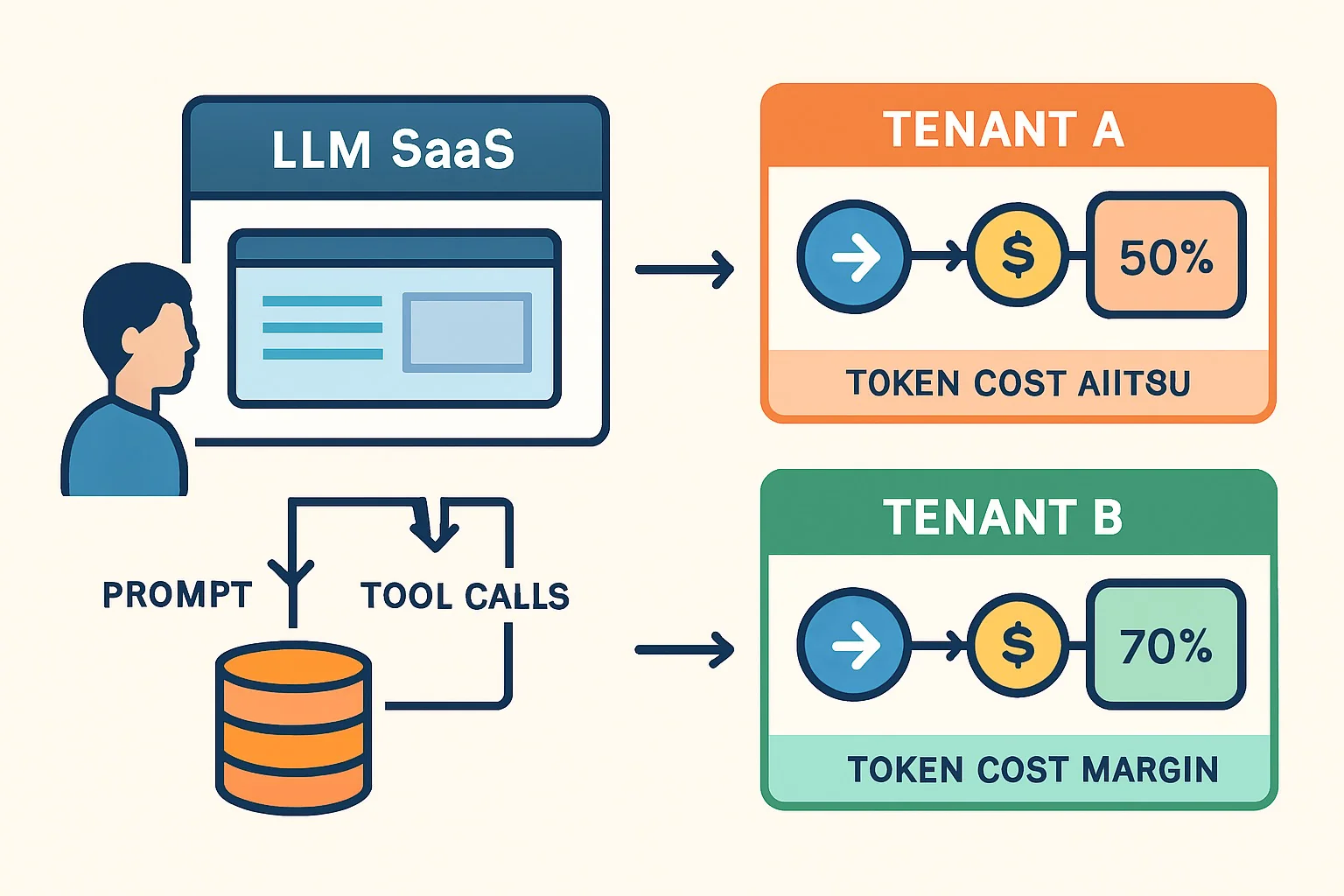
In production multi-tenant LLM SaaS, per-tenant token cost attribution is the difference between "we think it's expensive" and a defensible unit-economics engine that drives pricing, caps risk, and prevents surprise margin erosion.
This article delivers an evidence-led, engineering-first approach to attribute LLM usage costs from prompt + tool calls through blended margins into tenant-level statements you can reconcile with real invoices and operational telemetry.
Failure scenario: You roll out a new RAG workflow with a tool-using agent. Token costs jump 4×, but billing shows no spike for the top tenant. Finance flags margin compression; Engineering blames "model pricing changes" while Product blames "unfair charges." Without request-level token accounting and a consistent chargeback model, you end up rewriting dashboards during incident reviews—every quarter.
Executive Summary
TL;DR: Implement request- and tool-level token accounting, then allocate both usage and overhead using a transparent FinOps attribution methodology to produce tenant-level cost and chargeback that reconciles with invoices.
- Attribute tokens at the smallest costable unit: prompt, completion, tool call inputs/outputs, and any downstream LLM calls.
- Separate measurement from pricing: track "raw provider tokens" vs "blended cost model" so finance can update margins without breaking auditability.
- Use a two-stage allocation: (1) direct tokens → tenant; (2) overhead → tenant via explicit allocation keys (e.g., tokens, concurrency, or active sessions).
- Design for observability: p95/p99 cost per request, anomaly detection, and reconciliation jobs catch leakage before it hits chargeback.
- Chargeback should be contract-aware: usage tiers, reserved caps, and overage rules must map cleanly to your unit economics per request.
Likely Q→A (for fast extraction):
- Q: How do I attribute LLM token costs to tenants in a multi-tenant SaaS? A: Record tokens per request and per tool call, join them to tenant_id, then roll up using your unit economics per request and allocation keys.
- Q: What is an LLM multi-tenant chargeback model that finance can reconcile? A: Maintain raw provider-cost totals from token accounting, then apply a separate blended margin LLM cost model to compute tenant charges.
- Q: Where do token costs go when an agent calls tools and re-prompts? A: Attribute every LLM invocation (including agent/tool orchestration prompts) to the originating request lineage, then allocate to the tenant.
How Per-tenant token cost attribution and chargeback for multi-tenant LLM SaaS (from prompt + tool calls to blended margins) Works Under the Hood
Good LLM FinOps attribution methodology is mostly bookkeeping—done with discipline. The trick is not "count tokens"; the trick is to count the right tokens, preserve lineage across orchestrations, and separate cost measurement from business pricing.
1) Define the costable units (what you will measure)
Your attribution model must agree with how you actually spend money. For most LLM SaaS, the measurable cost drivers are:
- Provider input tokens: system + developer + user prompt, retrieved context (RAG), conversation history, tool schemas, and any serialized data you include.
- Provider output tokens: generated completion tokens (including JSON outputs, function-call arguments, and assistant responses).
- Tool-call related LLM invocations: many agents re-prompt after tool results; each LLM call is costable.
- Embedding tokens (if applicable): if you embed per request, include it as a distinct line item.
- Moderation / reranking / LLM-as-judge: treat as separate models; either attribute directly or via overhead allocation.
Editorial rule: Do not mix "tokens" with "time" in the direct allocation stage. Keep the direct stage token-based; time-based costs belong to overhead allocation unless you're doing true per-token latency modeling.
2) Capture token usage per LLM call (prompt + completion)
At runtime, every LLM request should emit a cost record containing at least:
- tenant_id (or workspace/account_id)
- request_lineage_id (a stable correlation id across retries and tool calls)
- llm_call_id (unique per provider API call)
- model_id and provider
- input_tokens, output_tokens (preferably directly from provider usage fields)
- timestamp, region (if price differs)
- status (success/failed/partial) and reason (for attribution policy)
If your platform streams tokens, still treat usage as one accounting record. If you can only estimate early, ensure you reconcile actual usage later by re-reading provider usage from logs.
3) Preserve lineage through agent/tool orchestration
Multi-tenant LLM SaaS often has a control plane that:
- builds a prompt (possibly with RAG)
- calls the LLM
- detects tool calls
- executes tools (search, DB, code runner, web requests)
- feeds tool results back to the LLM
To allocate correctly, you need a lineage graph with a root request. Practically, you can model this as:
- root_event = user interaction (chat, endpoint call, workflow start)
- child_events = each LLM call and each tool call
- edges = "LLM call produced tool calls" and "tool results were injected into next LLM call"
You don't have to implement a full graph database. Most teams do this with request_lineage_id plus parent pointers (parent_llm_call_id / parent_tool_call_id) in logs.
Then you roll up costs by tenant_id and root request. This solves the "agent called tools and re-prompted" attribution problem.
4) Compute provider cost (direct measurement)
Attribution should start with measured provider unit costs. Maintain a price catalog keyed by:
- provider
- model_id
- effective date (prices change)
- region (if you have region-specific pricing)
Compute:
provider_cost = input_tokens * input_unit_price + output_tokens * output_unit_priceOptionally include embedding costs similarly. Do not yet apply margins.
Policy note: For failed calls, you need a consistent attribution rule (e.g., charge only for tokens actually returned; for non-usage errors, cost may be zero or include retries you attempted). Decide this early and codify it.
5) Attribute non-token costs (overhead allocation keys)
Real unit economics per request isn't only token cost. Your cost center might include:
- inference gateway / proxies
- vector DB / retrieval
- orchestration runtime (workers)
- observability overhead
- batch evaluation (LLM-as-judge runs)
Because you can't always attribute these directly per token, use an explicit overhead model. Typical approaches for the LLM unit economics per request include:
- Token-proportional overhead: overhead_share = tenant_tokens / total_tokens
- Active-session overhead: based on distinct sessions or concurrency
- Hybrid: overhead partially token-based, partially time/concurrency-based
Whatever you choose, make it auditable: publish the allocation keys and lock them behind a versioned model.
6) Apply a blended margin LLM cost model (business pricing layer)
Once you have provider_cost and allocated_overhead, you can compute a blended cost model and then charge back.
A clean pattern is to separate:
- Measured cost: provider_cost + allocated_overhead
- Blended margin model: multiply by margin factors and/or add fixed platform fees
Example blended approach:
blended_cost = (provider_cost + overhead_allocation) * (1 + margin_rate_model)But you may need more than one margin bucket: e.g., premium tenants using high-latency models carry different ops costs. In that case you apply margin by model class or endpoint.
This layered approach is the core of a reconciliable LLM unit economics per request pipeline: finance can audit measured costs, while product can tune margins without reprocessing raw usage.
7) Produce chargeback and statements (invoice-like outputs)
Tenants usually need:
- monthly summary by endpoint, model, and cost type (tokens, embeddings, judges)
- breakdown: prompt vs completion tokens
- overage vs included allowance (if you have contracts)
- reconciliation metadata (model price version, usage record counts)
Then you map blended costs to billing rules:
- Usage-tier credits (e.g., first 10M tokens included)
- Overage rates (may differ from blended cost rate)
- Reserved caps / throttles (when exceeded, you may cap rather than bill higher)
In other words, your chargeback is the business logic layer on top of the LLM FinOps attribution methodology.
For a deeper unit-economics and chargeback framing, see FinOps for LLMs: Token Costs, Unit Economics, Chargeback.
For request-level instrumentation and cost leakage debugging, the practical companion is LLM Observability Beyond Latency: Trace, Diff, Bill.
Implementation: Production Patterns
Step 1: Data model that won't collapse under agents
Create two primary event tables (or streams):
- llm_call_usage: one row per provider API call with tenant_id and lineage
- root_request_usage (optional): aggregated rollups per root request for faster dashboards
Minimum schema fields:
llm_call_usage(tenant_id, request_lineage_id, llm_call_id, parent_llm_call_id, provider, model_id, input_tokens, output_tokens, input_unit_price_version, output_unit_price_version, provider_cost, status, created_at)For tools, store tool-call events separately if you want auditing, but token costs are easiest when they're attached to each LLM call.
Step 2: Correlation IDs across prompt + tool calls
Implementation pattern:
- Generate a request_lineage_id at the entrypoint (API call / workflow start).
- Pass it through every agent loop iteration and tool execution.
- For each provider call, create llm_call_id and record the parent (if known).
Example (pseudo-code):
request_lineage_id = new_uuid()for step in agent_steps: # tool loop + re-prompts happen here llm_call_id = new_uuid() usage = provider.chat(model, messages) emit_llm_call_usage(tenant_id, request_lineage_id, llm_call_id, parent_llm_call_id, usage.input_tokens, usage.output_tokens, model_id) if usage.contains_tool_call: tool_result = run_tool(...) parent_llm_call_id = llm_call_idTwo things to get right:
- Retries: include a retry_reason and do not silently de-duplicate usage records unless you can prove idempotency.
- Streaming: compute final token totals from provider usage fields (or post-stream reconciliation).
Step 3: Reconciliation job (make it finance-proof)
You need an automated "bill reconciliation" job that checks:
- Sum of provider_cost in your logs for model X over period P equals provider invoice totals (within an allowed tolerance).
- Price catalog version used matches the effective provider price.
- Missing usage records don't exceed a threshold.
If you skip this, your chargeback will always be disputed.
Use the same pipeline to support "what changed?" diffs after incidents.
Again, Trace, Diff, Bill is directly relevant to diagnosing cost drift and attribution gaps.
Step 4: Build the allocation engine (measured + overhead + margin)
Implement a versioned "cost model" service:
- Versioned price catalog per model and date
- Overhead allocation config (token-proportional, hybrid keys)
- Margin rules per endpoint/model class
- Chargeback rules per tenant contract
Process outline (batch daily or hourly):
- Ingest llm_call_usage for window W.
- Join with price catalog to compute provider_cost.
- Compute overhead pools and allocate overhead to tenants.
- Apply blended margin rules to compute blended_cost.
- Apply contract rules to compute chargeable amount.
- Write tenant statements + reconciliation metadata.
Step 5: Concrete code example (cost rollup by root lineage)
Below is an illustrative SQL rollup pattern. Adapt to your warehouse (BigQuery/Snowflake/Postgres).
-- Roll up direct token cost to the tenant for a periodINSERT INTO tenant_cost_rollup (tenant_id, root_request_id, period_start, period_end, direct_cost)SELECT tenant_id, root_request_id, @period_start, @period_end, SUM(provider_cost) AS direct_costFROM llm_call_usageWHERE created_at >= @period_start AND created_at < @period_endGROUP BY tenant_id, root_request_id;Then overhead allocation can be computed from total tokens:
-- Example token-proportional overhead allocationWITH totals AS ( SELECT period_start, period_end, SUM(input_tokens + output_tokens) AS total_tokens FROM llm_call_usage WHERE created_at >= @period_start AND created_at < @period_end GROUP BY period_start, period_end)SELECT r.tenant_id, r.direct_cost, (@overhead_pool * (t.tenant_tokens / tot.total_tokens)) AS allocated_overheadFROM tenant_cost_rollup rJOIN (SELECT tenant_id, SUM(input_tokens + output_tokens) AS tenant_tokens FROM llm_call_usage WHERE created_at >= @period_start AND created_at < @period_end GROUP BY tenant_id) t ON r.tenant_id = t.tenant_idJOIN totals tot ON 1=1;Keep this allocation versioned; treat it like a financial statement algorithm.
Step 6: Guardrails and optimization
Attribution isn't only for billing; it's for controls:
- Per-tenant caps: stop spending after a token budget (and mark overage behavior).
- Prompt size budgets: enforce max context length per endpoint/tenant.
- Tool result bounding: summarize tool outputs before re-prompting (reduces re-prompt explosion).
If you're using prompt engineering practices that reduce context bloat, you'll see the improvement in tenant cost curves. Consider pairing FinOps with multimodal prompt engineering best practices when your workloads include large attachments or encoded payloads.
Comparisons & Decision Framework
Direct token attribution vs blended allocation only
Option A: Token-only direct allocation. Attribute all costs using tokens proportionally (including overhead). Pros: simple, intuitive. Cons: may mis-allocate overhead when model usage differs in latency/concurrency.
Option B: Two-stage (recommended): direct token attribution + explicit overhead allocation keys. Pros: reconciliable, auditable, more accurate. Cons: slightly more engineering.
Decision checklist:
- Do you need finance reconciliation? Choose two-stage.
- Do tenants differ wildly in concurrency or session behavior? Use hybrid overhead keys.
- Do you run non-LLM work per request (RAG, rerank, eval)? Consider separate line items or overhead pools.
Lineage rollup: root request vs per-step chargeback
Root-request attribution (most common): map everything under the user's initial interaction. Best for "why did this tenant get charged?"
Per-step chargeback (rare): charge per tool invocation or per agent loop iteration. Useful if your contracts are step-based (e.g., "tool uses cost X").
For most SaaS, start with root-request attribution and optionally provide step breakdown for transparency.
Margin model placement: after overhead vs per-component
- After overhead: blended_cost = (direct + overhead) * (1 + margin_rate). Simple.
- Per-component: apply different margin rates to tokens vs embedding vs judges. More accurate; more config.
Choose per-component when you have materially different service-level costs across model types or when judges/evals are operationally heavy.
Failure Modes & Edge Cases
Failure mode 1: Missing tenant_id in logs
Symptom: Unknown tenant buckets; reconciliation mismatch.
Mitigation: enforce tenant_id propagation at the boundary, fail fast on missing context, and add runtime assertions.
Failure mode 2: Double counting due to retries
Symptom: provider_cost grows while request counts look stable.
Mitigation: implement idempotency for provider calls where possible, or tag retries with a dedupe key. If you can't dedupe, then charge retries explicitly and show them in cost drilldowns.
Failure mode 3: Streaming/partial usage ambiguity
Symptom: token totals don't match provider invoice usage.
Mitigation: always reconcile to provider usage fields after completion; treat estimates as provisional and mark them.
Failure mode 4: Context bloat from RAG and tool outputs
Symptom: tenant cost per request climbs while "successful answer quality" remains stable.
Mitigation: cap retrieved chunks, limit tool output size, and add summarization steps that are enforced by a budget. Then track "tokens per retrieved chunk" as a KPI.
Failure mode 5: Orchestration prompts not attributed correctly
Symptom: agent outputs look cheap, but tool-heavy workflows are expensive.
Mitigation: ensure every internal LLM invocation (including "planner" and "verifier" models) is recorded with the same request_lineage_id.
Failure mode 6: Overhead allocation disputes
Symptom: tenants dispute "why am I paying for others?"
Mitigation: publish allocation keys, provide per-tenant explainability ("your share based on 23% of tokens"), and version the allocation model. Tenants will accept overhead when it's consistent and transparent.
Performance & Scaling
Cost pipeline SLOs
Your cost attribution engine itself must be reliable and fast enough not to become a bottleneck in billing cycles.
- Freshness: compute near-real-time or hourly for chargeback previews; daily for final statements.
- Reconciliation latency: within 24h of provider invoice export availability.
- Accuracy: target <0.5–1.0% drift vs provider invoice totals (depending on tolerance and data completeness).
KPIs to monitor
- Cost per request (p50/p95/p99) by tenant and endpoint
- Tokens per request (input/output split)
- Tool-call amplification factor = total llm_call_usage / root requests
- Attribution coverage = % of requests with full tenant_id + model usage
- Anomaly scores for per-tenant cost drift week-over-week
p95/p99 guidance (what usually hurts)
Most LLM SaaS see long tails when:
- retrieval returns too many chunks
- agents iterate too many loops
- tool outputs are unbounded
Instrument these and correlate them with token distribution at p95/p99. Then enforce hard budgets at those points (context length, tool output length, max tool loops).
For performance engineering around latency and tail behavior (which often correlates with cost and retry loops), see Production LLM Inference Latency SLO Framework.
Production Best Practices
Explainability and tenant trust
- Include prompt vs completion token breakdowns.
- Provide model-level breakdowns (what model drove cost).
- Provide "top cost requests" drilldowns for disputed statements.
Testing the attribution model
Build deterministic test fixtures:
- mock provider responses with known input/output token usage
- simulate agent tool loops with multiple LLM calls under one lineage id
- simulate retries and verify expected cost behavior
- validate price catalog version selection
Because this affects billing, treat it like financial logic: strong tests, strong review, versioned configs.
Security and privacy considerations
Token logs can contain sensitive content if you store prompts. For chargeback, you usually don't need raw prompt text—only token counts and model identifiers. Apply least privilege:
- store prompts separately with retention controls (if needed)
- keep cost data in an access-controlled analytics schema
- prevent cross-tenant access via query policies
If you operate agents and tool execution, also consider threat modeling around tool injection and prompt leakage; the cost attribution system should not become a side-channel. For a structured approach, see LLM security testing methodology: threat modeling.
Rollout plan
- Shadow mode: compute chargeback without charging; compare to existing billing.
- Backfill: recompute last 1–3 months for validation.
- Tenant preview: publish dashboards to top tenants first.
- Version pinning: lock allocation and margin models for each billing period.
- Incident runbook: define what to do when reconciliation drift exceeds tolerance.
Further Reading & References
- FinOps for LLMs: Token Costs, Unit Economics, Chargeback
- LLM Observability Beyond Latency: Trace, Diff, Bill
- Production LLM Inference Latency SLO Framework
- Multimodal LLM Prompt Engineering Best Practices
- LLM Security Testing Methodology: Threat Modeling
Final editorial take: Treat cost attribution like you'd treat distributed tracing for payments—lineage, reconciliation, versioning, and explainability. If you do that, per-tenant LLM cost attribution becomes a growth lever rather than a recurring billing argument.


