
RAG Staleness Detection in Production (Automated Alerts)
Introduction
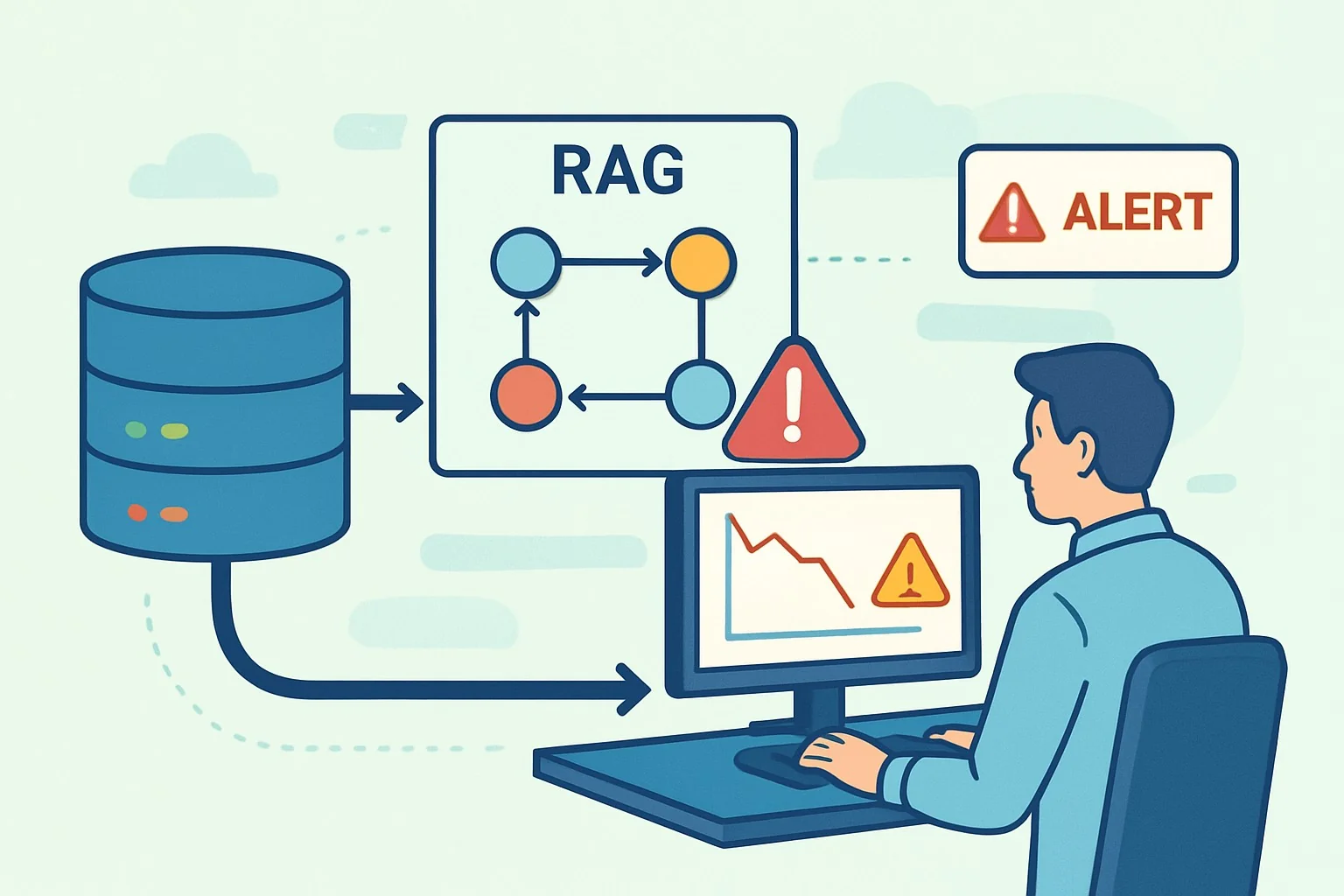
Production systems that use RAG fail in predictable ways: the pipeline keeps returning answers, but retrieval quality silently decays as indexes age, corpora change, embeddings drift, or prompts evolve—until trust collapses. This article shows how RAG staleness detection production systems can automatically diagnose why quality degraded and alert the right owners with evidence.
Promise: you’ll get an operator-grade blueprint for automated RAG health checks, real-time RAG quality monitoring, and RAG retrieval drift detection—including practical metrics, decision thresholds, and implementation patterns. If you also need a measurement plan, start with RAG Evaluation Checklist for Production Systems.
Failure scenario (what happens in the wild): your monthly content refresh updates policy docs and product FAQs, but the vector index rebuild lags by 3–10 days. Meanwhile, an embedding model upgrade changes similarity geometry. The chat service still responds, but citations increasingly point to outdated paragraphs, “latest” constraints are ignored, and LLMs begin hallucinating when retrieval returns older evidence. Because overall latency and token volume look normal, the degradation is detected only after customer escalations—often a week too late.
Executive Summary
TL;DR: Detect RAG staleness by coupling freshness-aware retrieval signals with continuous retrieval+answer quality probes, then route evidence-based alerts to the owning pipeline.
- Measure freshness and utility separately: “is the retrieved content new enough?” vs “did retrieval improve answer correctness?”
- Use canary questions tied to known facts + time-sensitive ground truth to track RAG quality degradation diagnosis.
- Detect drift with offline/online alignment: compare embedding distributions, retrieval hit rates, and LLM-as-judge scores over time.
- Automate health checks with a production evaluation pipeline: run sampling-based probes continuously (not only on deploy).
- Alert on actionable causes: index lag, embedding mismatch, reranker regressions, prompt changes, or corpus taxonomy drift.
Likely Q→A (direct extraction)
- Q: How do I detect RAG quality decay in production?
A: Run continuous canary probes that score retrieval freshness, answer faithfulness, and judge-based quality; alert when metrics regress beyond control limits. - Q: What is RAG staleness monitoring in production?
A: Tracking the age and correctness of retrieved evidence relative to time-sensitive questions, alongside retrieval drift and LLM RAG observability signals. - Q: How do I distinguish staleness from general retrieval drift?
A: Use freshness-weighted hit rates (age-aware retrieval metrics) plus drift metrics (embedding and ranking distribution shifts) to attribute the failure mode.
How RAG Staleness Detection in Production: automated quality degradation diagnosis and alerting Works Under the Hood
Think of RAG as two coupled systems:
- Retrieval system (vector search, reranking, filters, metadata constraints)
- Generation system (prompting, tool-calling, response synthesis, hallucination risk control)
“Staleness” usually lives in the retrieval system, but it becomes visible through generation quality. Therefore, robust LLM RAG observability requires signals from both layers.
A reference architecture for freshness + quality probes
At a high level, your staleness detector should continuously run automated RAG health checks in parallel with real traffic:
- Freshness-aware query sampling: select queries that are time-sensitive or have known “latest” facts.
- Retrieval trace capture: for each probe, log retrieved document IDs, their timestamps, scores, and applied filters.
- Answer/faithfulness scoring: compare the probe output against ground truth (when available) and/or run LLM-as-judge and citation faithfulness checks.
- Drift & decay attribution: compute separate metrics for freshness, retrieval ranking quality, and judge-based answer correctness.
- Decision + alerting: raise alerts with evidence and likely root cause (index lag vs embedding drift vs prompt regression).
Text diagram:
Canary Query Set (time-sensitive facts) → RAG Retrieval Probe (same code path as prod) → Evidence Store (doc_id, doc_timestamp, rank, scores) + Answer Output → Quality Scorers (ground truth/LLM-judge/citation checks) → Metric Aggregation (freshness-weighted hit rate, answer faithfulness, judge score) → Attribution Engine → Alert Manager (PagerDuty/Slack) + Runbook links
Key definitions: freshness, relevance, and staleness
- Freshness: how recent the retrieved evidence is (e.g., document publication_date age at query time).
- Relevance/utility: whether the retrieved evidence supports the answer.
- Staleness: a failure mode where correct evidence exists in the corpus, but the system retrieves older/irrelevant evidence—often because indexes are stale, embeddings changed, filters aren’t applied, or ranking drifts.
Metric families that work in production
You’ll get far better signal separation by tracking three metric families rather than one “overall score”.
1) Freshness monitoring (RAG freshness monitoring)
- Age distribution of retrieved evidence: compute p50/p95 age (now - doc_timestamp) for top-k docs.
- Fresh hit rate: proportion of probes where at least one retrieved doc is newer than a threshold (e.g., 7 days) and supports the target fact.
- Recency-weighted recall proxy: sum of (1 / (age+ε)) over retrieved supporting docs, normalized by expected maximum.
2) Retrieval drift detection (RAG retrieval drift detection)
- Embedding similarity distribution shift: compare query embedding norms, centroid shifts, or cosine similarity histograms vs baseline.
- Index hit-rate drift: fraction of probes where the retriever returns docs matching key metadata (product line, jurisdiction, language).
- Ranking stability: Kendall tau / nDCG deltas between “current” and “reference” retrieval results for a fixed probe set.
3) Answer quality monitoring (real-time RAG quality monitoring)
- Faithfulness/citation correctness: verify that claims in the answer are supported by retrieved citations.
- LLM-as-judge score: consistent grading rubric across time (use the same model/version for comparability).
- Ground truth match rate: when possible, use structured facts (effective_date, version number, policy ID) to avoid subjective grading.
Attribution: turning regressions into diagnosis
When a probe fails, you want attribution—not just “quality went down.” Build a lightweight rules engine with evidence-backed hypotheses:
- Index lag: freshness metrics degrade while retrieval metadata hit-rate remains stable; retrieved doc timestamps skew older.
- Embedding drift / mismatch: retrieval drift metrics degrade (ranking stability drops, similarity distributions shift) while timestamps appear normal.
- Reranker/prompt regression: freshness may be stable but citation faithfulness drops; judge scores regress disproportionately vs retrieval hit-rate.
- Filter/taxonomy mismatch: metadata hit-rate and language/region filters fail; retrieval returns “wrong bucket” evidence.
This separation is exactly what makes RAG quality degradation diagnosis actionable: you can route alerts to the index pipeline owner vs the retrieval model owner vs the LLM prompt owner.
Implementation: Production Patterns
Below is a pragmatic path from “minimum viable staleness detection” to “production-grade diagnosis.”
Step 1: Create a probe set (canaries) that detects staleness fast
Start with 30–200 canary questions spanning time-sensitive categories (pricing, policy versions, release notes, SLAs). Each canary should have:
- Target fact (what must be present in retrieval/answer)
- Expected effective date/version (for freshness scoring)
- Optional supporting doc IDs (if you maintain a mapping)
- Query category tags (region, product, language) for attribution
Editorial discipline: Do not rely solely on subjective canary outputs. Prefer structured verifications for “latest X is Y” facts so graders are consistent.
Step 2: Run probes continuously using the same code path as production
Probes must exercise the exact retrieval stack used for users (same filters, reranker, chunking, and query rewriting). The simplest pattern:
- Sample canaries every N minutes.
- For each probe, call retrieval and generation as production does.
- Log evidence (doc_id, doc_timestamp, top-k scores) and the final answer.
- Score with deterministic checks first; then use LLM-as-judge if needed.
Step 3: Add freshness-aware scoring and evidence auditing
Implement two thresholds:
- Freshness threshold (e.g., doc age < 7 days) for categories where recency matters.
- Evidence requirement (e.g., at least one retrieved citation must support the target fact).
Code sketch (Python-like pseudocode):
# Evidence model for one probe
class RetrievedDoc:
    def __init__(self, doc_id, timestamp, score, metadata):
        self.doc_id = doc_id
        self.timestamp = timestamp  # datetime
        self.score = score
        self.metadata = metadata

def age_days(doc_timestamp, now):
    return (now - doc_timestamp).total_seconds() / 86400.0

def freshness_metrics(retrieved_docs, now, freshness_days):
    ages = [age_days(d.timestamp, now) for d in retrieved_docs]
    topk_fresh = any(age <= freshness_days for age in ages)
    return {
        "p50_age_days": quantile(ages, 0.50),
        "p95_age_days": quantile(ages, 0.95),
        "fresh_hit": int(topk_fresh),
        "min_age_days": min(ages) if ages else None,
    }
Step 4: Add drift detection signals (retrieval drift detection)
Track drift relative to a baseline computed from a “healthy” window. Practical drift metrics:
- Top-k overlap: Jaccard similarity between retrieved doc ID sets for the same probe queries.
- Score distribution shift: compare mean/variance or KS test on similarity scores.
- Metadata match rate: proportion of retrieved docs whose jurisdiction/product tags match canary tags.
Code sketch (top-k overlap):
def jaccard(a, b):
    a, b = set(a), set(b)
    if not a & b:
        return 0.0
    return len(a & b) / len(a | b)

def retrieval_drift(probe_results_today, probe_results_baseline):
    # Both are dict: probe_id -> list of top-k doc_ids
    scores = []
    for pid in probe_results_today.keys():
        scores.append(
            jaccard(probe_results_today[pid], probe_results_baseline[pid])
        )
    return {
        "topk_jaccard_mean": sum(scores)/len(scores),
        "topk_jaccard_p10": quantile(scores, 0.10),
    }
Step 5: Grade answer quality and citation faithfulness
For real-time RAG quality monitoring, you typically combine:
- Deterministic checks for structured answers (dates, version numbers, IDs)
- LLM-as-judge for natural language correctness
- Citation faithfulness to ensure the answer is grounded in retrieved evidence
Practical rubric guidance: keep the judge prompt stable and include the retrieved evidence excerpt(s) plus the candidate answer; then return a numeric score and a short rationale (for operators).
If you want deeper production evaluation metrics and pitfalls, align your scoring strategy with our metrics & pitfalls for RAG evaluation in production.
Step 6: Decide thresholds with statistical guardrails (p95/p99 guidance)
Do not hardcode a single “staleness < X” for all time-sensitive categories. Instead:
- Maintain a healthy baseline window (e.g., last 14 days after a successful index build).
- Alert when metrics regress beyond a control limit, e.g., moving median drop or p95 increase.
- Use two-stage alerts: warning at mild regression, page at strong regression or repeated failures.
Example policy: page if (fresh_hit_rate < 0.85 for 15-min window) OR (citation_faithfulness < 0.90) for > 3 consecutive windows, and annotate with suspected root cause from attribution rules.
Step 7: Optimization and cost control
Continuous probes add cost. Reduce cost without losing detection power:
- Stratified sampling: more probes for critical canary categories.
- Two-tier scoring: cheap deterministic checks first; only run judge scoring on “maybe failing” probes.
- Trace compression: store retrieved doc IDs + timestamps + top-k scores; keep full text only for failed probes.
If you also run token-heavy evaluation pipelines, pair this with our real-time cost/quality monitoring dashboard to prevent “observability” from becoming your biggest cost center.
Comparisons & Decision Framework
There are multiple ways to detect RAG staleness. The right choice depends on ground truth availability, latency constraints, and how fast you need detection.
Option comparison (what to choose)
- Freshness-only (age of retrieved docs)
Pros: cheap, fast attribution to index lag.
Cons: can miss cases where stale docs are still correct; can’t detect ranking failures well. - Retrieval drift-only (ranking overlap/score shifts)
Pros: catches embedding/model changes quickly.
Cons: may flag drift even when answer quality remains acceptable; weak on “latest fact” detection. - Answer-quality-only (judge score)
Pros: directly measures what users see.
Cons: slower and more expensive; judge variance can create noisy alerts. - Coupled freshness+quality (recommended)
Pros: high signal separation; strong diagnosis; scalable with sampling and tiered grading.
Cons: requires probe set and evidence logging.
Decision checklist
- Do you have time-sensitive facts with expected effective dates/versions? If yes, prioritize freshness-aware scoring.
- Can you log doc_id + doc_timestamp for retrieved evidence? If no, implement it before adding complex judge scoring.
- Do you change embeddings/rerankers often? If yes, add drift detection baselines and ranking stability metrics.
- Is it costly to run LLM-as-judge? If yes, use deterministic checks + judge only on suspect probes.
- Do you need root cause attribution (routing to index vs retriever team)? If yes, implement a rule-based attribution engine over metric families.
For a broader approach to production evaluation (metrics, benchmarks, and operationalization), see our production LLM evaluation framework.
Failure Modes & Edge Cases
Staleness detection systems themselves fail. Here are the recurring edge cases you should design for.
1) Document timestamps lie (or are inconsistent)
- Symptom: freshness metrics show “fresh” docs but answers still use outdated policies.
- Cause: publication_date is not effective_date; backfills overwrite timestamps; timezone handling errors.
- Mitigation: store both ingest_time and effective_time, and choose the correct one per domain.
2) Fresh evidence exists, but retrieval filters block it
- Symptom: fresh_hit_rate drops sharply while embedding drift metrics remain stable.
- Cause: incorrect metadata filter defaults, language mismatch, or taxonomy drift.
- Mitigation: metadata match rate as a first-class metric; alert on filter mismatch patterns.
3) Canaries are too easy (or not truly time-sensitive)
- Symptom: system stays “healthy” while real user traffic degrades.
- Cause: probe set lacks coverage of high-stakes, rapidly changing domains.
- Mitigation: periodically audit canaries; add “latest version” questions per major content class.
4) Judge score drift (LLM-as-judge instability)
- Symptom: judge quality changes without corresponding evidence/freshness changes.
- Cause: judge model/version changes; prompt changes; non-determinism (temperature).
- Mitigation: lock judge model/version, set temperature to 0, and include rubric invariants. Track judge variance separately.
5) Index rebuild windows create “sawtooth” metrics
- Symptom: fresh_hit_rate improves after rebuild, then decays linearly until next rebuild.
- Cause: index freshness pipeline is periodic by design.
- Mitigation: convert alerts into SLA-based expectations (e.g., “must rebuild within 48h of publish”), not absolute thresholds.
6) Multi-hop retrieval hides staleness
- Symptom: top-1 doc may be fresh, but later retrieved context is stale.
- Cause: chunk-level citations span old sub-documents; multi-query retrieval mixes corpora.
- Mitigation: compute freshness over all used evidence chunks, not only top-k docs.
Performance & Scaling
Staleness detection must be operationally cheap enough to run 24/7 while still catching issues quickly.
KPIs to track
- Detection latency: time from first regression to alert (target minutes).
- Alert precision: fraction of alerts that correlate with actual user-visible degradation.
- Coverage: canary categories covered by alerts vs total critical categories.
- Cost per 1k probes: LLM judge + storage overhead.
p95/p99 guidance for monitoring pipelines
Your probe system should have predictable tail latency because it feeds alerting. Use SLO-style targets similar to inference latency frameworks (even if this is background work):
- Probe execution p95: < 2s for retrieval-only probes; < 10s for retrieval+judge.
- Metric aggregation p99: < 30–60s from probe completion to metrics availability.
- Alert routing p99: < 10s after threshold breach.
If you want the SLO thinking applied directly to production inference, refer to our production LLM inference latency SLO framework.
Scalability approach
- Partition by domain: separate baselines and thresholds for legal, product, support, etc.
- Rolling baselines: recompute healthy windows after known deploys to avoid false positives.
- Async evidence enrichment: if citation faithfulness requires additional evidence text, enrich only for suspect probes.
Production Best Practices
Make staleness detection boring—in the best way.
Rollout strategy
- Shadow mode: run probes but don’t alert for 1–2 weeks; compare to known incidents.
- Canary-only alerts: page only on high confidence failures first.
- Expand coverage: add domains/canaries gradually; keep thresholds per category.
Testing and validation
- Replay tests: replay a week of traffic/canaries after an index rebuild to verify detection fidelity.
- Fault injection: simulate index lag by querying an older index version; verify freshness alerts trigger.
- Judge regression checks: run rubric stability tests when upgrading judge models.
Security and privacy
- Minimize PII in logs: store doc_ids and timestamps; redact query text where feasible.
- Access controls: restrict who can view evidence payloads used for judge scoring.
- Audit trails: keep a record of retrieval versions, embedding model versions, and prompt versions used for probes.
Runbooks (what alerts should include)
Every alert should link to a short runbook with:
- Which metric breached (freshness vs drift vs faithfulness)
- Top impacted canary categories
- Representative probe IDs with retrieved doc timestamps
- Suspected root cause (with confidence)
- First mitigation steps (e.g., “trigger incremental index rebuild”, “rollback embedding version”, “verify filter defaults”)
Further Reading & References
- RAG Evaluation Checklist for Production Systems
- RAG Evaluation in Production: Metrics & Pitfalls
- RAG Evaluation Framework for Production LLMs
- Real-Time LLM Cost Monitoring Dashboard: Token Efficiency & Quality
- Production LLM Inference Latency SLO Framework
Closing note
If you implement just one thing, implement the coupled probe architecture: freshness-aware retrieval evidence logging + continuous quality scoring + drift attribution. That combination is what turns RAG staleness detection production from a vague “quality dropped” ticket into an evidence-led diagnosis you can automate.


