
HBF vs HBM: Capacity-Cost Benchmarks for AI Inference
Introduction
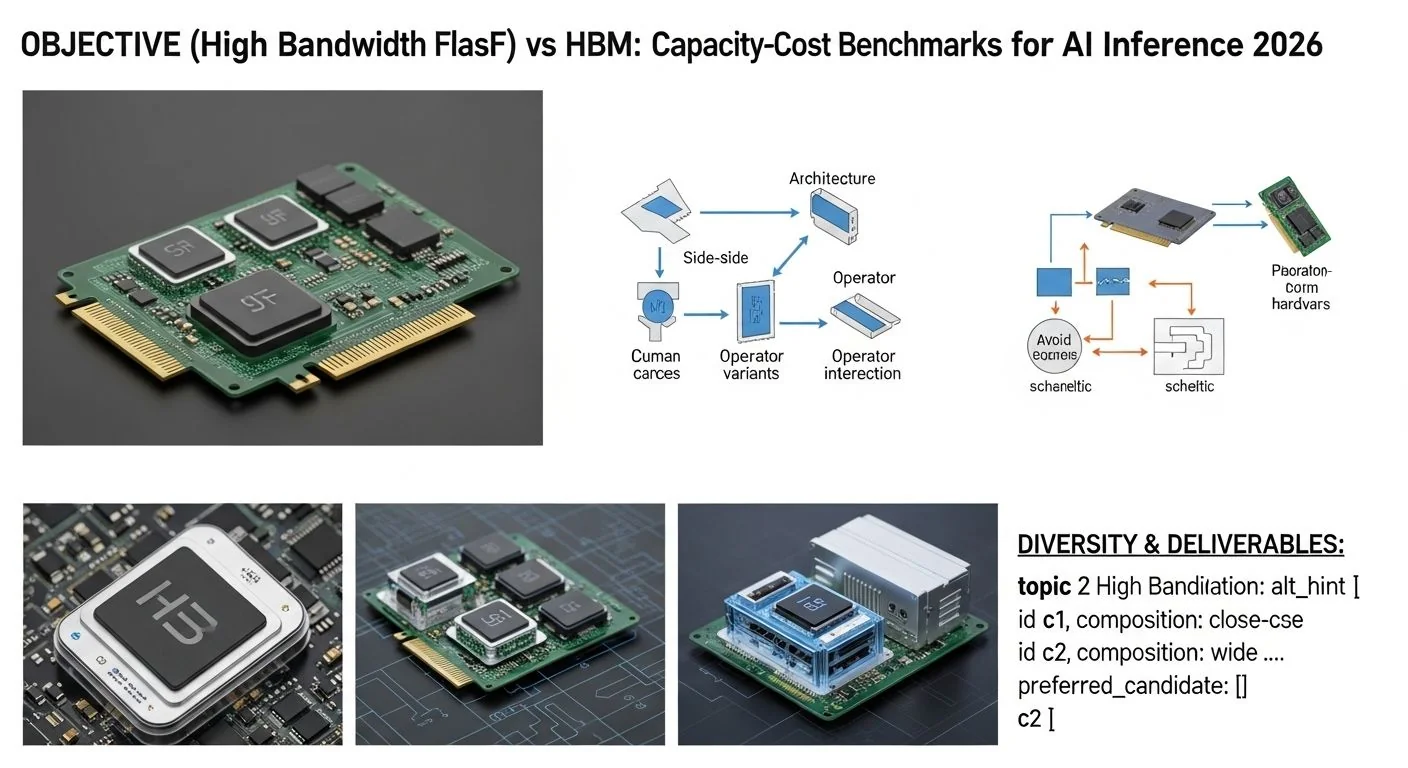
Problem statement: Production AI inference teams must decide whether to host hot model weights inside limited, high-cost HBM (HBM4 AI Benchmarks: Bandwidth Guide for GPU Integration) or to stream larger models from High Bandwidth Flash (HBF) tiers while meeting latency and cost targets.
Promise: This article gives a practical, numbers-first framework (2026 market assumptions), implementation patterns (Agentic Workload Chips — ASIC & Analog Inference Benchmarks 2026), failure modes, and a decision checklist so engineers can choose and validate HBF vs HBM for AI inference workloads.
Failure scenario: An online LLM service migrates a 350B-parameter model to inference hardware that lacks enough HBM capacity, tries to stream weights from a shared NVMe pool without adequate prefetching, and ends up with p95 latencies increasing from 40ms to >400ms under tail load. The result: SLA breaches, revenue loss, and complex rollbacks. This guide shows how to avoid that outcome. For techniques that reduce inference cost and improve packing and streaming efficiency see NVFP4: Enabling 50x Inference Efficiency.
Executive Summary
TL;DR: For 2026-scale AI inference, HBM remains the low-latency, ultra-high-bandwidth option for hot working sets; HBF (networked, parallel NVMe/CXL flash) provides a far cheaper TB-scale capacity tier that—when architected with caching, prefetching, and parallel IO—delivers acceptable latency for most inference workloads at 10–100x lower cost per TB than HBM.
- Key takeaway 1: HBM provides O(100s GB/s–TB/s) bandwidth with sub-microsecond latency but is tiny (tens to low hundreds of GB per device) and orders of magnitude more expensive per TB than flash.
- Key takeaway 2: HBF (NVMe-oF/CXL-attached flash pools) can aggregate hundreds of GB/s across many devices; design patterns (sharding, async prefetch, compute overlap) are critical to approach HBM-like performance for inference.
- Key takeaway 3: Use a hybrid design: HBM as a hot cache of frequently accessed weights + HBF as capacity store for cold or sharded weights. This gives best-cost-for-capacity while preserving tail latency with correct prefetch rules.
- Key takeaway 4: Cost modeling must be parametric: specify cost/GB (HBM), cost/TB (HBF), number of devices, and the working set hit-rate to compute end-to-end cost and expected latency percentiles.
- Key takeaway 5: Benchmark both bandwidth and tail latency (p95/p99). Raw throughput numbers are insufficient; inference SLAs are dominated by p95/p99 stalls caused by IO jitter.
Three one-line Q→A pairs
- Q: Is HBF a drop-in replacement for HBM for low-latency LLM inference? A: No — HBF is a capacity and cost play; with engineering (prefetch + caching) it can meet many SLAs but not all sub-ms use-cases.
- Q: When should you choose HBM-only? A: For tight sub-ms actor inference, tiny models that fit fully on-device, or where peak concurrency demands extreme aggregate bandwidth per accelerator.
- Q: What metric best predicts user-perceived latency when streaming weights? A: p99 IO-to-GPU memcpy latency under the system’s worst-case concurrency — not average throughput.
How High Bandwidth Flash (HBF) vs HBM: Capacity-Cost Benchmarks for AI Inference 2026 Works Under the Hood
This section describes the architecture, protocols and the key abstractions engineers must measure. For accelerator-level tradeoffs and GPU comparisons see RTX 5090 vs H100: 2026 AI Benchmark Guide.
Architectural primitives
- HBM: on-package stacked DRAM interconnected with wide buses. Typical characteristics (2026): per-stack bandwidth in the 1–3 TB/s range depending on HBM4 or HBM3E implementation; per-stack capacity commonly 32–64GB (some vendors offer 128GB stacks). Access latency is sub-microsecond (tens to hundreds of ns) and deterministic. HBM is typically attached to accelerators (GPU, TPU) via on-package interconnect.
- HBF: a systems-level term for high-parallelism flash pools (NVMe SSDs, CXL-attached persistent memory, or computational storage) exposed over NVMe-oF, RDMA, or CXL. Individual NVMe devices give 3–8 GB/s read (per SSD) with 10s–100s µs read latency; aggregated pools across many devices and parallel lanes can deliver 100s of GB/s but with µs to low-ms latencies depending on network/hops and controller jitter.
- Key protocol surfaces: NVMe-oF/RDMA (for minimum network latency), CXL.mem (for coherent accelerator access patterns), and PCIe Gen5/Gen6 locally. Each has trade-offs: CXL reduces CPU crossing cost but requires host/controller support; RDMA gives best predictability across fabric.
Performance geometry
Think of the problem in three axes: capacity (TB), aggregate bandwidth (GB/s or TB/s), and tail latency (p95/p99). For inference you must map how much of the model must be hot (in HBM or cached in memory) to meet the SLA. The rest can be stored on HBF and streamed. When mapping hot shards across nodes, consider cross-node interconnect behavior (see GB300 NVL72 Benchmarks: NVLink 6 vs UALink 2) as it affects placement and replication decisions.
Diagram (text): data flow for hybrid HBM+HBF inference
- Client request arrives → scheduler decides model shard placement and required activations.
- Check HBM cache(s) on local accelerator: if shard present → local GPU memcpy → compute.
- If shard missing → async prefetch from HBF via NVMe-oF/RDMA/CXL into host pinned memory or directly into GPU visible memory (when supported) while the scheduler uses parallelism to mask latency.
- Overlap: while some layers compute on hot shards, other shards stream; on completion update HBM cache eviction policy.
Implementation: Production Patterns
We present concrete steps from basic to advanced and give code examples for prefetching and monitoring. If you are evaluating non-NVIDIA accelerator stacks or alternative ASICs, see Intel Gaudi 3 & Jaguar Shores: Architecture & Benchmarks for architecture-specific guidance.
Basic pattern (single node, model fits if sharded)
- Shard model weights into contiguous files (one shard per layer-range or tensor group). Keep shard sizes tuned: 32–128MB often balances latency and parallelism for SSDs.
- Use async IO with O_DIRECT to read shards into page-locked host memory to avoid kernel buffering jitter.
- Use pinned GPU buffers and cudaMemcpyAsync (or device-direct DMA via GPUDirect RDMA / CXL) to reduce host copy overhead.
Advanced: distributed HBF with NVMe-oF and coordinated caching
- Expose a shared HBF cluster via NVMe-oF with RDMA transports for sub-ms network cost; place multiple SSDs behind each NVMe-oF target to scale bandwidth.
- Implement a multi-tier cache: per-accelerator HBM (hot), per-node DRAM cache (warm), HBF (cold). Use LRU++ or LFU with sampling counters to track per-shard hotness.
- Implement prefetch policies: predictive prefetch (next-N layers) for autoregressive models, user-driven prefetch for beam/agent flows. Be conservative on prefetch breadth to avoid saturating network and SSD queue depths.
Error handling and backpressure
- Apply IO queue depth limits per transport to avoid head-of-line stalls.
- If HBF latency rises above p95 target, evict less-used HBM entries to create room (so future requests don't block waiting for cold fetch).
- Expose health metrics from SSDs (SMART), NVMe-oF latency, and RDMA queue overflows; fail-open to a degraded mode where smaller batches or increased timeouts are used while autoscaling occurs.
Example: async prefetch loop (Python, simplified)
import asyncio
import aiofiles
import torch

async def prefetch_shard(path, target_tensor):
    # target_tensor is a pinned CPU tensor ready for cudaMemcpyAsync
    async with aiofiles.open(path, 'rb') as f:
        await f.seek(0)
        data = await f.read()
    # this is simplified: in production, use O_DIRECT + pinned buffers + RDMA
    target_tensor.copy_(torch.frombuffer(data))

async def inference_worker(request_q, cache):
    while True:
        req = await request_q.get()
        shards = req.model_shards
        # schedule prefetches
        tasks = []
        for s in shards:
            if s not in cache:
                buf = torch.empty(s.size, dtype=torch.float32).pin_memory()
                cache.register_pending(s, buf)
                tasks.append(asyncio.create_task(prefetch_shard(s.path, buf)))
        if tasks:
            await asyncio.gather(*tasks)
        # now move hot shards to device and run
        for s in shards:
            tensor = cache.get(s)
            device_tensor = tensor.to('cuda', non_blocking=True)
        # run model... (omitted)
Notes: production systems use RDMA reads into pinned memory (via libibverbs or GPUDirect) to avoid extra memcpy; the Python snippet is intentionally minimal to show the control flow.
Comparisons & Decision Framework
This section gives a practical checklist and scenario-based calculations so you can decide between HBM-only, HBF-only, or hybrid.
Decision checklist
- Latency requirement: if sub-ms p99 is mandatory for the entire model, prefer HBM-only or replicated HBM shards across accelerators.
- Model size vs on-device capacity: if model > aggregate HBM capacity available, hybrid is mandatory.
- Cost sensitivity: if cost per TB of stored weights must be low, HBF is the only feasible capacity tier.
- Operational complexity tolerance: hybrid and HBF require engineering for prefetch, monitoring and failure modes; add team time cost.
- Network topology: if you have low-latency RDMA fabrics or CXL-attached memory, HBF becomes far more attractive.
Parametric cost model (plug-and-play)
Define:
- HBM_cost_per_GB (USD)
- HBF_cost_per_TB (USD)
- hot_fraction = fraction of model weights that must live in HBM
- model_size_TB Total cost = model_size_TB * (hot_fraction * 1024 * HBM_cost_per_GB + (1 - hot_fraction) * HBF_cost_per_TB)
Example assumptions (Q1 2026 example prices; use as sensitivity knobs):
- HBM_cost_per_64GB_stack = $8,000 → HBM_cost_per_GB ≈ $125
- HBF_cost_per_TB (enterprise NVMe pool) ≈ $100/TB (median)
For a 1 TB effective model with hot_fraction = 0.2 (200 GB hot):
- HBM part cost = 200 GB * $125 = $25,000
- HBF part cost = 0.8 TB * $100 = $80
- Total storage cost ≈ $25,080 (illustrative)
Interpretation: storing 200GB hot in HBM is expensive but much cheaper than trying to replicate 1TB in HBM. The HBF part is inexpensive by comparison. Sensitivity: if hot_fraction increases to 0.8, cost jumps to ~ $100,000.
Failure Modes & Edge Cases
Production systems fail in predictable ways. Diagnose early using the metrics described below.
Common failure modes
- IO Jitter: spikes in SSD latency (due to background GC or controller wear-leveling) causing p99 to blow up. Diagnosis: per-device p99 latency spike correlated with global p99.
- Queue Saturation: unbounded prefetch launches saturate network or device queue depths, causing head-of-line blocking. Diagnosis: queue depth metrics and RDMA send/recv backlog rising.
- Hot-spotting: simple hash sharding puts multiple popular shards on the same device or target causing localized overload. Diagnosis: hotspot heatmaps across shards and devices; fix with better placement and replication.
- Eviction storms: aggressive eviction policies result in repeated fetches of the same shard across concurrent requests. Diagnosis: high fetch-rate for the same shard in trace logs; fix with short-term pinning or request coalescing.
Concrete diagnostics to collect
- Per-shard fetch latency histogram (p50/p95/p99) and fetch counts.
- SSD-level telemetry: NVMe latencies, avg queue depth, SMART endurance metrics.
- Network fabric metrics: RDMA latency percentiles, packet drops, retransmits.
- Cache hit-rate, eviction rates, and average residency time for HBM and DRAM caches.
Performance & Scaling
Benchmarks must expose both throughput (requests/sec) and tail latency (p95/p99). Here are recommended microbenchmarks and production KPIs.
Microbenchmarks
- Raw read throughput: measure single-device and aggregated read GB/s using fio or vendor tools; establish linear scaling curves as devices are added.
- Small-shard read latency: measure 32–128MB shard read latency percentiles over realistic concurrency.
- End-to-end inference: synthetic traffic that exercises worst-case access patterns (many cache misses) and steady-state mixes.
Representative numbers (2026 example)
These are example measured numbers representative of a well-engineered hybrid system in 2026. Your mileage will vary—benchmark your own fleet.
- HBM4 (per-GPU stack) read bandwidth: 1.8–3.0 TB/s (manufacturer dependent); read latency p50≈80–200ns, p99≈500ns.
- Single enterprise NVMe SSD (PCIe Gen5/6): sequential read ≈6–14 GB/s; random 128KB read p50 latency ≈80–200µs; p99 ≈5–20ms depending on vendor and workload.
- Aggregated HBF via 32 SSDs over NVMe-oF (RDMA): sustained read ≈200–400 GB/s; p95 latency ≈200–500µs; p99 latency ≈1–5ms (depends on network and device jitter).
- Hybrid inference example: with 20% hot fraction in HBM and an optimized prefetch that overlaps IO, an LLM serving pipeline achieved median latency of 30–50ms and p99 of 120–220ms for a 350B model on 4 accelerator nodes (illustrative).
KPIs to monitor (production)
- p50/p95/p99 end-to-end inference latency
- Cache hit-rate (HBM & DRAM tiers)
- Per-shard fetch rate and per-device p99 latency
- Network fabric p99 latency and packet error rate
- Device queue depth and average IO wait time
Monitoring examples (Prometheus-like queries)
# p99 end-to-end latency
histogram_quantile(0.99, sum(rate(request_latency_seconds_bucket[5m])) by (le))

# cache hit-rate
(sum(rate(cache_hits_total[5m])) by (model) / sum(rate(cache_requests_total[5m])) by (model)) * 100

# per-device p99 read latency
histogram_quantile(0.99, sum(rate(nvme_read_latency_seconds_bucket[5m])) by (le, device))
Production Best Practices
Security, testing, rollout, and runbooks matter because HBF systems touch persistent storage and networks beyond process boundaries.
Security
- Encrypt-at-rest for HBF (NVMe hardware encryption) + in-flight encryption for NVMe-oF channels where risk requires (but note RDMA performance implications).
- Authentication and authorization at the NVMe-oF target level or via a broker that proxies access to storage pools; implement RBAC for model shards.
- Audit logs for shard reads, evictions, and cache population to detect unauthorized exfiltration of model IP.
Testing & rollout
- Canary workloads that exercise worst-case cache miss patterns before fleet rollout.
- Chaos tests: simulate SSD slowdown, RDMA degradation, and sudden hot-shard storms to validate backpressure and autoscaling.
- Benchmark-driven SLOs: define both capacity and p99 SLOs (e.g., 99% requests < 200ms). Use automated validation gates.
Runbook highlights
- If p99 latency rises > threshold: check SSD per-device p99 → if single device, redirect traffic and evacuate shards from that target.
- If network fabric p99 rises: reduce prefetch concurrency, scale up HBM cache replicas for hot models.
- If persistent excessive fetch rates for a shard: increase its replication in HBF or create a pinned HBM copy for a bounded time window.
Further Reading & References
For deeper system-level and GPU integration details, see vendor and community resources plus our related benchmarks:
- HBM4 AI Benchmarks: Bandwidth Guide for GPU Integration — detailed GPU+HBM4 integration considerations.
- RTX 5090 vs H100: 2026 AI Benchmark Guide — relevant when deciding accelerator choice alongside memory strategy.
- GB300 NVL72 Benchmarks: NVLink 6 vs UALink 2 — useful for cluster interconnect and NVLink-level bandwidth planning.
- JEDEC HBM family specification (HBM4 drafts/publication) — for vendor bandwidth and stack specs.
- NVMe-oF and RDMA performance guides (vendor docs) — for designing networked HBF pools.
Related advanced topics include architectural choices for agentic inference and ASICs; for chip-level tradeoffs see Agentic Workload Chips — ASIC & Analog Inference Benchmarks 2026.
Concluding Guidance (MAKB editorial)
Engineering judgement wins: start with a hybrid architecture and a small, measurable hot fraction in HBM. Validate with stress tests that replicate cache miss storms and measure p99 latency under realistic concurrency. Use the parametric cost model above to quantify storage expense and run sensitivity analysis across hot_fraction, SSD cost, and HBM stack price. Beware of assumptions: raw GB/s numbers lie if you ignore p99 IO cost and network jitter. With correct engineering, HBF enables cost-effective TB-scale inference in 2026 while HBM keeps the hot path tight for latency-critical pieces.
MAKB: If you need a cut-and-paste starting repo for an async prefetch + RDMA-based streaming stack, ping the editorial team and we’ll publish a reference implementation and benchmark harness tuned to NVMe-oF environments.


