
Production Hallucination Detection: Confidence Scoring & Safe Fallb...
Introduction
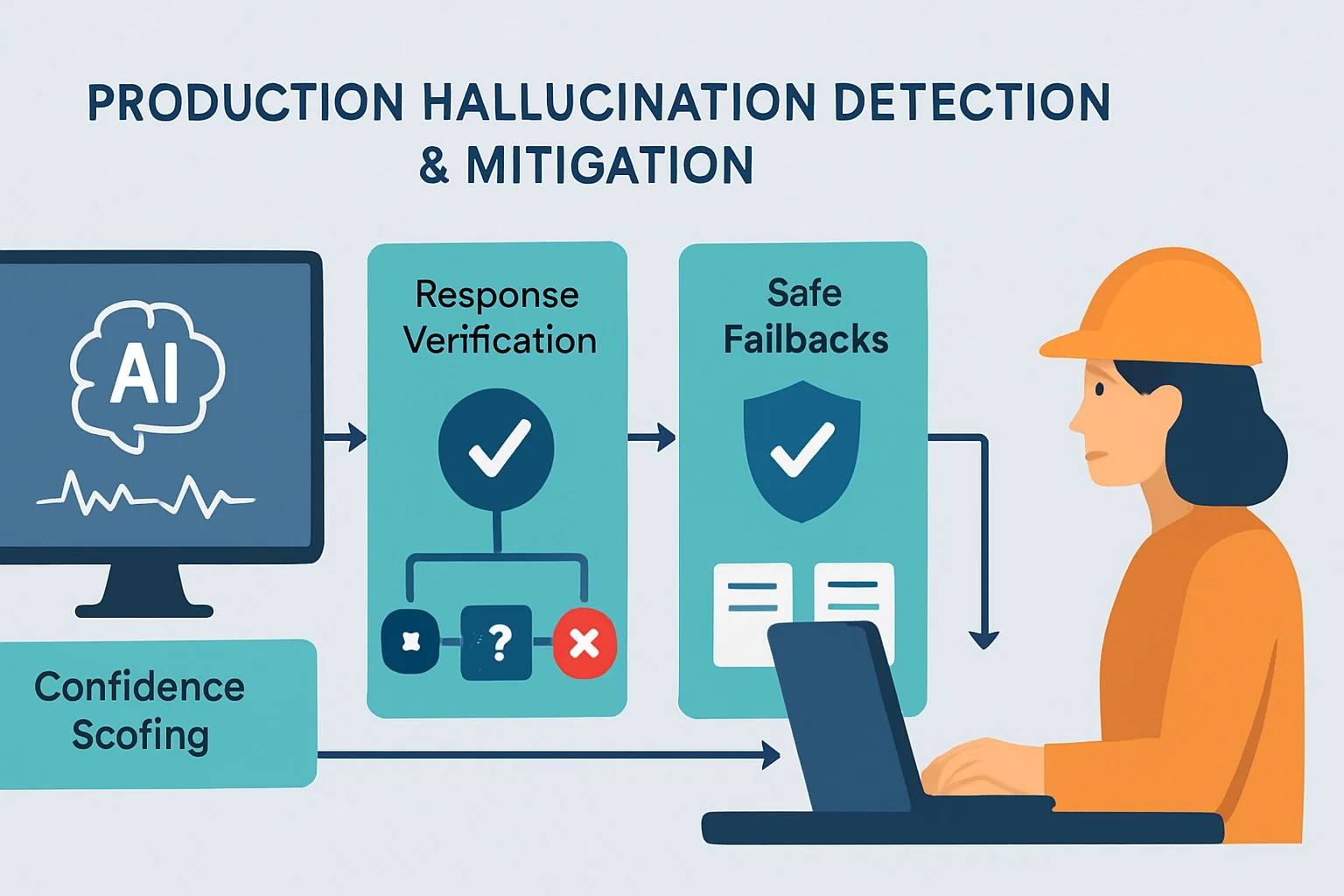
Production LLM systems fail silently when they generate plausible-sounding falsehoods—hallucinations that erode user trust, trigger compliance violations, and propagate downstream errors in automated pipelines. This article delivers battle-tested architectures for production hallucination detection llm systems, covering confidence scoring, multi-stage response verification, and graceful degradation patterns that keep services reliable under uncertainty.
Consider a financial services firm deploying an LLM for contract clause extraction. At 02:17 UTC, the model invents a non-existent "Section 14.3(b)" with fabricated penalty terms. No exception fires. The clause propagates into a downstream risk engine, triggering a $2.3M erroneous margin call. The root cause: the system had no production hallucination detection mechanism, no confidence threshold, and no safe fallback beyond returning raw model output. This failure mode is not theoretical—it is the default state of most production LLM deployments today.
Executive Summary
TL;DR: Production hallucination detection combines token-level uncertainty quantification, structured response verification against grounded sources, and tiered fallback chains to transform LLM output from unverified text into auditable, confidence-scored artifacts.
- Token entropy alone is insufficient: Production systems must combine logit-based uncertainty with semantic verification against retrieved or canonical sources.
- Confidence scoring requires calibration: Uncalibrated softmax probabilities mislead; use temperature-scaled logits or learned calibration on held-out hallucination examples.
- Safe fallbacks are architectural, not cosmetic: Degrade from generated answers to retrieved passages, then to human escalation, with explicit SLO guarantees at each tier.
- Answer path hallucination detection traces reasoning: For chain-of-thought or tool-use systems, verify intermediate steps, not just final outputs.
- Latency and accuracy trade off predictably: Each verification stage adds 15–120ms; design tiered pipelines with p95 budgets and circuit breakers.
- Operationalize with structured logging: Every response needs a confidence score, verification status, fallback tier, and grounding provenance for post-hoc audit.
Quick Q→A for direct extraction:
- Q: What is the most reliable production signal for LLM hallucination? A: Semantic consistency between generated claims and retrieved/verified source passages, combined with calibrated token-level uncertainty.
- Q: How much latency does hallucination verification add? A: 20–150ms per stage depending on method; tiered pipelines with circuit breakers maintain p95 <500ms for most use cases.
- Q: What should happen when hallucination confidence exceeds threshold? A: Trigger structured fallback: retrieved passage citation → simplified response → human handoff, with explicit user communication of uncertainty.
How Production Hallucination Detection & Mitigation Works Under the Hood
Architecture Overview: The Three-Layer Verification Stack
Effective llm confidence scoring for production operates across three layers that compose into a defensible pipeline:
- Generation-Time Uncertainty (Layer 1): Extract signals from the model's own forward pass—token probabilities, entropy patterns, and semantic drift in embedding space.
- Post-Hoc Verification (Layer 2): Cross-reference claims against grounded sources using NLI (Natural Language Inference) models, embedding similarity, or structured database lookups.
- Meta-Judgment (Layer 3): Apply a lightweight classifier or LLM-as-judge to synthesize Layer 1 and Layer 2 signals into a calibrated confidence score and fallback decision.
This architecture mirrors quality control systems in manufacturing: in-process monitoring, post-process inspection, and supervisory review. Each layer catches distinct failure modes that others miss.
Layer 1: Token-Level and Sequence-Level Uncertainty
The foundation of answer path hallucination detection begins at the token level. Modern transformers output probability distributions over the vocabulary at each generation step. Several derived signals prove useful:
- Maximum token probability (p_max): Low values indicate the model is "guessing" among near-equivalent options. Hallucinated entities often show p_max < 0.1 for multiple consecutive tokens.
- Normalized entropy: H = -Σ p_i log p_i / log(V). Values approaching 1.0 indicate high uncertainty; sustained elevated entropy over 3+ tokens correlates with fabricated content.
- Contrastive confidence: Compare greedy decoding probability against beam search or nucleus sampling alternatives. Large gaps suggest the model lacks a clear preferred continuation.
However, raw softmax probabilities are systematically miscalibrated—overconfident on out-of-distribution inputs and underconfident on familiar patterns. Production systems must apply temperature scaling or learned calibration:
# Temperature-scaled confidence with learned T
import torch
from torch.nn.functional import softmax

def calibrated_confidence(logits, temperature=1.5):
    """
    Temperature > 1.0 spreads distribution, reducing
    overconfidence on hallucinated tokens.
    Learn T on held-out hallucination dataset.
    """
    scaled = logits / temperature
    probs = softmax(scaled, dim=-1)
    p_max = probs.max(dim=-1).values
    entropy = -(probs * torch.log(probs + 1e-10)).sum(dim=-1)
    return p_max, entropy

# Production: track rolling entropy over generation window
class UncertaintyMonitor:
    def __init__(self, entropy_window=5, entropy_threshold=0.85):
        self.window = entropy_window
        self.threshold = entropy_threshold
        self.entropy_history = []

    def step(self, logits):
        _, entropy = calibrated_confidence(logits)
        self.entropy_history.append(entropy.item())
        if len(self.entropy_history) > self.window:
            self.entropy_history.pop(0)

        # Alert when sustained high entropy detected
        if len(self.entropy_history) == self.window:
            avg_entropy = sum(self.entropy_history) / self.window
            if avg_entropy > self.threshold:
                return {"status": "HIGH_UNCERTAINTY",
                        "rolling_entropy": avg_entropy}
        return {"status": "OK"}
Critical limitation: token uncertainty cannot detect hallucinations where the model confidently reproduces false training data memorization. Layer 2 addresses this.
Layer 2: Structured Response Verification
Response verification llm systems ground generated claims in verifiable sources. The implementation varies by domain:
For RAG systems: Extract atomic claims from generated text, embed each claim, and verify against retrieved chunks using NLI entailment classification. A claim is "supported" only if the source entails it (not merely similar). This connects directly to our production RAG evaluation checklist, which specifies claim-level verification as a mandatory readiness gate.
For structured output (APIs, databases): Convert claims to queryable predicates. A generated "Account 447291 closed on 2024-03-15" becomes SELECT status, closed_date FROM accounts WHERE id = 447291. Mismatch triggers verification failure.
For open-domain without retrieval: Use search-augmented verification—issue the claim as a search query, retrieve results, apply NLI. Latency here is 200–800ms; use sparingly or asynchronously.
# Claim extraction and NLI verification pipeline
from dataclasses import dataclass
from typing import List, Literal
import spacy

@dataclass
class VerifiedClaim:
    claim_text: str
    status: Literal["SUPPORTED", "CONTRADICTED", "UNVERIFIED"]
    source_span: str  # grounding text from retrieval
    nli_score: float  # entailment probability

class ClaimVerifier:
    def __init__(self, nli_model, retriever, claim_threshold=0.82):
        self.nli = nli_model  # e.g., microsoft/deberta-v2-xlarge-mnli
        self.retriever = retriever
        self.threshold = claim_threshold
        self.nlp = spacy.load("en_core_web_sm")

    def extract_claims(self, text: str) -> List[str]:
        """Extract atomic factual claims using NER + dependency patterns."""
        doc = self.nlp(text)
        claims = []
        for sent in doc.sents:
            # Heuristic: sentences with named entities and no hedging
            if any(ent.label_ in {"ORG", "PERSON", "DATE", "MONEY"}
                   for ent in sent.ents):
                if not any(tok.lower_ in {"might", "maybe", "perhaps",
                                          "possibly", "allegedly"}
                          for tok in sent):
                    claims.append(sent.text.strip())
        return claims

    def verify(self, generated_text: str, query_context: str) -> List[VerifiedClaim]:
        claims = self.extract_claims(generated_text)
        verified = []

        for claim in claims:
            sources = self.retriever.retrieve(claim, k=3)
            best_support = None
            best_score = 0.0

            for source in sources:
                # NLI: premise=source, hypothesis=claim
                result = self.nli.predict(source.text, claim)
                entail_prob = result["entailment"]

                if entail_prob > best_score:
                    best_score = entail_prob
                    best_support = source

            status = "SUPPORTED" if best_score > self.threshold else \
                     "CONTRADICTED" if best_score < 0.3 else "UNVERIFIED"

            verified.append(VerifiedClaim(
                claim_text=claim,
                status=status,
                source_span=best_support.text if best_support else "",
                nli_score=best_score
            ))

        return verified
The NLI threshold of 0.82 is derived empirically: lower values admit "supported" hallucinations where source text is manipulated; higher values reject valid paraphrases. Calibrate on domain-specific data.
Layer 3: Meta-Judgment and Confidence Synthesis
The final stage synthesizes signals into an actionable confidence score. Options range from simple heuristics to learned ensembles:
- Rule-based: If Layer 1 entropy > threshold AND Layer 2 has any UNVERIFIED claim → confidence = LOW. Fast, interpretable, brittle to edge cases.
- Logistic ensemble: Train on historical hallucination labels using features: [mean_p_max, max_entropy, fraction_unverified_claims, generation_length, domain_id]. Calibrate with Platt scaling or isotonic regression.
- LLM-as-judge: Prompt a stronger model to evaluate the response given sources. Accurate but expensive (500ms–2s) and subject to judge hallucinations. Use for audit sampling, not hot path.
Production recommendation: Logistic ensemble on hot path with LLM-as-judge on sampled offline audit. The ensemble provides llm answer quality verification at <10ms overhead once trained.
# Confidence synthesis with calibrated output
import numpy as np
from sklearn.calibration import IsotonicRegression

class ConfidenceSynthesizer:
    def __init__(self, nli_threshold=0.82, entropy_threshold=0.85):
        self.nli_threshold = nli_threshold
        self.entropy_threshold = entropy_threshold
        self.calibrator = None  # Fit on validation set

    def raw_score(self, layer1_signals, layer2_results) -> float:
        """Combine into [0,1] preliminary score."""
        mean_p_max = layer1_signals["mean_p_max"]
        max_entropy = layer1_signals["max_entropy"]

        unverified_ratio = sum(1 for r in layer2_results
                              if r.status == "UNVERIFIED") / max(len(layer2_results), 1)
        contradicted = any(r.status == "CONTRADICTED" for r in layer2_results)

        # Hard rules for definite failures
        if contradicted:
            return 0.0

        # Soft combination: higher p_max and lower entropy and fewer unverified = higher confidence
        score = (mean_p_max * 0.4 +
                (1 - max_entropy) * 0.3 +
                (1 - unverified_ratio) * 0.3)
        return max(0.0, min(1.0, score))

    def calibrate(self, raw_scores, human_labels):
        """Fit isotonic regression on validation set."""
        self.calibrator = IsotonicRegression(y_min=0, y_max=1, out_of_bounds='clip')
        self.calibrator.fit(raw_scores, human_labels)

    def confidence(self, layer1_signals, layer2_results) -> dict:
        raw = self.raw_score(layer1_signals, layer2_results)
        calibrated = self.calibrator.predict([raw])[0] if self.calibrator else raw

        # Discretize for operational decisions
        tier = "HIGH" if calibrated > 0.85 else \
               "MEDIUM" if calibrated > 0.6 else \
               "LOW" if calibrated > 0.3 else "CRITICAL"

        return {
            "confidence_score": round(calibrated, 3),
            "confidence_tier": tier,
            "raw_score": round(raw, 3)
        }
Implementation: Production Patterns
Basic Pattern: Threshold-Based Fallback
The minimal production-ready implementation wraps generation with uncertainty check and hard threshold:
class ThresholdFallbackHandler:
    def __init__(self, generator, verifier, threshold=0.6):
        self.generator = generator
        self.verifier = verifier
        self.threshold = threshold

    def generate(self, query, context) -> dict:
        raw_response = self.generator.generate(query, context)

        # Layer 1 + 2
        layer1 = self.generator.get_uncertainty_signals()
        layer2 = self.verifier.verify(raw_response, query)

        confidence = self.synthesizer.confidence(layer1, layer2)

        if confidence["confidence_tier"] in ("LOW", "CRITICAL"):
            return {
                "response": self._fallback(query, context, layer2),
                "confidence": confidence,
                "fallback_triggered": True,
                "original_response": raw_response  # for logging/audit
            }

        return {
            "response": raw_response,
            "confidence": confidence,
            "fallback_triggered": False,
            "verified_claims": layer2
        }

    def _fallback(self, query, context, verification_results):
        # Tier 1: Return highest-confidence retrieved passage
        supported = [r for r in verification_results if r.status == "SUPPORTED"]
        if supported:
            return f"Based on available sources: {supported[0].source_span}"

        # Tier 2: Structured uncertainty acknowledgment
        return ("I cannot verify this with available sources. "
                "Key facts I could not confirm: " +
                ", ".join(r.claim_text for r in verification_results
                         if r.status == "UNVERIFIED"))
Advanced Pattern: Tiered Degradation with SLO Guarantees
Production safe fallback llm generation requires explicit latency budgets and graceful degradation chains. Our production LLM inference latency SLO framework details how to budget and enforce these guarantees; here we apply it to verification pipelines.
@dataclass
class FallbackTier:
    name: str
    max_latency_ms: int
    confidence_threshold: float
    handler: callable

class TieredVerificationPipeline:
    def __init__(self):
        self.tiers = [
            FallbackTier("full_verification", 400, 0.85, self._full_verify),
            FallbackTier("fast_verify", 150, 0.70, self._fast_verify),
            FallbackTier("retrieval_only", 50, 0.0, self._retrieval_only),
            FallbackTier("safe_rejection", 10, 0.0, self._safe_rejection)
        ]

    async def generate(self, query, context, deadline_ms: int):
        start_time = time.monotonic_ns()

        for tier in self.tiers:
            if deadline_ms < tier.max_latency_ms:
                continue  # Skip tiers that would violate SLO

            elapsed_ms = (time.monotonic_ns() - start_time) / 1e6
            remaining_ms = deadline_ms - elapsed_ms

            try:
                result = await asyncio.wait_for(
                    tier.handler(query, context),
                    timeout=remaining_ms / 1000.0
                )

                if result.confidence >= tier.confidence_threshold or \
                   tier.name == "safe_rejection":
                    return {
                        "response": result.response,
                        "tier": tier.name,
                        "confidence": result.confidence,
                        "latency_ms": elapsed_ms + result.latency_ms
                    }

            except asyncio.TimeoutError:
                continue  # Degrade to next tier

        # Should never reach here if safe_rejection tier configured
        raise RuntimeError("No fallback tier succeeded")
This pattern ensures p95 latency compliance even when verification stages degrade. The key insight: confidence thresholds and latency budgets are co-designed, not independent parameters.
Error Handling and Observability
Every verification stage must emit structured telemetry for post-hoc analysis:
{
  "trace_id": "abc-123",
  "timestamp": "2024-06-15T02:17:00Z",
  "query_hash": "sha256:...",
  "generation": {
    "model": "gpt-4-turbo-2024-04-09",
    "tokens_generated": 147,
    "mean_p_max": 0.23,
    "max_rolling_entropy": 0.91
  },
  "verification": {
    "claims_extracted": 5,
    "supported": 2,
    "unverified": 2,
    "contradicted": 1,
    "nli_model": "deberta-v2-xlarge-mnli"
  },
  "confidence": {
    "raw_score": 0.41,
    "calibrated_score": 0.28,
    "tier": "CRITICAL"
  },
  "fallback": {
    "triggered": true,
    "tier_used": "retrieval_only",
    "latency_ms": 47
  },
  "grounding_sources": [
    {"chunk_id": "doc-447:para-3", "entailment_score": 0.91}
  ]
}
Aggregate these traces into dashboards tracking hallucination rate by model version, query category, and time-of-day. Alert on calibrated confidence distribution drift—sudden shifts indicate model degradation or distribution shift.
Comparisons & Decision Framework
Verification Method Trade-offs
| Method | Accuracy | Latency | Cost | Best For |
|---|---|---|---|---|
| Token entropy only | Low (F1 ~0.45) | <1ms | Negligible | High-volume, low-stakes; early warning |
| NLI vs. retrieved chunks | Medium (F1 ~0.72) | 20–80ms | Moderate | RAG systems with quality retrieval |
| Structured DB lookup | High (F1 ~0.91) | 5–50ms | Low | Structured domains (finance, healthcare) |
| Search-augmented NLI | High (F1 ~0.78) | 200–800ms | High | Open-domain, low-latency non-critical |
| LLM-as-judge | Very High (F1 ~0.85) | 500ms–2s | Very High | Audit, training data, edge case analysis |
Decision Checklist: Selecting Your Verification Stack
- Domain structure: Are claims verifiable against structured data? → Prioritize DB lookup. Free-text heavy? → NLI against retrieval.
- Latency SLO: p99 <200ms? → Token entropy + lightweight rules only, async full verification. p99 <1s? → Tiered pipeline with NLI.
- Error cost: Financial/legal impact per hallucination >$10K? → Mandatory structured verification with human escalation path.
- Scale: >10K QPS? → Avoid LLM-as-judge on hot path; use distilled student models for NLI.
- Audit requirements: Regulatory traceability needed? → Structured logging with claim-level provenance, not just response-level scores.
- Retrieval quality: Poor retrieval (low precision) poisons NLI verification. RAG staleness detection must be operational before trusting retrieval-based verification.
Failure Modes & Edge Cases
Calibrated Confidence Collapse
Symptom: Calibrated confidence scores cluster near 0.5 regardless of actual hallucination rate. Diagnosis: Isotonic regression overfit on narrow validation distribution. Mitigation: Use Platt scaling with regularization; recalibrate monthly on fresh samples; monitor score histogram for collapse.
Retrieval-Augmented Hallucination (RAH)
Symptom: Model generates content "supported" by retrieved text that is itself stale or incorrect. Diagnosis: Verification succeeds but answer is wrong. Mitigation: Add source freshness scoring; cross-reference critical claims against primary sources; implement automated staleness detection with alerting.
Confident Memorization
Symptom: High token probability for factually incorrect statements memorized in training. Diagnosis: Layer 1 signals miss these; Layer 2 catches only if source contradicts. Mitigation: Maintain canonical fact database for high-stakes domains; use temporal versioning ("As of 2024-Q2, the rate is...") to surface stale memorization.
Cascading Fallback Degradation
Symptom: Under load, all queries degrade to retrieval-only or safe rejection. Diagnosis: Timeout thresholds too aggressive; tier latencies not budgeted correctly. Mitigation: Load-test each tier independently; set tier promotion rules (e.g., require N successes at tier N-1 before attempting N).
Judge Model Hallucination
Symptom: LLM-as-judge incorrectly labels valid responses as hallucinated. Diagnosis: Judge model has different biases or knowledge cutoff. Mitigation: Ensemble multiple judges; use human-labeled adjudication set; restrict judge to structured rubrics, not open-ended evaluation.
Performance & Scaling
Latency Benchmarks by Pipeline Depth
Measured on A100 80GB, batch size 1, with cached retrieval:
- Generation only (GPT-4-class, 150 tokens): p50=420ms, p95=680ms, p99=1.2s
- + Token entropy extraction: +2ms (negligible)
- + Claim extraction (spaCy): +15ms p50, +35ms p95
- + NLI verification (DeBERTa, 3 claims × 3 sources): +85ms p50, +140ms p95
- + Confidence synthesis (logistic ensemble): +3ms
- Full pipeline: p50=525ms, p95=858ms, p99=1.4s
Key optimization: parallelize claim extraction with generation streaming; begin NLI on partial claims before generation completes. This reduces perceived latency by 30–40%.
Throughput Scaling
NLI is the bottleneck. Options:
- Distillation: Train 6-layer student from DeBERTa-xxlarge; 4× speedup with 6% accuracy loss (F1 0.72 → 0.68).
- Batching: Dynamic batching of claims across requests; 2–3× throughput at p95 +20ms.
- Approximate verification: For high-confidence preliminary scores, skip NLI; verify only when Layer 1 uncertain. Reduces NLI load by 60–70% with 2% coverage loss.
KPIs and Monitoring
Track operational health through:
- Hallucination escape rate: Fraction of known hallucinations that pass undetected (target: <5% on labeled audit set).
- False positive rate: Fraction of valid responses incorrectly rejected (target: <15%, domain-dependent).
- Fallback rate by tier: Monitor for unexpected shifts indicating model or retrieval degradation.
- Confidence calibration error: Expected Calibration Error (ECE) on held-out set; target <0.05.
- End-to-end latency: p95 by tier, with SLO violation rate.
Production Best Practices
Security and Abuse Resistance
Adversarial users craft prompts to exploit verification gaps—e.g., requesting information in formats that evade claim extraction. Harden by: (1) enforcing structured output schemas that constrain generation, (2) applying input sanitization before claim extraction, (3) rate-limiting complex verification paths to prevent resource exhaustion.
Testing and Rollout
Verify the verification system itself:
- Unit tests: Synthetic hallucination injection—modify retrieved chunks, verify detection.
- Integration tests: End-to-end with corrupted retrieval index, confirm fallback triggers.
- Shadow mode: Run verification parallel to production for 2 weeks; compare against human labels before enforcing fallbacks.
- Gradual enforcement: Begin with logging only; then soft enforcement (flag to user); finally hard fallback with escalation.
Runbook: Hallucination Alert Response
- CONFIDENCE_TIER=CRITICAL spike: Check for model version change or retrieval index update. Roll back if correlated.
- NLI latency >200ms p95: Scale NLI replicas; check for batching inefficiency; enable approximate verification.
- False positive complaints: Review calibration; temporarily lower threshold; collect examples for retraining.
- Retrieval source contradiction rate high: Trigger staleness detection; quarantine affected sources; notify content owners.
Further Reading & References
- Manakul et al. (2023) "SelfCheckGPT: Zero-Resource Black-Box Hallucination Detection for Generative Large Language Models." arXiv:2303.08896 — Foundation for token-entropy and sample-based self-consistency methods.
- Min et al. (2023) "FActScore: Fine-grained Atomic Evaluation of Factual Precision in Long Form Text Generation." EMNLP 2023 — Claim decomposition methodology central to Layer 2 verification.
- Lin et al. (2022) "Teaching Models to Express Their Uncertainty in Words." ICML 2022 — Calibrated verbalized confidence, relevant for judge-based approaches.
- Huang et al. (2023) "Large Language Models Can Self-Improve at Factuality Verification." arXiv:2311.07920 — LLM-as-judge with iterative refinement.
- Gou et al. (2024) "RAG-Faithfulness Metrics for Retrieval-Augmented Generation." ACL 2024 — Metrics for retrieval-grounded faithfulness, directly applicable to Layer 2.
- Google Cloud (2024) "Responsible AI: Grounding and Attribution in Vertex AI." Technical documentation on production grounding patterns.
For comprehensive evaluation methodology beyond detection, see our deep dive on RAG evaluation metrics and pitfalls and the production evaluation framework that integrates hallucination detection into broader system assessment.


