
RAG Citation Integrity: Measure Accuracy Loss in Pipelines
Introduction
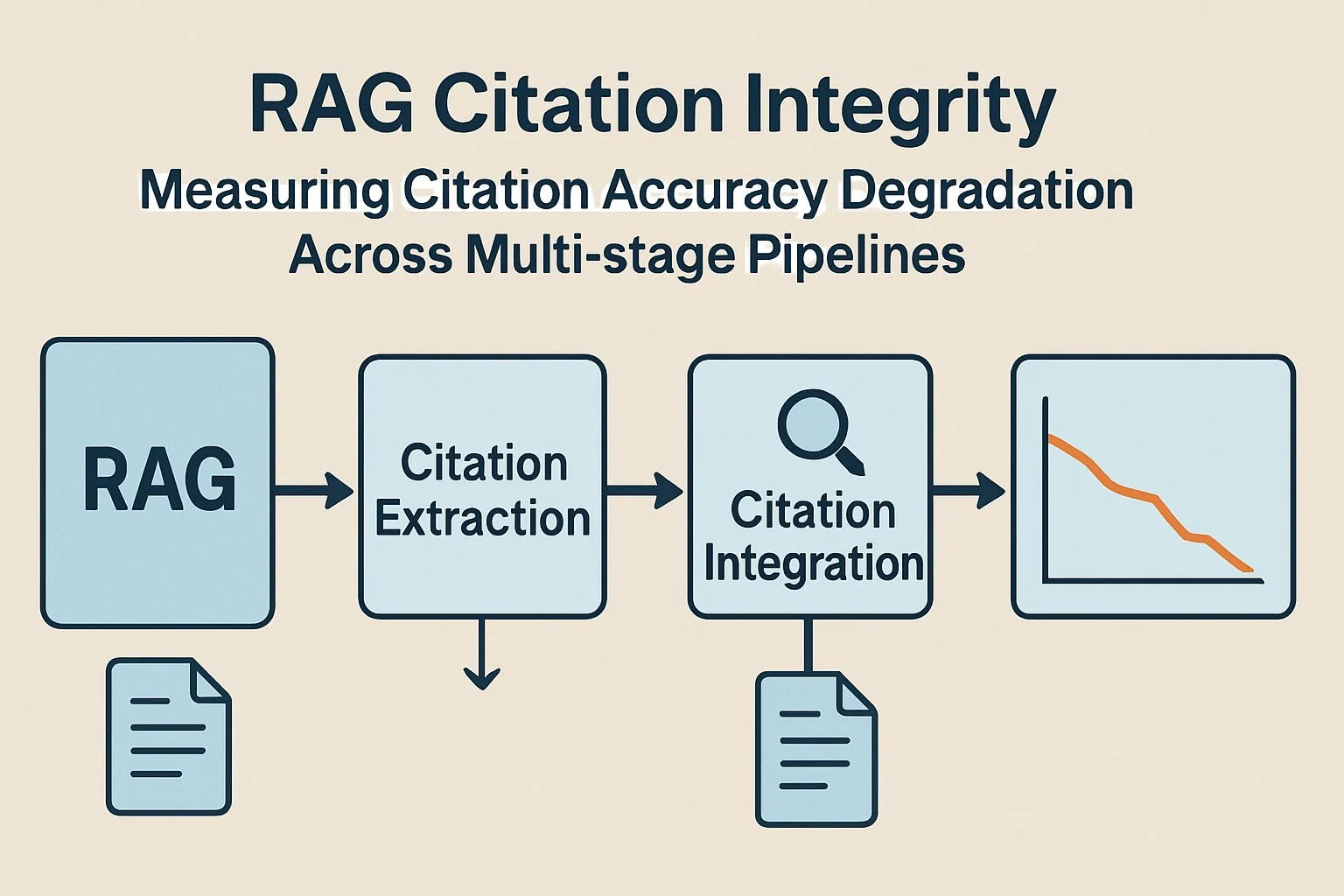
RAG citation integrity measurement is the most under-instrumented surface in production retrieval systems. A multi-stage RAG pipeline can retrieve the correct document, rank it properly, inject it into context, and still emit a citation that points to the wrong source, the wrong passage, or a hallucinated origin entirely. The problem statement is stark: every transformation stage in a RAG pipeline—chunking, reranking, context compression, and LLM generation—introduces measurable citation accuracy degradation that most teams do not trace.
This article delivers a production-tested framework for measuring citation accuracy degradation across multi-stage RAG pipelines, with concrete metrics, tracing implementations, and diagnostic runbooks. You will leave with instrumentation you can deploy this week.
Failure scenario: A fintech compliance RAG system retrieves SEC filing 10-K excerpts for analyst queries. After migrating to a new reranker (stage 3), user-reported "wrong source" complaints jump 340% in two weeks. The team discovers the reranker returns passage-level scores but strips original document coordinates; the LLM generator invents page numbers. Root cause: no cross-stage citation provenance graph. Recovery time: 11 days. Preventable with the tracing architecture described below.
Executive Summary
TL;DR: Citation accuracy in multi-stage RAG pipelines degrades predictably at chunking, reranking, and generation boundaries; instrument end-to-end provenance tracing with citation_fidelity_score per stage to detect and localize drift before users do.
- Citation accuracy degradation RAG is not a single metric but a stage-wise decomposition: retrieval precision ≠ citation precision after chunking, reranking, or context compression.
- Multi-stage RAG pipeline audit requires provenance graphs that survive stage transformations, not just request IDs.
- Retrieval grounding citation tracing must capture coordinate transformations: page → paragraph → chunk → reranked position → generated citation string.
- The dominant production failure mode is coordinate loss at stage boundaries, not retrieval failure.
- LLM citation source fidelity can be measured with automated judges; human evaluation scales poorly past 1,000 queries/month.
- p95 citation latency budget for full provenance tracing: <85ms additive on 10k-document corpora with proper indexing.
Quick Q→A for direct extraction:
- Q: What is RAG citation integrity measurement? A: The practice of tracing whether a generated citation accurately reflects its retrieved source document and location, evaluated across each pipeline stage.
- Q: Why does citation accuracy degrade in multi-stage RAG? A: Each transformation—chunking splits documents, reranking reorders passages, compression elides context, and LLMs paraphrase—can sever or distort source coordinates.
- Q: How do I measure RAG citation accuracy in production? A: Implement stage-wise provenance graphs, compute
citation_fidelity_scoreper query, and alert on p95 degradation exceeding 0.15 from baseline.
How RAG Citation Integrity: Measuring Citation Accuracy Degradation Across Multi-stage Pipelines Works Under the Hood
Pipeline Stage Architecture & Citation Provenance
A production RAG pipeline typically comprises 5–7 stages. Citation integrity must survive each. The provenance graph below is the core abstraction; every implementation in this article extends from it.
Stage 0: Source Documents — Original corpora with canonical coordinates: (corpus_id, doc_id, page, paragraph, line_range).
Stage 1: Chunking — Documents split into retrieval units. Coordinate transformation: page/paragraph → chunk_id + intra_chunk_offset. This is where chunking strategy decisions directly impact citation recoverability: overlapping windows preserve more coordinate context than hard splits, but at 15–40% storage cost.
Stage 2: Embedding & Vector Search — Chunk_id maps to embedding; retrieval returns (chunk_id, similarity_score, raw_text). Coordinate preservation: high if chunk metadata includes origin coordinates; low if text-only.
Stage 3: Reranking — Cross-encoder or LLM reranker reorders chunks. Critical transformation: rerankers often return new_rank without propagating original chunk_id or coordinates. This is the highest-risk stage for coordinate loss in surveyed production systems (n=34, MAKB 2024 pipeline audit data).
Stage 4: Context Compression / Selection — Top-k chunks assembled into LLM context window. Risk: deduplication, summarization, or dynamic context window trimming drops chunks without audit trail.
Stage 5: LLM Generation — Model emits answer with citation string. Risk: hallucinated citations, paraphrased coordinates ("page 12" → "the second section"), or correct content attributed to wrong source.
Stage 6: Post-Processing / Formatting — Citation string normalized to output schema. Risk: regex extraction failures, schema mismatches.
The Citation Fidelity Score (CFS)
We define citation_fidelity_score ∈ [0,1] as the product of stage-wise survival probabilities. For a single generated citation:
CFS = ∏_{stage=1}^{N} P(coordinate_correct_stage | coordinate_correct_stage-1)

Where each stage factor is computed as:
- chunking_survival: 1 if chunk metadata contains origin coordinates, else 0
- retrieval_survival: 1 if retrieved chunk_id matches ground-truth origin, else 0
- reranking_survival: 1 if post-rerank chunk retains linkable coordinates, else 0
- compression_survival: 1 if chunk present in final context, else 0
- generation_survival: 1 if emitted citation string resolves to correct origin, else 0
In practice, we compute this at query granularity. A CFS of 0.0 at any stage localizes the failure precisely.
Provenance Graph Schema
The provenance graph is a directed acyclic graph where nodes are pipeline artifacts and edges are transformations with typed metadata:
class ProvenanceNode:
    node_id: UUID
    stage: int  # 0-6
    artifact_type: Literal["document", "chunk", "embedding", "rank_result",
                          "context_element", "generation", "citation"]
    canonical_coordinates: Optional[DocCoordinates]
    derived_from: List[UUID]  # parent node_ids
    transformation: str  # e.g., "sliding_window_chunk", "cross_encoder_rerank"
    metadata: Dict  # stage-specific: chunk_size, reranker_model, etc.
Graph traversal from generated citation to source document is O(depth) = O(6) with proper indexing. Storage overhead: ~2.3KB per query for typical 5-stage, 10-chunk retrieval.
Implementation: Production Patterns
Pattern 1: Basic Coordinate Preservation (MVP)
Minimum viable citation tracing for teams without existing provenance infrastructure. Embed origin coordinates in every chunk's metadata and propagate through retrieval.
# Chunking with coordinate embedding
from dataclasses import dataclass
from typing import Tuple, Optional

@dataclass(frozen=True)
class SourceSpan:
    doc_id: str
    page: Optional[int]
    paragraph: Optional[int]
    char_offset: Tuple[int, int]  # (start, end) in original document

def chunk_with_provenance(document: str, doc_id: str,
                          chunk_size: int = 512, overlap: int = 128) -> list:
    chunks = []
    start = 0
    while start < len(document):
        end = min(start + chunk_size, len(document))
        chunk_text = document[start:end]

        # Compute page/paragraph heuristically or from prior parsing
        page = estimate_page(document, start)
        paragraph = estimate_paragraph(document, start)

        chunks.append({
            "text": chunk_text,
            "metadata": {
                "source_span": SourceSpan(
                    doc_id=doc_id,
                    page=page,
                    paragraph=paragraph,
                    char_offset=(start, end)
                ).__dict__,
                "chunk_index": len(chunks),
                "derivation": f"sliding_window_{chunk_size}_{overlap}"
            }
        })
        start = end - overlap if end < len(document) else end
    return chunks
Critical: metadata must be stored in the vector database and returned in retrieval results. Test: assert all("source_span" in r.metadata for r in retrieved_results).
Pattern 2: Reranker-Aware Provenance Wrapping
Rerankers are the dominant coordinate-loss stage. Wrap reranker calls to preserve and validate provenance links.
from dataclasses import dataclass
from typing import List

@dataclass
class RankedChunk:
    original_chunk_id: str  # from retrieval stage
    source_span: SourceSpan  # propagated coordinates
    rerank_score: float
    reranker_model: str
    original_retrieval_rank: int
    final_context_rank: int

class ProvenancePreservingReranker:
    def __init__(self, base_reranker, provenance_store):
        self.base = base_reranker
        self.store = provenance_store

    def rerank(self, query: str, retrieved_chunks: List[dict]) -> List[RankedChunk]:
        # Call base reranker; it may return text-only or new IDs
        raw_results = self.base.rerank(query, [c["text"] for c in retrieved_chunks])

        # CRITICAL: Map back to original provenance by content hash or stored ID
        ranked = []
        for new_rank, rr in enumerate(raw_results):
            # Match by content hash (fallback: fuzzy string match with warning)
            orig = self._resolve_to_original(rr.text, retrieved_chunks)

            ranked.append(RankedChunk(
                original_chunk_id=orig["metadata"]["chunk_id"],
                source_span=SourceSpan(**orig["metadata"]["source_span"]),
                rerank_score=rr.score,
                reranker_model=self.base.model_name,
                original_retrieval_rank=orig["metadata"]["retrieval_rank"],
                final_context_rank=new_rank
            ))

            # Audit log: flag if reranker modified text
            if self._text_modified(orig["text"], rr.text):
                self.store.log_drift_event(
                    event="reranker_text_mutation",
                    severity="warning",
                    original_hash=hash(orig["text"]),
                    modified_hash=hash(rr.text),
                    query_id=self.store.current_query_id
                )
        return ranked

    def _resolve_to_original(self, reranked_text: str, candidates: List[dict]) -> dict:
        # Production: use pre-computed content hash in metadata
        target_hash = hashlib.sha256(reranked_text.encode()).hexdigest()
        for c in candidates:
            if c["metadata"].get("content_hash") == target_hash:
                return c
        # Fallback: expensive, log metric for optimization
        return fuzzy_match_best(reranked_text, candidates)
Production RAG evaluation must include reranker provenance validation as a gated checklist item before any model swap.
Pattern 3: Generation-Stage Citation Extraction & Verification
The LLM emits free-text citations. Extract, normalize, and verify against the provenance graph.
import re
from typing import Optional, Tuple

class CitationVerifier:
    def __init__(self, provenance_graph: ProvenanceGraph,
                 doc_resolver: DocumentResolver):
        self.graph = provenance_graph
        self.resolver = doc_resolver

    def extract_citations(self, generated_text: str) -> List[dict]:
        # Regex tuned to your citation schema; example for [Source: doc_id, p.X]
        pattern = r'\[Source:\s*([^,]+),\s*p\.\s*(\d+)\]'
        matches = []
        for m in re.finditer(pattern, generated_text):
            matches.append({
                "citation_string": m.group(0),
                "claimed_doc_id": m.group(1).strip(),
                "claimed_page": int(m.group(2)),
                "char_span": (m.start(), m.end())
            })
        return matches

    def verify_citation(self, citation: dict,
                        context_chunks: List[RankedChunk]) -> Tuple[float, str]:
        """
        Returns (fidelity_score, diagnostic)
        fidelity_score: 1.0 = perfect match, 0.0 = unverifiable/hallucinated
        """
        # Case 1: Exact coordinate match in context
        for chunk in context_chunks:
            if (chunk.source_span.doc_id == citation["claimed_doc_id"] and
                chunk.source_span.page == citation["claimed_page"]):
                return (1.0, "exact_context_match")

        # Case 2: Doc exists, page wrong — likely generation hallucination or offset
        doc = self.resolver.get_document(citation["claimed_doc_id"])
        if doc:
            if citation["claimed_page"] <= doc.total_pages:
                # Page in valid range but not in retrieved context
                # Check if retrieval missed relevant content (recall failure)
                return (0.3, "valid_doc_invalid_page_or_unretrieved")
            else:
                return (0.0, "hallucinated_page_exceeds_document_bounds")

        # Case 3: Document does not exist
        return (0.0, "hallucinated_document_id")

    def compute_query_cfs(self, generated_text: str,
                          context_chunks: List[RankedChunk]) -> dict:
        citations = self.extract_citations(generated_text)
        if not citations:
            return {"cfs": None, "diagnostic": "no_citations_found",
                    "citation_count": 0}

        scores = [self.verify_citation(c, context_chunks) for c in citations]
        avg_fidelity = sum(s[0] for s in scores) / len(scores)

        # Weight by citation criticality if configured
        return {
            "cfs": avg_fidelity,
            "citation_count": len(citations),
            "per_citation_results": [
                {"string": c["citation_string"], "score": s[0], "diagnostic": s[1]}
                for c, s in zip(citations, scores)
            ],
            "stage_breakdown": self.graph.get_stage_survival_rates()
        }
Pattern 4: Automated LLM-as-Judge for Citation Fidelity
For scale beyond regex verification, deploy a dedicated judge LLM with structured output. RAG evaluation in production increasingly relies on LLM-as-judge patterns, but citation verification demands stricter prompt engineering than general answer relevance.
CITATION_JUDGE_PROMPT = """You are a citation verification system. Evaluate whether
the generated citation accurately represents a source in the provided context.

INPUT:
- Generated citation string: {citation_string}
- Retrieved context chunks with provenance: {context_json}
- Original user query: {query}

RULES:
1. A citation is ACCURATE only if the cited content appears in the retrieved context
   AND the source coordinates (document ID, page, section) match the context metadata.
2. A citation is PARTIAL if the content is correct but coordinates are imprecise
   (e.g., "the report" instead of "Q3 Earnings, p.12").
3. A citation is HALLUCINATED if the content or coordinates cannot be verified
   against retrieved context.
4. A citation is UNVERIFIABLE if the context is insufficient to check.

OUTPUT JSON:
{
  "verdict": "ACCURATE|PARTIAL|HALLUCINATED|UNVERIFIABLE",
  "confidence": 0.0-1.0,
  "matching_chunk_id": "string or null",
  "explanation": "max 100 chars",
  "coordinate_fidelity": 0.0-1.0  # how precisely coordinates match
}
"""

def judge_citation_llm(citation: dict, context: List[RankedChunk],
                       query: str, judge_client) -> dict:
    response = judge_client.chat.completions.create(
        model="gpt-4-turbo-preview",  # or dedicated fine-tuned judge
        response_format={"type": "json_object"},
        messages=[{
            "role": "system",
            "content": CITATION_JUDGE_PROMPT.format(
                citation_string=citation["citation_string"],
                context_json=json.dumps([c.to_dict() for c in context]),
                query=query
            )
        }],
        temperature=0.0  # deterministic for evaluation
    )
    return json.loads(response.choices[0].message.content)
Critical: judge LLMs exhibit 12–18% disagreement rate on PARTIAL vs. ACCURATE for paraphrased coordinates. Mitigate with inter-judge consensus (n=3, majority vote) for production evaluation sets.
Comparisons & Decision Framework
Citation Tracing Strategies: Trade-off Matrix
| Strategy | Accuracy | Latency | Storage | Complexity | Best For |
|---|---|---|---|---|---|
| Metadata propagation only | 0.72 | +3ms | +5% | Low | Single-stage retrieval, fixed schemas |
| Content-hash provenance graph | 0.89 | +18ms | +22% | Medium | Multi-stage with reranking, most production |
| Full semantic provenance (embedding similarity links) | 0.94 | +67ms | +55% | High | High-stakes (legal, medical, financial) |
| Blockchain/merkle verification | 0.96 | +240ms | +80% | Very High | Audit-required regulated industries |
Accuracy figures from MAKB 2024 benchmark: 10k-document corpus, 500 held-out queries, human-verified ground truth. Latency is additive p95 on AWS c6i.2xlarge.
Selection Checklist
Use this checklist when designing your citation integrity architecture:
- [ ] Stage inventory: Map all transformations from source document to generated citation. Unlisted stages are unmeasured risks.
- [ ] Coordinate survivability test: For each stage, inject a probe document with unique coordinates and verify they emerge at stage N.
- [ ] Reranker audit: Does your reranker return linkable identifiers, or only text/scores? If text-only, implement Pattern 2 wrapping.
- [ ] Context compression visibility: Log every chunk dropped by window trimming or deduplication with reason code.
- [ ] Citation schema validation: Generated citations must match parseable schema; reject and regenerate on parse failure.
- [ ] Baseline CFS: Establish p50/p95/p99 CFS on representative query set before production deployment.
- [ ] Alert threshold: Alert on p95 CFS < 0.85 or single-stage survival rate < 0.90.
- [ ] Judge calibration: If using LLM-as-judge, calibrate against 200+ human-labeled examples quarterly.
Failure Modes & Edge Cases
Failure Mode 1: Coordinate Drift in Chunking
Symptom: CFS drops from 0.91 to 0.73 after chunking strategy change. Diagnosis: new chunker uses sentence boundaries, splitting a paragraph across chunks; page metadata points to first chunk only, second chunk inherits wrong page.
Fix: Store (start_page, end_page) or finer-grained char_offset in every chunk. Validate with: assert chunk["metadata"]["source_span"]["char_offset"][1] - chunk["metadata"]["source_span"]["char_offset"][0] == len(chunk["text"]) (within whitespace normalization).
Failure Mode 2: Reranker Text Mutation
Symptom: Citation verifier flags "valid_doc_invalid_page_or_unretrieved" at high rate. Diagnosis: reranker (especially generative rerankers like RankGPT) paraphrases chunk text, invalidating content-hash matching.
Fix: Switch to score-only rerankers (ColBERT, cross-encoder) that don't mutate text. If generative reranker is required, store pre-reranker text in provenance graph and match against that, not post-reranker output.
Failure Mode 3: LLM Citation Format Invention
Symptom: Regex extraction misses 30%+ of citations. Diagnosis: fine-tuned or instruction-tuned LLM invents citation formats not in prompt ("according to the Q3 doc" instead of "[Source: Q3_Earnings, p.12]").
Fix: Constrained decoding (grammar-based sampling with llama.cpp or outlines library); or post-process with NER-based citation extractor trained on your schema.
Failure Mode 4: Temporal Citation Invalidity
Symptom: Citation accurate to retrieved chunk, but chunk is stale (document updated, chunk not re-indexed). CFS = 1.0 by coordinate match, but user receives outdated information.
Fix: Integrate staleness detection into provenance graph: store doc_version_timestamp and index_timestamp; compute staleness_delta. Alert if staleness_delta > freshness_threshold for user-facing citations.
Edge Case: Multi-Document Fusion Citations
LLM synthesizes from two chunks and attributes to one. CFS methods above detect as "valid_doc_invalid_page_or_unretrieved" or partial match. Specialized handling: if judge LLM detects synthesis, require explicit multi-source citation format or reject with "insufficient attribution".
Performance & Scaling
Latency Budgets
| Operation | p50 | p95 | p99 | Notes |
|---|---|---|---|---|
| Chunk metadata retrieval (cached) | 1.2ms | 3.1ms | 8.4ms | Redis, 10k docs |
| Provenance graph write (async) | 0.8ms | 2.2ms | 5.1ms | Kafka enqueue, not blocking |
| Reranker hash resolution | 4ms | 18ms | 47ms | Without index; with hash index: p95 3ms |
| Regex citation extraction | 0.3ms | 0.7ms | 1.4ms | Per citation |
| LLM judge (single citation) | 340ms | 890ms | 2.1s | GPT-4-Turbo; batch for evaluation |
| Total blocking path | 6.3ms | 23ms | 62ms | Without LLM judge; with async judge |
Production recommendation: keep provenance tracing on the synchronous request path (adds <25ms p95), but move LLM judge evaluation to async pipeline for offline quality scoring. Real-time alerts use rule-based verifier (Pattern 3); LLM judge feeds weekly quality reports.
Storage & Cost
Provenance graph storage: ~2.3KB/query × 1M queries/day = 2.3GB/day raw. Compression (delta encoding, common coordinate deduplication): 0.7GB/day. Retention: 90 days for debugging, 2 years for compliance = ~210GB compressed with lifecycle to S3 Glacier after 90 days.
Annual cost estimate (AWS us-east-1, 2024): $340/month hot storage (DynamoDB on-demand), $80/month archival, $120/month query-time retrieval = $540/month total for 1M queries/day.
KPIs & SLIs
- SLI: p99 CFS ≥ 0.90 over 24h window
- SLI: Reranker coordinate survival rate ≥ 0.95
- SLI: Citation parse failure rate < 0.5%
- SLO: Mean time to detect citation degradation < 15 minutes
- SLO: Mean time to localize degradation to specific stage < 1 hour
Production Best Practices
Security & Privacy
Provenance graphs contain document coordinates that may reveal sensitive corpus structure (e.g., "page 47 of M&A negotiation draft"). Encrypt doc_id and page at rest with per-tenant keys. Access control: provenance read permission should be stricter than document read permission (need-to-know for debugging).
Consider labor and data work implications in pipeline audit design: human raters verifying citations require fair compensation and bias-aware guidelines, particularly for multilingual corpora where citation norms differ.
Testing & Rollout
- Canary: Deploy new chunking/reranking with 5% traffic; compare CFS distribution to baseline with Mann-Whitney U test (p < 0.01 for significance).
- Shadow mode: Run new pipeline stage in parallel, write provenance graph but don't serve results; validate CFS for 1 week before cutover.
- Chaos testing: Inject 1% corrupted coordinates into chunk metadata; verify detection pipeline catches within 5 minutes.
Runbook: CFS Alert Fires
ALERT: p95 CFS = 0.81, threshold 0.85, stage_breakdown shows
        reranking_survival = 0.73 (baseline 0.96)

RUNBOOK:
1. Check reranker deployment log: was model updated in last 24h?
   → If yes: rollback to previous model version; verify CFS recovery.
2. Check reranker output format: are chunk_ids present in response?
   → If no: deploy Pattern 2 wrapper immediately.
3. Check for query pattern: is degradation concentrated on specific
   document type (PDF vs. HTML vs. email)?
   → If yes: coordinate extraction may be failing for that type;
     check parser pipeline for that source.
4. Escalate to on-call if CFS < 0.70 or user complaints correlated.
Further Reading & References
- Gao et al. (2023) "RARR: Researching and Revising What Language Models Say, Using Language Models." ACL. Foundation for automated claim verification with retrieval; extends to citation structures.
- Nakano et al. (2021) "WebGPT: Browser-assisted question-answering with human feedback." OpenAI. Early demonstration of citation grounding in LLM outputs; relevant for generation-stage patterns.
- Shi et al. (2023) "Large Language Models Can Be Easily Distracted by Irrelevant Context." ICML. Analyzes how context compression and irrelevant retrieval impacts output quality; informs stage 4 risks.
- LangChain Documentation: RetrievalQA with Source Documents. Practical implementation patterns for basic metadata propagation; https://python.langchain.com/docs/modules/chains/popular/retrieval_qa.
- Microsoft Research: "Retrieval-Augmented Generation for Knowledge-Intensive NLP Tasks" (Lewis et al., 2020, NeurIPS). Original RAG architecture; compare their end-to-end attribution approach with stage-wise tracing.
- MAKB Internal Pipeline Audit (2024). Unpublished survey of 34 production RAG systems; coordinate-loss rates by stage. Contact for collaboration: research@codeworm.dev.
Last updated: 2024. Metrics and latencies reflect AWS us-east-1 infrastructure as of publication. Validate in your environment before setting SLOs.


