
ATO for LLM Systems: A Defense AI Procurement Blueprint
Introduction
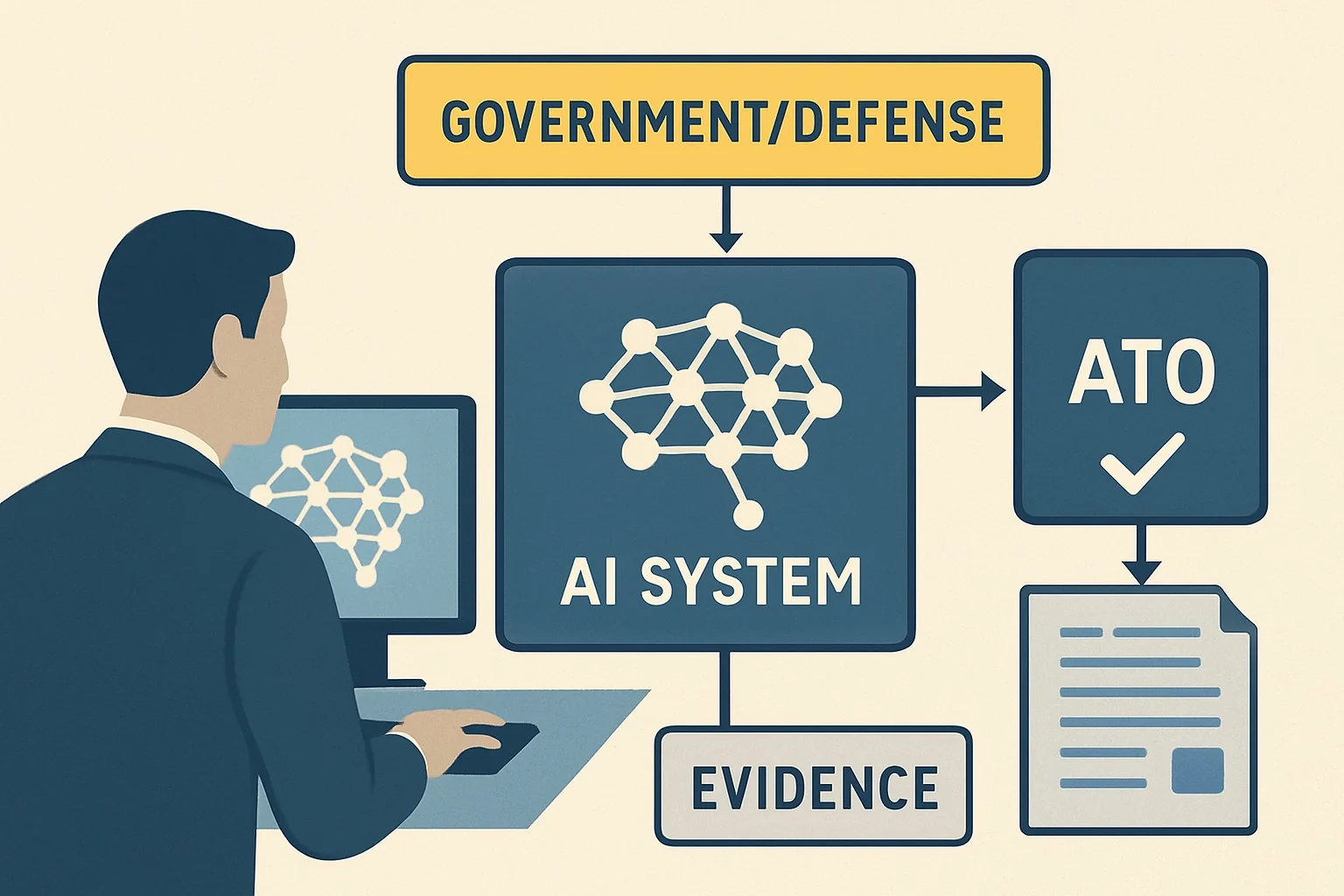
Every deployed ML/LLM system in government and defense environments must earn an Authority to Operate (ATO) before processing production data—yet the evidence artifacts required for LLM authorization remain poorly defined, inconsistently interpreted, and frequently misaligned with the iterative nature of modern model development. This article delivers a production-tested framework for generating, organizing, and presenting ATO evidence for LLM systems, mapped directly to federal AI procurement pathways and authorization timelines that engineering teams actually encounter.
Failure scenario: A defense contractor's summarization LLM, deployed to assist intelligence analysts, operated for 11 months on a provisional ATO with quarterly manual security reviews. When the provisional authority expired, the system lacked documented evidence of supply chain provenance for its fine-tuned weights, continuous monitoring of prompt injection attempts, and traceable lineage between training data versions and model behavior changes. The ATO renewal was denied; the system was sunset, and the $2.3M program reverted to manual analysis workflows while a 14-month re-authorization cycle began.
Executive Summary
TL;DR: Government LLM ATOs require evidence packages that bridge traditional NIST RMF controls with ML-specific risks—model provenance, inference observability, and behavioral drift monitoring—structured for iterative deployment cycles rather than static software releases.
- ATO evidence for LLM systems must extend beyond standard software artifacts to include model cards, data lineage, inference telemetry, and adversarial test results that demonstrate behavioral bounds.
- Government AI procurement pathways (traditional FAR, OTAs, CSOs, and rapid acquisition channels) impose different evidence timelines and review depths; pathway selection should precede ATO strategy.
- Authority to Operate ML models demands continuous authorization models, not point-in-time approvals, because model behavior changes with inputs, prompts, and retrieval context even when weights are static.
- Defense AI acquisition requirements increasingly reference NIST AI RMF, DoD Responsible AI Guidelines, and service-specific AI directives that engineering teams must translate into verifiable controls.
- ML/LLM ATO evidence documentation should be generated automatically from CI/CD and observability pipelines, not assembled manually during authorization crunch periods.
- Federal AI system authorization process timelines range from 6 weeks (provisional ATO with pre-approved components) to 18+ months (full JAB review for high-impact systems), with LLM-specific unknowns adding 3-6 months of first-mover friction.
Quick Q&A for direct extraction:
- Q: What makes an LLM ATO different from standard software ATO? A: LLM ATOs must demonstrate behavioral bounds and drift monitoring, not just code integrity and vulnerability posture.
- Q: Which procurement pathway is fastest for defense LLM deployment? A: Other Transaction Authority (OTA) agreements with rapid prototyping provisions, but they require explicit ATO planning in the agreement structure.
- Q: How long should LLM ATO evidence documentation be maintained? A: For the system lifecycle plus 3-7 years post-sunset, with continuous monitoring logs retained for the duration of operational use and any known downstream dependencies.
How Government AI Procurement Pathways Shape ATO Evidence Requirements
The Procurement-Authorization Coupling
Government AI procurement is not merely a funding mechanism—it pre-structures the ATO evidence that will be required, the timeline for its production, and the organizational authority that will review it. Engineering teams frequently treat procurement as a business function and ATO as a security function, then discover at month 9 that their OTA's rapid fielding provisions conflict with their service component's full RMF implementation requirements.
The four primary pathways for defense AI systems each create distinct ATO evidence constraints:
- Federal Acquisition Regulation (FAR) based contracts: Full DFARS 252.204-7012 (NIST 800-171/CMMC) compliance, CDRLs for all evidence artifacts, and typically service-level ATO authority with 12-18 month initial timelines. Evidence must be complete at contract award for COTS components, or delivered via CDRLs for development efforts.
- Other Transaction Authority (OTA) agreements: Flexible evidence requirements negotiated per agreement, often enabling provisional ATOs with iterative evidence delivery. Critical for rapid LLM prototyping, but requires explicit ATO authority designation—absent this, OTAs default to the most conservative review path.
- Commercial Solutions Openings (CSO) via DIU: Pre-validated vendor solutions with existing ATO evidence packages that can be inherited or adapted. Fastest path for non-custom LLM deployments (6-12 weeks), but limited to solutions already in the DIU portfolio.
- Rapid Acquisition pathways (Section 804/ Middle Tier of Acquisition): Compressed timelines with delegated ATO authority, but require explicit security planning in the acquisition strategy and often limit operational deployment scope until full RMF is completed.
The NIST RMF-AI Mapping Problem
The NIST Risk Management Framework (SP 800-37 Rev. 2) provides the structural backbone for all federal ATOs, but its controls were designed for traditional IT systems with deterministic behavior. LLM systems violate core assumptions: identical inputs do not produce identical outputs, behavior emerges from training data rather than explicit programming, and vulnerability surfaces include prompt injection and training data extraction that have no analog in conventional software.
The NIST IR 8596 AI Cybersecurity Profile begins addressing this gap, but as of 2024-2025, most authorizing officials lack implementation guidance for translating AI-specific risks into verifiable control evidence. This creates first-mover friction: early LLM ATO attempts establish precedent that subsequent programs inherit, for better or worse.
Production teams should map their evidence generation to the following control families with LLM-specific augmentations:
- AC (Access Control): Standard identity and authorization, plus prompt-level rate limiting, content filtering gates, and role-based output restrictions that demonstrate bounded disclosure.
- AU (Audit): Standard logging, plus full prompt-response trace capture with diff-based change detection, embedding retrieval logs, and token-level attribution for sensitive content generation.
- CM (Configuration Management): Standard baseline control, plus model version registry with cryptographic provenance, training data snapshot hashes, and pipeline configuration immutability.
- IR (Incident Response): Standard procedures, plus model-specific playbooks for prompt injection campaigns, jailbreak pattern emergence, and training data contamination detection.
- RA (Risk Assessment): Standard vulnerability analysis, plus adversarial robustness testing, bias measurement across demographic slices, and red-team exercises with LLM-specific attack surfaces.
- SA (System and Services Acquisition): Standard supply chain verification, plus model provenance documentation with SBOM-style artifact manifests and third-party training data licensing verification.
- SC (System and Communications Protection): Standard encryption and boundary protection, plus inference-time input sanitization, output watermarking or provenance marking, and retrieval-augmented generation (RAG) source isolation.
- SI (System and Information Integrity): Standard integrity monitoring, plus behavioral drift detection, embedding space anomaly identification, and automated regression testing against known-good output distributions.
Implementation: Production Patterns for ATO Evidence Generation
Pattern 1: The Evidence Pipeline Architecture
ATO evidence assembled manually during authorization review periods is invariably incomplete, inconsistent, and untrusted by authorizing officials. Production teams should implement automated evidence generation as a first-class pipeline output, not a documentation afterthought.
The core architecture has three stages:
Stage 1: Build-time evidence capture. Every model training, fine-tuning, or quantization operation generates immutable artifacts with cryptographic attestation. This includes:
class ModelProvenanceArtifact:
    def __init__(self, training_config, data_manifest, base_model_ref):
        self.config_hash = hashlib.sha256(
            json.dumps(training_config, sort_keys=True).encode()
        ).hexdigest()
        self.data_manifest = data_manifest  # List of (uri, hash, license_ref)
        self.base_model_ref = base_model_ref  # Cryptographic reference to upstream
        self.timestamp = datetime.utcnow().isoformat()
        self.builder_identity = os.environ.get('CI_BUILDER_IDENTITY')

    def generate_sbom(self):
        return {
            'sbom_version': '1.4',
            'spec_version': 'SPDX-2.3',
            'packages': self._packages_from_data_manifest(),
            'relationships': self._derive_lineage(),
            'annotations': [{
                'annotator': f'Person: {self.builder_identity}',
                'annotationDate': self.timestamp,
                'annotationType': 'REVIEW',
                'comment': f'Config hash: {self.config_hash}'
            }]
        }
Stage 2: Deployment-time evidence validation. The deployment pipeline verifies artifact integrity, checks against authorized component baselines, and generates deployment-specific evidence:
def validate_deployment_evidence(model_artifact, target_environment):
    # Verify cryptographic chain from build
    assert verify_signature(model_artifact, trusted_builder_key)

    # Check against environment-specific authorization boundary
    allowed_models = load_authorized_models(target_environment.cage_id)
    assert model_artifact.model_family in allowed_models

    # Generate deployment evidence package
    return DeploymentEvidence(
        artifact_ref=model_artifact.canonical_hash,
        environment_hash=target_environment.configuration_hash(),
        boundary_crossings=target_environment.identify_boundary_crossings(),
        control_inheritance=map_inherited_controls(target_environment),
        timestamp=datetime.utcnow().isoformat()
    )
Stage 3: Runtime evidence continuous generation. The operational system generates ongoing evidence of control effectiveness, behavioral bounds maintenance, and anomaly response. This is where LLM systems diverge most sharply from traditional software:
class LLMContinuousMonitoringEvidence:
    def __init__(self, inference_telemetry_sink):
        self.sink = inference_telemetry_sink
        self.drift_baseline = load_behavioral_baseline()

    def generate_periodic_evidence(self, window_hours=168):
        window = self.sink.query_window(
            start=datetime.utcnow() - timedelta(hours=window_hours),
            event_types=['inference', 'prompt_injection_detected',
                        'output_filtered', 'retrieval_access']
        )

        return {
            'window': window.metadata,
            'behavioral_metrics': self._compute_drift_metrics(window),
            'security_events': self._summarize_security_events(window),
            'control_effectiveness': self._assess_control_performance(window),
            'anomalies_requiring_review': self._flag_anomalies(window),
            'operator_attestations': self._collect_operator_signatures(window)
        }

    def _compute_drift_metrics(self, window):
        current_embeddings = extract_output_embedding_distribution(window)
        return {
            'embedding_drift_kl_div': kl_divergence(current_embeddings,
                                                      self.drift_baseline),
            'p95_response_length_ratio': percentile_ratio(window,
                                                          self.drift_baseline, 0.95),
            'demographic_parity_delta': self._bias_metrics(window),
            'retrieval_source_entropy': self._source_diversity(window)
        }
Pattern 2: The Model Card as Control Evidence
Model cards (Mitchell et al., 2019) have evolved from documentation best practice to de facto ATO evidence requirements. For government LLM systems, the model card must be structured as verifiable control evidence, not descriptive marketing material.
Required sections for ATO-grade model cards:
- Intended Use Declaration: Explicitly bounded operational scenarios with negative use cases (what the system must not be used for). This directly supports AC and SA control families.
- Performance Characteristics: Per-domain accuracy, latency distributions (p50/p95/p99), and failure mode rates on held-out government-representative test sets. Supports SI and RA.
- Training Data Provenance: Complete data lineage with licensing verification, demographic representation metrics, and contamination checks against known evaluation sets. Supports SA and RA.
- Behavioral Bound Verification: Results from structured red-teaming, adversarial robustness testing, and threat-modeled attack simulation. Supports RA and IR.
- Known Limitations: Explicit capability boundaries with operational mitigations and escalation procedures. Supports IR and SA.
- Environmental and Compute: Training compute with carbon accounting, inference efficiency metrics, and hardware dependency documentation. Supports SA and CM.
Pattern 3: The RAG-Specific Evidence Extension
Retrieval-augmented generation (RAG) architectures, common in government LLM deployments for classified or compartmented information, introduce evidence requirements beyond the base model:
- Retrieval source authorization: Evidence that each retrieval corpus is authorized for the system's classification level and user population, with automated access control verification at query time.
- Source grounding verification: Evidence that generated content is traceable to retrieved sources, with hallucination rates measured on government-domain test queries.
- Dynamic source update procedures: Evidence that corpus updates maintain authorization boundaries, with automated re-verification of source provenance on ingestion.
- Cross-corpus leakage prevention: Evidence that multi-corpus RAG systems prevent information flow between sources at different classification or compartment levels.
Comparisons & Decision Framework
Procurement Pathway Selection Matrix
| Pathway | Typical Timeline | ATO Flexibility | Evidence Completeness Required | Best Fit |
|---|---|---|---|---|
| FAR Traditional | 14-24 months | Low; full RMF required | Complete at award for COTS; CDRL delivery for dev | Mature requirements, high assurance needs, legacy system integration |
| OTA Rapid Prototyping | 4-12 months initial | High; negotiated per agreement | Iterative, with explicit provisional authority provisions | Novel LLM capabilities, urgent operational need, willing to accept residual risk |
| DIU CSO | 2-6 months | Medium; inherits vendor evidence | Adaptation of pre-existing vendor ATO package | Commercial LLM with government tuning, non-critical applications |
| Section 804 Rapid | 3-9 months | Medium; delegated authority | Phased: rapid fielding evidence, then full RMF | Operational experimentation, limited deployment scope, iterative refinement |
ATO Evidence Maturity Model
Teams should assess their current evidence generation maturity:
- Level 1 (Reactive): Evidence assembled manually for each ATO review. No automated artifact generation. Typical result: 6-12 week authorization preparation periods, frequent evidence gaps, conditional ATOs with extensive POA&M items.
- Level 2 (Defined): Standard evidence templates with manual population from known sources. Build scripts generate some artifacts (dependency lists, test results). Typical result: 3-6 week preparation, consistent structure but variable completeness.
- Level 3 (Automated): CI/CD pipelines generate core evidence artifacts with cryptographic attestation. Runtime monitoring produces continuous control effectiveness evidence. Typical result: 1-2 week preparation for renewal, provisional ATOs achievable within procurement timeline.
- Level 4 (Continuous): Real-time evidence generation with automated anomaly flagging and operator attestation. Authorizing official has dashboard access to current control state. Typical result: Continuous ATO model with minimal renewal friction, rapid adaptation to model updates.
Decision Checklist: Pathway and ATO Strategy Alignment
- Is the operational need urgent (< 6 months) or can full RMF timeline be accommodated?
- Is the LLM capability novel (no existing government deployment precedent) or proven?
- What is the maximum acceptable residual risk for initial deployment?
- Does the intended user population have existing authorization for comparable systems?
- Is the deployment environment isolated (air-gapped, enclave) or connected to wider networks?
- Can the system tolerate operational pause for ATO renewal, or must continuity be guaranteed?
- What evidence generation infrastructure exists in the target development environment?
Failure Modes & Edge Cases
Failure Mode 1: The "Frozen Model" Assumption
Teams frequently assume that freezing model weights eliminates behavioral drift evidence requirements. This is incorrect: RAG retrieval corpus updates, prompt template modifications, and even upstream dependency changes (tokenizer libraries, inference optimization frameworks) can alter system behavior without weight changes. Evidence must capture the complete inference pipeline state, not merely model checksums.
Diagnostic: Behavioral drift detected in continuous monitoring with no corresponding model version change. Root cause analysis reveals retrieval corpus update, prompt template modification, or dependency version drift.
Mitigation: Version and hash the complete inference pipeline configuration, including retrieval system state, prompt templates, and all dependency versions. Include these in deployment evidence packages.
Failure Mode 2: The Inherited Control Gap
LLM systems frequently inherit infrastructure controls (cloud authorization, network boundary protection) from existing ATOs, but model-specific controls are not inheritable. Teams under-document model-specific evidence, assuming infrastructure inheritance provides sufficient coverage.
Diagnostic: ATO review identifies extensive POA&M items for controls that were assumed inherited. Authorization timeline extends 3-6 months for model-specific evidence generation.
Mitigation: Explicitly map inherited versus system-specific controls in the System Security Plan (SSP). Pre-generate model-specific evidence for all non-inherited controls before authorization review submission.
Failure Mode 3: The Provisional ATO Trap
Provisional ATOs (P-ATOs) with accelerated timelines and residual risk acceptance are valuable for rapid deployment, but teams frequently fail to plan the transition to full ATO. P-ATO conditions accumulate without resolution, creating technical debt that eventually forces system shutdown.
Diagnostic: P-ATO approaching expiration with majority of POA&M items still open. Authorization official indicates unwillingness to extend provisional authority without significant risk reduction.
Mitigation: Structure P-ATO conditions with explicit prioritization, resourced remediation plans, and monthly progress reporting. Treat P-ATO as risk reduction sprint, not indefinite operational state.
Failure Mode 4: The Classification Escalation
LLM systems initially authorized for unclassified information processing may be pressured to handle higher classification levels as operational value is demonstrated. Classification escalation requires complete re-authorization; it cannot be treated as incremental change.
Diagnostic: Operational request to process SECRET information on system authorized for CUI only. Timeline pressure to "just add encryption" without re-authorization.
Mitigation: Design initial architecture with maximum anticipated classification in mind, even if initial authorization is lower. Document upgrade pathway and pre-position evidence for higher classification controls.
Performance & Scaling
ATO Evidence Generation Overhead
Evidence generation imposes measurable overhead on development and operational workflows. Production teams should budget for:
- Build-time: 15-45% increase in CI/CD pipeline duration for cryptographic provenance generation, SBOM construction, and test artifact capture. For large model training runs, this is negligible relative to training time; for frequent fine-tuning iterations, it becomes significant.
- Runtime: 5-15% inference latency increase for comprehensive telemetry capture, with p95/p99 impact typically higher than p50 due to burst logging and trace serialization. Latency SLO frameworks must account for evidence generation overhead.
- Storage: Telemetry and evidence retention scales with inference volume. Budget 10-100GB per million inferences for full prompt-response trace capture, depending on context window and output length. Compressed embeddings and differential storage reduce this 5-10x.
- Personnel: Mature evidence automation (Level 3-4) requires 0.5-1.0 FTE security engineer per 3-5 ML engineers for evidence pipeline maintenance and authorization liaison. Manual evidence assembly (Level 1-2) requires 2-4 FTE during authorization crunch periods.
Scaling Evidence Review
As government LLM deployment scales, authorizing officials face evidence review bottleneck. Teams can reduce review friction:
- Structured evidence formats: Machine-readable evidence packages (JSON-LD, OSCAL) enable automated pre-validation and anomaly flagging before human review.
- Precedent reuse: Document control implementation decisions with explicit rationale, enabling inheritance across similar systems in the same organization.
- Continuous authorization dashboards: Real-time control state visibility reduces periodic review scope to anomalies and changes, not complete re-verification.
Production Best Practices
Security
- Implement cryptographic provenance for all model artifacts, training data snapshots, and pipeline configurations. Use hardware-backed signing where available (TPM, AWS Nitro, Azure confidential computing).
- Segment RAG retrieval sources by authorization boundary; implement automated verification that query-time source selection respects user clearance and need-to-know.
- Deploy prompt injection detection as inline control, not post-hoc audit, with automated response (output blocking, session termination, operator alert) at detection threshold.
Testing
- Maintain government-domain test sets representative of operational queries, with held-out evaluation subsets for periodic behavioral verification.
- Implement automated adversarial testing in CI/CD: prompt injection suites, jailbreak pattern libraries, and data extraction attempts. Results become standard RA control evidence.
- Conduct periodic human red-teaming with authorization official observation, generating direct evidence for risk acceptance decisions.
Rollout
- Structure deployment in authorization-bounded phases: limited user pilot, expanded operational test, full production. Each phase generates evidence for the next authorization decision.
- Implement feature flags for capability expansion (longer context, new retrieval sources, additional output formats) with independent authorization gates.
- Plan decommissioning evidence requirements from initial design: data retention, model artifact destruction verification, and downstream system dependency notification.
Runbooks
- Model-specific incident response: prompt injection campaign detection and response, behavioral drift escalation procedures, training data contamination response.
- Authorization continuity: P-ATO renewal preparation timeline (begin 90 days before expiration), evidence package update procedures for model version changes, emergency authorization contact protocols.
- Classification boundary enforcement: automated detection of potential over-classification in outputs, manual review procedures for edge cases, escalation to security officer.
Further Reading & References
- NIST SP 800-37 Rev. 2, Risk Management Framework for Information Systems and Organizations — foundational ATO structure, with AI-specific implementation guidance emerging.
- NIST IR 8596, Artificial Intelligence Risk Management Framework: Generative Artificial Intelligence Profile — direct mapping of AI risks to RMF controls, essential for LLM ATO evidence structuring.
- DoD Directive 3000.09, Autonomy in Weapon Systems and subsequent Responsible AI guidelines — defense-specific AI governance that shapes service-level ATO requirements.
- Mitchell, M. et al. (2019), "Model Cards for Model Reporting" — academic foundation for structured model documentation now evolving into ATO evidence requirement.
- OMB Memorandum M-24-10, Advancing Governance, Innovation, and Risk Management for Agency Use of Artificial Intelligence — federal AI procurement and governance direction with ATO implications.
- FedRAMP Rev. 5 and emerging FedRAMP AI guidance — for cloud-hosted LLM systems, the intersection of cloud authorization and AI-specific controls.
The MAKB Editorial team practices what we publish. This framework reflects direct engagement with defense AI procurement and authorization processes across multiple programs. We welcome corrections, edge cases, and evolving practice reports from the field.


