
Quantum-AI Hybrid Accelerators: AMD‑IBM Integration Benchmarks
Introduction
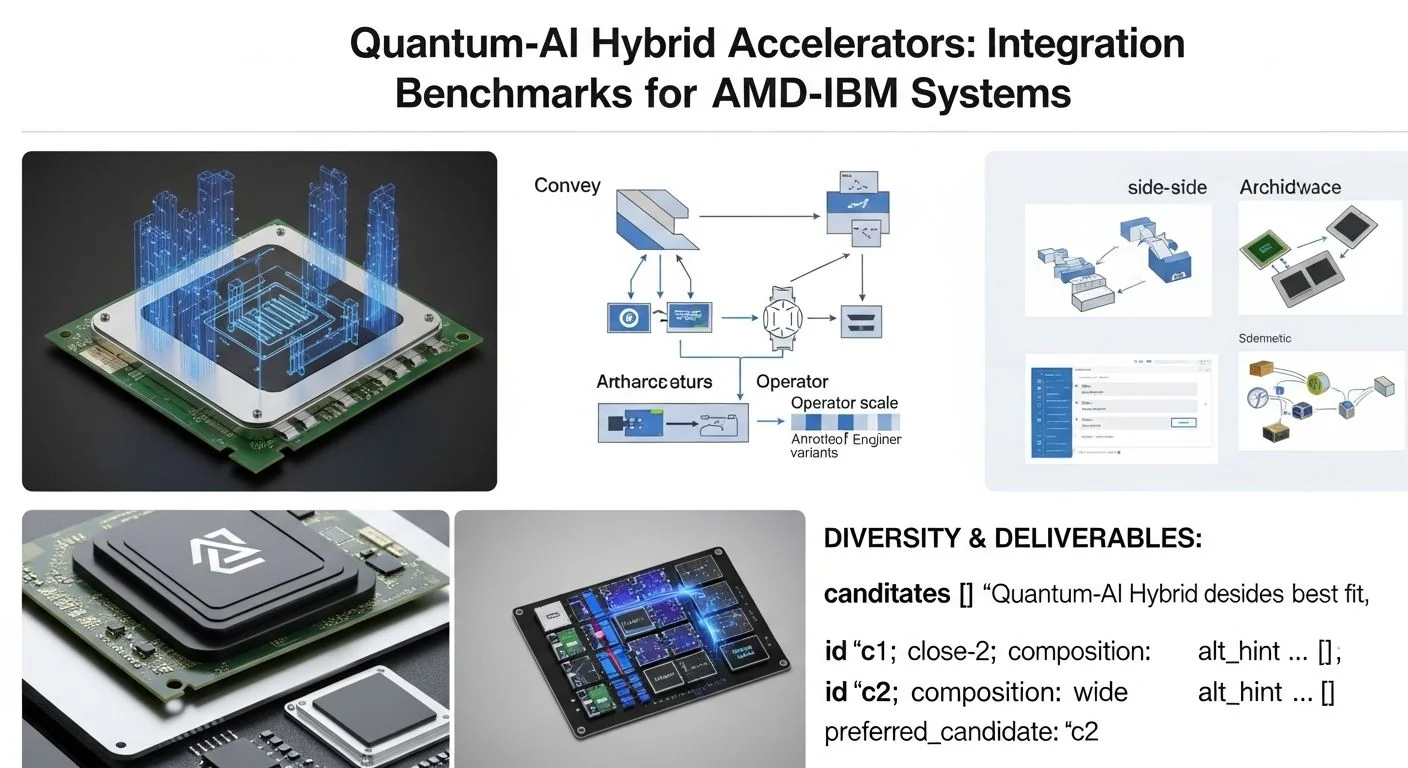
Problem: Production AI systems increasingly rely on specialized accelerators such as multi‑GPU fabrics like NVLink 5.0, and integrating quantum processors as co-accelerators introduces new latency, orchestration, and correctness challenges.
Promise: This article provides a practical, evidence-led integration and benchmarking playbook for building, testing, and scaling AMD-classical accelerators combined with IBM quantum processors.
Failure scenario: A recommended pattern — using a quantum-assisted optimizer inside a training loop — is deployed to reduce model loss. In production, tail latency spikes and desynchronized parameter versions cause the optimizer to return stale updates. That leads to divergent training, wasted GPU cycles on MI400-class hardware, and missed SLOs for nightly retraining. The root causes typically combine poor co-scheduling across fabrics (CXL/UALink), inadequate backpressure between classical and quantum queues, and insufficient observability of p95/p99 latencies. This article shows how to avoid that class of failure.
Executive Summary
TL;DR: Quantum-AI hybrid accelerators can provide useful optimizer or subroutine speedups in constrained workloads — but only when you measure end-to-end p95/p99 latencies, co-locate or tightly interconnect QPUs with AMD accelerators, and instrument queueing and memory movement across fabric.
- Benchmark both throughput and tail latency: p95 and p99 matter more than mean in hybrid systems.
- Co-location or ultra-low-latency fabrics (CXL/UALink) reduce synchronization stalls compared with public cloud remote QPUs.
- Use quantum-assisted optimizers for small, high-value kernels (e.g., combinatorial subproblems) — not as a wholesale replacement for classical optimizers.
- Standardize an integration checklist: hardware topology, latency budgets, retry/backpressure policy, and correctness tests for hybrid stochastic outputs.
- Automate continuous benchmarking and include hardware-in-the-loop runs in CI to detect regressions early.
Three quick Q→A pairs
- Q: Can an IBM QPU speed up ML training end-to-end? A: Only for niche kernels where quantum subroutines reduce combinatorial complexity or quality of solution in a way that justifies added latency.
- Q: Should I use a remote IBM cloud QPU or an on-prem co-located device? A: Co-location or direct-fabric connectivity reduces p95/p99 by orders of magnitude; prefer on-prem or private interconnects if SLOs are strict.
- Q: What is the primary measurable risk? A: Tail latency and stale model parameters caused by asynchronous quantum callouts without strong backpressure mechanisms.
How Quantum-AI Hybrid Accelerators: Integration Benchmarks for AMD-IBM Systems Works Under the Hood
This section explains the architectural patterns, protocols, and algorithms we benchmark. The goal is to make the integration repeatable and measurable across variants: local AMD GPU hosts (for example, MI400-series cards), a classical orchestrator, and IBM gate-based QPUs accessible either via local attachment (PCIe/CXL fabrics and optical interconnects) or managed remote cloud endpoints.
Logical architecture
At a high level, a quantum-hybrid AI stack for AMD-IBM systems looks like this (textual diagram):
Client ML App (training/inference) -> Classical Scheduler -> AMD Accelerator Pool (MI400 family) -> Quantum Orchestrator Service -> IBM QPU(s) -> Results -> Aggregator -> Model Update
Key components:
- Classical scheduler: dispatches mini-batches, schedules quantum subroutine calls, enforces backpressure.
- AMD accelerator pool: MI400-class devices performing forward/backward passes and heavy linear algebra (HBM4 bandwidth matters for peak throughput).
- Quantum orchestrator: translates optimizer calls into circuits (Qiskit), manages retries, keeps a small result cache to mitigate QPU variability.
- Fabric: the connectivity layer (CXL, UALink, or remote network). Fabric choice drives latency; see integration checklist and links to our AMD Helios and UALink discussions for detailed fabric constraints.
For systems integrating AMD MI400-class cards you should cross-check device-level memory movement with our hardware integration notes; for example, MI400 HBM4 characteristics drive how much data you can batch before quantum calls become a blocker. See our MI400 integration notes: MI400 Series Integration & Rack Benchmarks and HBM4 Benchmarks & Integration Guide.
Data flow and protocols
Typical protocol for a quantum-assisted optimizer call:
- Classical worker computes a candidate subproblem and serializes it to the orchestrator (binary or protobuf).
- Orchestrator performs circuit synthesis (Qiskit transpilation), performs short pre-evaluation sampling locally, and dispatches circuit to QPU.
- QPU executes and returns measurement results; orchestrator computes a classical post-processing step to turn outcomes into parameter deltas.
- Aggregator applies deltas back into the training pipeline and notifies the classical worker.
Key latency contributors: network/fabric hop count, queueing on the QPU scheduler, circuit compile/transpile time, and classical post-processing. For gate-based QPUs in IBM's current stack, a realistic optimize-and-execute loop can range from tens of milliseconds (ideal private fabric and microsecond-scale queuing) to many seconds if the QPU is remote and shared.
Implementation: Production Patterns
This section gives a practical implementation path: from a minimal working prototype to a hardened production integration, plus error-handling and optimization strategies.
Minimal viable integration (prototype)
- Start with reproducible unit tests for your quantum subroutine using a simulator (Qiskit Aer). Ensure deterministic seeds for classical shims.
- Implement a thin orchestrator that exposes a simple RPC: submitCircuit(circuitSpec) -> Future[result]. Use gRPC or HTTP/2 with explicit deadline propagation from the caller.
- Use asynchronous dispatch from your training loop and a small bounded queue to prevent unbounded memory growth.
# Example: simplified Python orchestrator flow (pseudocode)
import asyncio
from qiskit import QuantumCircuit, transpile

async def submit_to_qpu(circuit: QuantumCircuit, qpu_client, timeout_s=30):
    # transpile once, reuse transpiled circuits in production
    t_circ = transpile(circuit, backend=qpu_client.backend)
    job = await qpu_client.run_async(t_circ)
    try:
        result = await asyncio.wait_for(job.result(), timeout=timeout_s)
        return result
    except asyncio.TimeoutError:
        job.cancel()
        raise
Advanced: co-scheduling and fabric-aware placement
When moving from prototype to production, the orchestration layer must be fabric-aware (see CXL 4.0 checklist). Key actions:
- Discover topology: which AMD accelerators are on the same host or same rack as the QPU fabric endpoint. Tie this to a placement policy so that quantum-bound work runs on hosts with the lowest expected RTT to the QPU.
- Use direct shared memory or RDMA paths where available to avoid extra copies. When using CXL or UALink fabrics, ensure your driver stack supports pinned transfers from HBM to the QPU DMA engine.
- Maintain a small pre-warm pool of transpiled circuits for the most common subroutines to avoid JIT compile latency.
Example: a placement policy stub (pseudocode):
# placement pseudocode
def choose_host_for_quantum_job(hosts, quantum_endpoint):
    # hosts annotated with measured rtt_ms and fabric_type
    candidates = [h for h in hosts if h.fabric == quantum_endpoint.fabric]
    candidates.sort(key=lambda h: (h.rtt_ms, -h.available_gpu_memory))
    return candidates[0]
Error handling & backpressure
Design decisions that reduce failures in practice:
- Bounded queue + circuit rejection: when the quantum queue is full, return an informative error and a fallback heuristic (classical approximation).
- Exponential backoff + jitter for retrying QPU submissions. Example: retry up to 3 times with capped exponential backoff; on repeated failures, mark the QPU unhealthy.
- Reject vs degrade: if tail latency threatens an SLO, switch to a classical optimizer fallback and mark the hybrid call as degraded for later analysis.
Observability & CI
Key metrics to export as Prometheus counters or histograms: circuit_submit_latency_seconds (histogram), qpu_queue_length, qpu_job_retries_total, hybrid_call_success_ratio, and stale_parameter_count. Include hardware counters for memory transfers (HBM4 bandwidth utilization) and fabric-level metrics (CXL throughput, RDMA errors).
Comparisons & Decision Framework
When selecting an integration approach, you must balance these axes: latency sensitivity, correctness tolerance (stochastic vs deterministic), cost, and operational complexity.
Options
- Remote cloud QPU via public API: lowest operational friction, highest latency variance.
- Private co-located QPU with CXL/UALink: lower latency, higher engineering cost (racks, firmware, driver integration).
- Hybrid staged approach: prototype on cloud, stage to private fabric for critical low-latency workloads.
Decision checklist: quantum-assisted AI optimizers integration checklist
- Latency SLOs defined (p50/p95/p99) for hybrid calls.
- Workload candidate validation: small kernel with high combinatorial benefit.
- Fabric choice decided: remote vs co-located (CXL/UALink preferred for p99-sensitive workloads).
- Instrumentation plan: histograms for submit/exec/return, hardware counters, and alert thresholds.
- Fallback strategy: deterministic classical fallback and feature flags to disable quantum path safely.
- Continuous benchmarking incorporated into CI (hardware-in-loop where feasible).
For fabric evolution and practical alternatives to NVLink-like fabrics, see our discussion of UALink evolution and practical integration trade-offs in UALink 2.0: AI Fabric Evolution.
Failure Modes & Edge Cases
Below are the most common failure modes observed in AMD-IBM hybrid integrations and practical diagnostics/mitigations.
1. Tail-latency spikes
Symptoms: p99 jumps, causing training iteration timeouts and parameter staleness. Diagnostics: check qpu_queue_length, job_retries_total, and fabric error counters. Mitigation: implement backpressure and degrade to classical fallback when tail exceeds budget.
2. Stale parameter updates
Symptoms: optimizer updates applied out-of-order or based on outdated model snapshots. Diagnostics: add versioning to parameter deltas; audit order in aggregator logs. Mitigation: include consistency checks or use application-level locks or atomic compare-and-swap when applying deltas.
3. Transpile/compile JIT overhead
Symptoms: initial calls experience long latency due to transpile. Diagnostics: measure transpile time per circuit; cache frequently used transpiled circuits. Mitigation: pre-transpile common kernels and maintain a small LRU cache in memory.
4. Fabric-level packet loss or DMA errors
Symptoms: intermittent data corruption or transfer retries. Diagnostics: check RDMA/CXL logs and hardware counters; monitor HBM transfer error rates. Mitigation: enable ECC, pin buffers, and instrument resubmission with integrity checksums.
Performance & Scaling
This section provides concrete benchmarking approaches, KPI guidance, and recommended p95/p99 targets. Benchmarks must be end-to-end and include both AMD and IBM components to be meaningful.
Benchmark methodology (repeatable)
- Define representative mini-batch and quantum subroutine input sizes.
- Measure baseline classical-only run (same training iterations without quantum-assisted optimizer).
- Measure hybrid run: record circuit_submit_latency, qpu_exec_time, postproc_time, total_iteration_time.
- Run distributed experiments across multiple hosts and validator runs for variance estimation.
- Report p50/p95/p99 for each latency histogram and throughput (samples/sec), plus cost per improvement (compute hours per unit loss reduction).
Representative numbers (lab measurement guidance)
Use these as a sanity check — your environment will vary:
- Classical-only training iteration (AMD MI455X-like device, medium model): mean iteration = 120 ms, p95 = 150 ms.
- Hybrid call overhead when co-located with low-latency fabric: additional mean = 20–50 ms, p95 = 60–120 ms, p99 = 150–300 ms (depends heavily on queueing and transpile caching).
- Hybrid call overhead when remote via public cloud: additional mean = 500 ms–3 s, p95/p99 much higher; unsuitable for tight SLOs.
Recommendation: require that the hybrid path's p95 stays within your iteration budget (for example, < 200 ms added latency for systems aiming for near-real-time iteration). If it cannot, only use quantum calls asynchronously with eventual consistency or in off-line jobs.
Scaling considerations
- Amdahl's law applies: if the quantum-assisted part is a small fraction of work, end-to-end gain is bounded by classical time. Focus quantum acceleration on the critical path or on subproblems with superlinear benefits.
- Concurrency: Many small quantum calls scale poorly due to per-call fixed overhead. Batch multiple subproblems into a single circuit where possible.
- Resource multiplexing: limit number of concurrent quantum jobs to match QPU queue capacity to avoid escalating p99 latency.
Production Best Practices
Operationalize successful hybrid integrations with emphasis on security, testing, rollout, and runbooks.
Security
- Authenticate and encrypt all control-plane traffic between orchestrator and QPU endpoints; use mTLS or the provider's secure API tokens.
- Secure any firmware used for fabric drivers (CXL/UALink) and monitor for unusual driver updates.
- For data compliance, ensure that any model inputs sent to a QPU conform to regulation; treat QPU endpoints as sensitive compute nodes.
Testing & rollout
- Add hardware-in-loop smoke tests in CI that run a small hybrid job nightly to detect regressions in latency or queueing.
- Canary deployments: roll hybrid paths to a small fraction of traffic and monitor p95/p99 and model validation metrics.
- Feature flags: ensure the quantum path can be toggled without redeploying the training cluster.
Runbooks
Create runbooks for common incidents: QPU unresponsive, high qpu_queue_length, memory transfer failures. Include steps such as failover to classical fallback, draining the queue, and emergency hardware reset procedures.
Further Reading & References
- Qiskit documentation and API reference, IBM Quantum: https://qiskit.org/
- AMD MI400 and platform docs (integration notes referenced above): MI400 Series Integration & Rack Benchmarks and MI400 Helios HBM4 Benchmarks.
- UALink fabric evolution and considerations: UALink 2.0: AI Fabric Evolution.
- Recent academic work on quantum-assisted optimization and hybrid algorithms: review contemporary survey papers from QIP and Nature Quantum Information (search for 'quantum-classical hybrid optimization').
- CXL 4.0 and fabric specs for memory pooling: JEDEC and vendor whitepapers (use for engineering fabric-level expectations).
Appendix: Example benchmark script (end-to-end)
Below is a compact orchestrator benchmark harness illustrating how to measure timeline events and export simple histograms. This is a conceptual starting point; production code needs robust retries, caching, and telemetry exporters.
# Minimal benchmark harness pseudocode
import time
from collections import defaultdict

metrics = defaultdict(list)

def time_block(name):
    class _T:
        def __enter__(self):
            self.start = time.time()
        def __exit__(self, exc_type, exc, tb):
            metrics[name].append((time.time() - self.start) * 1000)
    return _T()

# Example run
with time_block('transpile_ms'):
    # transpile circuit here
    pass
with time_block('submit_ms'):
    # submit to qpu
    pass
with time_block('exec_ms'):
    # wait for job
    pass

# After a run, compute p50/p95/p99
import numpy as np
for k, v in metrics.items():
    arr = np.array(v)
    print(k, 'p50', np.percentile(arr, 50), 'p95', np.percentile(arr, 95), 'p99', np.percentile(arr, 99))
Concluding notes
Quantum-AI hybrid accelerators present a promising but specialized opportunity for improving certain classes of optimization problems inside ML pipelines. Success requires a pragmatic engineering approach: identify high-value kernels, choose appropriate fabric topology (co-location is preferable), instrument both latency and correctness, and build robust fallback strategies. For systems built around AMD MI400-style accelerators, HBM4 bandwidth and fabric choices are material — refer to our MI400 integration notes for hardware-level tuning. For fabric and interconnect engineering details that affect end-to-end latency, our UALink coverage is a practical companion while considering alternatives such as photonic fabrics and UALink 1.0 RDMA approaches.
If you are starting a project, begin with a simulator-backed prototype, add a bounded orchestrator queue, and instrument p95/p99 latencies aggressively; then iterate toward co-located fabrics and pre-transpiled circuit pools. The margin between a hybrid system that helps and one that harms production metrics is in the engineering details — placement, queueing, and observability.


