
AI healthcare triage: Symptom Triage & Treatment Agents
Introduction
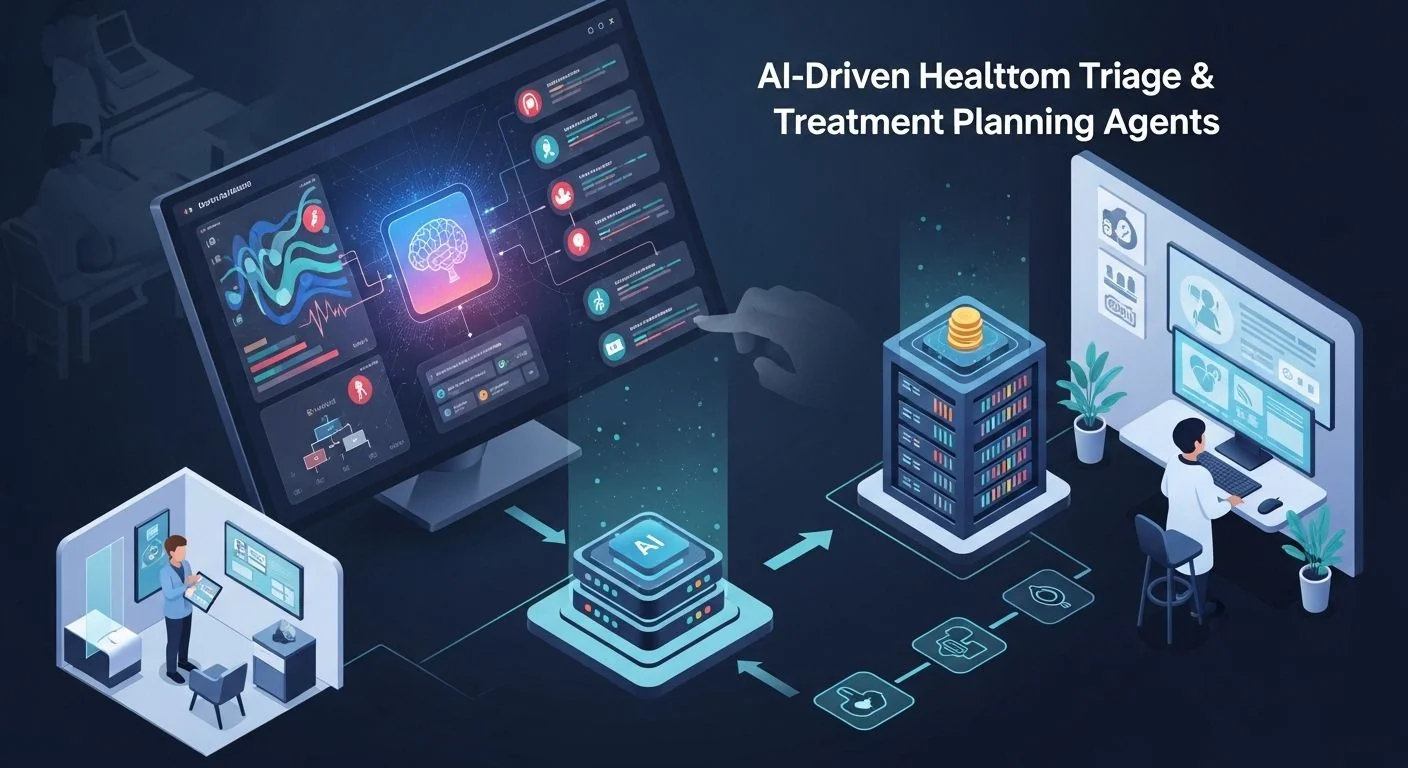
Problem statement (production-framed): Health systems need reliable, auditable AI-driven symptom triage and treatment-planning agents that operate safely under regulatory constraints, integrate with clinical workflows, and degrade predictably when uncertain.
Promise: This article gives senior engineers a practical, evidence-led blueprint — architecture, production patterns, benchmarks, failure diagnostics, and rollout checklists — to build, validate, and operate AI healthcare triage agents that meet clinical and engineering requirements.
Failure scenario: A deployed triage agent returns an urgent-care recommendation for a patient with conflicting input signals (chest pain + history of heart disease), the downstream call center escalates incorrectly, and care is delayed because the model produced an overconfident but unsupported plan. The root causes are (1) insufficient clinical context passed into the model, (2) absent rule-based safety overrides for red-flag symptoms, and (3) poor uncertainty calibration and logging that prevented rapid rollback.
Executive Summary
TL;DR: Combine structured clinical input (FHIR), calibrated LLMs for reasoning, a rules-based safety layer, and a rigorous validation pipeline to deliver auditable, high-availability AI triage and treatment-planning agents.
- Integrate at the FHIR resource layer and normalize inputs before LLM reasoning to reduce hallucination surface area.
- Use layered safety: intent classifiers, red-flag rules, uncertainty calibration (temperature scaling), and human-in-the-loop (HITL) gating for high-risk outputs.
- Measure both clinical metrics (sensitivity for red-flags, negative predictive value) and engineering SLAs (p95 latency, end-to-end throughput, audit logging completeness).
- Adopt trial-grade validation: prospective shadow testing, A/B rollout, and clinical outcomes linkage, following FDA/CDS guidance and reporting standards like TRIPOD/CONSORT-AI where appropriate.
- Prepare runbooks for edge-case failures: data drift detection, model confidence collapse, and downstream integration outages.
Three likely direct Q→A pairs
- Q: How do you prevent hallucinated medical advice from a generative model? A: Always normalize inputs into structured FHIR entities, use templates and constrained decoding, apply post-hoc rule-based safety checks, and route uncertain outputs to clinicians.
- Q: Which clinical metrics matter for triage agents? A: Prioritize sensitivity for high-acuity conditions, specificity trade-offs documented by decision thresholds, and calibrated negative predictive value for safe discharge recommendations.
- Q: How should a deployment degrade when the model is uncertain? A: Fall back to deterministic decision trees or human triage, flag the encounter for clinician review, and increment a safety counter that triggers HITL routing above a threshold.
How AI-Driven Healthcare: Symptom Triage & Treatment Planning Agents Works Under the Hood
High-level architecture (layers):
- Data ingress and normalization: patient intake (text, structured answers, vitals) → FHIR resources (Condition, Observation, Patient, MedicationRequest).
- Context assembler: assemble longitudinal EHR context + current encounter + care settings (telehealth vs emergency) → compact prompt representation.
- Reasoning core: an LLM (on-prem or hosted) used for generative differential diagnosis, triage priority, and treatment plan drafting; combined with symptom classifiers and intent detectors.
- Safety & deterministic layer: red-flag rules, drug-interaction checker, allergy constraints, and guideline enforcers (e.g., reference to NICE, USPSTF) that can block or alter outputs.
- Decision router: determines whether output is auto-actionable, requires clinician sign-off, or triggers urgent escalation.
- Audit & observability: immutable logs (what inputs, prompts, model version), confidence scores, provenance pointers to references cited by the model, and downstream outcome linking.
Algorithmic components and protocols:
- Prompt engineering with structured templates and sentinel tokens to reduce free-form hallucination. Use constrained generation (e.g., schema-first outputs like JSON-LD) and validation parsers.
- Ensemble reasoning: combine a discriminative symptom classifier (fast, low-latency) with a generative LLM for complex cases. Ensemble voting or meta-classifier decides which output to trust.
- Calibration and uncertainty quantification: use temperature scaling for softmax-based models, Monte Carlo dropout or predictive ensembles for Bayesian-style uncertainty, and expected calibration error (ECE) monitoring.
- Formalized safety rules implemented as deterministic policies that run after the generative model but before actioning. These are derived from clinical guidelines and local protocols.
Textual diagram description: "Patient input → FHIR normalization → Context assembler → Ensemble: (symptom classifier + LLM) → Safety & rule engine → Decision router → Clinician/HITL or Automated action → Audit log".
Implementation: Production Patterns
We'll walk basic → advanced patterns, error handling, and optimizations. Examples use Python, FHIR resource mapping, and a LangChain-like orchestration (see our agentic AI validation protocols) but keep components modular so your infra can swap model providers.
Basic pattern: deterministic-first, LLM-second
1) Normalize intake to FHIR. 2) Run a fast symptom classifier (<=50ms) that checks red flags. 3) If no red flags, call LLM with constrained JSON schema output and safety template. 4) Validate output and commit to audit log.
from fhir.resources.patient import Patient
from fhir.resources.observation import Observation
# Pseudocode: normalize simple intake into FHIR-like dicts
patient = Patient.construct(id='patient-123', name=[{'family':'Doe','given':['Jane']}])
obs = Observation.construct(code={'text':'heart rate'}, valueQuantity={'value':92})
# Serialize into context for prompt assembly
context = {
  'patient': patient.dict(),
  'observations': [obs.dict()],
  'chief_complaint': 'chest pain'
}
# Call fast classifier
if fast_classifier.detect_red_flag(context):
  route = 'urgent_escalation'
else:
  llm_input = build_constrained_prompt(context)
  llm_output = llm.generate(llm_input)  # use structured schema
  validated = validate_schema(llm_output)
  commit_audit(context, llm_input, llm_output)
Advanced pattern: multi-stage reasoning with ensembles and HITL
Use an orchestrator (workflow engine) that runs:
- Symptom classifier + risk-score model (fast)
- LLM for differential + plan drafting (intermediate latency)
- Deterministic drug & allergy checks (instant)
- HITL queues for items where uncertainty or risk thresholds exceed safe auto-actioning
def triage_pipeline(context):
    score = risk_model.predict(context)  # continuous 0..1
    if score > 0.8:
        return urgent_escalation()
    # Call LLM with retrieval augmentation
    retrieved_docs = retriever.get_topk(context, k=5)
    prompt = assemble_prompt(context, retrieved_docs)
    draft = llm.generate(prompt, schema='triage_json')
    # Deterministic checks
    if drug_interaction_check(draft):
        draft['action'] = 'requires_clinician_review'
    # Uncertainty gating
    if draft['confidence'] < 0.6:
        enqueue_hitl(draft)
    else:
        apply_action(draft)
    audit_log(context, draft)
Constrained generation & schema validation (best practice)
Require the LLM to output a strict JSON schema and validate with a JSON Schema validator. This reduces post-processing errors and supports traceable audits.
Error handling patterns
- Model timeout: fallback to rule-based triage with clear message to user and clinician alert.
- Schema failure: reject output, increase model temperature conservatively for a retry, then route to HITL if still invalid.
- Drift detection event: freeze auto-actioning on that patient cohort and enable enhanced logging and clinician oversight.
Comparisons & Decision Framework
Common design choices and trade-offs:
- Generative-first vs deterministic-first: Generative-first yields richer plans but higher hallucination risk. Deterministic-first (fast classifier then LLM) reduces safety exposure and is recommended for new deployments.
- On-prem vs hosted models: On-prem improves control and compliance (PHI minimization) but raises ops complexity and hardware cost. Hosted models offer rapid updates but require strict ingestion filters and enterprise contracts.
- Retrieval-Augmented Generation (RAG) vs closed-prompt: RAG improves the model's ability to cite sources (helpful for clinician trust), but retrieval freshness and indexing are additional operational concerns.
Selection checklist (use before design sign-off)
- Does the system need PHI to be sent off-site? If yes, lean on on-prem or zoned private cloud.
- Are regulatory or institutional requirements strict on explainability? If yes, prefer structured outputs, RAG with document citations, and deterministic fallback.
- What is acceptable latency? If p95 < 500ms is required, design for classifier-led triage with asynchronous LLM drafts.
- Is there a hit budget for false positives on urgent escalation? Tune thresholds with clinical stakeholders to balance sensitivity/specificity.
Failure Modes & Edge Cases
Concrete diagnostics and mitigations:
- Failure: Overconfident false negatives for high-acuity symptoms (missed red-flags).
- Diagnostics: Compare model confidence vs actual outcomes; monitor sensitivity for conditions flagged as "red"; run retrospective audit of missed cases.
- Mitigation: Harden rule-based detection for explicit red-flag symptom tokens (e.g., "chest pain, shortness of breath, syncope"), require forced HITL when those tokens are present.
- Failure: Hallucinated medication doses.
- Diagnostics: Check divergence between suggested medication and local formulary; validate against dosage databases.
- Mitigation: Block any medication advice that does not match a verified formulary entry; require clinician confirmation for new prescriptions.
- Failure: Data drift after a UI change alters symptom encoding.
- Diagnostics: Statistical data validation (schema, cardinality), sudden change in feature distribution, growing schema validation errors.
- Mitigation: Automated schema checks, circuit breaker that routes to safe fallback on drift detection, integration tests tied to UI changes.
Performance & Scaling
KPIs and target guidance (practical, production-oriented): For low-latency planning and inference checklists, see our CXL 4.0 latency benchmarks & checklist.
- Clinical KPIs: Sensitivity for high-acuity conditions > 95% (goal), NPV > 98% for safe discharge recommendations. Track confusion matrices per condition class.
- Model calibration: ECE < 0.05 target for deployed confidence scores; continuously monitor and recalibrate (temperature scaling) monthly or after drift events.
- Latency targets: For synchronous triage (user-facing), aim for p95 end-to-end latency < 800ms; for clinician-assist workflows, p95 < 2s may be acceptable depending on context.
- Throughput & availability: Plan for p99 availability > 99.9% for triage services in production clinical settings. Use autoscaling for the model-serving tier and circuit breakers for dependent services.
- Audit completeness: 100% of decisions should have a stored provenance record (input snapshot, model version, prompt, output, confidence, rule overrides).
Benchmarks & infrastructure notes: For data-center memory architecture guidance, see our CXL 3.1 fabric-attached memory guide.
- When using on-prem LLMs for low-latency, industrial deployments, planning must consider model size vs latency. Quantized 7B-class LLMs can often achieve sub-200ms inference on modern accelerator nodes for single-turn prompts when batched; larger 30B+ models typically require 300–1200ms depending on hardware.
- For scale and interconnect considerations in data-center environments, consider fabric performance and low-latency RDMA/CXL fabrics for model sharding. If you're evaluating high-throughput inference fabrics, our analysis of advanced AI fabric architectures provides helpful context, including optical interconnects and integration trade-offs: an architecture and benchmarks guide for photonic AI fabric integration.
- For teams building on next-generation AI fabric topologies, the evolution of UALink 2.0 is relevant when selecting on-prem inference clusters: see our deep dive on UALink 2.0 and its system trade-offs for AI fabrics explaining evolution beyond NVLink.
Production Best Practices
Security and privacy: See our Arm CCA confidential AI implementation guide for production PHI handling patterns.
- Adhere to data minimization: do not send raw PHI to external model providers unless covered by a BAA and encrypted transport; prefer on-prem or VPC-hosted models for PHI.
- Encrypt audit logs at rest and use tamper-evident append-only storage (write-once logs with hash chains) for medico-legal traceability.
- RBAC and attribute-based access for model version rollout, with approvals required for changes to safety rules.
Testing & validation:
- Unit test: schema validation, deterministic rule engine tests, and prompt->schema parsers.
- Integration test: end-to-end cycles with synthetic and historical cases; ensure the system responds correctly to red-flag inputs.
- Clinical validation: prospective shadow deployments against clinician decisions, with paired analysis of discordant cases. Use metrics aligned with regulatory guidance (false negatives on critical conditions tracked closely).
Rollout & runbooks:
- Shadow Mode (60–90 days minimum): model runs in parallel but does not affect care; measure sensitivity and calibration, and tune thresholds.
- Phased rollout: start in low-risk specialties (e.g., dermatology triage) before emergency medicine.
- Runbook essentials: how to cutover to deterministic fallback, how to escalate model anomalies to clinical safety officers, and post-incident reporting templates that map to governance needs.
Further Reading & References
- FDA Clinical Decision Support (CDS) guidance and enforcement discretion principles (US FDA) — for regulatory context on clinician-facing decision systems.
- CONSORT-AI / SPIRIT-AI / TRIPOD guidelines — recommended reporting standards for AI in clinical studies.
- Peer-reviewed work on AI triage systems and validation methodologies — see recent meta-analyses on digital symptom checkers for recommended validation frameworks.
- For engineering teams tackling agentic system validation and objective alignment, our practical protocols can be helpful: a protocol-focused guide on agentic AI validation.
Appendix: Example Prompt Template and JSON Schema
Use structured prompt templates and enforce a JSON schema on outputs. Below is an abbreviated example prompt (template) and a candidate schema used in validation.
"PROMPT TEMPLATE (pseudocode):
You are a clinical decision assistant. Input: {FHIR_patient}, {chief_complaint}, {observations}, {medications}.
Return a JSON object with keys: triage_level ("home","primary","urgent","emergent"),
confidence (0..1), differential (array of {condition, likelihood}), recommended_actions (array), rationale (short), citations (list of referenced-doc-ids).
Strictly return JSON only. If uncertain, set triage_level to "requires_clinician_review" and confidence<0.6.
"
JSON Schema (simplified):
{
  "type": "object",
  "properties": {
    "triage_level": {"enum": ["home","primary","urgent","emergent","requires_clinician_review"]},
    "confidence": {"type": "number", "minimum": 0, "maximum": 1},
    "differential": {"type":"array"},
    "recommended_actions": {"type":"array"}
  },
  "required": ["triage_level","confidence"]
}
Concluding Notes
AI healthcare triage systems are useful and possible in production, but they require conservative engineering: structured inputs, layered safety, and clinical alignment. Build in auditability from day one and treat the LLM as a reasoning augmentation rather than an oracle. By combining deterministic rule enforcement with calibrated generative capabilities, teams can deploy agents that are both productive and safe. For teams that need to scale low-latency on-prem inference or are evaluating advanced interconnects and fabrics for model serving, the architectural trade-offs covered in our fabric guides are relevant context; see our background on UALink 1.0 ultrahigh-bandwidth AI fabric, and see our discussion of fabric evolution beyond NVLink for system trade-offs and performance planning explaining UALink 2.0 design considerations.


