
Edge Computing IoT Battery Life Strategies
Introduction
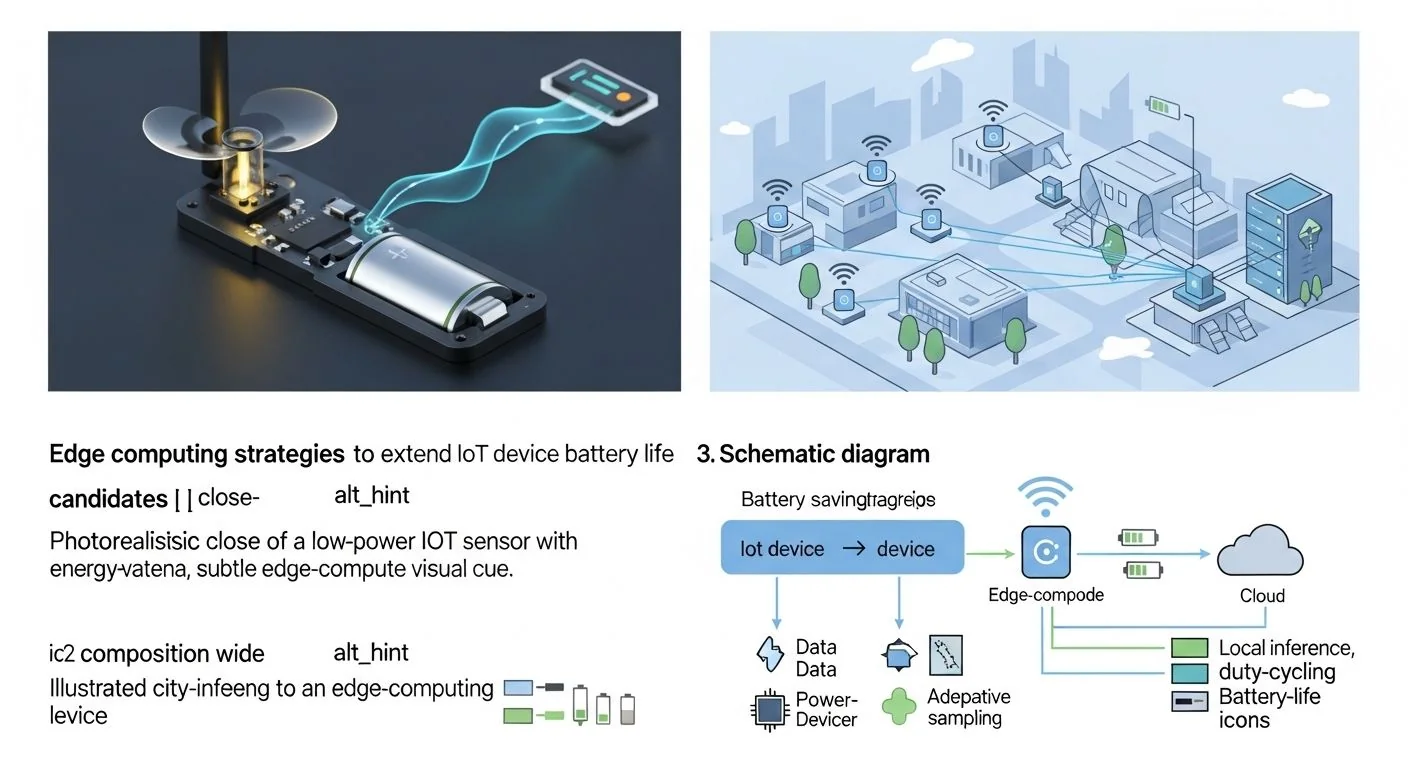
Battery-powered IoT devices fail in production when the edge processing strategy consumes more energy than the application budget allows. This article gives engineers practical, production-tested patterns for edge computing battery life optimization to push device lifetime farther using edge computing — from TinyML on Cortex‑M to energy-aware networking and sleep scheduling.
What this delivers: a compact decision framework, reproducible implementation patterns (including low-power inference and network strategies), failure diagnostics, and measurable KPIs you can apply within an incremental rollout.
Failure scenario: a deployed sensor fleet that was specified to last two years on a set of AA cells instead lasts 6–9 months. Initial investigation shows frequent wakeups for cloud inference and an always‑on TCP stack. Teams swapped batteries repeatedly without root cause analysis. This article shows how to replace those costly cloud round trips with on-device inference, push more work into duty-cycled endpoints, and obtain 3–10× improvements in energy per useful event with realistic tradeoffs.
Executive Summary
TL;DR: Move decision-making to the edge, duty‑cycle radios aggressively, and use TinyML plus optimized firmware and lightweight protocols to reduce per-event energy by multiple orders of magnitude.
- Run only the minimal model(s) required at the edge and compress them (quantize/prune) to cut inference energy by 3–20× compared to naive models.
- Prefer UDP/CoAP and LwM2M patterns with connectionless session strategies for sporadic telemetry; use MQTT session persistence only when required by QoS.
- Duty-cycle radios with synchronized or event-driven wake triggers — radios dominate battery budgets in most wide-area deployments (70–90% of energy in many profiles).
- TinyML on Cortex‑M + TF Lite Micro + CMSIS‑NN provides a practical low-latency inference path; optimize compiler flags, CMSIS kernels, and CMSIS‑DSP to get to p95 inference latencies under 10 ms for small models.
- Measure p95/p99 energy/latency and SNR of sensing pipeline; optimize for the 95th percentile operational case, not average-only.
Three one-line Q→A pairs
- Q: Is on-device inference always better for battery life? A: Not always — it depends on model cost vs. communication cost; perform an energy trade-off estimation that compares inference joules to cloud round-trip wireless joules at p95.
- Q: Which protocol is most battery-efficient? A: Connectionless UDP + CoAP with blockwise transfer or DTLS for security is generally more efficient for infrequent small messages; MQTT with persistent sessions benefits when messages are frequent and latency requirements are strict.
- Q: How much battery gain can TinyML deliver? A: Real-world gains range from 3× to 20× reduction in energy-per-event when models and inference stacks are optimized for the target MCU and sensor pipeline.
How Edge computing strategies to extend IoT device battery life Works Under the Hood
At a high level, reducing battery drain from IoT devices by using edge computing changes where work occurs and when the radio is active. The core levers are:
- Compute placement: move classification/decision logic to the MCU (TinyML) to avoid transmitting raw data.
- Radio duty-cycle: minimize radio-on time by batching, local decisioning, or by using low-power wake mechanisms.
- Protocol selection and configuration: prefer compact, stateless or lightweight session protocols (CoAP, MQTT-SN) and avoid long-lived TCP sessions when idle.
- Sensor+preprocessing optimization: do cheap filtering, thresholding, event detection in hardware or ISR to avoid unnecessary wakeups.
Architecture text diagram (logical components):
- Sensors + analog front-end — always low-power; thresholds in comparator/RTC to trigger MCU wake
- Microcontroller (Cortex‑M) — deep sleep most of the time; wakes to run minimal preprocessing, then a small TF Lite Micro model for classification
- Network stack — lightweight UDP/DTLS or MQTT-SN client, with radio turned on only for batched uplinks/ACKs
- Edge/Cloud aggregator — receives concise events or model outputs, performs heavy analytics and long-term storage
Algorithmically, the strategy balances local compute cost C_local (joules to run inference + preprocessing) against communication cost C_comm (joules to wake radio, connect, transmit, receive). The break-even condition is C_local < C_comm × expected reduction in transmissions. For repeated events, caching decisions and hysteresis can further reduce C_comm by avoiding redundant transmissions.
Implementation: Production Patterns
This section walks from basic to advanced, with code and configuration patterns tested on Cortex‑M class devices. The patterns assume you can iterate on both firmware and server behavior.
Basic pattern — sensor thresholding and batched uplinks
Start simple: keep the MCU in deep sleep and let a hardware comparator or the ADC watchdog do level detection. When an event exceeds a threshold, wake the MCU, sample, preprocess, and decide whether to transmit. Batch small events into a single uplink interval (e.g., 5–15 s) to amortize radio startup cost.
// Pseudocode: threshold-driven wake and batch
while(true) {
  enter_deep_sleep(); // RTC or comparator wakes MCU
  samples = collect_samples(duration_ms=100);
  features = preprocess(samples);
  if (meets_event_condition(features)) {
    buffer_event(features);
    if (time_since_last_tx >= TX_BATCH_INTERVAL) {
      radio_on(); send_buffered_events(); radio_off();
    }
  }
}
Intermediate pattern — TinyML inference on Cortex‑M
When raw telemetry is large or transmission costs are high (NB‑IoT, LTE‑M, satellite), push classification to the MCU. Use TensorFlow Lite Micro (TF Lite Micro) with CMSIS‑NN kernels for Cortex‑M. Quantize to int8; prune redundant neurons and use small receptive fields.
Key implementation steps:
- Train a compact model (e.g., 1–50k parameters) and export a TFLite flatbuffer.
- Apply post-training quantization (full integer) and test accuracy on the quantized model.
- Integrate TF Lite Micro into firmware and use CMSIS‑NN acceleration for convolutional layers.
- Measure inference energy and latency on-device; tune polling rates, window sizes, and thresholds.
// TF Lite Micro initialization sketch (pseudocode)
// Assumes model_data[] is the TFLite FlatBuffer
MicroInterpreter interpreter(model_data, tensor_arena, arena_size, resolver);
interpreter.AllocateTensors();
input = interpreter.input(0);
// fill input with preprocessed features
interpreter.Invoke();
output = interpreter.output(0);
if (output[0] >= DETECTION_THRESHOLD) {
  enqueue_event(output);
}
Practical tip: use a 32–64 KB tensor arena aligned and sized using live profiling. Keep arena fragmentation low; avoid dynamic allocation during runtime.
For a concrete, production-proven starting point, consult our practical guide to TinyML and Cortex‑M optimizations which covers TF Lite Micro integration and CMSIS‑NN tuning in depth.
Advanced pattern — hierarchical models and event cascades
Combine a tiny, ultralow-power detector with an on-demand larger model. Use a cascade: a comparator ISR or an 8‑bit model triggers a larger 16–32 KB model only rarely. This yields good accuracy with low average energy.
// Event cascade pseudocode
if (tiny_detector(features) == POSITIVE) {
  wake_larger_model();
  result = bigger_model.infer(features_window);
  if (result.confidence >= CONF_THRESHOLD) send_event(result);
}
Cascade benefits: run-time complexity O(k) where k is number of cascaded stages; in practice, average k ≈ 1.x for sparse events. Memory and flash tradeoffs exist: a second model increases flash but reduces radio energy significantly.
Networking: MQTT vs CoAP and power considerations
Choose network protocol based on message frequency and connection cost. For infrequent small uplinks, CoAP over UDP (RFC 7252) or MQTT‑SN are more energy-efficient than MQTT over TCP because they avoid TCP handshake and keepalive overheads. If using NB‑IoT or LTE‑M, account for long radio tail times (10s of seconds) after data transfer — batch or minimize transfer windows.
When using secure transport, DTLS session resumption or pre-shared keys (PSK) reduce handshake energy relative to full certificate-based TLS on constrained devices. For systems requiring broker semantics, consider MQTT with QoS 0 and controlled keepalive; only keep long-lived sessions when message frequency justifies the power cost.
// UDP/CoAP transmit pattern pseudocode
radio_on();
coap_msg = build_coap_message(payload);
send_udp(coap_server, coap_msg);
wait_for_ack_or_timeout();
radio_off();
For production reference architectures and protocol comparisons, see our practical guide to edge computing battery life optimization that lays out MQTT/CoAP trade-offs and examples for Cortex‑M devices.
Error handling and robustness
- On retransmit: exponential backoff with capped retries minimizes radio occupancy during network congestion.
- Store events in a circular buffer with wear-leveling if you must persist across power cycles; prefer volatile if battery replacement is cheap.
- Implement an emergency bulk upload mode that temporarily sacrifices battery life to drain buffered critical events when maintenance is scheduled.
Comparisons & Decision Framework
Use this checklist when deciding between local inference and cloud processing:
- Communication energy per transmission (C_comm): measure joules to wake, attach (if cellular), transmit, and receive a typical payload.
- Inference energy per decision (C_local): measure joules to run inference including wake costs.
- Event frequency (f): average events/hour and p95 spikes.
- Accuracy delta: degradation you accept when moving model to the edge (quantization loss).
- Latency/SLOs: whether local decision latency is required for safety or UX.
Rule-of-thumb decision: if C_local < C_comm × probability_event_transmission_saved, prefer edge inference. When event frequency is high, persistent connections and cloud-side processing can be efficient (trade to MQTT keepalives and persistent sessions).
Trade-off table (summary):
- Edge inference: lower bandwidth, lower latency, increased firmware complexity, potentially lower accuracy if model is smaller.
- Cloud inference: simpler devices, higher bandwidth and latency, higher operational cost, possible privacy concerns.
Failure Modes & Edge Cases
Common failure modes and diagnostics with mitigations:
- Excessive radio-on time: Symptom — measured throughput low but radio active long. Diagnosis — missing batching or frequent reconnections. Mitigation — batch events, increase idle timeout, use connectionless protocol.
- Model drift and false positives: Symptom — cloud-side analytics shows dip in accuracy after deployment. Diagnosis — change in sensor characteristics or environment; data distribution shift. Mitigation — enable periodic labeled uplinks, server-side retraining, and over-the-air model updates with signed artifacts.
- Memory fragmentation and crashes: Symptom — sporadic reboots after inference. Diagnosis — insufficient tensor arena, dynamic allocations in ISR. Mitigation — fix arena sizing, avoid malloc during runtime, use static buffers.
- Boot radiation spikes: Symptom — battery voltage dips on radio startup causing MCU brownout. Diagnosis — insufficient decoupling and power sequencing. Mitigation — add bulk capacitor on power rail, stagger startup, increase regulator headroom.
- Edge/cloud inconsistency: Symptom — server expects raw telemetry but device sends events only. Diagnosis — integration misalignment. Mitigation — agree on event schemas, provide optional raw sample uplink on demand, include delta-encoded diagnostics in events.
Performance & Scaling
Measure and monitor the following KPIs in the field (collect p95/p99 values):
- Energy per inference (µJ or mJ) — measure using a power profiler (e.g., Otii, Monsoon) at p50/p95/p99.
- Energy per transmission (mJ) — include radio attach/registration cost for cellular networks.
- Average current in sleep (µA) and active (mA) modes.
- Event detection latency (ms), and end-to-end time to acknowledgement (s) for critical events.
Benchmarks: typical observed ranges on Cortex‑M4/7 devices:
- Tiny detector (quantized int8, <10k params): inference energy ≈ 10–100 µJ, latency p95 < 10 ms.
- Larger on-MCU models (50–200k params): inference energy ≈ 0.5–10 mJ, latency p95 10–200 ms depending on SIMD/CMSIS acceleration.
- Wi‑Fi transmit (per short TX, including association): 50–200 mJ; NB‑IoT attach can be joules per attach depending on network.
- Radio tail time for LTE: long tail can add 5–20 seconds of elevated current → tens to hundreds of mJ added per transmission.
Target optimization goals: reduce expensive units (radio attaches/transmits) by 3–10× and inference energy by 2–5× via quantization and compiler optimization. Measure p95 and p99 to capture burst behaviors common in field deployments.
Production Best Practices
- Security: use DTLS or TLS with PSKs for constrained devices; sign model binaries for OTA updates and verify with a secure boot chain.
- Testing: maintain hardware-in-the-loop CI with representative power profiles; run long-duration soak tests with synthetic event bursts.
- Rollout: staged rollout with telemetry feature flags; enable server-side fallbacks to cloud inference for a small percent of devices initially.
- Runbooks: include runbook steps to collect power traces, firmware logs, and model versions; automate fallbacks and remote reconfiguration if battery drain exceeds expected thresholds.
- Monitoring: capture device-reported sleep/active durations, battery voltage curves, and event rates; set alerts for deviations beyond 2σ from baseline.
Further Reading & References
- TensorFlow Lite Micro documentation — https://www.tensorflow.org/lite/micro
- ARM CMSIS‑NN and Cortex‑M optimization guides — https://developer.arm.com
- RFC 7252 — Constrained Application Protocol (CoAP) — IETF
- MQTT standard and MQTT‑SN discussion papers — OASIS
- TinyML: Efficient Machine Learning on Microcontrollers (book and resources)
Appendix: Practical Code & Measurement Examples
1) Minimal low-power CoAP transmit (pseudo C using a lightweight socket API)
#include "coap_client.h"

void send_event_coap(uint8_t* payload, size_t len) {
  power_radio_enable(); // enable regulator and antenna
  coap_init();
  coap_send_blockwise(server_ip, server_port, payload, len);
  coap_cleanup();
  power_radio_disable();
}
2) Tiny cascade example with energy accounting
// energy accounting (simple counters)
uint32_t inferences = 0;
uint32_t txs = 0;
uint32_t elm_joules = 0; // measured externally per profile

void on_wakeup() {
  features = collect_and_preprocess();
  if (tiny_detector(features)) {
    inferences++;
    result = big_model_infer(features_window);
    if (result.confidence >= CONF_THRESHOLD) {
      txs++;
      send_event(result);
    }
  }
}

// After N cycles, report
report_energy_metrics(inferences, txs, elm_joules);
3) Measuring break-even point (concept)
// Given measured values
C_comm = measured_joules_per_tx;
C_local = measured_joules_per_inference;
// If expected number of avoided transmissions per inference >= C_local / C_comm -> run locally

double break_even_saved_tx = C_local / C_comm;
Practical note: include radio attach energy for cellular networks when calculating C_comm. For Wi‑Fi or LoRaWAN, measure the join/tx/tx+rx sequence energy separately.
Closing — Operational Checklist
Before you ship an edge computing battery optimization, run this checklist:
- Measure baseline p95/p99 energy for sleep, inference, and radio transmit on target hardware.
- Quantize and test a compact model on the device; ensure accuracy meets SLOs.
- Implement duty-cycling and batch uplink logic; validate radio tail costs in the field.
- Simulate worst-case event storms and verify battery meets reserve targets at p99.
- Rollout incrementally with server-side fallbacks and signed OTA model deployment capability.
For implementation reference and a deeper dive into TinyML on Cortex‑M and protocol trade-offs, consult our guide to practical optimizations for edge TinyML and MQTT/CoAP, which includes real device traces and measurement patterns used in production.
Edge optimization is engineering: measure first, change one variable at a time, and validate using p95/p99 metrics. The combination of TinyML, duty-cycling, and protocol selection is the most reliable path to extend battery life without sacrificing the product's core functionality.


