
CXL 4.0: Bandwidth Doubling, Bundled Ports & Multi-Rack Memory Fabrics
Introduction
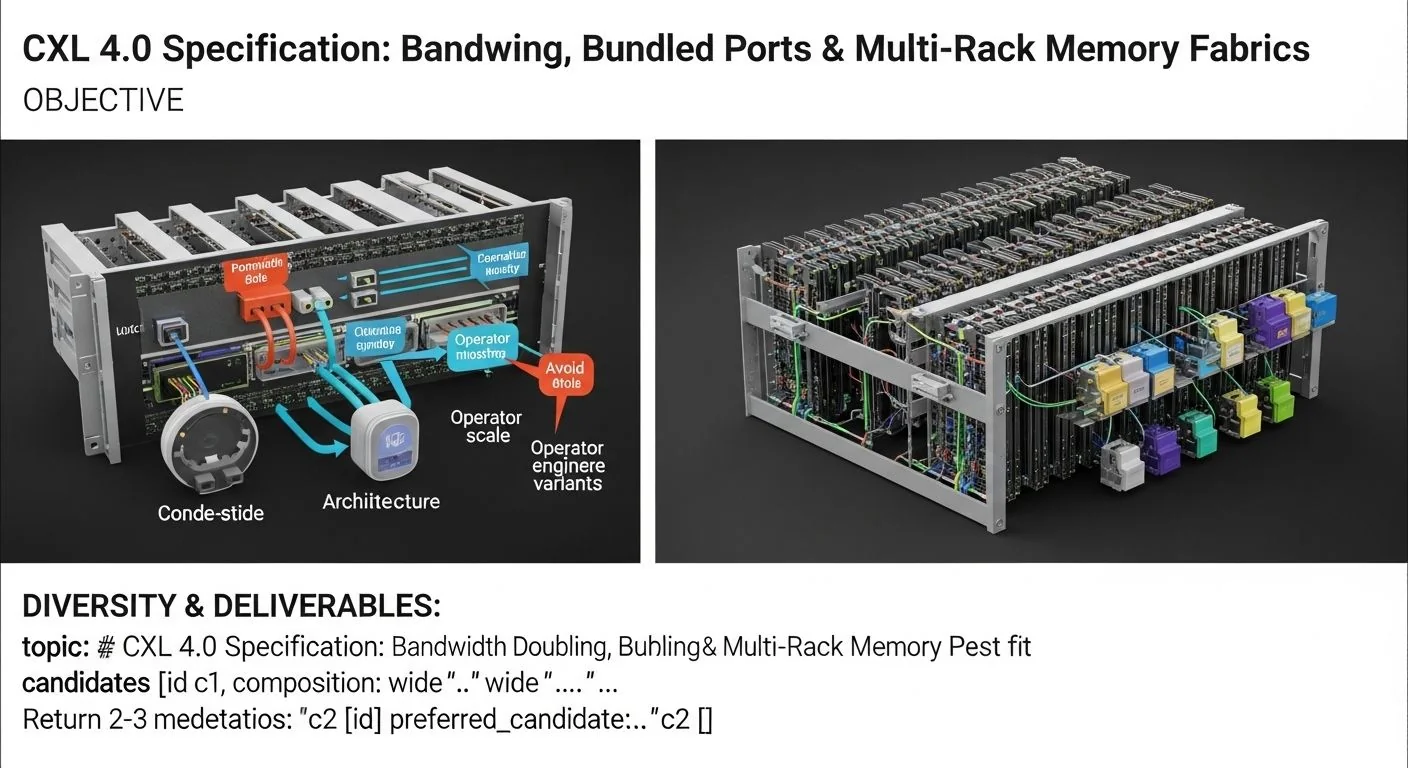
Problem statement (production-framed): Datacenter AI inference clusters are hitting two limits simultaneously — host memory capacity vs. model working set and inter-node bandwidth/latency when sharing that memory — and operators need a practical plan to adopt CXL 4.0 fabrics without breaking SLAs. For training-focused capacity and cost comparisons, see our guide to CXL 3.2 pooled memory for AI training (architecture & cost models).
What this article delivers: a pragmatic, engineering-first explanation of the CXL 4.0 spec features that matter for inference — bandwidth aggregation ("doubling"), bundled ports, and cross-rack memory fabrics — with deployment patterns, measurable failure modes, p95/p99 guidance, and a checklist for rolling CXL memory pooling into inference clusters.
Failure scenario (brief): A production inference pool is upgraded to CXL pooled memory to host large models' parameters. Without careful topology planning and monitoring, the cluster experiences unpredictable p99 latency spikes during bursty traffic: model shards page to remote memory over multiple switch hops, saturating bundled links and causing tail-latency violations. The business impact: dropped requests and degraded SLOs until the team rebalanced traffic and applied QoS to fabric paths.
Executive Summary
TL;DR: CXL 4.0 brings link-aggregation primitives (bundled ports) and formal multi-rack fabric topologies that approximately double aggregate bandwidth compared to prior CXL generations under ideal conditions — but real-world gains depend on topology, switch ASICs, and workload locality; plan for p95/p99 tail-latency management and incremental rollout.
- Key takeaway 1: Bundled ports aggregate physical links to raise aggregate throughput and improve failover; expect near-2x aggregate bandwidth in single-hop, balanced configurations.
- Key takeaway 2: Multi-rack memory fabrics enable pooled memory across racks but add variable latency depending on hop count and switch buffering — mitigate with topology-aware allocation and QoS.
- Key takeaway 3: For inference, CXL pooled memory can be used for oversized models if you control working-set placement; measure p95/p99 before presuming remote-memory parity with local DRAM.
- Key takeaway 4: Validation requires microbenchmarks (read/write latency, tail-latency under contention), fabric monitoring (per-port, flow telemetry) and a staged rollout checklist we provide.
- Key takeaway 5: Failure modes are predictable: link imbalance, congested egress ports in bonded groups, firmware mismatches, and topology mismatches. Instrument and automate remediation.
Three likely one-line Q→A pairs
- Q: How much bandwidth improvement does CXL 4.0 deliver? A: In balanced, single-hop setups, bundled ports can provide near-2x aggregate bandwidth compared with an individual prior-generation port; real gains depend on switch and host implementation.
- Q: How much latency does CXL memory pooling add to AI inference? A: Expect microsecond-class extra latency: single-hop remote memory commonly adds a few hundred nanoseconds to several microseconds depending on link speed and OS stacks; multi-hop fabric accesses can push p99 into multiple microseconds — measure per topology.
- Q: Is CXL pooled memory ready for production inference? A: Yes, if you design for locality, instrument tail-latency, and use topology-aware allocation and QoS; it's not a drop-in DRAM replacement for strict sub-microsecond SLOs without validation.
How CXL 4.0 Specification: Bandwidth Doubling, Bundled Ports & Multi-Rack Memory Fabrics Works Under the Hood
At a high level, CXL 4.0 extends the compute-to-device fabric model in two important ways relevant for inference:
- Link aggregation and bundled ports — the spec formalizes mechanisms to group multiple physical CXL/PCIe links into a logical fabric port. This supports higher aggregate throughput, path redundancy, and load-balancing across lanes at the protocol layer rather than relying solely on PCIe lane bonding in hardware. In practice this means a host can see an aggregated endpoint reachable over several physical links, with the fabric and endpoints coordinating ordering and flow control.
- Multi-rack memory fabrics — CXL 4.0 standardizes fabric topologies and routing behaviors across multiple switches and racks to enable coherent memory pooling at datacenter scale. Routing, address discovery, and authorization mechanisms allow hosts to allocate memory regions that map to devices in other racks while preserving CXL coherence semantics where supported.
Architectural components and behaviors (textual diagram):
- Host CPU complex with CXL Root Ports -> physical CXL links -> Top-of-Rack (ToR) or rack fabric switch supporting CXL-aware routing.
- Bundled port grouping across multiple physical uplinks from the host to the switch (or across multiple host ports into a logical endpoint when used device-side).
- Fabric control plane (CXL manager + control-plane orchestration) that handles AD (address discovery), device enumeration, access control lists, and per-flow QoS shaping.
- Memory targets (cxl.mem devices) attached to switches or host-attached devices that register with the fabric and expose regions that hosts can map as remote memory or device memory.
Protocol-level notes:
- Flow control uses credit-based mechanisms extended to aggregated paths to avoid head-of-line blocking. Implementations typically use per-lane credits aggregated under a virtual link context managed by the CXL fabric logic.
- Ordering is preserved by the fabric with sequence numbers or virtual channels where needed; bundled-port implementations choose deterministic hashing or per-flow assignment to lanes to keep ordering and avoid reordering penalties.
- Topology awareness is crucial: the fabric control plane includes discovery so allocation decisions can be made with hop counts, link utilization, and path QoS in mind.
Implementation: Production Patterns
I'll walk through patterns from basic to advanced, then error handling and finally optimization. Each pattern assumes Linux hosts with CXL-capable NICs/switches and the standard kernel cxl/cxl_mem drivers.
Basic: Single-rack pooled memory with bundled host uplink
- Verify hardware: CPU root ports, ToR or fabric switch, and memory targets all list CXL 4.0 capability in firmware release notes and vendor docs.
- Connect two physical uplinks from host root port to fabric switch and configure them as a bundled logical link. The exact commands are vendor-specific; on many platforms this happens at the switch via a logical port channel or MLAG-like configuration with the CXL manager coordinating the grouping.
- On the host, ensure the kernel detects the cxl device: dmesg should show cxl and cxl_mem enumeration. Use /sys/bus/cxl/devices/ to inspect memory-region capability.
- Allocate remote pages with devdax/persistent/mmap depending on your OS and workload. For inference, map large read-mostly parameters into remote memory but keep hot working sets local.
Advanced: Multi-rack pooling with topology-aware allocator
- Deploy a CXL management plane (controller) that maintains fabric topology and health (link utilization, per-port errors).
- Implement a topology-aware allocator: prefer zero-hop or single-switch targets for the hot shard; allocate cold or infrequent pages across further racks in a capacity tier.
- Use software that supports NUMA-like hints for CXL memory (some libraries expose placement hints; otherwise implement a local allocator in runtime that prefetches or pins hot pages to local DRAM).
- Apply flow-level QoS on fabric switches to prioritize small, latency-sensitive flows for inference over large background transfers (model checkpointing, large remote writes).
Error handling patterns
- Detect link flaps in the management plane and automatically failover from a failed physical link in a bundle to remaining links — ensure host drivers support online failover without tearing down mappings.
- When a target becomes unreachable, do a graceful demotion of memory regions: unmap and remap to alternative targets with a prioritized list stored in allocation metadata; if remapping fails, fall back to local paging or model sharding.
- Automate alerts for CRC or flow control credit exhaustion on bundled ports — these are early indicators that aggregate link capacity is being exceeded or balancing is poor.
Optimization recipes
- Use per-flow lane assignment (if available) within the bundle to reduce reordering; prefer deterministic hashing keyed by traffic class or PID to keep inference flows on single lanes.
- Co-locate inference workers with local DRAM caches and use read-prefetchers that pull hot segments into local memory during low load windows.
- Measure and tune buffer sizes on switches to avoid microburst-induced drops that disproportionately affect small, latency-sensitive inference packets.
Practical code & runbook snippets
Example: a small shell-driven microbenchmark to measure one-way read latency to a CXL memory region (user-space rdtsc-based sampler). This is a diagnostic, not a production harness.
#!/bin/bash
# cxl-latency.sh - simple read latency microbenchmark
# Requires: /sys/bus/cxl/devices/.../regionX mapped at /dev/cxl_regionX
REGION=/dev/cxl_region0
TEST_OFF=0
COUNT=100000
# use dd to read individual 8-byte words (slow but illustrative)
for i in $(seq 1 $COUNT); do
  # read 8 bytes at offset (not efficient but measures syscall+driver path)
  TIME_START=$(/dev/null
  TIME_END=$(max) max=$1; a[NR]=$1} END {print "avg="sum/NR" us max="max}'
Better: use rdtscp and a bespoke user-space test that mmap()s the devdax region and issues loads from a tight loop to measure raw memory read latency without syscall overhead.
Comparisons & Decision Framework
Decision axis: latency sensitivity, working-set locality, capacity needs, operational complexity.
- Low-latency SLOs (sub-millisecond p99): Prefer local DRAM for hot working sets. Use CXL pooled memory only for cold parameters or model shards with aggressive prefetching.
- Capacity-first (large models, relaxed tail-latency): Use multi-rack pooling with bundling to maximize aggregate capacity; accept higher p99 and trade off with autoscale and request queuing.
- Hybrid: Keep inference kernels local; use remote CXL memory for embeddings, sparse tables, and large less-active parameter stores. Use topology-aware allocator and QoS.
Checklist: Choosing between local DRAM, CXL pooled memory, or NVMe-like tiers
- Measure the hot set size and access frequency (p50/p95/p99) over representative traffic.
- If hot set fits in local DRAM, keep it local. If not, quantify how much remote memory is needed and the expected remote-access rate.
- Estimate acceptable p99 tail using business SLOs; if remote accesses push p99 over SLO, implement caching/pinning or reject pooled memory for those pieces.
- Ensure your fabric supports bundled ports and multi-rack routing; confirm vendor interoperability with CXL 4.0 profiles.
Failure Modes & Edge Cases
Concrete diagnostics and mitigations:
- Link imbalance in a bundle (symptom): One physical link in the bundle shows 95% utilization while others are low; aggregate bandwidth lower than expected. Diagnosis: per-lane hashing or flow steering not balanced. Mitigation: change hashing keys, move hot flows to dedicated lanes, or enable per-flow lane assignment if the fabric supports it.
- Credit exhaustion and head-of-line blocking (symptom): Sudden tail latency spikes under microbursts. Diagnosis: fabric flow-control credits are exhausted; packets are buffered or dropped causing retransmit-like behavior. Mitigation: increase buffer credits, enable QoS, spread traffic across multiple bundles.
- Topology mismatch (symptom): Some hosts can see certain memory targets and others cannot. Diagnosis: AD/enumeration mismatches or inconsistent control-plane state. Mitigation: reconcile fabric manager database, force re-enumeration, and validate firmware alignment.
- Remote target firmware bug (symptom): device resets or stale pages during heavy writes. Diagnosis: vendor firmware incompatibilities. Mitigation: pin down firmware versions, run vendor-supplied compatibility tests, and keep a rollback plan.
Performance & Scaling
Benchmarks and practical p95/p99 guidance require you to measure in your topology. Below are realistic baseline expectations and recommended KPIs to track.
Baseline expectations (typical ranges — validate)
- Local DRAM read latency (single-socket, DDRx): ~50–120 ns (platform dependent).
- Single-hop CXL remote memory read (modern PCIe/CXL link at high speed, minimal software overhead): low hundreds of nanoseconds to low microseconds (e.g., ~300ns–3µs). Expect variability based on link speed, switch ASIC, and host driver.
- Multi-hop or inter-rack CXL remote memory read (with 1–2 switch hops and congestion): single-digit microseconds commonly; tail can reach 10s of microseconds under contention or retransmission-like events.
- Aggregate bandwidth improvement with bundled ports: near-2x theoretical in balanced conditions; real-world typically 1.6–1.95x depending on steering efficiency and per-lane serialization overhead.
Monitoring KPIs (must-have):
- Per-link utilization and per-lane error counters (CRC, symbol errors).
- Fabric queue depths and flow control credit usage.
- p50/p95/p99 response times for representative inference RPCs with correlation to fabric metrics.
- Remote memory page fault rates and remapping counts.
Scaling guidance
- Scale in: keep hot data local; scale out: use topology-aware allocator to avoid adding remote hops for latency-sensitive shards.
- When scaling beyond single rack, add a hierarchical allocator that prefers local, then same-rack, then multi-rack targets. Maintain a capacity headroom of ~30–40% on bundled aggregated bandwidth for burst tolerance.
- Design for graceful degradation: if fabric saturation occurs, have a policy to reduce model parallelism or fall back to smaller replicas to preserve p99.
Production Best Practices
Security, testing, rollout, and runbooks:
- Security: enforce least privilege on fabric control plane APIs; use mutual authentication between hosts and management plane; encrypt control-plane traffic. For data-plane confidentiality, if your fabric passes unencrypted memory traffic, use higher-layer encryption for sensitive model weights if needed.
- Testing: build a staged test harness: lab (single rack) → pilot (subset of pods) → canary (low-SLO traffic) → ramp. Run stress tests mimicking peak QPS and microbursts and measure p99 stability for 24–72 hours before full rollout.
- Rollout runbook (high level):
- Preflight: firmware, drivers, topology discovery and capacity verification.
- Enable CXL pooled memory on a small set of inference hosts; map cold shards only.
- Observe KPIs for 48–72 hours; validate no p99 regressions and monitor link error counters.
- Progressively increase allocation of pooled memory and widen deployment if stable.
Further Reading & References
- CXL Consortium — CXL specification repository and technical notes (vendor and group implementation papers).
- PCI-SIG documentation on PCIe link aggregation and PCIe/CCIX interop notes.
- Linux kernel documentation: cxl, cxl_mem drivers and devdax mappings (kernel.org).
- Vendor implementation notes (Mellanox/Netronome/AMD/Intel whitepapers) on switch-level QoS and bonded ports for coherent fabrics.
- For an architecture- and cost-oriented view of pooled memory in training workloads, see our analysis of CXL 3.2 pooled-memory architecture and cost models for AI training — it’s useful background when comparing training vs inference placement strategies.
- Operational guidance and case studies from early adopters published on vendor blogs and conference proceedings (USENIX/HotCloud/SC).
Additional contextual analysis: if your workloads are training-heavy and you’re deciding between versions, review our guide to CXL 3.2 pooled memory for training for explicit cost trade-offs that also inform inference deployment choices.
Finally, a short, focused deployment checklist for inference clusters that you can paste into your runbook:
- Inventory: list hosts, root-port firmware, switch firmware, and memory target firmware; verify CXL 4.0 capability.
- Topology map: produce a fabric graph (hosts, links, switches) and annotate hop counts and per-link bandwidth.
- Capacity planning: estimate remote memory needs and leave 30–40% headroom on aggregated bundles.
- Allocator policy: implement locality-first placement and a fallback strategy for remapping under failure.
- QoS plan: reserve low-latency lanes/flows for inference RPCs; rate-limit background transfers.
- Monitoring: enable per-port telemetry, flow control metrics, and p99 tracing integrated into your APM tools.
- Testing: run microbenchmarks (latency + tail under contention) and full-stack inference load tests during pilot.
- Rollback plan: have node-scope rollback steps (unmap CXL regions, pin replicas local) and orchestration playbooks ready.
Closing notes from the MAKB editorial desk
CXL 4.0 is a meaningful step: bundled ports and multi-rack fabrics unlock higher aggregate bandwidth and larger pooled capacities. The practical value for inference depends on how you architect locality, QoS, and failure handling. The specification gives you new tools, but they’re not automatic speedups — they require topology-sensitive software, instrumentation, and conservative rollout. Use the diagnostic patterns above to validate p95/p99 under realistic loads; treat CXL pooled memory as a new resource tier with its own SLOs.
If you’re deploying for AI inference today, prioritize a staged adoption: start with cold/large-parameter placement, instrument aggressively, and iterate on allocator heuristics. For more on pooled memory economics — specifically the training-side trade-offs that inform capacity and cost decisions — see our architecture and cost model write-up for CXL 3.2 pooled memory.
MAKB — Lead Editor & Principal Author. Practical, evidence-led engineering for infrastructure growth.


