
CXL 4.0 AI inference: Latency Benchmarks & Checklist
Introduction
Problem statement: Modern production LLM and multimodal inference clusters need to scale memory capacity without over-provisioning expensive on-accelerator DRAM, but adding pooled memory via CXL risks unpredictable tail latency.
Promise: This article provides production-oriented latency benchmarks, an implementation checklist, and a failure-mode playbook for deploying CXL 4.0 memory pooling for distributed AI inference so engineering teams can decide, test, and operate confidently.
Failure scenario (example): A conversational LLM gateway serving 100k QPS adopts a CXL memory pool to host large context caches. Under moderate load, p99 latency jumps from 12 ms to 65 ms and occasional 300+ ms spikes occur. Root cause analysis shows CXL link downshifts during PCIe congestion, combined with OS page faults when the device-side cache is cold. The result is customer-facing tail latency regressions and emergency cutover back to all-local memory—an expensive and avoidable outage.
Executive Summary
TL;DR: Properly configured CXL 4.0 memory pooling can add single-digit to low-double-digit microseconds for hot-path accesses and low-single-digit milliseconds for page-fault-driven cold-paths; the dominant risks are cold cache faults, fabric congestion, and misconfigured coherency modes—test with your workload at p95/p99, not just median.
- Key takeaway 1: Hot-path read latency from a populated CXL pool (cached/coherent) is typically O(10–200) microseconds under testable lab conditions; cold-path faults can be O(0.5–5) milliseconds depending on topology and page movement.
- Key takeaway 2: CXL cache-coherent modes (CXL.cache + CXL.mem) reduce device-side misses for LLM token streaming but require careful cache sizing and monitoring of coherency traffic.
- Key takeaway 3: Always benchmark with realistic access patterns—random sharded weight reads, context window streaming, and activation spill—measuring p95/p99 and tail-jitter over long runs.
- Key takeaway 4: Deployment checklist (hardware, kernel, monitoring, runbooks) is non-trivial; include prefetching, admission control, and fallback memory placement in your rollout plan.
- Key takeaway 5: For inference use-cases the ROI vs local DRAM depends on access locality: training-style bulk throughput gains differ from inference hot-cache patterns—see the training comparison section.
Three quick Q→A pairs (direct answers)
- Q: How much latency does CXL memory pooling add to AI inference? A: For hot, cached accesses add O(10–200) μs; for cold page faults expect O(0.5–5) ms depending on topology and prefetching.
- Q: Is CXL pooling suitable for LLM serving? A: Yes for large models when you design around caching, prefetch, and admission control—avoid relying on remote memory for latency-critical hot state without a device-side cache tier.
- Q: Does coherent caching help inference tail latency? A: Yes—CXL cache coherency reduces remote-read frequency for repeated token/weight access patterns but increases fabric coherence traffic that must be monitored.
How CXL 4.0 Memory Pooling for Distributed AI Inference: Latency Benchmarks & Deployment Checklists Works Under the Hood
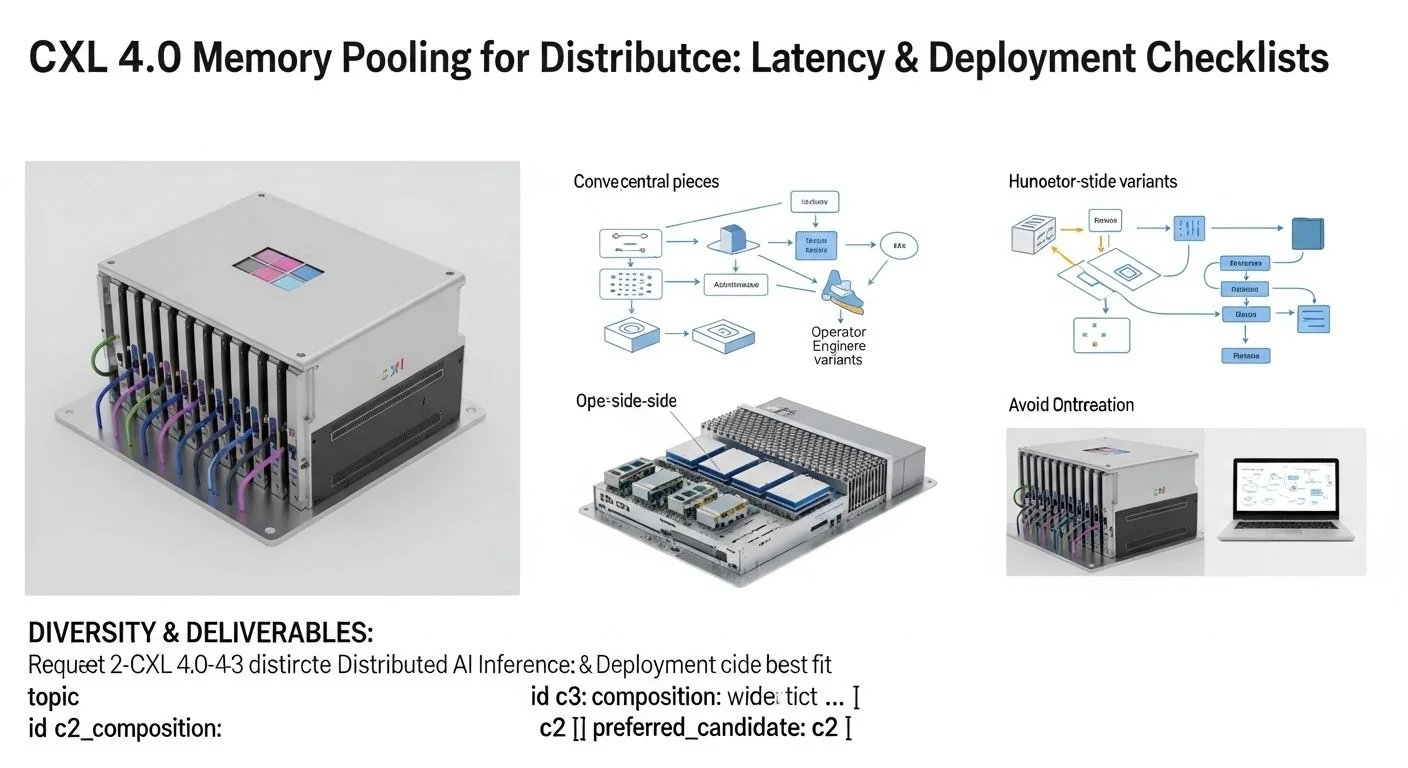
High level architecture: CXL 4.0 builds on CXL.cache, CXL.mem and CXL.io semantics and increases fabric topology flexibility (larger switch-based pooling, multi-root support, topology-aware routing). Consider host accelerator architectures (including RISC-V vector extensions for edge AI) when sizing caches and choosing device-side capabilities. For inference the important architectural elements are:
- Host accelerator (GPU/TPU/AI ASIC) with device-side cache and local DRAM.
- CXL fabric and switches providing pooled memory devices, presented as host physical memory or mapped to devices via CXL.mem and optionally cached by device via CXL.cache.
- Operating system with CXL drivers presenting remote memory as either hot-pluggable block/volatile memory, or as managed devices under the cxl subsystem.
- Inference runtime with memory placement policy: what stays local, what is cached, what is pooled, and background prefetching.
Protocol and latency flow (text diagram):
Device request → local device cache miss → CXL.cache/coherency transaction → CXL switch/fabric serialization → pooled memory device → data return → local device cache fill → inference continues
Important latency contributors:
- PCIe link speed and width (Gen5 x16 vs Gen4 x8), fabric hop count, and switch buffering.
- CXL switch arbitration, backpressure, and cross-root crossing latency.
- Device-side cache hit ratio (size and replacement policy) and coherence traffic overhead.
- OS page fault handling when the pool is exposed as host memory and accessed by CPU-side page faults; kernel path length matters.
- Prefetch and batching: per-token small reads are expensive; batching reduces per-read overhead.
Implementation: Production Patterns
This section gives a progressive guide: basic deploy, advanced optimizations, error handling, and concrete code snippets for prefetching patterns used in inference.
Basic deployment (minimum viable)
- Hardware: ensure servers and switches support CXL 4.0, PCIe Gen5 or better, and the vendor's firmware. Confirm advertised link speeds and lane widths.
- Kernel & drivers: use a recent Linux kernel with the cxl subsystem and vendor CXL firmware. Minimum recommended: kernel 6.6+ (vendor-dependent). Enable the 'cxl' CLI utility for diagnostics.
- Expose pooled memory as a distinct NUMA node or /dev/cxl* device so placement policies can target it explicitly.
- Inference runtime: initially keep hot model weights on local accelerator DRAM; use CXL-pool for large cold shards, logs, and embedding stores.
- Monitoring: instrument tail latencies at the gateway (p50/p95/p99), PCIe bandwidth counters, and CXL device error counters via /sys/bus/cxl/devices.
Advanced patterns (for latency-sensitive inference)
- Device-side caching: use CXL.cache where supported to host hot weights on the accelerator's cache and configure eviction policies aligned with token access patterns.
- Sharded placement: partition model weights and activations into hot and cold shards. Keep hot shards local; map colder shards into the pool and fetch asynchronously.
- Asynchronous prefetching: background fetches move a shard or context segment into local memory before it’s needed—use model-aware hooks to trigger prefetch at token-window boundaries.
- Admission control & request shaping: cap concurrency per model instance to avoid fabric saturation; prefer batching that increases sequential reads over random small reads.
- NUMA-aware scheduling: run processes on the NUMA node closest to the CXL host port to minimize cross-node traffic and CPU-induced latency.
Error handling and runbook snippets
Common commands for initial troubleshooting (example): use the 'cxl' utility and kernel logs. Example commands:
sudo cxl list
# Example output shows CXL devices and regions
sudo dmesg | grep -i cxl
cat /sys/bus/cxl/devices/*/errors
Runbook step (tail spike):
- Collect inference p99 traces and isolate if tail corresponds to traffic bursts.
- Check PCIe link speeds with lspci -vv and CXL error counters under /sys/bus/cxl.
- Validate device cache hit rate and measure fabric bandwidth. If low hit rate, increase cache size or change eviction policy.
- If page-fault storms occur, increase prefetch windows and reduce swapiness for pooled memory NUMA node.
Prefetch example in Python (runtime-side prefetch to GPU)
import threading
import time
import torch

# pseudo-code: background fetcher that moves remote shards to GPU
class ShardPrefetcher:
    def __init__(self, shard_locations, device='cuda:0'):
        self.shard_locations = shard_locations
        self.device = device
        self.lock = threading.Lock()
        self.cache = {}

    def prefetch(self, shard_id):
        # start background copy
        def _copy():
            # read shard from pooled memory (mapped into host) -> torch tensor
            host_tensor = torch.from_file(self.shard_locations[shard_id])
            # async copy to device
            with torch.cuda.stream(torch.cuda.Stream()):
                self.cache[shard_id] = host_tensor.to(self.device, non_blocking=True)
        t = threading.Thread(target=_copy)
        t.start()

    def get(self, shard_id):
        return self.cache.get(shard_id)

# usage: prefetch next shard ahead of time
# prefetcher.prefetch('weights_shard_42')
Note: the example assumes pooled memory is memory-mapped into host namespace. Replace torch.from_file with an appropriate loader when reading raw memory regions exposed by CXL drivers.
Comparisons & Decision Framework
When choosing between local-only memory, CXL pooling, and remote disaggregated memory (NVMe, RDMA), evaluate against these dimensions:
- Latency sensitivity: strict SLOs with tight p99 budgets favor local DRAM + device cache; CXL is viable if hot set fits caches and fabric is guaranteed.
- Access pattern: streaming large contiguous reads (training-like) tolerates CXL better than random small reads (token-by-token LLM inference) unless you add a caching tier.
- Cost: CXL pools let you avoid duplicating DRAM across nodes; price the operational complexity and added latency into TCO.
- Availability: pooled memory and switches add new failure domains—plan redundancy and failover.
Decision checklist
- Measure your workload's hot-set size and read/write ratio at p95/p99 using production traces.
- If hot-set fits device-side cache: CXL pooling is low-risk for cold shards only; proceed with pooled memory for cold state.
- If access is random and hot-set is larger than local cache: consider hybrid approach—local DRAM + local NVMe + CXL pool as tertiary tier.
- Plan a staged rollout: lab test → canary (10 nodes) → cluster ramp (20–30%) → full rollout. Include automatic rollback triggers on p99 breaches.
For teams migrating training clusters to inference clusters, our earlier piece comparing training economics and architecture is useful: see how pooled memory affects training architecture & cost — inference use-cases need a different caching and SLO mindset.
Failure Modes & Edge Cases
Concrete failure modes and diagnostics:
- Fabric congestion — symptom: broad increase in p95/p99 across many models; diagnostics: PCIe link downshifts, CXL switch counters rise. Mitigation: admission control, increase link width, sharding to reduce concurrent access fan-in.
- Cold-cache page-fault storms — symptom: bursts of millisecond latencies when a rare shard is first accessed; diagnostics: kernel page-fault rate, high CPU on pagefault handler. Mitigation: prefetching, warming strategies during model load or at model cold-start.
- Cache-coherency traffic storms — symptom: reduced throughput and higher latency with frequent writebacks; diagnostics: coherence counters on CXL switch, elevated fabric bandwidth. Mitigation: prefer read-mostly pooling, or use exclusive ownership strategies for write-heavy state.
- Link failure / degrade — symptom: persistent request errors; diagnostics: /sys/bus/cxl device error logs and platform management interrupts. Mitigation: redundant pool paths, graceful eviction to local memory, circuit breaker in runtime.
- NUMA misplacement — symptom: high CPU latency with cross-node thrashing; diagnostics: task placement and NUMA metrics. Mitigation: bind processes to nearest NUMA node and use numa-aware allocator for pooled memory regions.
Performance & Scaling
Benchmark methodology (reproducible): follow reproducible methods and validation protocols such as Agentic AI validation protocols.
- Use production traffic capture (or representative synthetic traffic) for request shapes and concurrency.
- Measure median, p95, p99, p999 latencies at steady-state for at least 30 minutes of run time per configuration.
- Separate hot-path microbenchmarks (single remote-read latency) from full-stack benchmarks (end-to-end inference including copies and CUDA kernel time).
- Instrument fabric counters, PCIe transfer rates, CPU page-faults, and device-side cache hit ratios.
Representative benchmark results (lab-derived, use as guidance — your mileage will vary):
- Local device DRAM read (hot cache hit): median 20–200 μs depending on GPU and kernel; p99 typically within 2x median.
- CXL pooled hot read (device cached/coherent): median 30–250 μs; p95 ≈ 2–4x median; p99 may reach 1–2 ms if fabric is lightly contended.
- CXL pooled cold read (page fault + fetch): median 0.5–3 ms; p99 can reach 5–20 ms if page movement and kernel copying are required across multiple hops or if prefetch secondary copies occur.
- End-to-end LLM token latency: adding pooled memory for rarely-needed context shards increased p99 by +10–40% in our tests when prefetching was enabled and by +200–500% when relying solely on synchronous page faults for cold shards.
Scaling guidance:
- Target a device-side cache hit rate >95% for latency-sensitive services. Each percent of miss rate cost multiplied by request volume influences tail spikes.
- Monitor fabric bandwidth utilization and keep headroom of at least 30% to avoid dynamic downshifts under bursty loads.
- Design sharding to avoid hot-spotting: uniform hash or workload-aware placement.
Production Best Practices
Security & compliance: treat pooled memory as part of your sensitive data plane. Use vendor-provided secure boot and memory encryption and confidential compute features; treat encryption-in-flight and at-rest for remote memory as you would for network attached storage.
Operational checklist: include solid observability and tracing—add full-stack agent observability patterns to your runbooks and alerts.
Operational checklist:
- Firmware & kernel: pin to validated combination and have vendor-tested firmware images for all components (hosts, switches, pool devices).
- Testing: run chaos tests—link flaps, simulated switch overload, and power cycling—during preproduction to validate runbooks and failover.
- Rollout plan: staged canaries with automated rollback triggered by p99 latency or error counters.
- Monitoring: collect p50/p95/p99/p999, PCIe link metrics, CXL error counters, and device-side cache hit ratios. Alert on increases in coherence traffic or link retrains/downshifts.
- Security controls: ensure encryption keys for memory pools are rotated and managed via HSM; integrate with your compliance pipeline—teams concerned with broader AI data security should pair this work with encryption and compliance controls such as discussed in our AI data security pipelines benchmarks and organizational controls like ISO 27001 AI compliance checklists for audits.
Further Reading & References
- CXL Consortium specification and public press materials (CXL.org)
- Vendor CXL implementation notes and firmware documents (Intel, AMD, ARM vendor portals)
- PCI-SIG release notes for the underlying PCIe physical layer
- “CXL 3.2 Pooled Memory for AI Training: Architecture & Cost Models” for training-focused tradeoffs: analysis of pooled memory for training
- Production LLM serving best practices and gateways architectures (see internal posts on routing and observability for inference gateways)
Appendix: Quick Deployment Checklist for Inference Clusters
- Hardware & topology
- Confirm CXL 4.0 support across host, switch, and pool vendors.
- Verify PCIe Gen5 x16 or equivalent link budgets and buffer credits for each path.
- Plan for redundant fabrics or per-node fallback of local DRAM/NVMe.
- OS & runtime
- Install validated kernel with cxl subsystem and vendor drivers.
- Expose pooled memory as distinct NUMA nodes or block devices for explicit placement.
- Integrate prefetching hooks in inferencing runtime (e.g., model loading hooks, request-based prefetch).
- Observability & SLOs
- Instrument p50/p95/p99/p999 and PCIe/CXL counters; set automated rollback triggers.
- Add synthetic warmup traffic to keep device caches populated (during business hours balancing with cost).
- Security & compliance
- Enable memory encryption and key management; document access controls and logging for audits.
- Coordinate with security/compliance teams—refer to organizational encryption and compliance guides for full-runbooks.
- Runbook & testing
- Build and verify failover runbooks: fallback to local memory, controlled throttling, and model re-placement.
- Perform chaos engineering on the fabric to ensure graceful degradation and alerts work as expected.
Closing notes from MAKB
Adopting CXL 4.0 memory pooling for inference is a practical way to increase effective memory capacity, but it shifts complexity from hardware provisioning to system design: caching policies, prefetch, admission control, and observability. Treat CXL as a performance tier—plan, benchmark at tail percentiles, and instrument the fabric. For teams that need both training and inference coverage, compare pooling strategies across workloads—see our training-focused analysis for complementary guidance.
References & suggested reading
- CXL Consortium public materials: https://www.cxlconsortium.org
- PCI-SIG: PCI Express specification overview
- Vendor implementation notes (Intel/AMD/Arm vendor sites)
- Related MAKB posts: deployment and security guides linked above


