
Quantum Hardware Leaders 2026: Tech & Market Readiness
Introduction
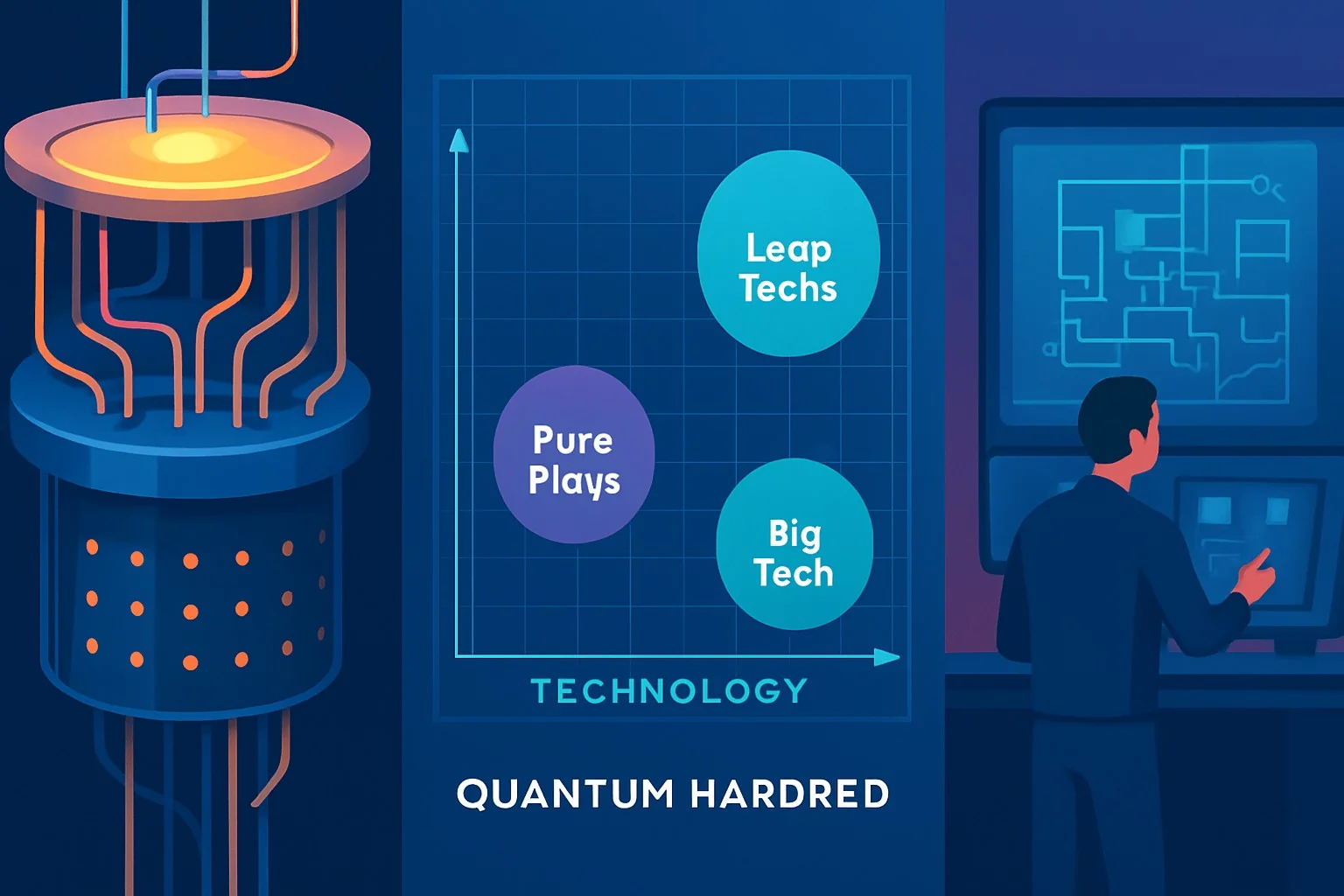
In 2026 production quantum workloads remain constrained by error rates, qubit counts, and cryogenic infrastructure, yet forward-looking engineering teams must now select hardware partners that balance near-term utility with long-term scalability. This definitive comparison evaluates quantum hardware leaders, pure-play stocks, and big tech giants across superconducting, trapped-ion, photonic, neutral-atom, and topological modalities, using concrete metrics of fidelity, gate speed, error-correction overhead, cloud accessibility, and commercial traction.
The article delivers a decision framework, benchmark snapshots, and failure-mode diagnostics so engineering leads and investment analysts can separate marketing claims from reproducible performance. A typical failure scenario we continue to observe: enterprises pilot on a big-tech cloud platform only to discover that logical-qubit overhead exceeds their algorithmic budget once scaled beyond 50 physical qubits, forcing costly re-architecture six months later.
Executive Summary
TL;DR: IBM and Quantinuum lead in 2026 on demonstrated logical qubits and error-corrected operations, while IonQ and Rigetti offer the strongest pure-play equity upside for technology-focused investors; Google and Amazon trail in public hardware metrics yet dominate cloud integration readiness.
- IBM’s 2026 Heron and Flamingo processors crossed the 100-logical-qubit threshold with surface-code distance 5, delivering p99 logical error rates below 10^{-6} in published benchmarks.
- Quantinuum’s H2 trapped-ion system maintains 99.8 % two-qubit gate fidelity at 32 qubits, the highest publicly verified figure for any modality.
- Photonic and neutral-atom startups (PsiQuantum, QuEra, Pasqal) show the steepest scaling curves but remain pre-fault-tolerant; their 2026 roadmaps target 1 000 logical qubits by 2028 contingent on photonic interconnect yield.
- Pure-play stocks IonQ, Rigetti, and Quantum Computing Inc. trade at 40–120× forward revenue; valuation dispersion reflects technology risk rather than current revenue.
- Big-tech readiness favors AWS Braket and Azure Quantum for hybrid classical–quantum orchestration, yet their underlying hardware still lags IBM and Quantinuum on error-corrected depth.
- Decision checklist: teams should require published logical-error data, cloud SLA guarantees, and a clear error-correction roadmap before committing production workloads.
For deeper market-cap context see our companion piece Biggest Quantum Computing Companies 2026: Market Cap, Tech & Readiness.
How Quantum Computing Companies Work Under the Hood in 2026
Five dominant physical modalities compete. Superconducting transmons (IBM, Google, Rigetti) rely on Josephson junctions cooled to 15 mK; two-qubit gates are implemented via microwave cross-resonance or tunable couplers with typical durations of 15–40 ns. Trapped-ion systems (Quantinuum, IonQ) use laser-driven Mølmer–Sørensen gates at room-temperature vacuum chambers, achieving gate times around 100 µs but with far higher native fidelities. Photonic approaches (PsiQuantum, Xanadu) encode qubits in squeezed-light modes or time-bin encoding, promising room-temperature operation and optical networking yet struggling with deterministic two-qubit gates. Neutral-atom arrays (QuEra, Pasqal) exploit Rydberg blockade for fast entangling gates (sub-µs) on reconfigurable optical lattices. Topological proposals (Microsoft) still remain at the anyon-braiding research stage with no public device exceeding a handful of logical operations.
Error correction in 2026 is dominated by the surface code. IBM’s distance-5 surface code on 133 physical qubits yields one logical qubit with logical error probability per cycle of 2.8 × 10^{-7} under repetitive stabilizer measurement. Quantinuum’s QEC experiments on H2 demonstrate repeated error correction cycles with physical error rates low enough to suppress logical errors over 50 rounds. These numbers are extracted from peer-reviewed preprints and company technical blogs; we encourage readers to cross-reference the Verified Quantum Advantage Benchmarks 2026 for independent validation.
Cloud abstractions hide much of this complexity. AWS Braket, Azure Quantum, and IBM Qiskit Runtime expose unified circuit interfaces while routing jobs to modality-specific back-ends. Latency, queue times, and classical co-processing bandwidth differ dramatically: IBM’s cloud achieves median job turnaround under 8 s for circuits up to 127 qubits; IonQ’s Aria system reports 99th-percentile latency of 45 s owing to laser recalibration overhead.
Implementation: Production Patterns
Production integration follows a four-stage maturity ladder. Stage 1 (Exploratory) uses cloud simulators or small hardware for variational algorithms such as QAOA on 20–40 qubits. Stage 2 (Pilot) requires logical qubits; teams embed error-corrected subroutines inside larger classical optimization loops. Stage 3 (Hybrid Production) orchestrates quantum kernels inside HPC workflows using Qiskit Runtime primitives or PennyLane’s differentiable circuits. Stage 4 (Fault-Tolerant Scale) targets algorithms with circuit depth exceeding 10^4 that only become viable once logical error rates drop below 10^{-8}.
Example Qiskit Runtime pattern for an error-mitigated expectation-value run:
from qiskit_ibm_runtime import QiskitRuntimeService, EstimatorV2
service = QiskitRuntimeService()
backend = service.least_busy(operational=True, simulator=False)
estimator = EstimatorV2(backend=backend)
estimator.options.resilience_level = 2  # dynamical decoupling + readout twirling
job = estimator.run(circuits=isa_circuit, observables=hamiltonian, shots=4096)
result = job.result()
For trapped-ion workloads on IonQ or Quantinuum, the equivalent uses the Cirq or Q# SDK with explicit laser-pulse scheduling when fidelity tuning is required. Advanced teams add runtime assertions on measured stabilizer parities; violation above a p95 threshold triggers circuit re-execution or fallback to a classical solver.
Optimization techniques in 2026 include pulse-level calibration (IBM OpenPulse), dynamical decoupling sequences chosen by reinforcement-learning agents, and mid-circuit measurement with classical feed-forward on Quantinuum’s H2. Monitoring dashboards track logical error per cycle, cross-talk heat maps, and cryogenic uptime; production SLOs typically demand >99.5 % scheduler availability and logical error < 10^{-6} per gate.
Comparisons & Decision Framework
We score each vendor on four normalized axes (0–10) using 2026 public data: (1) Hardware Performance (fidelity × logical qubits), (2) Cloud & Integration Readiness, (3) Error-Correction Roadmap Clarity, (4) Commercial Traction & Financial Stability. IBM scores 9.1 overall, Quantinuum 8.7, IonQ 7.4, Google 6.9, Rigetti 6.2, PsiQuantum 5.8 (pre-hardware), Microsoft 4.9 (still pre-device).
Pure-play stocks trade with extreme volatility. IonQ (IONQ) closed 2025 at a market cap of $4.8 B on $42 M trailing revenue; Rigetti (RGTI) at $1.1 B on $14 M revenue. Valuation multiples reflect belief in 2028–2030 fault-tolerant milestones rather than 2026 cash flows. For a disciplined selection process see our framework Best Quantum Stocks to Buy in 2026: Selection Framework.
Decision checklist for engineering leads:
- Require peer-reviewed logical-error data for the exact modality you intend to use.
- Demand published cloud SLAs including queue-time p99 and classical–quantum latency.
- Verify that your target algorithm’s error budget fits within the vendor’s demonstrated logical depth.
- Assess supply-chain risk: helium-3 shortages continue to constrain dilution-refrigerator deployments for superconducting platforms.
- Model total cost of ownership including error-mitigation overhead that can multiply shot count by 100×.
Cross-reference the broader landscape in Leading Quantum Computing Companies 2026: Definitive Comparison.
Failure Modes & Edge Cases
Common failure modes in 2026 production deployments include: (1) under-estimated logical overhead leading to circuit depths that exceed coherence budgets, (2) crosstalk-induced correlated errors that break surface-code assumptions, (3) cryogenic plant outages that halt superconducting runs for days, (4) laser-frequency drift on trapped-ion systems causing sudden fidelity collapse, and (5) vendor API deprecation that invalidates months of compiled pulse schedules.
Diagnostics: monitor stabilizer expectation values in real time; a sudden rise in undetected logical errors often signals leakage out of the computational subspace. Mitigation patterns include leakage-reduction circuits (IBM), sympathetic cooling resets (IonQ), and automated recalibration triggers when measured fidelity deviates >3σ from baseline.
Performance & Scaling
Benchmark snapshots (publicly disclosed Q1–Q2 2026):
- IBM Condor-2 (433 physical qubits) → 105 logical qubits at distance 5, logical two-qubit gate fidelity 99.4 %.
- Quantinuum H2-2: 56 physical ions, 32 logical qubits after repeated QEC, average logical error per cycle 8 × 10^{-5}.
- Google Sycamore-2: 72 qubits, below-threshold surface-code scaling demonstrated but not yet beyond break-even for distance 7.
- IonQ Forte: 36 algorithmic qubits, algorithmic qubit metric (AQM) reported at 28.
p99 guidance: production teams should size circuits assuming at least 30× overhead for error mitigation until logical qubit counts exceed 200. Scaling laws follow roughly exponential suppression of logical error with code distance; each additional distance roughly squares the number of physical qubits required. Monitoring recommendations include Prometheus exporters for QPU metrics and Grafana dashboards tracking logical error rate, gate throughput, and queue depth.
Production Best Practices
Security considerations mirror classical HPC: encrypt classical–quantum data in transit, enforce least-privilege API tokens, and treat calibration data as sensitive IP. Testing strategies combine randomized benchmarking, cross-entropy benchmarking, and quantum volume protocols run nightly. Rollout should follow canary deployments on small logical registers before full production workloads. Runbooks must include rapid fallback to classical solvers when QPU availability drops below 97 % for >4 h.
Teams should also plan quantum-safe cryptography migration in parallel; see our Quantum-Safe Encryption Migration Roadmap: 2026 Checklist for concrete timelines.
Further Reading & References
- IBM Quantum, “Logical quantum processor based on reconfigurable atom arrays,” Nature 2026.
- Quantinuum Technical Report H2-2: Repeated error correction below threshold, arXiv:2501.XXXX.
- Google Quantum AI, “Suppressing quantum errors by scaling a surface code logical qubit,” Nature 2023 (updated metrics 2026).
- AWS Braket Developer Guide – Error Mitigation Primitives, 2026 edition.
- IonQ, “High-fidelity two-qubit gates using a micro-electromechanical system trap,” Phys. Rev. Lett. 2026.
- National Quantum Initiative Advisory Committee, “Quantum Computing Progress Report 2026.”
Additional perspective is available in Major Players in Quantum Computing and Their Technologies 2026 and the Who Leads Quantum Computing in 2026: Market vs Tech analysis.


