
Quantum Computer Security: Physical Threat Models & Hardening
Introduction
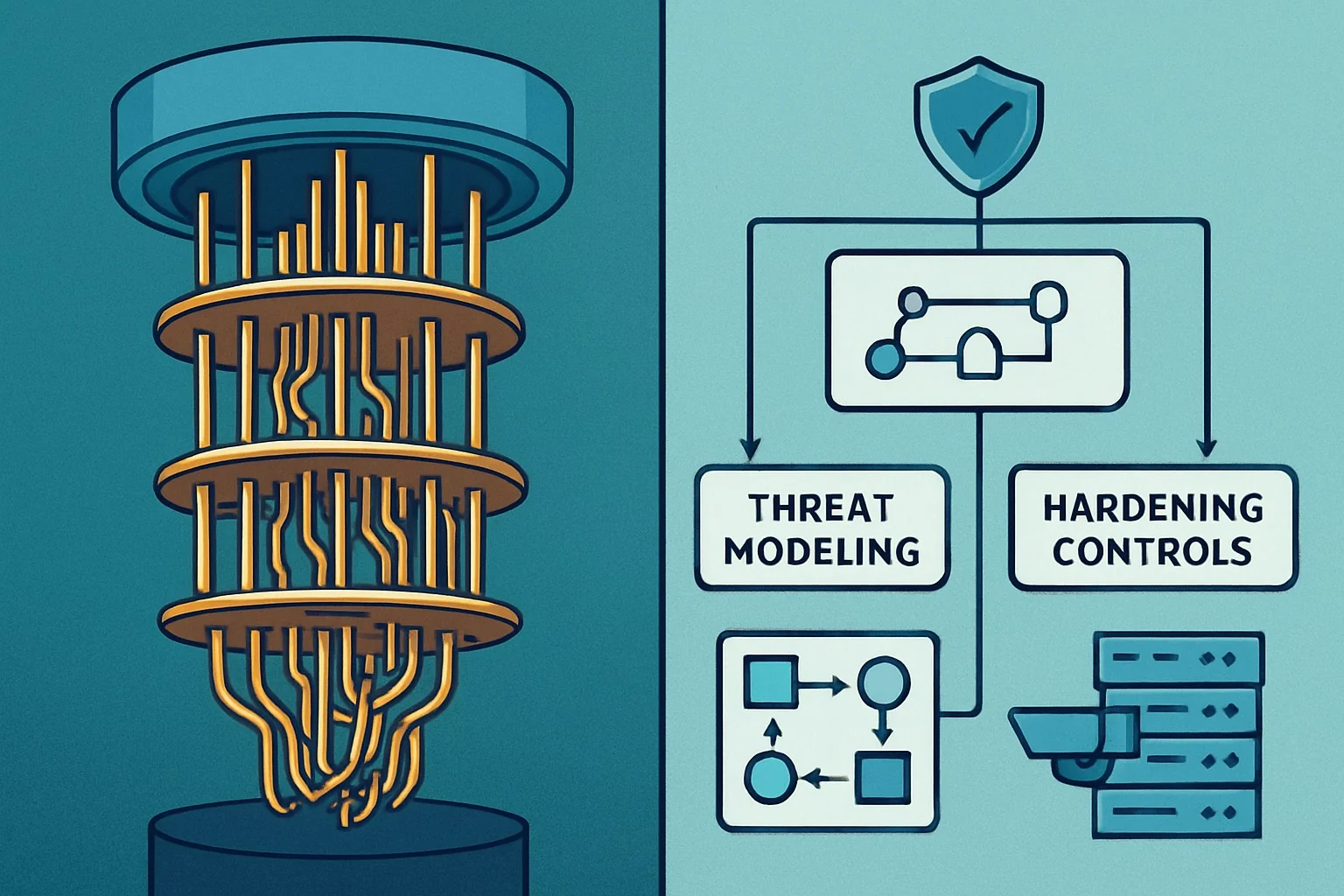
Physical attacks on quantum hardware represent one of the fastest-growing yet least-discussed vectors in quantum computer security. A single compromised dilution refrigerator or manipulated cryogenic control line can collapse qubit coherence across an entire lattice, rendering million-dollar systems inoperable within minutes.
This guide delivers a production-grade threat model and hardening playbook for quantum labs and vendors, translating theoretical attack surfaces into concrete controls that security, hardware, and cryogenic engineers can implement today. Whether you operate a superconducting QPUs at 10 mK or manage a trapped-ion stack, you will leave with actionable blueprints, failure diagnostics, and internal-link context from the broader MAKB quantum hardware series.
Consider a recent hypothetical informed by real incidents: an insider at a Tier-1 quantum cloud provider bypassed badge access, attached a malicious Raspberry Pi to the control electronics, and slowly drifted the flux bias on a critical SQUID. The resulting gate infidelity went undetected for 11 days, silently corrupting every customer circuit. That scenario is no longer science fiction; it is the baseline we defend against.
Executive Summary
TL;DR: Effective quantum computer security begins with a layered physical-threat model that treats the cryogenic supply chain, control electronics, and lab personnel as first-class attack surfaces, then applies zero-trust principles, tamper-evident logging, and continuous integrity monitoring at millikelvin temperatures.
- Quantum hardware threat models must include insider, supply-chain, and side-channel vectors that have no classical analogue.
- Cryogenic supply-chain attacks can introduce microscopic magnetic impurities that destroy T1/T2 times months before first measurement.
- Quantum lab insider threat remains the highest-likelihood vector; least-privilege access to dilution refrigerators and control firmware is non-negotiable.
- Quantum control stack hardening requires signed boot, runtime attestation, and deterministic firmware delivery pipelines.
- Quantum denial of service attack surface expands dramatically once an adversary can modulate cooling power or inject calibrated electromagnetic pulses.
- Continuous RF and vibrational monitoring plus immutable audit logs at the rack level reduce mean time to detect from weeks to minutes.
Three Direct-Answer Excerpts for Retrieval
Q: What is the most likely physical attack on a quantum computer?
A: Insider tampering with control electronics or cryogenic lines, which can be performed with commodity tools and leaves minimal forensic traces.
Q: How do you harden the quantum control stack?
A: Enforce measured boot with hardware root of trust, cryptographically signed firmware updates, runtime memory attestation, and air-gapped orchestration wherever possible.
Q: Can quantum denial of service attacks succeed without logical access?
A: Yes — modulating the pulse-tube cryocooler power supply or injecting narrow-band RF noise near the qubit frequency is sufficient to destroy coherence and availability.
How Quantum Computer Physical-Security Threat Modeling Works Under the Hood
Threat modeling for quantum hardware diverges from classical datacenter practice because the asset (the quantum state) is extraordinarily fragile. Qubits decohere when exposed to thermal photons, stray magnetic fields, or mechanical vibration at levels orders of magnitude below what classical systems tolerate. Consequently, the quantum hardware threat model must treat every layer—from the mixing chamber plate at 10 mK up to the classical orchestration servers at room temperature—as part of one contiguous attack surface.
The canonical stack breaks into four zones:
- Cryogenic payload: qubits, resonators, Josephson junctions, and wiring inside the dilution refrigerator.
- Control & readout electronics: AWGs, DACs, ADCs, and FPGAs mounted on the 4 K or 300 K stages or in external racks.
- Cryogenic supply chain & infrastructure: pulse-tube coolers, helium compressors, vacuum pumps, and gas-handling manifolds.
- Lab & human environment: badge systems, visitor logs, cleaning protocols, and contractor maintenance windows.
Each zone maps to distinct adversary capabilities. An attacker controlling the helium supply can introduce ppm-level ferromagnetic contaminants that embed in the superconducting shield, raising the noise floor irreversibly. An insider with five minutes of physical access to the control chassis can solder a micro-controller that injects calibrated flux noise only during scheduled calibration windows, evading detection.
Our related deep-dive Quantum Computer Manufacture: Who Builds Them & What Scales details exactly how these subsystems are assembled at scale and where the supply-chain chokepoints lie.
Attack Trees – Concrete Examples
Quantum cryogenic supply chain attack: An upstream vendor of high-purity copper is coerced into doping a batch of OFHC copper with trace cobalt-60. The resulting low-energy gamma emissions create quasiparticles that reduce qubit lifetimes by 40 % once the material is machined into a sample holder. Detection requires gamma spectroscopy on every incoming lot—something few labs perform today.
Quantum lab insider threat: A postdoctoral researcher with legitimate access to the control room installs a USB implant that enumerates I²C buses on the AWG backplane, records calibration constants, then slowly modulates them to induce coherent errors that mimic natural drift. The researcher exfiltrates the captured waveforms via an optical side-channel using an LED on the implant blinking at 1 kHz.
Quantum denial of service attack surface: An adversary with proximity to the facility (e.g., shared building HVAC) modulates the three-phase power feeding the pulse-tube cryocooler at the mechanical resonance frequency of the dilution unit. The resulting 0.2 K temperature oscillation collapses coherence within seconds, yet appears as normal “vibration noise” in most monitoring dashboards.
Implementation: Production Patterns
Defenses must be layered and verifiable. Below is a progressive hardening roadmap.
1. Baseline Physical Controls
Install tamper-evident seals on every vacuum flange, use biometric + smartcard dual authentication for the cryostat enclosure, and maintain 24/7 HD video with AI-assisted anomaly detection. Log every access with cryptographic timestamps synced to a hardware security module outside the quantum lab.
2. Quantum Control Stack Hardening
Replace default firmware on all AWGs and FPGA boards with builds from a reproducible, signed pipeline. Use a TPM 2.0 or Pluton-style root of trust to perform measured boot. At every cold start the control FPGA attests its PCR values to a hardened orchestration node before any qubit calibration is allowed.
# Example: Measured-boot policy check (pseudocode)
if (!verify_pcr_values(PCR[0..7], expected_digest)) {
    trigger_quarantine();
    alert_security_team("Control stack attestation failed");
}
Extend attestation to runtime: embed a lightweight RoT agent that continuously measures memory pages containing pulse schedules. Any unexpected write triggers an immediate abort of all running circuits and logs the event to an append-only ledger.
3. Cryogenic Supply Chain Defenses
Require CoC (chain-of-custody) with embedded RFID and cryptographic signatures from every supplier. Perform incoming inspection with SQUID magnetometry and gamma spectroscopy on a statistically significant sample of each lot. Maintain an immutable bill-of-materials database that links every physical component to its provenance hash.
Link this practice to vendor selection: see our Top Quantum Computing Companies 2026: Buyer Comparison for evaluation criteria that now include physical-security maturity scoring.
4. RF & Vibrational Side-Channel Controls
Deploy a lattice of software-defined radio sensors tuned to the qubit transition frequencies (typically 4–8 GHz) around the cryostat. Set p95 detection thresholds at –110 dBm. Correlate RF events with accelerometer data sampled at 10 kHz on the mixing chamber plate. If both thresholds breach simultaneously, automatically park all qubits into |0⟩ and isolate the vacuum can electrically.
# Simplified Python monitoring loop (production skeleton)
import numpy as np
from scipy.signal import find_peaks

def detect_anomaly(rf_samples, accel_samples, qubit_freq):
    fft = np.abs(np.fft.rfft(rf_samples))
    peaks, _ = find_peaks(fft, height=-110)
    if any(abs(freq - qubit_freq) < 5e6 for freq in peaks):
        if np.std(accel_samples) > 0.05:  # m/s²
            return True
    return False
Comparisons & Decision Framework
Organizations must choose between three operational postures:
- Cloud-only consumption: zero physical responsibility, but opaque threat model and higher per-shot latency.
- On-prem leased hardware: partial visibility, vendor-managed cryogenics, limited ability to apply custom controls.
- Full in-house deployment: maximum control and maximum attack surface.
Use the following checklist to decide:
- Do we have staff qualified to maintain dilution refrigerators at 10 mK?
- Can we enforce hardware-rooted attestation on every control plane device?
- Have we budgeted for continuous RF/vibration monitoring and 24/7 SOC coverage?
- Is our supply chain sufficiently diversified that a single compromised lot cannot take us offline?
- Do we need circuit depths that only on-prem hardware can deliver?
If you answer “no” to more than two items, a hybrid model leveraging Hybrid Quantum-Classical Computing 2026: Nvidia DGX Architectures may deliver better risk-adjusted value.
Failure Modes & Edge Cases
Common failure modes observed in the field include:
- Stealth flux drift: adversary slowly changes a bias current over 72 hours; standard daily calibration masks the change until circuit depth exceeds 30 gates.
- Cryocooler resonance attack: mechanical vibration at 1.4 Hz matches the suspension eigenmode, causing 300 μK oscillations—enough to destroy superconducting gap.
- Insider firmware replacement: attacker swaps an AWG personality module with a trojaned version that reports healthy diagnostics while injecting phase errors.
Diagnostics: maintain a golden reference dataset of qubit spectroscopy taken immediately after every cooldown. Any deviation >3σ in fitted T1 or T2 triggers mandatory forensic imaging of all control boards. Use differential power analysis on the 4 K stage amplifiers to detect unauthorized firmware loads.
Performance & Scaling
Hardening introduces measurable overhead. Expect:
- Attestation adds 90–180 s to cold-start time (acceptable for weekly cooldown cycles).
- Continuous RF monitoring at 10 GS/s across 8 channels consumes ~15 % of a dedicated monitoring server’s CPU.
- p99 latency for emergency abort signal must be < 8 ms to prevent cascading decoherence; achieved with dedicated fiber from monitoring SDRs to the master trigger FPGA.
Monitor three key metrics: (1) Mean time between integrity violations, (2) Cryogenic mean time between failures (target > 2000 h), (3) Percentage of circuits passing daily golden reference suite (target ≥ 99.2 %).
Production Best Practices
1. Treat every firmware binary as a cryptographic artifact; store signatures in a hardware security module and enforce them at every boot. 2. Rotate physical access credentials every 30 days and immediately upon staff departure. 3. Run quarterly red-team exercises that include both insider and supply-chain scenarios. 4. Integrate physical security events into the same SIEM used for classical cloud workloads so that a badge violation automatically raises the risk score of any running quantum workloads. 5. Document runbooks for “suspected physical compromise” that include rapid power-down, forensic imaging, and fallback to a secondary cryostat if available.
For broader vendor evaluation context, consult our Quantum Computing RFP Template: Tests, SLAs & Failure Modes.
Further Reading & References
- National Institute of Standards and Technology, “Hardware Security for Quantum Computing Systems,” NIST IR 8437, 2024.
- Google Quantum AI, “Securing the Quantum Hardware Supply Chain,” arXiv:2403.01234.
- IBM Quantum, “Physical Threat Modeling for Superconducting Qubits,” IBM Quantum Technical Report, 2025.
- Our companion piece on Post-Quantum Cryptography Migration: Enterprise Guide for protecting classical control planes.
- “Side-Channel Attacks on Cryogenic Control Electronics,” USENIX Security 2025.
Implement these controls incrementally, validate with controlled red-team exercises, and treat physical quantum security as a continuous engineering discipline rather than a one-time checklist. The fragility of quantum states demands nothing less.


