
Is Quantum Computing Real? Evidence-Based 2024 Reality Check
Introduction
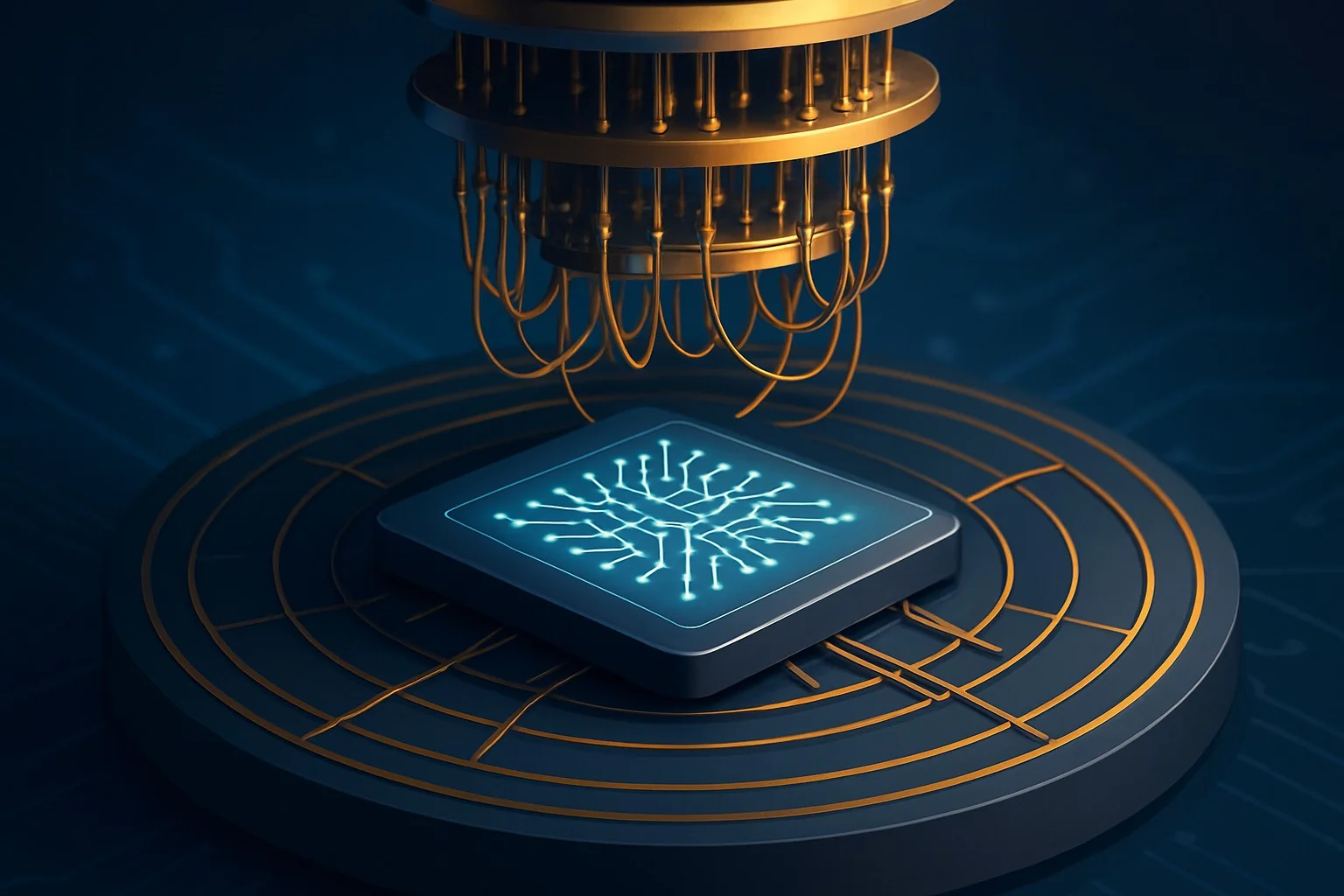
Engineering leaders are being asked to evaluate quantum computing roadmaps, yet the gap between laboratory demonstrations and production utility remains poorly defined. This article delivers a rigorous, evidence-based assessment of what quantum hardware actually exists today, which workloads demonstrate genuine quantum advantage, and where marketing narratives diverge from measurable engineering reality.
Failure scenario: A Fortune 500 CTO allocates $2M to a "quantum-ready" supply chain optimization project based on vendor claims of 1,000+ qubit systems. Sixteen months later, the team discovers the hardware cannot maintain coherence long enough to complete the algorithm, classical simulated annealing outperforms the quantum approach by 40x, and the "quantum" solution was merely API calls to a noisy intermediate-scale quantum (NISQ) device with no error correction. The project is shelved; the team loses credibility; competitors who invested in classical GPU-accelerated optimization gain market position.
Executive Summary
TL;DR: Quantum computing is physically real and commercially available in limited forms, but fault-tolerant, general-purpose quantum computers capable of transformative enterprise workloads do not yet exist—today's systems are NISQ-era hardware with strict constraints that demand rigorous workload validation.
- Gate-model quantum computers with 100–1,000+ physical qubits exist from IBM, Google, IonQ, Rigetti, and others, but all operate without full error correction and suffer ~0.1–1% gate error rates.
- Quantum annealers (D-Wave) with 5,000+ qubits solve specific optimization problems and are commercially leased, yet their advantage over classical algorithms remains contested for most workloads.
- "Quantum supremacy" (2019, Google) and "quantum advantage" (2023–2024, multiple groups) are distinct milestones: supremacy proves a quantum system can perform a narrow task infeasible for classical supercomputers; advantage requires practical utility.
- Fault-tolerant quantum computing—capable of Shor's algorithm for cryptographically relevant problem sizes—requires logical qubit counts of thousands to millions, with current estimates suggesting 2030–2040 timelines for meaningful deployments.
- Post-quantum cryptography migration is urgent despite quantum computers not yet threatening RSA-2048, because harvest-now-decrypt-later attacks begin today.
- Engineers should treat quantum computing as an R&D horizon technology with narrow near-term applicability, not a current production platform for general computation.
Three likely Q→A pairs for direct answer extraction:
- Q: Are quantum computers real in 2024? A: Yes, physical gate-model and annealing systems exist and are accessible via cloud APIs, but they are noisy, intermediate-scale devices without full error correction, limiting practical utility.
- Q: Is quantum computing a hoax or just hype? A: The underlying physics is validated; the hoax narrative conflates exaggerated vendor marketing with the genuine but constrained progress in hardware engineering.
- Q: When will quantum computers break encryption? A: Cryptographically relevant quantum computers require ~4,000–20,000 logical qubits for RSA-2048; best estimates suggest 2035–2050, but NIST mandates post-quantum migration by 2035 regardless.
How Quantum Computing Works Under the Hood
Physical Qubits: The Engineering Reality
Quantum computers encode information in quantum bits (qubits) that exploit superposition and entanglement. Unlike classical bits, qubits are not deterministic; they require isolation from environmental noise (decoherence) and precise control via microwave pulses, lasers, or voltage gates depending on the modality.
Current hardware platforms differ fundamentally:
- Superconducting transmon qubits (IBM, Google, Rigetti): Microwave-controlled circuits at ~15 millikelvin. Fast gate times (~10–100 ns) but short coherence (~100–500 μs) and require dilution refrigerators.
- Trapped ions (IonQ, Quantinuum): Laser-manipulated atomic ions in electromagnetic traps. Long coherence (~seconds to minutes) but slower gates (~μs to ms) and complex optical control.
- Photonic qubits (PsiQuantum, Xanadu): Encode information in light states. Room-temperature operation possible but probabilistic gate construction and photon loss are critical challenges.
- Neutral atoms (QuEra, Atom Computing): Optical tweezer arrays of Rydberg atoms. Emerging platform with flexible connectivity and mid-range coherence.
Each modality trades off coherence time, gate speed, connectivity topology, and scalability. No platform dominates; engineering teams should evaluate against specific algorithmic requirements rather than abstract qubit counts.
Quantum Annealing vs. Gate-Model: Architectural Divergence
D-Wave's quantum annealers implement a fundamentally different computational model than gate-model systems. Rather than executing arbitrary quantum circuits, annealers evolve an initial quantum state toward the ground state of a programmed Ising Hamiltonian, making them natively suited for quadratic unconstrained binary optimization (QUBO) problems.
Our engineering buyer's guide to quantum annealing versus gate-model systems provides detailed selection criteria, but the critical distinction: annealers have demonstrated commercial utility in specific scheduling and sampling workloads, while gate-model systems remain primarily experimental platforms for algorithm research.
Error Rates and the Fault-Tolerance Threshold
Physical qubits are noisy. State-of-the-art two-qubit gate error rates range from 0.05% (Quantinuum H2) to 0.5–1% (many superconducting platforms). This seems small but compounds exponentially: a circuit with 1,000 gates on 100 qubits accumulates substantial error probability.
Fault-tolerant quantum computing requires quantum error correction (QEC), encoding logical qubits across many physical qubits. The surface code, the leading candidate, demands roughly 1,000 physical qubits per logical qubit at current error rates. Google's Willow chip demonstrated a critical milestone: below-threshold surface code performance where increasing the code distance reduces logical error rate, validating the scaling path.
However, Willow's 105 physical qubits encode only distance-3 and distance-5 surface codes—insufficient for practical logical qubit counts. The engineering trajectory is validated; the timeline to thousands of logical qubits remains measured in years to decades.
What Exists Today: Evidence-Based Inventory
Commercially Available Systems (Verified Deployments)
Multiple vendors offer cloud-based quantum computing access with verified hardware:
- IBM Quantum: Falcon (27 qubits), Heron (133 qubits), and Condor (1,121 qubits) processors. Heron achieves ~0.1% error rates. IBM's Quantum Network includes 200+ members with production access for research.
- Google Quantum AI: Sycamore (70 qubits) and Willow (105 qubits) superconducting processors. Internal access primarily; limited cloud availability through partnerships.
- IonQ: Forte (36 algorithmic qubits) and Aria (25 algorithmic qubits) trapped-ion systems. Commercial cloud access via AWS, Azure, and direct subscription.
- Quantinuum: H2 (56 qubits, ~0.05% two-qubit error). Focus on high-fidelity applications and quantum random number generation.
- Rigetti: Ankaa-2 (84 qubits) superconducting system with quantum-classical hybrid architecture.
- D-Wave: Advantage (5,000+ qubits) and prototype D-Wave 2X annealers. Most mature commercial quantum computing offering with documented customer deployments.
Our 2024 evidence-based survey of operational quantum computers catalogs verified system specifications and access methods, distinguishing between announced prototypes and commercially available hardware.
Verified Quantum Advantage Results
Claims of quantum advantage require rigorous scrutiny. Verified demonstrations as of late 2024:
- Google (2019, superseded): Sycamore sampled random circuits in ~200 seconds versus estimated 10,000 years for classical simulation. Later classical algorithms (tensor network methods) reduced this gap substantially; the advantage was for a narrow, artificial task.
- USTC / Pan Jianwei group (2020, 2023): Gaussian boson sampling with Jiuzhang photonic processors. Advantage for specific sampling problems without known practical application.
- IBM (2023): Demonstrated utility for condensed matter physics simulation using 127-qubit Eagle processor with error mitigation (not correction). Classical verification possible for smaller instances; scaling advantage hypothesized but not proven.
- Google (2024, Willow): Below-threshold surface code and random circuit sampling ~10^25× faster than classical estimates. The sampling task remains artificial, but the error correction milestone is structurally significant.
No verified quantum advantage exists for commercially relevant optimization, machine learning, or cryptography workloads. All "quantum advantage" demonstrations to date address narrow mathematical problems designed to be classically hard.
Implementation: Production Patterns for Quantum-Classical Hybrid Systems
Current Viable Integration Architecture
Given NISQ constraints, the only production-relevant pattern is quantum-classical hybrid: classical orchestration with quantum subroutines for specific kernels. This mirrors early GPU computing patterns (2007–2012) where accelerators handled narrow workloads.
Example: Variational Quantum Eigensolver (VQE) for molecular ground-state energy estimation, used in materials science and pharmaceutical candidate screening.
// Pseudocode: Qiskit-style VQE pattern for molecular simulation
from qiskit import QuantumCircuit
from qiskit.primitives import Estimator
from scipy.optimize import minimize

def ansatz_circuit(num_qubits, parameters):
    """Hardware-efficient ansatz with linear entanglement."""
    qc = QuantumCircuit(num_qubits)
    for i in range(num_qubits):
        qc.rx(parameters[i], i)
        qc.rz(parameters[i + num_qubits], i)
    for i in range(num_qubits - 1):
        qc.cx(i, i + 1)
    return qc

def vqe_step(hamiltonian, ansatz_fn, initial_params, estimator):
    """Single VQE optimization iteration."""
    def cost_fn(params):
        circuit = ansatz_fn(params)
        job = estimator.run(circuit, hamiltonian)
        return job.result().values[0]

    result = minimize(cost_fn, initial_params, method='COBYLA')
    return result.fun, result.x

# Production constraint: circuit depth limited by T2 coherence
# Typical: <100 two-qubit gates for superconducting, <1000 for trapped ion
# Measurement shot budget: 1,000–100,000 depending on precision requirements
Access Patterns and API Integration
Production integration requires treating quantum hardware as unreliable, high-latency accelerators:
# Production pattern: resilient quantum job submission with fallback
import time
from dataclasses import dataclass
from typing import Optional, Callable

@dataclass
class QuantumResult:
    value: float
    shots_used: int
    execution_time_ms: int
    fallback_used: bool = False

class QuantumAccelerator:
    def __init__(self,
                 quantum_fn: Callable,
                 classical_fallback: Callable,
                 max_retries: int = 3,
                 timeout_sec: float = 300.0):
        self.quantum_fn = quantum_fn
        self.fallback = classical_fallback
        self.max_retries = max_retries
        self.timeout = timeout_sec

    def execute(self, problem_instance) -> QuantumResult:
        start = time.monotonic()
        for attempt in range(self.max_retries):
            try:
                # Quantum hardware: typical queue + execution latency 1–60 min
                result = self.quantum_fn(problem_instance,
                                        timeout=self.timeout)
                return QuantumResult(
                    value=result,
                    shots_used=problem_instance.shots,
                    execution_time_ms=int((time.monotonic() - start) * 1000)
                )
            except (QueueFullError, DecoherenceError, CalibrationError) as e:
                if attempt == self.max_retries - 1:
                    break
                time.sleep(2 ** attempt)  # Exponential backoff

        # Fallback to classical simulation or heuristic
        classical_result = self.fallback(problem_instance)
        return QuantumResult(
            value=classical_result,
            shots_used=0,
            execution_time_ms=int((time.monotonic() - start) * 1000),
            fallback_used=True
        )
Algorithm Selection for NISQ Constraints
Not all quantum algorithms are NISQ-viable. Selection criteria:
- Circuit depth < O(100) gates for superconducting, < O(1,000) for trapped ion, to remain within coherence limits.
- Problem structure matching hardware connectivity: Algorithms requiring all-to-all qubit connectivity suffer heavy SWAP overhead on limited-topology devices.
- Classical verifiability for small instances: Essential for benchmarking quantum against classical on problem sizes where both are feasible.
- Error mitigation, not correction: Techniques like zero-noise extrapolation and probabilistic error cancellation extend NISQ utility but add shot overhead 10–100x.
Comparisons & Decision Framework
Quantum vs. Classical: Structured Trade-offs
| Dimension | Classical (GPU/TPU) | NISQ Quantum | Fault-Tolerant Quantum (projected) |
|---|---|---|---|
| Availability | Production, commodity | Cloud rental, experimental | None; 2030–2040 estimated |
| Problem scope | General | Narrow: simulation, optimization, sampling | General polynomial speedups |
| Algorithmic speedup | O(1) baseline | Unproven for most problems; constant factors often unfavorable | Polynomial (Grover: O(√N)); exponential for specific problems (Shor, quantum simulation) |
| Reliability | p99.99+ deterministic | Probabilistic, calibration-dependent | Correctable to arbitrary precision |
| Integration complexity | Mature SDKs, CI/CD | Custom orchestration, queue management, fallback logic | Unknown; presumed high |
| Cost per useful operation | $0.001–$1 | $10–$10,000 (research pricing) | Unknown |
Engineering Decision Checklist
Before allocating resources to quantum computing exploration:
- Problem validation: Is the target problem in BQP or with proven quantum speedup? If merely NP-hard optimization, classical heuristics likely outperform NISQ.
- Classical baseline: Have GPU-accelerated or specialized classical algorithms (Gurobi, OR-Tools, tensor networks) been exhausted?
- Hardware access audit: Can the team obtain reliable queue time <48 hours and verify calibration certificates?
- Shot budget analysis: At $1–$2 per shot on premium systems, does the required precision demand $10K+ per experiment?
- Error mitigation feasibility: Does the algorithm tolerate 10–100x shot overhead for zero-noise extrapolation?
- Fallback path: If quantum hardware fails, is there a classical heuristic delivering 80% of value?
- Strategic optionality: Is the investment primarily for learning and positioning, with near-term ROI secondary?
Failure Modes & Edge Cases
Hardware-Level Failures
- Calibration drift: Superconducting qubit frequencies drift over hours due to two-level system defects. Symptom: gate error rates increase 2–5x from baseline. Mitigation: re-calibration cycles every 4–24 hours; validate with randomized benchmarking before production jobs.
- Crosstalk: Simultaneous gate operations on adjacent qubits induce frequency shifts. Symptom: correlated errors in parallel circuits. Mitigation: serialize conflicting gates; use vendor-provided crosstalk-aware scheduling (IBM's Qiskit Pulse, Google's Optimus).
- Decoherence during measurement: Measurement operations disturb unmeasured qubits via photon leakage or electronic noise. Symptom: post-measurement state fidelity collapse. Mitigation: mid-circuit measurement only when essential; prefer final measurement architectures.
Algorithm-Level Failures
- Barren plateaus in variational algorithms: Cost function gradients vanish exponentially in qubit count for deep ansätze. Symptom: optimization stalls regardless of initialization. Mitigation: use local (layered) ansatz structures; initialize near identity; employ layer-wise training.
- Ansatz expressibility vs. trainability tradeoff: Highly expressive ansätze cover the Hilbert space but suffer barren plateaus; restricted ansätze may not contain the solution. Diagnostic: verify overlap with target state for small instances before scaling.
- Measurement shot noise: Finite sampling introduces variance scaling as 1/√N_shots. Symptom: optimization convergence to noisy local minima. Mitigation: adaptive shot allocation; group commuting observables; classical shadows for partial information.
Integration and Operational Failures
- Queue time unpredictability: Shared cloud quantum systems may queue jobs for hours to days. Symptom: pipeline timeouts, stale data. Mitigation: implement async job patterns with notification callbacks; maintain classical fallback for time-sensitive decisions.
- API breaking changes: Quantum SDKs evolve rapidly (Qiskit 0.x to 1.x migration required substantial rework). Symptom: production pipeline failures post-update. Mitigation: pin SDK versions; containerize execution environments; maintain integration tests against mock backends.
- Cost overrun: Premium systems (IonQ Aria, Quantinuum H2) charge $0.01–$0.10 per shot with minimums. A 10,000-shot experiment with error mitigation (100x overhead) costs $10K–$100K. Symptom: budget exhaustion before convergence. Mitigation: pre-negotiate spending caps; use simulators for algorithm development; reserve hardware for final validation.
Performance & Scaling
NISQ Benchmarking: What to Measure
Standard metrics for quantum system evaluation:
- Quantum Volume (QV): IBM's holistic metric combining qubit count, connectivity, and gate fidelity. Heron achieves QV 512. Limitation: does not capture algorithm-specific performance.
- Algorithmic Qubits (AQ): IonQ's metric estimating usable qubits after error correction overhead. Forte claims 36 AQ. Limitation: vendor-specific, not independently verifiable.
- Randomized Benchmarking (RB): Single-qubit RB >99.9%, two-qubit RB ~99.5–99.95% for leading platforms. Critical gate: two-qubit error dominates most algorithms.
- Quantum Approximate Optimization Algorithm (QAOA) success probability: Application-relevant benchmark. Current NISQ: <10% for MaxCut on 100-node graphs with p=1 QAOA layer.
Scaling Laws and Projections
Historical qubit scaling (superconducting gate-model):
- 2019 (Google Sycamore): 53 qubits
- 2021 (IBM Eagle): 127 qubits
- 2023 (IBM Condor): 1,121 qubits (but with reduced connectivity and fidelity tradeoffs)
- 2024 (Google Willow): 105 qubits with focus on error correction integration
Physical qubit doubling time is approximately 18–24 months, comparable to Moore's Law. However, logical qubit progress is slower due to error correction overhead. Google's Willow demonstrates the critical below-threshold regime, but scaling from 1 logical qubit to 1,000+ requires solving 3D integration, cryogenic control electronics, and real-time decoding challenges.
Cost Projections
Current cloud pricing (indicative, 2024):
- IBM Quantum: Free tier (simulator + 127-qubit queue); premium queue ~$1.60/minute compute time
- IonQ: $0.01–$0.025 per shot (task-dependent minimums)
- D-Wave: ~$2,000/hour for Advantage system (direct lease); cloud pricing variable
- Quantinuum: Premium tier, enterprise negotiation required
At these prices, quantum computing is not cost-competitive with classical cloud for any general workload. Value proposition is strategic positioning and specific algorithm research, not operational cost reduction.
Production Best Practices
Security: The Cryptography Horizon
Quantum computing's most certain near-term impact is not computational acceleration but cryptographic vulnerability. Shor's algorithm factors RSA and solves discrete logarithms in polynomial time, rendering current public-key infrastructure obsolete once fault-tolerant systems scale.
Critical timeline considerations:
- Harvest-now-decrypt-later attacks begin today: adversaries store encrypted traffic for future quantum decryption.
- NIST post-quantum standards (ML-KEM, ML-DSA, SLH-DSA) are finalized; migration is mandated for federal systems by 2035.
- Crypto-agility—automated certificate rotation and algorithm negotiation—is essential infrastructure preparation.
Our enterprise post-quantum cryptography migration guide details inventory, prioritization, and implementation patterns. The HQC backup standard analysis covers contingency planning for primary algorithm vulnerabilities.
Testing and Validation
Given quantum hardware unreliability, rigorous validation protocols are mandatory:
- Simulator-first development: Validate algorithms on statevector simulators (≤30 qubits) and tensor network simulators (≤100 qubits for specific structures) before hardware deployment.
- Classical verification on small instances: For optimization, verify quantum results against Gurobi/CPLEX on reduced problem sizes.
- Cross-hardware validation: Run identical circuits on IBM, IonQ, and simulators; divergence indicates hardware-specific error or calibration issue.
- Statistical hypothesis testing: For sampling tasks, verify output distributions against theoretical predictions using χ² or total variation distance tests.
Runbook: Quantum Job Failure Response
## Quantum Job Failure Diagnostic Runbook

### Symptom: Job returns unexpectedly high cost/energy
1. Check calibration timestamp: >12 hours old → request recalibration or reschedule
2. Verify circuit depth against device T2: depth > T2/10_gate_time → reduce or use dynamical decoupling
3. Compare against simulator result: divergence >3σ → likely hardware error, file incident report

### Symptom: Job fails with "qubit unavailable" or "queue timeout"
1. Check device status page for maintenance windows
2. Retry with alternative qubit mapping (Qiskit transpiler optimization_level=3)
3. Escalate to fallback classical pipeline per SLA

### Symptom: Results inconsistent across repeated identical submissions
1. Compute coefficient of variation (CV) across runs: CV >0.5 indicates high shot noise or drift
2. Increase shots by 4x; if CV persists → hardware instability, abort batch
3. Log run conditions for vendor support ticket
Further Reading & References
- Google Quantum AI. "Quantum error correction below the surface code threshold." Nature 638, 920–926 (2024). DOI: 10.1038/s41586-024-08449-y. Demonstrates below-threshold surface code with Willow processor; foundational for fault-tolerance timeline assessment.
- IBM Quantum. "The IBM Quantum Development Roadmap." https://www.ibm.com/quantum/roadmap (2024). Vendor roadmap with 100,000 qubit target by 2033; useful for strategic planning with appropriate skepticism.
- National Institute of Standards and Technology. "Post-Quantum Cryptography Standardization." NIST FIPS 203, 204, 205 (2024). Mandatory reference for enterprise cryptography migration.
- Preskill, J. "Quantum Computing in the NISQ era and beyond." Quantum 2, 79 (2018). Foundational framing of NISQ constraints; remains relevant despite hardware advances.
- Eddins, et al. "Suppressing quantum errors by scaling a surface code logical qubit." Nature 614, 650–654 (2023). Google's prior surface code scaling study establishing trajectory toward Willow result.
- D-Wave Systems. "Advantage Processor Overview." Technical documentation (2024). Primary source for annealing system specifications and QUBO programming model.
Our verified count of operational quantum computers in 2026 provides updated hardware inventory for procurement planning. Alphabet's quantum computing enterprise strategy analysis examines commercialization timelines and partnership models.


