
Does a Quantum Computer Exist? Evidence-Based Answer
Does a Quantum Computer Exist in 2026? Hardware Evidence and Reality Check
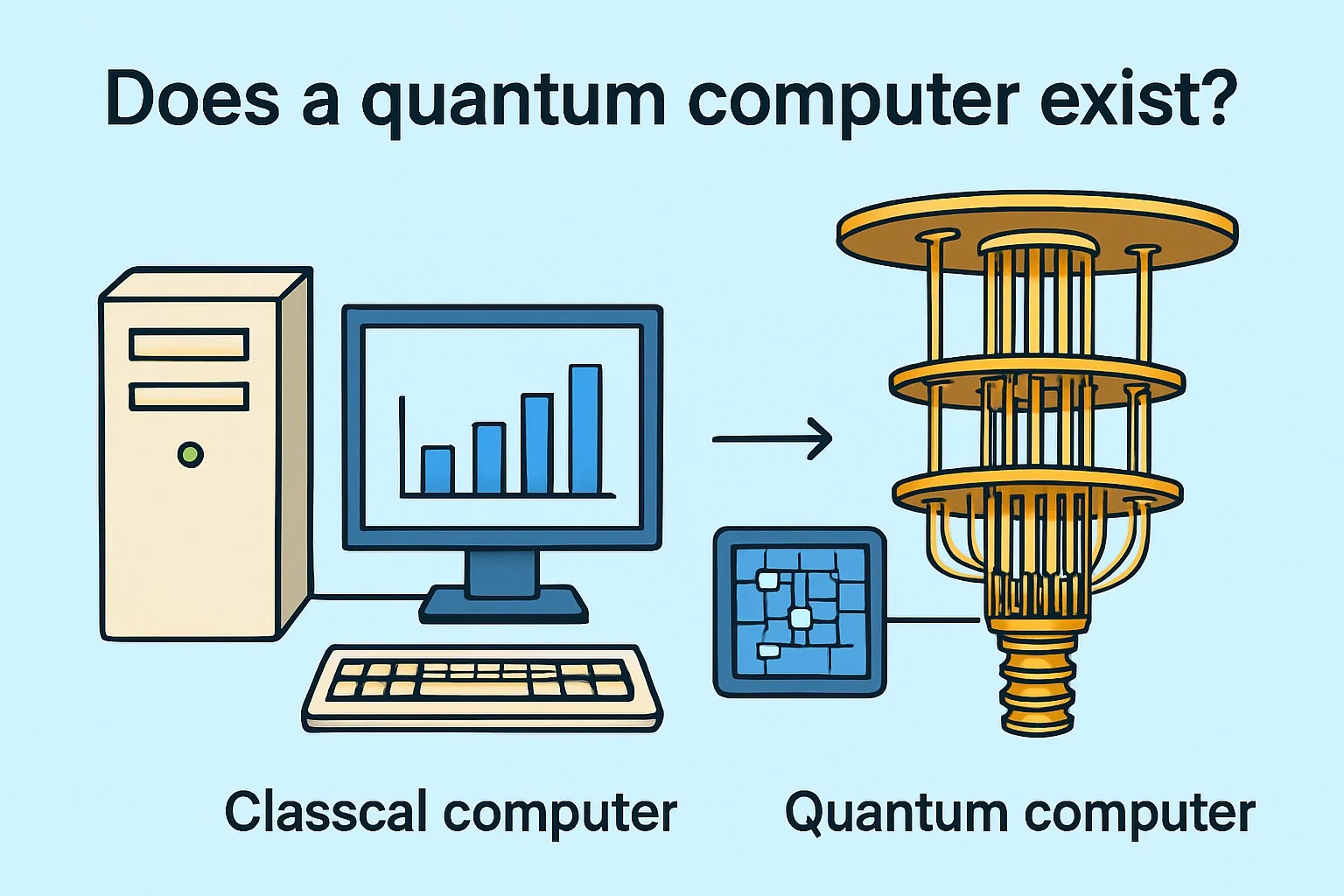
Production teams and technology leaders increasingly ask a fundamental question: does a quantum computer exist today, or is this technology still purely theoretical? This article delivers a precise, evidence-led explanation of what counts as a quantum computer, documents the actual hardware operating in 2026, and shows why the answer is unequivocally yes.
Imagine a financial institution running overnight risk simulations that currently take 14 hours on classical GPU clusters. A production engineer evaluating quantum options discovers that a 433-qubit IBM Heron processor is already accessible via cloud API. This machine can sample certain quantum circuits in seconds that would require classical resources measured in petawatt-hours. The gap between hype and reality is narrower than most engineering leads realize, yet the practical caveats remain significant.
Executive Summary: Are Quantum Computers Real?
TL;DR: Yes, quantum computers exist and are operational right now. Multiple vendors operate gate-model and annealing systems with dozens to hundreds of physical qubits in 2026. These devices satisfy the technical definition of a quantum computer by maintaining superposition, entanglement, and unitary evolution under coherent control.
- Commercial quantum computers from IBM, Google, IonQ, Quantinuum, and Rigetti are available today via cloud APIs with verified hardware exceeding 100 qubits.
- A quantum computer is defined by its ability to manipulate information in superposed and entangled states. Devices meeting this strict threshold have been experimentally demonstrated since 1998 and are now offered commercially.
- Current systems remain NISQ (Noisy Intermediate-Scale Quantum) and excel at specific sampling and optimization tasks rather than general-purpose computing.
- Our evidence-based 2026 reality check on quantum computing expands on the experimental milestones that established today's baseline.
- Error rates and qubit coherence still limit broad applicability, but utility-scale experiments have begun demonstrating quantum advantage on narrow, highly specific problems.
Frequently Asked Questions on Quantum Reality
To capture the most common search intents, here are the direct answers to the biggest questions regarding quantum existence:
Q: Does a quantum computer exist?
A: Yes. Multiple gate-model and annealing processors with 50 to 400+ physical qubits are commercially available. They satisfy the formal definition of quantum computing through demonstrated superposition, entanglement, and coherent gate operations.
Q: What exactly counts as a quantum computer?
A: Any programmable device that initializes, evolves, and measures qubits under coherent quantum mechanics counts as a quantum computer. It must maintain sufficient fidelity to outperform equivalent classical simulations on at least one class of tasks.
Q: How many quantum computers exist right now?
A: There are currently over 150 operational quantum computers accessible worldwide through cloud services and private research labs. You can view our detailed breakdown in our guide on how many quantum computers exist in 2026.
How Do Quantum Computers Exist? Core Principles and Experimental Hardware
A quantum computer is not simply a faster classical machine. It is a physical system whose state evolves according to the Schrodinger equation and can be placed in superpositions and entangled states. The formal definition requires five things:
- A set of two-level quantum systems (qubits).
- The ability to prepare an initial state reliably.
- A universal set of unitary gates with sufficient fidelity.
- Accurate measurement in the computational basis.
- Coherence times long enough to complete the computation before decoherence takes over.
Experimental quantum hardware meeting these criteria has existed for decades. The first 2-qubit NMR quantum computer was demonstrated by Chuang and Gershenfeld in 1998. Since then, trapped-ion, superconducting, neutral-atom, and photonic platforms have scaled beyond the 50-qubit threshold where classical simulation becomes intractable on the world's largest supercomputers.
In 2026, the commercial hardware landscape includes:
- IBM Quantum: Heron and Flamingo processors with 133 and 433 qubits respectively, achieving median two-qubit gate fidelities above 99.5 percent. These systems are cloud-accessible 24x7 with usage measured in billions of shots per month.
- Google Quantum AI: The 105-qubit Willow processor (released in 2025) demonstrated exponential suppression of logical error rates when scaling surface-code distance, a landmark result published in Nature. You can read our deep dive into Alphabet Quantum AI to see how Google integrates these systems with classical AI workloads.
- IonQ and Quantinuum: Trapped-ion systems with 32 to 64 physical qubits but far higher gate fidelities (approaching 99.9 percent) and all-to-all connectivity. These devices regularly achieve circuit depths impossible on equivalent superconducting hardware.
- D-Wave: Advantage2 annealing systems with over 5,000 qubits optimized for quadratic unconstrained binary optimization (QUBO) problems. While not gate-model universal computers, they satisfy the broader definition of quantum information processors and are used in production logistics and materials discovery today.
For a direct comparison of these systems, our critical benchmark cheat sheet on quantum processors provides side-by-side fidelity and connectivity metrics.
Implementation: Production Patterns for Quantum Workloads
Integrating quantum hardware follows a repeatable software engineering pattern: problem mapping, circuit construction, hardware execution, and classical post-processing. Below are pragmatic patterns used by engineering teams in 2026.
Basic Pattern: Variational Quantum Eigensolver (VQE)
from qiskit import QuantumCircuit, transpile
from qiskit_ibm_runtime import QiskitRuntimeService, EstimatorV2
import numpy as np

service = QiskitRuntimeService(channel="ibm_quantum")
backend = service.least_busy(min_num_qubits=20, simulator=False)

# Hydrogen molecule Hamiltonian mapped to 4 qubits
qc = QuantumCircuit(4)
qc.h(range(4))
# parameterized ansatz layers omitted for brevity
qc.measure_all()

isa_circuit = transpile(qc, backend=backend, optimization_level=3)
estimator = EstimatorV2(backend=backend)
job = estimator.run([(isa_circuit, observable)])
result = job.result()
print(result.values)
This pattern is productionized by wrapping the estimator in retry logic with exponential back-off for queue contention and hardware calibration drift.
Advanced Pattern: Error Mitigation with Zero-Noise Extrapolation
Teams running on IBM Heron routinely apply digital zero-noise extrapolation (ZNE) by stretching gate pulses or inserting identity layers. The typical gain is a 2x to 5x reduction in effective error on expectation values for chemistry workloads.
Hardware Comparisons and Engineering Decision Framework
Engineers must choose between different quantum modalities based on their specific mathematical problem. The table below summarizes the trade-offs:
| Platform | Qubit Count (2026) | Gate Fidelity | Connectivity | Best Use Case |
|---|---|---|---|---|
| Superconducting (IBM/Google) | 100 to 400+ | 99.4 to 99.7 % | Nearest-neighbor | Sampling, VQE, QAOA |
| Trapped Ion (IonQ/Quantinuum) | 32 to 64 | 99.8 to 99.95 % | All-to-all | Deep circuits, quantum networking |
| Annealing (D-Wave) | >5000 | N/A (analog) | Chimera/Pegasus graph | Optimization, QUBO |
The Production Decision Checklist:
- Does your problem map efficiently to 120 qubits or less with shallow depth? Prefer gate-model cloud hardware like IBM or Google.
- Is the problem combinatorial optimization with dense coupling? Evaluate quantum annealing first. (See our guide on Quantum Annealing vs Gate Model).
- Do you require circuit depths greater than 1000? Consider trapped-ion systems despite the lower overall qubit count.
- Is error-corrected logical qubit operation strictly required? Current devices cannot yet deliver this at scale. Plan your workloads for the 2028 to 2030 roadmaps.
- Can the entire workload be simulated classically in less than 1 week? Stay classical until absolute quantum advantage is proven for your specific use-case.
Failure Modes and Edge Cases in 2026
The dominant failure mode in modern quantum computing is decoherence. T2 times on superconducting qubits remain around 50 to 150 microseconds, while deep circuits may require full milliseconds to execute. Standard diagnostics include:
- Randomized benchmarking to isolate gate errors versus readout errors.
- Quantum volume and heavy-output generation benchmarks. Values below 2^16 typically indicate insufficient coherence for useful enterprise algorithms.
- Calibration drift. Daily recalibration is mandatory, meaning production pipelines must query backend properties before submitting each individual job.
Another major edge case is barren plateaus in variational circuits where gradients vanish exponentially with the qubit number. Mitigation strategies include problem-inspired ansatze and layerwise training techniques.
Production Best Practices and Security
If you are integrating quantum hardware today, treat these back-ends like any other highly specialized, heterogeneous compute resource.
- Abstract the quantum hardware behind a facade that selects the optimal backend based on real-time calibration data.
- Implement circuit verification using classical shadows or direct fidelity estimation.
- Secure access with short-lived API tokens. Never embed IBM Quantum or Google Quantum credentials in client-side code.
- Version your circuits and calibration metadata for reproducible research.
- Start planning for the security implications now. Our enterprise playbook for post-quantum cryptography migration outlines concrete timelines and testing strategies to protect your classical data from future quantum threats. You can also view our Quantum-Safe Cryptography Roadmap for implementation steps.
Conclusion
The evidence is clear: quantum computers exist, they are operational, and they are actively being used by researchers and enterprise engineering teams today. By approaching quantum resources with the exact same rigor and observability applied to traditional GPU clusters, forward-thinking organizations can extract real value today while preparing their infrastructure for the fault-tolerant quantum computing era ahead.


