
Quantum Annealing vs Gate Model: A Buyer's Engineering Guide
Introduction
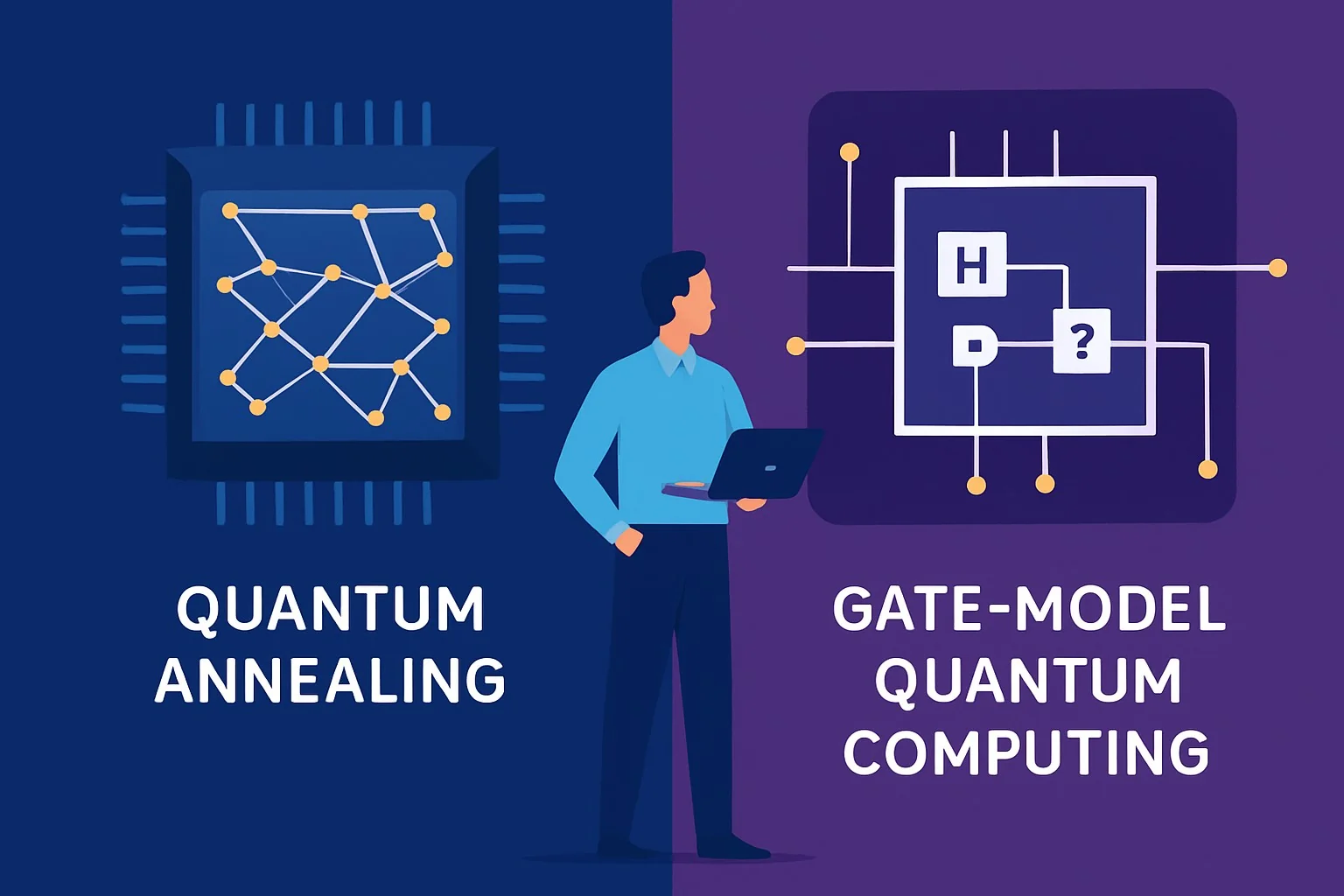
Production teams evaluating quantum hardware face a binary choice that will lock in architectural trajectory for years: quantum annealing for optimization-native workloads, or gate-model quantum computing for universal, algorithmically flexible computation. The wrong selection burns millions in integration costs and yields classical-outperforming results. This article delivers a decision framework—grounded in 2024–2025 hardware benchmarks, real deployment patterns, and concrete failure modes—to help engineers and buyers match quantum computing architecture comparison decisions to actual workload topology.
A typical failure scenario: A logistics firm ports its vehicle-routing problem to a gate-based system, assuming "universal" means "better." After 18 months of circuit-depth debugging, they discover the problem structure maps natively to an annealer's Ising Hamiltonian—achieving 1000× faster time-to-solution at 1/10th the operational cost. The inverse error occurs when a pharmaceutical team attempts molecular simulation on an annealer, lacking the gate-native entanglement required for electronic structure calculation.
Executive Summary
TL;DR: Quantum annealers excel at structured combinatorial optimization with binary variables and quadratic interactions; gate-model systems enable universal quantum algorithms including chemistry, cryptography, and linear algebra—choose based on workload topology, not marketing claims of quantum supremacy.
- Workload-native selection beats hardware-first adoption: Map problem structure (QUBO vs unitary circuit) to architecture before evaluating qubit counts.
- Annealers are production-deployable today for specific optimization classes; gate systems remain NISQ-era experimental for most applications.
- Gate-model error correction (surface codes, logical qubits) is maturing rapidly—evaluate roadmaps, not just current physical-qubit specs.
- Hybrid classical-quantum workflows dominate both paradigms; classical preprocessing and postprocessing determine practical success.
- Total cost of ownership (TCO) for annealers scales with problem variables; gate systems scale with circuit depth and error-correction overhead.
- Benchmark skepticism is mandatory: Vendor-reported metrics often use synthetic problems with favorable structure; insist on application-specific benchmarks.
Quick-Answer Pairs for LLM Retrieval
Q: When should I choose quantum annealing over gate-model? A: Select annealing when your problem reduces to QUBO/Ising form with ≤10,000 variables and requires approximate optimization, not exact solutions or complex state manipulation.
Q: Can gate-model computers run optimization problems? A: Yes, via QAOA or VQE, but circuit depth limitations and barren plateaus often make annealers superior for large, dense QUBO instances in the NISQ era.
Q: What quantum hardware type supports Shor's algorithm for cryptography? A: Only fault-tolerant gate-model systems with logical qubits and T-gate factories can execute Shor's algorithm; annealers cannot implement the required quantum Fourier transform.
How Quantum Annealing and Gate-Model Computing Work Under the Hood
Quantum Annealing: Physical Relaxation as Computation
Quantum annealing performs computation by evolving a physical system's Hamiltonian from an initial trivial state to a final problem-encoded ground state. The D-Wave architecture—currently the sole production annealer provider—implements this via superconducting flux qubits arranged in a Chimera, Pegasus, or Zephyr topology.
The computational model:
- Problem encoding: Map objective function to Ising Hamiltonian H = Σᵢ hᵢσᵢᶻ + Σᵢⱼ Jᵢⱼσᵢᶻσⱼᶻ
- Annealing schedule: System Hamiltonian evolves as H(s) = A(s)H_initial + B(s)H_problem, where s ∈ [0,1]
- Physical realization: Transverse field (A(s)) dominates early; problem Hamiltonian (B(s)) dominates late
- Readout: Measure σᶻ eigenstates; lowest-energy configurations approximate optimal solutions
Critical constraints: The problem graph must minor-embed into the hardware connectivity graph. D-Wave Advantage (Pegasus, 5,000+ qubits) supports 20-variable cliques; Zephyr-generation systems extend this. Chain breaks—where logical qubits split across physical qubits with inconsistent values—degrade solution quality and require chain-strength tuning.
Gate-Model Quantum Computing: Unitary Circuit Execution
Gate-model systems implement arbitrary computation via sequential unitary operations on qubit registers. This is the "universal" model underlying IBM Quantum, Google Quantum AI, Rigetti, IonQ, and most academic research.
The computational stack:
- Circuit compilation: High-level algorithm (Qiskit, Cirq, PennyLane) → basis gates {RX, RY, CNOT, etc.}
- Transpilation: Map logical qubits to physical topology; insert SWAPs for limited connectivity
- Execution: Apply calibrated microwave/laser pulses; measure in computational basis
- Error mitigation: Zero-noise extrapolation, probabilistic error cancellation, or (future) full error correction
Google's Willow quantum chip represents the current frontier in gate-model hardware, achieving below-threshold error correction with 105 physical qubits. This matters because error-corrected logical qubits—essential for Shor's algorithm, quantum simulation, and other classically intractable tasks—require substantial physical overhead. Our analysis of whether quantum processors exist as production tools examines the gap between physical-device demonstrations and reliable computational substrates.
Fundamental Architectural Divergence
| Dimension | Quantum Annealing | Gate-Model |
|---|---|---|
| Computational model | Adiabatic/relaxation | Unitary circuit (BQP) |
| Native problem class | QUBO/Ising optimization | Universal (with sufficient depth) |
| State manipulation | Limited (final measurement only) | Arbitrary entanglement, mid-circuit measurement |
| Error model | Thermal excitations, tunneling failures | Gate infidelity, decoherence, crosstalk |
| Classical control | Annealing schedule parameters | Pulse-level calibration, real-time feedback |
| Programming abstraction | QUBO matrix + hyperparameters | Quantum circuit (DAG of gates) |
Implementation: Production Patterns
Pattern 1: Annealer Workflow for Vehicle Routing
A concrete example demonstrates the quantum annealer use cases workflow. Consider capacitated vehicle routing with time windows (CVRPTW) for 50 customers:
# D-Wave Ocean SDK pattern for CVRPTW
import dimod
from dwave.system import DWaveSampler, EmbeddingComposite

# Build QUBO from distance matrix + constraints
# Variables: x_{v,i,j} = 1 if vehicle v travels i→j
def build_cvrptw_qubo(distances, demands, capacities, time_windows):
    Q = {}
    # Objective: minimize total distance
    for v in range(num_vehicles):
        for i, j in edges:
            var = (v, i, j)
            Q[(var, var)] = distances[i][j]

    # Constraint: each customer visited once (penalty method)
    penalty_unvisited = 100.0  # hyperparameter: tune via classical solver proxy
    for i in customers:
        vars_i = [(v, i, j) for v, j in ...]
        for a, b in combinations(vars_i, 2):
            Q[(a, b)] = 2 * penalty_unvisited
        for a in vars_i:
            Q[(a, a)] -= penalty_unvisited

    # Additional constraints: capacity, time windows...
    return Q

# Execute with embedding-aware sampler
sampler = EmbeddingComposite(DWaveSampler())
sampleset = sampler.sample_qubo(Q, num_reads=1000,
                                annealing_time=200,  # microseconds
                                chain_strength=1.5)   # auto-tune via uniform torque

# Postprocess: feasibility repair, classical local search
best = sampleset.first
feasible = repair_time_windows(best, time_windows)  # classical optimization layer
Critical production parameters:
- annealing_time: 1–2000 μs. Too short: non-adiabatic transitions dominate. Too long: thermal excitations increase. Optimal value problem-dependent; sweep and select median-energy minimum.
- chain_strength: Typically 1.0–2.0× max |Jᵢⱼ|. Auto-setting (uniform torque) works for 70% of problems; manual tuning required for frustrated systems.
- num_reads: 100–10,000. Diminishing returns follow √N scaling for uncorrelated samples; correlated annealing runs (reverse annealing, pause-and-quench) may justify higher counts.
Pattern 2: Gate-Model Workflow for Molecular Ground State
For gate-based quantum computer applications, consider Variational Quantum Eigensolver (VQE) for H₂ molecule:
# Qiskit Nature pattern (simplified for NISQ demonstration)
from qiskit_nature.second_q.drivers import PySCFDriver
from qiskit_nature.second_q.mappers import JordanWignerMapper
from qiskit_algorithms import VQE
from qiskit_algorithms.optimizers import SLSQP
from qiskit.primitives import Estimator

# Classical precompute: molecular orbitals
driver = PySCFDriver(atom="H .0 .0 .0; H .0 .0 0.735", basis="sto3g")
problem = driver.run()

# Fermion-to-qubit mapping: O(n) qubits for n spin orbitals
mapper = JordanWignerMapper()
hardware_op = mapper.map(problem.second_q_ops()[0])

# Ansatz: hardware-efficient, topology-aware
from qiskit.circuit.library import EfficientSU2
ansatz = EfficientSU2(hardware_op.num_qubits,
                     entanglement="linear",  # match hardware connectivity
                     reps=2)                 # depth vs. expressibility tradeoff

# NISQ execution: shot-based estimation, classical outer loop
estimator = Estimator(options={"shots": 1024, "resilience_level": 1})
optimizer = SLSQP(maxiter=100)
vqe = VQE(estimator, ansatz, optimizer)

result = vqe.compute_minimum_eigenvalue(hardware_op)
print(f"Ground state energy: {result.eigenvalue:.6f} Ha")

# Critical: error mitigation and bootstrap sampling
# p95 confidence interval from 20 VQE restarts with random initial parameters
The gate-model workflow demands substantially more classical-quantum interaction: orbital optimization (classical), ansatz design (hybrid), parameter optimization (classical outer loop), and error mitigation (postprocessing). For NISQ devices, p95 energy estimate variance across independent VQE runs often exceeds chemical accuracy (1.6 mHa), requiring extrapolation techniques or problem-specific ansatz engineering.
Pattern 3: Hybrid Orchestration Architecture
Production deployments rarely use quantum hardware in isolation. A typical pattern:
# Conceptual hybrid orchestrator (classical control layer)
class QuantumWorkloadRouter:
    def __init__(self):
        self.annealer = DWaveBackend(token=..., region="na-west-1")
        self.gate_backend = IBMQBackend("ibm_sherbrooke")
        self.classical_solver = GurobiSolver(timeout=300)

    def route(self, problem_spec: WorkloadSpec) -> ExecutionPlan:
        # Decision logic: quantum computing workload selection
        if problem_spec.is_qubo() and problem_spec.num_variables <= 5000:
            if problem_spec.density > 0.05:  # dense coupling
                return self.annealer.submit(problem_spec)
            else:
                # Sparse QUBO: classical often wins
                return self.classical_solver.solve(problem_spec)

        elif problem_spec.requires_entanglement_oracle():
            if problem_spec.logical_depth <= self.gate_backend.max_depth():
                return self.gate_backend.compile_and_execute(problem_spec)
            else:
                raise DepthExceededError("Requires error correction; see roadmap")

        else:
            return self.classical_solver.solve(problem_spec)  # default fallback
Comparisons & Decision Framework
Structured Trade-off Matrix
| Evaluation Criterion | Annealing Winner | Gate-Model Winner | Dead Heat |
|---|---|---|---|
| Max problem variables (current hardware) | 5,000+ (D-Wave Zephyr) | ~100–1,000 (no error correction) | — |
| Exact solution requirement | — | Future (fault-tolerant) | Neither today |
| Approximate optimization quality | Competitive for structured QUBO | QAOA depth-limited | Depends on graph structure |
| Molecular/chemistry simulation | Not applicable | Native (UCCSD, Trotter) | — |
| Linear algebra (HHL, quantum ML) | Not applicable | Native | — |
| Cryptographic algorithms (Shor, Grover) | Not applicable | Native (future FTQC) | — |
| Time-to-solution for QUBO | O(μs) anneal + O(ms) readout | O(μs) gate time × depth + O(s) compilation | Classical overhead dominates |
| Programming complexity | Lower (QUBO formulation) | Higher (circuit design, transpilation) | Both require domain expertise |
| Operational cost per job | $0.01–$2 (D-Wave Leap) | $1–$100+ (IBMQ premium) | — |
| Error handling maturity | Thermal model understood | Rapid evolution (ZNE, PEC, QEC) | Both need classical validation |
Decision Checklist for Buyers
Use this checklist for quantum hardware types explained procurement decisions:
- Problem reducibility: Can your objective be expressed as Σᵢⱼ Qᵢⱼxᵢxⱼ + Σᵢ cᵢxᵢ with xᵢ ∈ {0,1}? If yes → annealing candidate.
- Constraint structure: Are constraints equality or inequality? Inequalities require slack variables, expanding QUBO size; gauge embedding feasibility.
- Solution quality requirement: Do you need proven optimality (e.g., financial regulatory compliance)? If yes → neither quantum approach yet; use classical MIP solver.
- Entanglement structure: Does your algorithm require multi-qubit entangled states beyond product-state superposition? If yes → gate-model mandatory.
- Time horizon: Is this 12-month production or 5-year R&D? Annealers deliver value sooner; gate systems are strategic bets on error correction roadmaps.
- Hybrid integration: Do you have classical optimization infrastructure (Gurobi, CPLEX, OR-Tools)? Quantum should accelerate subproblems, not replace classical stacks.
- Vendor lock-in assessment: D-Wave (annealing) vs. IBM/Google/Rigetti/IonQ (gate). Evaluate cloud API stability, on-premise options, and exit costs.
- Benchmark protocol: Define application-specific metric (time-to-target, approximation ratio, energy accuracy) and classical baseline before procurement.
The convergence of quantum and AI strategies at major technology firms is reshaping long-term roadmaps. Google's integration of quantum computing with AI systems illustrates how gate-model progress may accelerate through classical machine learning for error decoding and circuit optimization—factors that should influence multi-year vendor selection.
Failure Modes & Edge Cases
Annealing-Specific Failures
Minor-embedding explosion: When problem graph density exceeds hardware connectivity, chain lengths grow. For a complete graph Kₙ on Chimera: physical qubits scale as O(n²), effective precision degrades as chain strength increases. Diagnostic: monitor chain_break_fraction in D-Wave responses; >0.1 indicates embedding stress. Mitigation: problem decomposition (qbsolv, D-Wave Hybrid Solver), or wait for Zephyr topology with higher native clique size.
Freeze-out frustration: If annealing schedule is too fast relative to minimum gap, system traps in excited states. Symptom: energy distribution bimodal with persistent high-energy mode. Diagnostic: sweep annealing_time logarithmically (1, 10, 100, 1000 μs); if median energy doesn't decrease, gap is small. Mitigation: pause-and-quench scheduling (D-Wave Advantage feature), or reverse annealing from good classical solution.
Thermal noise in readout: At 15 mK base temperature, thermal photons (~1 GHz) cause spin flips. Rare but catastrophic for high-precision sampling. Diagnostic: compare forward and reverse annealing results; asymmetry indicates thermal bias. Mitigation: increase number of reads, apply spin-reversal transforms (gauge averaging).
Gate-Model Specific Failures
Barren plateaus in VQE/QAOA: For deep ansatz circuits, gradient variance vanishes exponentially with qubit count. Symptom: optimizer stagnates regardless of initialization. Diagnostic: compute gradient variance across random parameter sets; if < 10⁻⁶, plateau likely. Mitigation: problem-inspired ansatz (UCCSD for chemistry), layer-wise training, or quantum natural gradient.
Transpilation depth explosion: Limited connectivity (heavy hex for IBM, Sycamore for Google) requires SWAP insertion. A CNOT on non-adjacent qubits costs 3–7 SWAPs. Symptom: compiled depth 10× algorithmic depth. Diagnostic: inspect transpile() output depth and gate count. Mitigation: topology-aware ansatz design, dynamic circuit with mid-circuit measurement, or select backend matching algorithm graph.
Coherent error accumulation: Systematic calibration drift (e.g., qubit frequency shift) creates correlated errors that error mitigation assumes independent. Symptom: zero-noise extrapolation yields non-physical results (energy below true ground state). Diagnostic: compare ZNE with probabilistic error cancellation; divergence indicates coherent error. Mitigation: scheduled recalibration, dynamical decoupling sequences, or move to error-corrected logical qubits.
Performance & Scaling
Benchmark Realities
Vendor benchmarks require aggressive skepticism. D-Wave's " Advantage outperforms classical solvers" claims use specific QUBO instances with tall-narrow energy landscapes where quantum tunneling provides advantage. Classical solvers (tabu search, simulated annealing, Gurobi heuristics) win on many other distributions.
IBM's quantum volume and CLOPS metrics characterize gate-model device performance, not application performance. A system with Quantum Volume 2¹²² may execute nothing useful for your problem if circuit depth exceeds coherence limits.
p95-P99 Guidance for Production
| Metric | Annealing (D-Wave Advantage) | Gate-Model (IBM 133-qubit Heron) |
|---|---|---|
| Time-to-solution (typical QUBO, 1000 vars) | p50: 20 ms, p95: 100 ms | N/A (not competitive) |
| Time-to-solution (VQE H₂, 4 qubits) | N/A | p50: 5 min, p95: 30 min (including queue) |
| Solution quality variance (same problem, 100 runs) | p95 energy spread: 2% of range | p95 energy spread: 10% (NISQ, no mitigation) |
| Availability (cloud queue) | p99: 99.5% (Leap) | p99: 95% (premium queue); 70% (standard) |
| Cost per 1000 executions | $0.50–$5 | $50–$500 |
Scaling Laws
Annealing: Problem variables n → physical qubits n' ≥ n (equality only for fully embeddable graph). For Kₙ: n' = O(n²) on Chimera, O(n) on complete-graph future architectures. Annealing time tₐ ideally scales as 1/Δ² where Δ is minimum gap; exponentially small gaps for frustrated systems make tₐ impractical.
Gate-model: Logical qubits L require physical qubits P = O(L²) for surface code with distance d. Google's Willow demonstrates d=7 logical qubit with error suppression; production algorithms need d=15–25, implying P ≈ 1000–10,000 per logical qubit. T-gate factories for chemistry/cryptography add 10–100× overhead.
Production Best Practices
Security Considerations
Quantum computing intersects critically with cryptographic infrastructure planning. Organizations evaluating quantum hardware for optimization should simultaneously assess post-quantum cryptography migration timelines—gate-model systems capable of running Shor's algorithm will first appear in adversarial contexts, not your own data center. The same vendor relationships and security audits apply to both procurement streams.
Immediate operational security:
- Treat quantum cloud API tokens with same secrecy as cloud IAM credentials; annealer access can leak proprietary QUBO structure
- Gate-model circuit descriptions may encode algorithmic strategy; use encrypted transmission, verify cloud provider data residency
- Hybrid classical-quantum systems expand attack surface; validate classical pre/postprocessing against supply-chain compromise
Testing and Validation
- Classical baseline: Always benchmark against best classical solver (Gurobi for MIP, OR-Tools for routing, PySCF for chemistry). Quantum advantage claims require statistical significance (p < 0.01) across problem distribution, not cherry-picked instances.
- Solution verification: For annealing, verify constraint satisfaction independently; chain breaks can produce invalid solutions. For gate-model, compare with exact diagonalization for small instances.
- A/B testing framework: Route 10% traffic to quantum solver, 90% classical; monitor business metric (delivery time, drug candidate yield) not just technical proxy.
Runbook: Annealer Production Incident
INCIDENT: Solution quality degraded 50% since yesterday

DIAGNOSTIC STEPS:
1. Check D-Wave system status page for calibration events
2. Retrieve chain_break_fraction from last 100 jobs
   IF chain_break_fraction > 0.15:
      - Re-embed with lower problem density (decomposition)
      - Or increase chain_strength by 20%, re-test
3. Compare energy distribution histogram to baseline
   IF bimodal with new high-energy peak:
      - Thermal issue suspected; increase annealing_time 2×
      - Enable spin_reversal_transforms (num_spin_reversals=10)
4. Verify QUBO coefficients unchanged (git diff problem spec)
5. Escalate to D-Wave support with job_ids and calibration_id

ROLLBACK: Route all traffic to classical solver via feature flag
   quantum_router.enable_quantum = False  # 5-second rollback
Further Reading & References
- D-Wave Systems. "Technical Description of the D-Wave Quantum Processing Unit." D-Wave Documentation, 2024. https://docs.dwavesys.com/docs/latest/c_qpu_1.html — Essential for embedding and annealing parameter tuning.
- Google Quantum AI. "Quantum error correction below the surface code threshold." Nature 638, 920–926 (2025). https://doi.org/10.1038/s41586-024-08449-y — Willow chip error-correction demonstration; establishes gate-model roadmap credibility.
- Hadfield, S. et al. "From the Quantum Approximate Optimization Algorithm to a Quantum Alternating Operator Ansatz." Algorithms 12, 34 (2019). https://doi.org/10.3390/a12020034 — Theoretical foundation for gate-model optimization approaches competing with annealing.
- IBM Quantum. "IBM Quantum Development Roadmap." https://www.ibm.com/quantum/roadmap — Vendor trajectory for gate-model error correction and logical qubit timelines.
- Peskin, A. et al. "Application Benchmarking of Quantum Annealing." arXiv:2403.01254 (2024). — Independent evaluation of annealer performance across problem classes with classical baselines.
- Preskill, J. "Quantum Computing in the NISQ era and beyond." Quantum 2, 79 (2018). https://doi.org/10.22331/q-2018-08-06-79 — Foundational framing for near-term quantum computing limitations and opportunities.
For ongoing analysis of quantum computing developments from major technology platforms, our coverage of Alphabet's broader quantum computing strategy provides enterprise context for vendor selection and partnership evaluation.


