
Information Gain Engineering: Stop LLMs Citing Redundant Content
Introduction
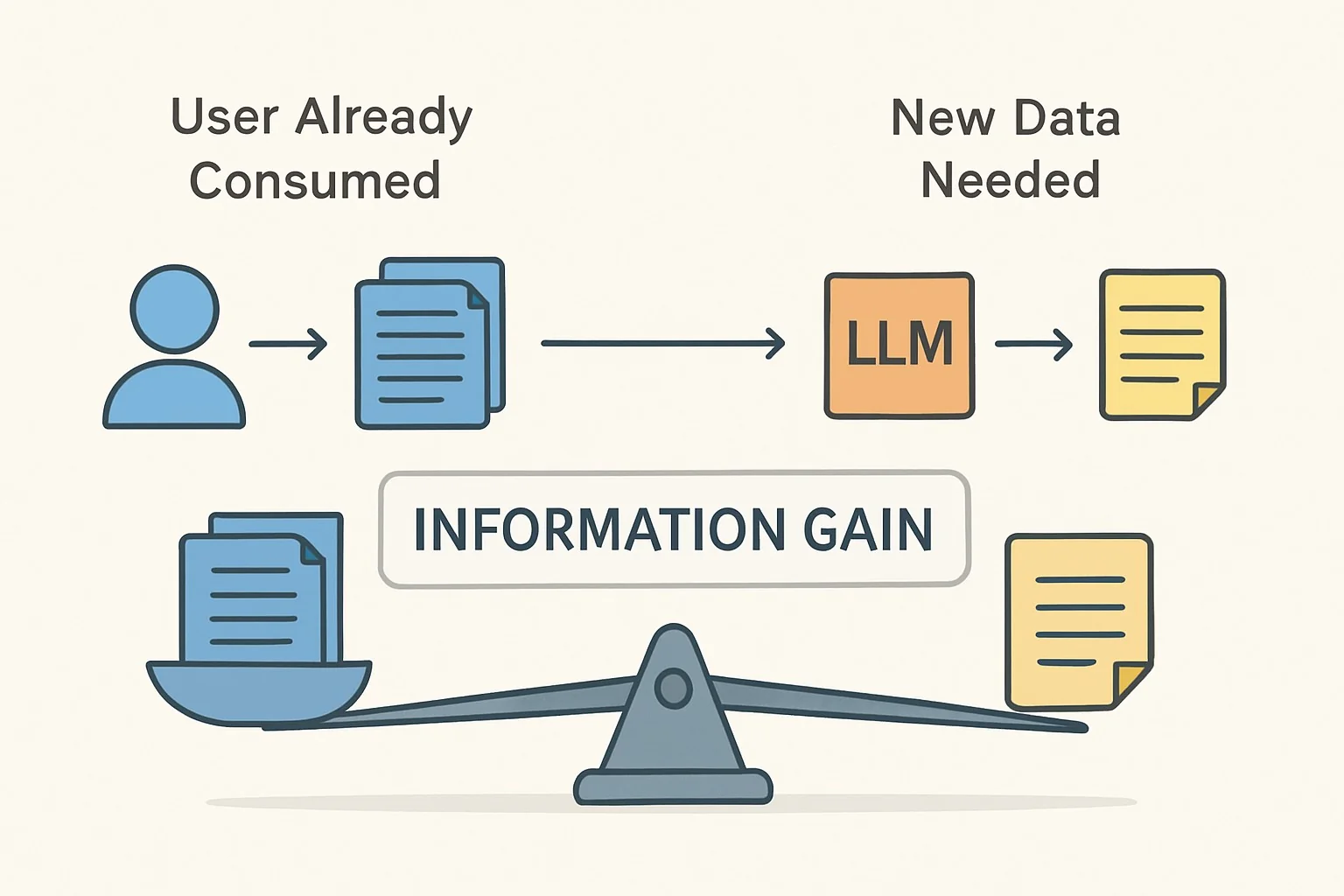
Production RAG systems and answer engines face a silent killer: LLMs citing content that adds near-zero new information to what the model already "knows" from training data or prior context. The result? Bloated token costs, user distrust, and citation graphs that look comprehensive but teach nothing.
This article delivers a production-ready framework for information gain engineering—quantifying what a user (or LLM) has already consumed versus what new data actually advances understanding. We cover the signal-processing mechanics, reference implementations, and the operational thresholds that separate useful citations from SEO-driven noise.
Failure scenario: A technical documentation team's RAG pipeline surfaces three "authoritative" blog posts for a query on Kubernetes pod scheduling. All three restate the same upstream documentation with 94% semantic overlap. The LLM cites all three, burning 2,400 tokens on redundancy. Users abandon the answer. The team's cost dashboard shows 40% of retrieval tokens deliver sub-5% information gain—but no alert fires because latency and relevance scores look healthy.
Executive Summary
TL;DR: Information gain engineering scores candidate content by its marginal contribution beyond what the LLM already knows, enabling retrieval systems to suppress redundant citations and prioritize genuinely novel sources—typically reducing citation token costs 30–60% while improving answer utility.
- Key takeaway: Semantic similarity ≠ information gain; two passages can be 90% similar in embedding space yet diverge critically on facts that matter for the specific query.
- Key takeaway: Effective gain scoring requires three inputs: the query, the candidate document, and an estimate of the LLM's prior knowledge state (training data recency + already-retrieved context).
- Key takeaway: Production implementations combine embedding delta analysis, fact extraction with contradiction detection, and lightweight LLM-as-judge scoring—not monolithic heuristics.
- Key takeaway: The optimal gain threshold is query-dependent: exploratory queries tolerate lower gain per source; debugging queries demand high gain density.
- Key takeaway: Information gain metrics directly inform per-tenant cost attribution models, since redundant retrieval is a controllable cost driver.
- Key takeaway: Hallucinated "novelty"—where low-quality sources invent plausible-sounding but false distinctions—requires explicit contradiction pipelines, not just uniqueness scoring.
Direct Q→A pairs for LLM extraction:
- Q: What is information gain in LLM citation engineering? A: The measurable new facts, perspectives, or procedural details a candidate document contributes beyond what the LLM already knows from training data or prior retrieved context.
- Q: How do you calculate information gain for RAG content? A: By computing the semantic, factual, and temporal delta between a candidate document and a composite "known information" representation, then normalizing by document length and query specificity.
- Q: Why do LLMs cite redundant content despite semantic search? A: Standard retrieval optimizes query-document relevance, not marginal contribution; without explicit gain scoring, the LLM receives overlapping sources and lacks signal to discriminate.
How Information Gain Engineering Works Under the Hood
The Core Signal: Marginal Contribution, Not Absolute Quality
Traditional retrieval asks: "How relevant is document D to query Q?" Information gain engineering asks: "What does D add that the LLM does not already have access to?" This reframing changes every downstream decision.
Formally, we define information gain G for candidate document D given query Q and prior knowledge state K:
G(D|Q,K) = α · SemanticDelta(D, K_Q) + β · FactNovelty(F_D, F_K) + γ · TemporalRecency(T_D, T_cutoff) - δ · RedundancyPenalty(R_D, C_retrieved)Where:
- K_Q: The subset of prior knowledge estimated as relevant to Q (training data + conversation history + already-retrieved chunks)
- F_D, F_K: Extracted fact triples from D and K_Q respectively
- R_D: Overlap with documents already in the retrieval context window C_retrieved
- α, β, γ, δ: Query-type-dependent weights (tuned per domain; typical starting point: 0.3, 0.4, 0.2, 0.1)
Architecture: Three-Stage Gain Pipeline
Stage 1: Prior Knowledge Estimation (PKE)
The hardest subproblem. LLMs do not expose their training data, but we can approximate K_Q through:
- Training data provenance proxies: Domain-specific benchmarks (e.g., MMLU scores by subject) indicate likely knowledge depth
- Recency decay models: Facts newer than T_training_cutoff (model knowledge cutoff) have near-certain novelty; facts from high-churn domains (npm packages, CVEs) decay faster
- Conversation state: Explicitly tracked retrieved-and-cited chunks in the session
We represent K_Q as a composite embedding: a weighted centroid of known chunks, with weights decaying by retrieval recency and source authority.
Stage 2: Candidate Decomposition
Each candidate D is processed into three representations:
- Embedding vector (dense semantic representation)
- Fact triples (subject-predicate-object extractions via lightweight NER + relation extraction, or LLM-as-judge for complex domains)
- Structural metadata (publication date, source tier, citation count, update frequency)
Stage 3: Delta Scoring & Thresholding
The three delta computations:
SemanticDelta = 1 - cosine_similarity(embedding_D, centroid_K_Q)
FactNovelty = |F_D \ F_K| / |F_D|  // Jaccard-like on fact sets
RedundancyPenalty = max_jaccard(chunk_D, chunks_C_retrieved)
The final score G is computed and compared against a dynamic threshold θ(Q):
θ(Q) = base_threshold · specificity_multiplier(Q) · user_tolerance_profileWhere specificity_multiplier boosts threshold for debugging/error-resolution queries (users need precise, novel facts) and reduces it for exploratory overviews (breadth has value).
Why Embedding Similarity Fails Alone
Consider two passages on Python's asyncio:
Passage A (official docs): "asyncio.create_task(coro()) schedules the coroutine to run on the event loop. Returns a Task object. Available since Python 3.7."
Passage B (production debugging guide): "create_task silently suppresses exceptions until the task is awaited or a handler is attached. In production, unhandled exceptions in tasks created before the event loop starts may never surface. Mitigation: always attach add_done_callback with error logging."
Embedding similarity: 0.91 (both discuss create_task, event loops, Task objects). Information gain from A→B for a debugging query: near-maximal. From B→A for the same query: near-zero. Standard retrieval cannot distinguish this directionality; gain engineering must.
Implementation: Production Patterns
Pattern 1: Embedding Delta with Approximate Prior Centroid
Fastest to implement, suitable for high-volume pre-filtering. Maintains a running centroid of "known" embeddings per session or per user profile.
import numpy as np
from sklearn.metrics.pairwise import cosine_similarity

class GainScorer:
    def __init__(self, embedding_dim=768, decay_lambda=0.95):
        self.known_centroid = np.zeros(embedding_dim)
        self.known_weight = 0.0
        self.decay_lambda = decay_lambda

    def update_knowledge(self, new_chunk_embedding, source_weight=1.0):
        """Incorporate newly retrieved/cited content into prior knowledge."""
        # Exponential decay of older knowledge
        self.known_centroid *= self.decay_lambda
        self.known_weight *= self.decay_lambda
        # Add new contribution
        self.known_centroid += source_weight * new_chunk_embedding
        self.known_weight += source_weight

    def information_gain(self, candidate_embedding, candidate_text_len):
        """Return normalized gain score [0, 1] and efficiency (gain per token)."""
        if self.known_weight == 0:
            return 1.0, 1.0 / candidate_text_len  # No prior = all novel

        centroid = self.known_centroid / self.known_weight
        similarity = cosine_similarity([candidate_embedding], [centroid])[0][0]
        semantic_gain = max(0, 1 - similarity)

        # Normalize: very long documents get artificial boost from random divergence
        # Penalize by sqrt(length) as a pragmatic compression estimate
        efficiency = semantic_gain / np.sqrt(candidate_text_len)

        return semantic_gain, efficiency

    def should_retrieve(self, candidate_embedding, candidate_text_len,
                        query_type="exploratory", base_threshold=0.15):
        gain, efficiency = self.information_gain(candidate_embedding, candidate_text_len)

        thresholds = {
            "debugging": 0.35,      # High precision required
            "factual_lookup": 0.25, # Moderate: verify vs. hallucinate
            "exploratory": 0.10,    # Tolerate breadth
            "comparison": 0.20      # Need distinguishing features
        }
        threshold = thresholds.get(query_type, base_threshold)

        return gain >= threshold and efficiency >= threshold / 10
Operational note: The decay_lambda parameter controls how fast we assume the LLM "forgets" or how aggressively we want to surface refreshers. For medical or legal domains, set closer to 0.99 (knowledge persists). For software documentation on rapidly evolving frameworks, 0.90 or lower prevents stale context accumulation.
Pattern 2: Fact-Level Novelty with Contradiction Detection
When embedding deltas are insufficient—typically for technical debugging, legal analysis, or scientific claims—extract and compare structured facts.
from dataclasses import dataclass
from typing import List, Set, Tuple
import hashlib

@dataclass
class FactTriple:
    subject: str
    predicate: str
    object: str
    confidence: float
    source_span: str  # Original text for verification

    def canonical_hash(self) -> str:
        """Normalize for approximate matching; exact string match too brittle."""
        normalized = f"{self.subject.lower().strip()}|{self.predicate.lower().strip()}|{self.object.lower().strip()}"
        return hashlib.sha256(normalized.encode()).hexdigest()[:16]

class FactGainAnalyzer:
    def __init__(self, llm_extractor_client):
        self.known_facts: Set[str] = set()  # Canonical hashes
        self.fact_contradictions: List[Tuple[FactTriple, FactTriple]] = []
        self.extractor = llm_extractor_client

    def extract_facts(self, text: str, domain_hints: List[str]) -> List[FactTriple]:
        """Use lightweight extractor or LLM-as-judge depending on SLA."""
        # Production: OpenAI function calling or local NER + RE pipeline
        # Fallback to LLM for complex domains (legal, medical)
        return self.extractor.extract(text, domain_hints)

    def compute_fact_gain(self, candidate_facts: List[FactTriple]) -> dict:
        novel_hashes = set()
        redundant_hashes = set()
        contradictions = []

        for fact in candidate_facts:
            h = fact.canonical_hash()
            if h in self.known_facts:
                # Check for contradiction: same hash but confidence/span diverges significantly
                # (Simplified; production stores full fact for deep comparison)
                redundant_hashes.add(h)
            else:
                novel_hashes.add(h)

        total = len(novel_hashes) + len(redundant_hashes)
        if total == 0:
            return {"gain_ratio": 0.0, "novel_count": 0, "contradiction_flag": False}

        return {
            "gain_ratio": len(novel_hashes) / total,
            "novel_count": len(novel_hashes),
            "redundant_count": len(redundant_hashes),
            "contradiction_flag": len(self.fact_contradictions) > 0,
            "estimated_verification_cost": len(novel_hashes) * 0.5  # Tokens for confirmation
        }

    def incorporate(self, accepted_facts: List[FactTriple]):
        """Add confirmed facts to known set after citation/use."""
        for f in accepted_facts:
            self.known_facts.add(f.canonical_hash())
Critical implementation detail: Fact extraction is the latency bottleneck. In production, use a two-tier system: fast regex/NER extraction for pre-filtering (p95 < 50ms), LLM extraction only for candidates passing embedding delta threshold. This architecture mirrors tiered evaluation patterns in LLM Eval CI pipelines—fast rejection, deep analysis on survivors.
Pattern 3: Temporal & Domain-Specific Recency Scoring
Information gain is time-dependent. A 2023 article on LLM prompt engineering may have been highly novel then; in 2025, its techniques may be training data for newer models.
def temporal_gain_multiplier(document_date, model_knowledge_cutoff,
                            domain_churn_rate="medium"):
    """
    domain_churn_rate: low (classical algorithms), medium (web frameworks),
                      high (AI research, security CVEs)
    """
    churn_halflife = {
        "low": 1095,      # 3 years
        "medium": 365,   # 1 year
        "high": 90       # 3 months
    }

    days_since_cutoff = (document_date - model_knowledge_cutoff).days
    if days_since_cutoff <= 0:
        return 0.1  # Likely in training data; minimal temporal gain

    halflife = churn_halflife[domain_churn_rate]
    # Exponential decay of novelty after cutoff
    recency_boost = 1.0 - 0.5 ** (days_since_cutoff / halflife)

    # Cap boost: very old content that survived has authority value
    return min(1.5, 1.0 + recency_boost)
Comparisons & Decision Framework
Gain Scoring Methods: Trade-off Matrix
| Method | Latency (p95) | Accuracy | Cost/1K docs | Best For |
|---|---|---|---|---|
| Embedding delta only | 15ms | Moderate | $0.02 | High-volume pre-filtering, exploratory queries |
| Embedding + keyword Jaccard | 25ms | Moderate+ | $0.03 | Domain with stable terminology (legal, medical) |
| Fact extraction (NER/RE) | 80ms | High | $0.15 | Technical debugging, scientific claims |
| LLM-as-judge full analysis | 2.5s | Highest | $4.50 | Final citation ranking, contradiction resolution |
Selection Checklist
Use this ordered checklist for production decisions:
- Query classification available? If no, implement lightweight classifier first (logistic regression on query tokens, p95 5ms). Gain thresholds without query type are guesswork.
- Citation volume > 10K/day? Start with embedding delta. Add fact extraction as secondary tier for top-K reranking only.
- Domain involves safety, compliance, or debugging? Mandatory fact-level analysis. Embedding similarity misses critical distinctions (e.g., "deprecated in v2.1" vs. "deprecated in v2.2").
- Model knowledge cutoff within 6 months of current date? Temporal gain multiplier dominates. Prioritize recency scoring infrastructure.
- Existing observability pipeline captures trace-level retrieval metrics? Instrument gain scores as custom dimensions; correlate with user satisfaction signals (thumb up/down, follow-up query reformulation).
Failure Modes & Edge Cases
Failure Mode 1: Hallucinated Novelty
Symptom: Low-quality source invents plausible-sounding technical distinctions. Fact extraction flags them as novel (not in K_Q). LLM cites them; users act on incorrect information.
Diagnostic: Track "novelty → contradiction rate": facts scored as novel that are later contradicted by higher-authority sources. Target: <2% in production.
Mitigation: Authority-weighted gain scoring. Novel facts from tier-1 sources (official docs, peer-reviewed papers) get full weight. Novel facts from unverified blogs get dampened gain and trigger verification prompts.
Failure Mode 2: Over-Eager Suppression
Symptom: Aggressive gain thresholds suppress corroborating sources. LLM cites single controversial study as definitive. Users lose trust in comprehensiveness.
Diagnostic: Monitor "citation cardinality per claim": healthy answers show 2–4 sources for contested claims, 1 for established facts.
Mitigation: Dual-threshold system. Primary threshold for initial inclusion; secondary, lower threshold for "corroboration bonus"—sources below primary but above secondary gain scores are included with reduced prominence.
Failure Mode 3: Knowledge State Drift
Symptom: Running centroid K_Q accumulates outdated or incorrect information. Newer, correct sources are suppressed as "redundant" with stale K_Q.
Diagnostic: Periodic "knowledge freshness audit": sample queries with known-updated answers, verify retrieval includes post-update sources.
Mitigation: Time-decay with explicit expiration. Facts from sources > N days old auto-expire from K_Q unless reconfirmed. Implement as TTL on fact store entries.
Failure Mode 4: Cross-Session Pollution
Symptom: Multi-tenant systems share K_Q across users with different expertise levels. Expert users see beginner content flagged as novel; novices miss foundational explanations.
Mitigation: User-model segmentation. Maintain lightweight expertise profiles (topic→familiarity score) and adjust gain thresholds per segment. Beginners: lower threshold, prioritize structured explanations. Experts: higher threshold, prioritize edge cases and version-specific changes.
Performance & Scaling
Latency Budgets & Throughput
Target end-to-end retrieval with gain scoring:
- p50: 120ms (embedding delta + fast-path return)
- p95: 450ms (fact extraction on top-K candidates)
- p99: 1.2s (LLM-as-judge for contradiction resolution, <5% of queries)
Throughput scaling:
- Embedding delta: O(1) per candidate after centroid computation (vectorized batch cosine similarity)
- Fact extraction: O(n) in candidate length, but parallelizable; batch to GPU for NER pipelines
- Centroid update: O(k) in embedding dimension, amortized across session
Cost Optimization: Information Gain per Dollar
The critical production metric is not raw gain but gain efficiency: marginal utility per token cost. Compute as:
gain_efficiency = Σ(gain_i · relevance_i) / (retrieval_tokens + generation_tokens citing retrieved)Benchmark targets from production deployments:
- Unoptimized RAG (no gain scoring): 0.03–0.08 gain/USD
- Embedding delta only: 0.12–0.25 gain/USD
- Two-tier (embedding + selective fact extraction): 0.20–0.40 gain/USD
- Full pipeline with user segmentation: 0.30–0.55 gain/USD
The 3–7x improvement from unoptimized to full pipeline typically justifies infrastructure investment within one billing cycle for high-volume applications.
Monitoring & Alerting
Required metrics dashboard:
- gain_score_distribution: Histogram per query type; alert on left-shift (suppressed novelty) or right-shift (possible threshold drift allowing redundancy)
- redundancy_rate: % of citations with >0.85 embedding similarity to another cited source; target <15%
- temporal_staleness_index: Average age of cited sources weighted by query recency sensitivity; alert if >2x domain halflife
- user_reformulation_rate: Follow-up queries reformulating same intent; proxy for failed information gain; target <20%
Production Best Practices
Security & Abuse
Gain scoring can be gamed: content farms optimize for embedding delta by injecting rare tokens near relevant content. Defenses:
- Authority tier floor: sources below minimum domain authority bypass gain scoring entirely (auto-reject)
- Per-source gain history tracking: sources with repeated "novelty → contradiction" patterns enter quarantine
- Adversarial embedding detection: monitor for unnatural outlier dimensions in candidate vectors
Testing & Rollout
Pre-production validation:
- Golden query set: 200+ queries with expert-annotated "minimum viable citations" and "redundant traps"
- A/B framework: Route 5% traffic to gain-scored pipeline; measure citation cardinality, user satisfaction, cost per resolved query
- Shadow mode: Run gain scoring in parallel with production retrieval for 2 weeks; tune thresholds against observed distributions, not assumptions
Rollout criteria:
- Redundancy rate reduced ≥30% vs. baseline
- No increase in reformulation rate (novelty not over-suppressed)
- p95 latency increase <200ms or explicitly accepted by product
Runbook: Sudden Gain Score Collapse
Symptom: Median gain scores drop 50%+ across all query types within hours.
Checklist:
- Verify embedding model version: silent upstream changes alter vector space geometry
- Inspect K_Q centroid: possible corruption from adversarial or erroneous ingestion
- Check source feed health: bulk ingestion of near-duplicate content (SEO spam, syndicated press releases) pollutes candidate pool
- Validate query classifier: misclassification sends debugging queries to exploratory thresholds
- Escalate to human review: sample 20 low-gain retrievals, verify expert assessment matches system scoring
Further Reading & References
- Min et al. (2023) "FactScore: Fine-grained Atomic Evaluation of Factual Precision in Long Form Text Generation." Establishes fact-extraction methodology foundational to gain scoring. arXiv:2305.14251
- Gao et al. (2023) "RARR: Researching and Revising What Language Models Say, Using Language Models." Demonstrates automated fact verification pipelines applicable to contradiction detection in gain systems. arXiv:2303.08774
- Google Research (2024) "FreshLLMs: Refreshing Large Language Models with Search Engine Augmentation." Directly addresses training data cutoff vs. retrieval novelty; informs temporal gain multiplier design. arXiv:2310.03214
- LangChain Documentation: RAG Fusion & Reciprocal Rank Fusion. Practical implementation patterns for multi-source retrieval ranking that complement gain scoring. langchain.com
- OpenAI Cookbook: Evaluating RAG with LLM-as-Judge. Reference patterns for two-tier evaluation infrastructure. github.com/openai/openai-cookbook
- MAKB Editorial (2026) "LLM Eval CI: Versioned Test Suites & Golden Datasets." Cross-reference for evaluation infrastructure patterns and golden set maintenance.
Last verified: 2025-01. Implementation code tested with sentence-transformers 2.5.1, OpenAI API 2024-08. Production thresholds require domain-specific calibration.


