
Fan-Out Regression Testing for AI Citation Drift
Introduction
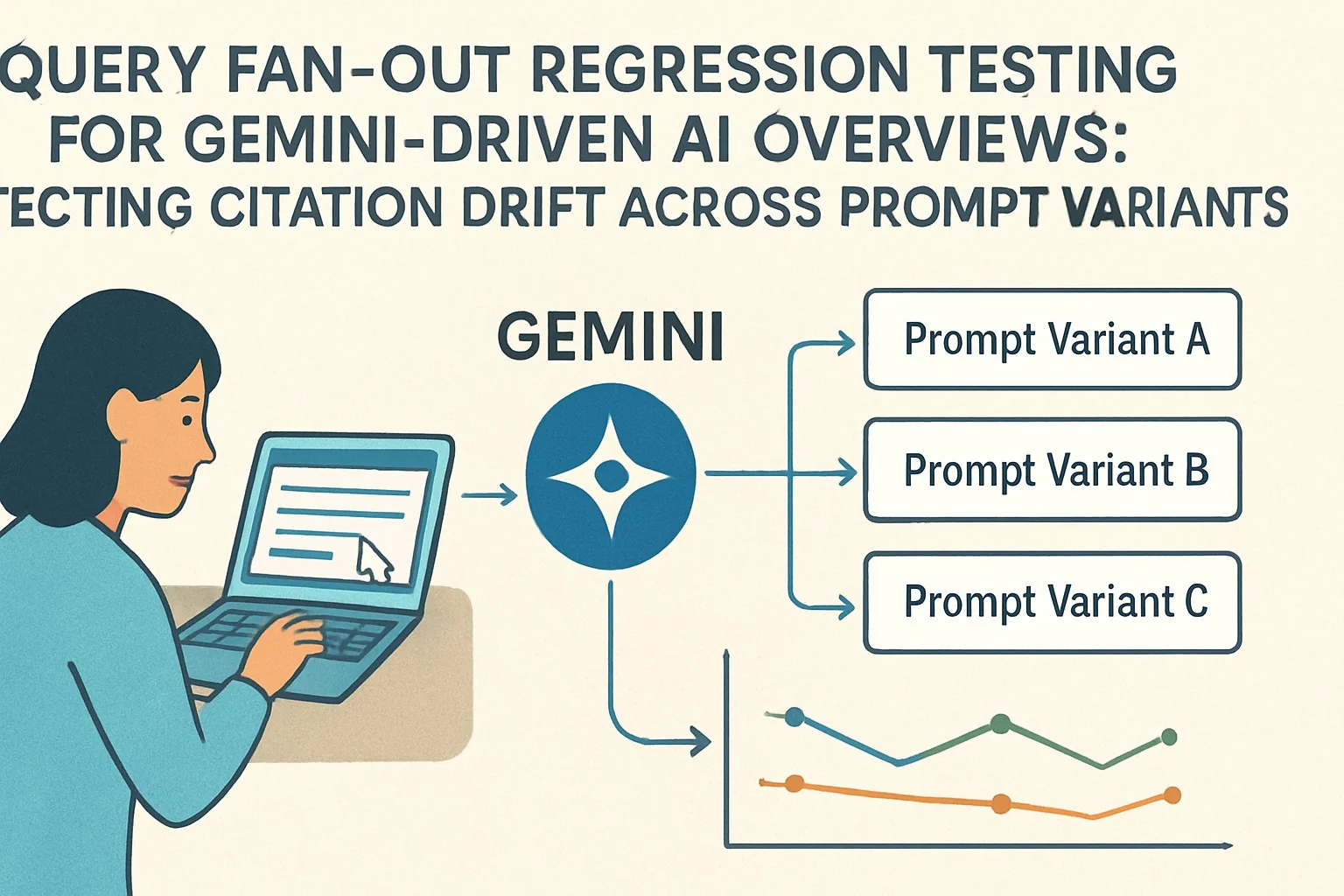
When a Gemini-driven AI Overview changes behavior due to prompt tweaks, retriever updates, or model rollouts, the answer can stay "semantically similar" while its citations silently drift—which breaks trust, violates internal policy, and can breach your AI Overview citation SLO.
This article delivers a production-grade method for Query Fan-Out Regression Testing for Gemini-driven AI Overviews: we execute a controlled set of prompt variants, capture citation outputs deterministically, and quantify drift so you can fail fast—before users see "new" (or worse, mismatched) sources.
Failure scenario (typical): After an innocuous prompt edit ("be more concise"), your AI Overview still answers the same question, but the cited passages now come from a different section of the same page, or from a different document entirely. A compliance audit later flags that the cited authority no longer supports the claim. Worse, your dashboards show stable latency and high overall QA scores—because semantic evaluation didn't test citation stability. The fix is a regression harness that treats citations as first-class outputs with measurable drift.
Executive Summary
TL;DR: Run a deterministic fan-out of prompt variants per query, then compute per-citation drift (ID, snippet, and claim-to-source alignment) to enforce an AI Overview citation SLO.
- Fan-out regression testing isolates "prompt sensitivity" by holding context constant and varying only the prompt surface.
- Citation drift detection should operate on structured citation objects (source ID, span, snippet hash, URL canonicalization), not raw text.
- Use SLO-style thresholds (e.g., drift rate p95 < X%) and gate releases when exceeded.
- Separate failure modes: retrieval churn vs prompt-induced citation selection vs generator extraction bugs.
- Make it observable: log prompt variant IDs, retrieved doc IDs, and citation spans to support root-cause attribution.
Likely Q→A pairs
Q: What is AI Overview citation drift detection?
A: A method to measure whether the citations (sources and supporting text spans) change across prompt variants or releases while the answer intent remains constant.
Q: How does Gemini AI Overview regression testing work?
A: It runs a regression harness that fans out multiple prompt variants, captures structured citations, and compares drift against a baseline using defined thresholds.
Q: What is the core signal for an AI citation regression harness?
A: Structured citation stability metrics—e.g., source ID consistency and citation-span overlap—plus optional claim-to-source alignment checks.
How Query Fan-Out Regression Testing for Gemini-Driven AI Overviews: Detecting Citation Drift Across Prompt Variants Works Under the Hood
Think of "citation drift" as output instability in the citation layer. You want to measure how much the cited authority changes when you alter prompt surface area, while keeping retrieval inputs (or at least their statistical distribution) under control.
1) Canonicalize the citation you are measuring
Before you compare runs, you must standardize citation representation so you're not comparing apples to whitespace. For each AI Overview response, extract citations into structured records like:
- source_id (canonical document identifier: URL normalized + content hash or internal doc ID)
- url (canonical)
- span (char offsets or token offsets if available)
- snippet_hash (hash of canonicalized supporting text)
- evidence_confidence (if your pipeline provides it)
- claim_links (optional mapping from claims to citations, if you perform alignment)
In practice, you'll often only have citation text + URL. Even then, store snippet hashes and canonicalized URLs; you can approximate span stability by normalizing text and using fuzzy overlap (more on that later).
2) Fan-out prompts without changing the underlying question semantics
"Fan-out" means: for each test query, you run N prompt variants that vary only in controlled ways (tone, verbosity, instruction phrasing, citation formatting constraints). Example variant dimensions:
- Output style: concise vs detailed
- Instruction strength: "cite every key claim" vs "cite the most important claims"
- Formatting**: JSON citation schema strictness (if supported)
- System prompt variants: safe-completion guard wording changes
Each run should attach a prompt_variant_id and keep other system inputs stable: query, user locale, retrieval index version, model version, temperature/top-p, and any reranking configuration.
3) Baseline and compare: drift as a function of structured differences
Define a baseline artifact for each query: either the current "gold" build (production) or a known-good reference run. Then compute drift metrics between each new run and baseline. Useful drift signals include:
- Source drift rate: fraction of citation slots whose
source_iddiffers - Snippet drift rate: snippet hashes differ (or overlap drops below threshold)
- Span overlap: Jaccard/token overlap between evidence spans (if available)
- Citation count delta: number of citations changed (a proxy for citation behavior shifts)
- Claim-to-source mismatch (optional but powerful): if you can align claims to citations, measure mismatch rate
Then summarize per query and per prompt variant. For SLO enforcement, compute distribution metrics (p95/p99) across the test suite, not just averages.
4) Root-cause attribution: separate retrieval churn from generator drift
In a Gemini-style pipeline, citations depend on multiple stages: retrieval, context assembly, prompt, generation, and post-processing. The key editorial discipline is: log the evidence supply chain so you can answer "why drift?"
At minimum, log per run:
- retrieved doc IDs (top-K) and their ranking scores
- context assembly template version
- prompt variant ID
- model version + generation params
- raw model output and extracted citation JSON (before/after post-processing)
If the retrieved doc IDs differ but citation drift is "stable relative to new docs," you may be seeing retrieval churn. If retrieved docs match but citation sources change, you likely have prompt-induced citation selection or generator extraction issues.
If you're also monitoring citations continuously in production (not only in regression), the instrumentation you build here aligns with AI Overview Citation Monitoring: Alerts, SLOs & Root-Cause Attribution.
Implementation: Production Patterns
Below is a practical progression: start simple (source+snippet drift), then add span/claim alignment, and finally implement gating + runbooks.
Step 1: Define your citation contract (schema first)
Even if Gemini emits citations in a format you don't control, standardize them into a contract your harness can compare. Recommended schema:
source_id(string)url_canon(string)evidence_text_canon(string)snippet_hash(e.g., SHA-256 of normalized evidence text)span(nullable)slot_index(0..m-1)
Normalization matters: canonicalize URLs (remove tracking params), normalize whitespace, lowercase where safe, and strip boilerplate like "©" artifacts. This is how you prevent false drift from formatting artifacts.
Step 2: Build the fan-out runner (deterministic harness)
Core harness behavior:
- For each query, enumerate prompt_variant_ids.
- For each variant, call the Gemini Overview endpoint with fixed generation params.
- Extract citations into your contract.
- Store (prompt_variant_id, baseline_artifact_id, citations_contract) in an immutable run log.
- Compute drift metrics and produce a pass/fail decision.
For reproducibility:
- set temperature=0 (or near-zero) for citation stability tests
- freeze retrieval index version (or run with fixed retrieval snapshot)
- pin post-processing versions (citation extractor / URL normalizer)
Step 3: Drift metrics that engineers can operationalize
A minimal set that works in production:
- Source drift rate = (# slots where source_id differs) / (baseline citation count)
- Snippet drift rate = (# slots where snippet_hash differs) / (baseline citation count)
- Citation count delta = |m_new - m_base| / max(1, m_base)
If you have span or can map snippet text back to evidence spans in the retrieved doc, add:
- Evidence overlap: Jaccard or token overlap between baseline and new evidence spans
Step 4: Code example — citation extraction + hashing
This is intentionally small: the goal is to show deterministic canonicalization and hashing.
import hashlib, re, urllib.parse

def canon_url(url: str) -> str:
    u = urllib.parse.urlsplit(url)
    # Drop tracking params; keep scheme/host/path/query sans known noise.
    q = urllib.parse.parse_qsl(u.query, keep_blank_values=False)
    noise_keys = {"utm_source","utm_medium","utm_campaign","utm_term","utm_content","gclid","fbclid"}
    q_clean = [(k,v) for (k,v) in q if k.lower() not in noise_keys]
    q_str = urllib.parse.urlencode(q_clean, doseq=True)
    return urllib.parse.urlunsplit((u.scheme.lower(), u.netloc.lower(), u.path, q_str, u.fragment))

def canon_text(s: str) -> str:
    s = re.sub(r"\s+", " ", s or "").strip()
    return s

def sha256_hex(s: str) -> str:
    return hashlib.sha256(s.encode("utf-8")).hexdigest()

def make_snippet_hash(evidence_text: str) -> str:
    return sha256_hex(canon_text(evidence_text).lower())

# Example citation normalization
# extracted_citations expected from your pipeline: list of {url, evidence_text, span(optional)}

def normalize_citations(extracted_citations, slot_index_start=0):
    out = []
    for i, c in enumerate(extracted_citations):
        url = c.get("url") or ""
        url_canon = canon_url(url)
        evidence_text = c.get("evidence_text") or ""
        snippet_hash = make_snippet_hash(evidence_text)
        out.append({
            "slot_index": slot_index_start + i,
            "source_id": c.get("source_id") or url_canon,
            "url_canon": url_canon,
            "evidence_text_canon": canon_text(evidence_text),
            "snippet_hash": snippet_hash,
            "span": c.get("span")
        })
    return out
Step 5: Code example — drift metrics
def index_citations_by_slot(citations):
    # citations are already ordered; use slot_index as alignment key.
    return {c["slot_index"]: c for c in citations}

def drift_metrics(baseline, candidate):
    b = index_citations_by_slot(baseline)
    c = index_citations_by_slot(candidate)

    slots = sorted(set(b.keys()) | set(c.keys()))
    base_count = max(1, len(b))

    source_diff = 0
    snippet_diff = 0
    nonmatching_slots = 0
    for s in slots:
        bc = b.get(s)
        cc = c.get(s)
        if bc is None or cc is None:
            # treat missing citation as drift
            nonmatching_slots += 1
            continue
        if bc["source_id"] != cc["source_id"]:
            source_diff += 1
        if bc["snippet_hash"] != cc["snippet_hash"]:
            snippet_diff += 1

    m_base = len(b)
    m_new = len(c)
    citation_count_delta = abs(m_new - m_base) / max(1, m_base)

    return {
        "source_drift_rate": source_diff / base_count,
        "snippet_drift_rate": snippet_diff / base_count,
        "missing_slot_delta": nonmatching_slots / base_count,
        "citation_count_delta": citation_count_delta,
        "baseline_citation_count": m_base,
        "candidate_citation_count": m_new,
    }
Step 6: Gate releases with citation SLOs
Replace "best effort QA" with an explicit AI Overview citation SLO. For example:
- For each query: source_drift_rate must be ≤ 0.10
- For the suite: p95 of source_drift_rate across all queries ≤ 0.05
- Hard failures: any increase in missing_slot_delta > 0.20
- Optional: claim_to_source_mismatch_rate ≤ 0.02
When you fail a build, your harness should emit:
- top offenders (queries + prompt_variant_ids)
- baseline vs candidate citation sets (structured diff)
- retrieval doc IDs delta (to classify drift origin)
For end-to-end monitoring design patterns, see AI Overview Citation Monitoring: Alerts, SLOs & Root-Cause Attribution.
Step 7: Error handling and "don't hide failures" discipline
Citation regression harnesses must treat extraction errors as signals, not as noise:
- If citations fail to parse into schema, tag run as citation_extraction_error and fail fast (or quarantine if you must).
- If evidence_text is empty while citations exist, flag evidence_missing.
- If URL canonicalization changes frequently, ensure you version the normalizer and include its version in logs.
Step 8: Optimization — make it cheap enough to run every PR
Fan-out can explode cost if you run 30 variants x 500 queries. The practical strategy:
- Tiered test suite: small "critical prompts" on PR, full suite on nightly
- Query clustering: sample queries that cover top intents/domains
- Early exit: if hard failure thresholds breached, stop remaining variants for that query
- Result caching: cache retrieval + context for unchanged query/index versions
If your upstream pipeline is RAG-heavy, and you want to quantify how citation correctness degrades across pipeline changes, pair this harness with RAG Citation Integrity: Measure Accuracy Loss in Pipelines.
Comparisons & Decision Framework
There are multiple ways to detect citation drift. Choose based on what you can extract and how strict your SLO must be.
Option A: Source-only drift (fast, low fidelity)
- Signal: source_id (URL/doc ID) changes
- Pros: cheap, robust to minor snippet formatting
- Cons: misses "same source, wrong evidence span" issues
Option B: Source + snippet-hash drift (recommended baseline)
- Signal: source_id + evidence_text_canon hash changes
- Pros: catches wrong excerpt selection; still inexpensive
- Cons: sensitive to text normalization; may over-report if evidence_text is unstable
Option C: Evidence span overlap (higher fidelity, higher integration cost)
- Signal: span overlap or mapped offsets into retrieved docs
- Pros: best at catching subtle extraction differences
- Cons: requires stable mapping from evidence text back to doc chunks
Option D: Claim-to-source alignment (best fidelity; hardest engineering)
- Signal: structured claim extraction + alignment scoring against citations
- Pros: detects "citation doesn't support claim" even if sources remain same
- Cons: additional compute; alignment model can introduce its own errors
Decision checklist
- Can you extract stable source identifiers (doc ID or canonical URL)? If no, implement canonicalization and/or enrich citation metadata.
- Can you extract evidence text consistently? If yes, add snippet_hash drift.
- Can you map evidence back to retrieved document chunks? If yes, implement span overlap.
- Is your compliance regime sensitive to "support mismatch"? If yes, add claim-to-source alignment with careful evaluation.
Editorial rule of thumb: start with Option B, then graduate to Option C for the queries that matter most, and use Option D for high-risk domains (legal/medical/defense).
Failure Modes & Edge Cases
1) Canonicalization false positives
Symptom: drift rate spikes after changes in URL tracking params or whitespace formatting.
Diagnostic: diff canonicalizer version and observe whether url_canon changes for the same underlying doc.
Mitigation: version canonicalization, drop tracking params, normalize evidence text before hashing.
2) Citation slot misalignment
Symptom: baseline has 5 citations; candidate has 4 and slots shift, inflating drift.
Diagnostic: inspect slot_index assignment logic and whether slots are stable across runs.
Mitigation: if slots aren't stable, align citations by best matching source_id first, then compute drift on matched pairs. (Your harness should support both slot-based and best-match modes.)
3) Retrieval churn masquerading as prompt drift
Symptom: drift correlates with retrieval rank changes.
Diagnostic: compare retrieved doc IDs distribution between runs; if top-K differs, treat as retrieval-driven and categorize accordingly.
Mitigation: freeze retriever snapshot for regression; or stratify reports by retrieval delta magnitude.
4) Generator "citation style" changes
Symptom: citations remain correct but formatting changes cause parser drift (e.g., parentheses vs brackets).
Diagnostic: check raw model output and parse coverage rate.
Mitigation: implement resilient parsing and store parse confidence. Parse failures should be counted separately from drift failures.
5) Non-determinism from sampling settings
Symptom: drift happens even with unchanged code.
Diagnostic: verify temperature/top-p; also confirm any backend uses sampling even when temperature=0.
Mitigation: enforce deterministic generation settings for citation tests; if not possible, measure variance and adjust thresholds with statistical discipline.
6) Hallucinated or "synthetic" citations
Symptom: citations reference documents not in your retrieval context.
Diagnostic: check whether cited source_id exists in retrieved doc ID set.
Mitigation: add a hard constraint: citations must be drawn from retrieved evidence; or at least flag "out-of-context citations" as a failure class.
If your system is in a regulated environment, combine citation stability with broader system assurance controls. For acquisition and governance framing, see ATO for LLM Systems: A Defense AI Procurement Blueprint.
Performance & Scaling
Citation drift harnesses are compute-heavy, but you can keep them practical with careful KPI design and cost controls.
Key KPIs
- Coverage: queries x variants processed per run
- Run time: p50/p95/p99 end-to-end harness duration
- Extraction health: citation_parse_success_rate
- Drift distribution: p50/p95/p99 source_drift_rate and snippet_drift_rate
- Cost per PR: tokens consumed per variant, averaged
p95/p99 guidance
Use p95 (and sometimes p99) drift thresholds rather than mean drift. Mean drift can look "fine" while a small set of queries regress severely—exactly what user trust concerns target.
Operationally, set thresholds such that:
- p95 source_drift_rate across suite < SLO_source (e.g., 0.05)
- p99 missing_slot_delta < hard_max (e.g., 0.20)
Complexity and batching
Let Q be number of queries and V be number of variants per query. Baseline complexity is O(Q·V) model calls. Everything else (hashing, diffing) is O(total citations) and comparatively negligible.
To reduce wall-clock:
- batch per query if your Gemini API supports it (keep isolation for caching keys)
- parallelize across queries, but preserve per-query ordering in logs
- use caching for retrieval/context assembly when index version + query are unchanged
Production Best Practices
Security & integrity of the harness pipeline
Your regression harness becomes part of your release safety net. Treat it like production infrastructure:
- Store run artifacts immutably (hash all logs and store model/params metadata).
- Protect the citation extractor code version (deploy with provenance; pin image digests).
- Apply SBOM/SLSA-style integrity gates to your CI artifacts. This mirrors the principles discussed in AI Supply Chain Security for Enterprise AI Systems.
Rollout strategy
- Quarantine mode for first week: compute drift metrics, do not block merges, tune thresholds.
- Warn mode after baseline is established: fail only on parse failures or severe drift.
- Enforce mode when metrics stabilize: gate on SLO thresholds.
Runbooks: what to do when drift fails
When the harness flags a regression, your team needs a deterministic path to root cause:
- Classify drift: is retrieval doc set different? If yes, inspect retriever changes.
- Inspect prompt variant sensitivity: does drift appear only in "style" variants or all variants?
- Compare raw outputs: check whether generator cites wrong spans or wrong docs.
- Verify parsing: ensure citation extraction hasn't broken due to formatting changes.
- Reproduce: run the single failing query locally with pinned settings.
Testing discipline for prompt variants
Don't treat prompt variants as arbitrary. Make a small, meaningful matrix:
- one axis for verbosity
- one axis for citation instruction strictness
- one axis for formatting constraints (e.g., "use a JSON citation object" if available)
This keeps your fan-out informative rather than noisy.
Further Reading & References
- AI Overview Citation Monitoring: Alerts, SLOs & Root-Cause Attribution
- RAG Citation Integrity: Measure Accuracy Loss in Pipelines
- ATO for LLM Systems: A Defense AI Procurement Blueprint
- AI Supply Chain Security for Enterprise AI Systems
- LLM Security Testing Methodology: Threat Modeling
Practical next step: Implement the citation contract + baseline diff (Option B) first, then iterate into span overlap and claim-to-source alignment for the highest-risk query set until your AI Overview citation SLO is reliably met.


