
Do Quantum Processors Exist? A Critical Benchmark Cheat Sheet
Introduction
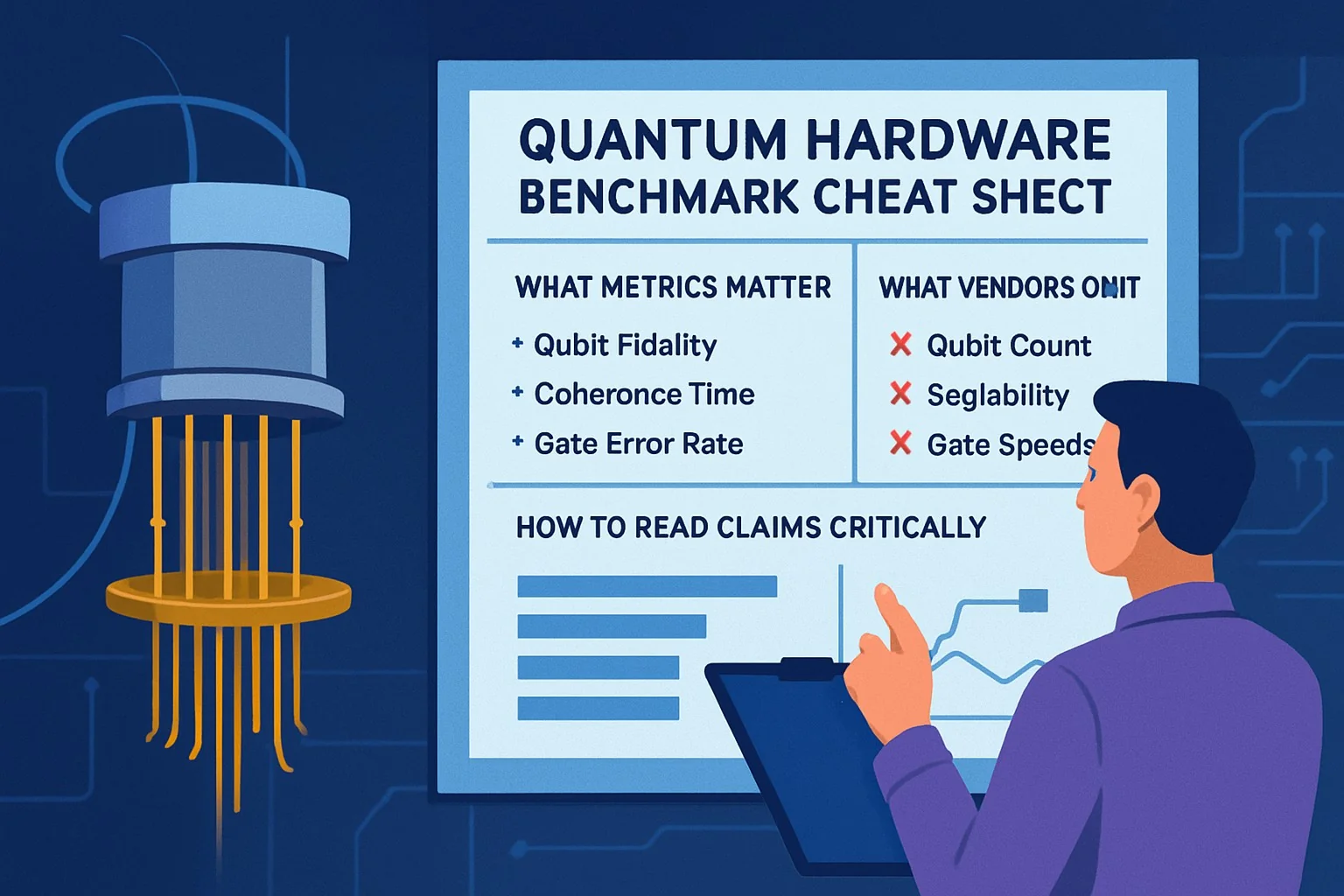
Production engineers evaluating quantum hardware face a credibility crisis: vendors publish headline metrics that resist direct comparison, omit critical error rates, and conflate physical qubit counts with computationally useful capacity. The question do quantum processors exist in any form that matters for real workloads has become harder to answer, not easier, as marketing sophistication outpaces standardization.
This article delivers a vendor-neutral, metric-by-metric decoding of quantum hardware claims. You will learn which benchmarks are meaningful, which are strategically buried, and how to construct a defensible procurement or research evaluation in an environment where Google's Willow quantum chip represents one path to error-corrected quantum advantage while competitors pursue radically different architectural bets.
Failure scenario: A systems team at a financial services firm allocated $2.3M to evaluate a "127-qubit" processor for portfolio optimization. Six months in, they discovered the vendor's published gate fidelity of 99.5% applied only to single-qubit operations; two-qubit gate fidelity—the bottleneck for their algorithm—was 97.2%, rendering the effective circuit depth insufficient. The omitted metric was not in the datasheet; it required direct measurement with randomized benchmarking. This article prevents that class of failure.
Executive Summary
TL;DR: Quantum processors exist in limited, noisy forms; vendor claims require cross-referencing six core metrics (coherence time, single/two-qubit gate fidelity, measurement fidelity, crosstalk, connectivity, and error correction overhead) against independently verified benchmarks, with particular scrutiny on omitted two-qubit and crosstalk specifications that dominate real circuit performance.
- Qubit count is the least informative metric—logical qubit yield after error correction matters more than physical qubit count by 10–1000×.
- Two-qubit gate fidelity is the dominant bottleneck for most algorithms; vendors often bury this below single-qubit figures.
- Coherence time (T1/T2) without gate speed context is meaningless—what matters is the ratio: (gate time × circuit depth) / coherence time.
- Randomized benchmarking (RB) and cross-entropy benchmarking (XEB) are the gold standards; state tomography and process tomography are too expensive for scale.
- Error correction overhead varies by 50× between surface code and LDPC implementations—vendor roadmap claims require code-specific scrutiny.
- Crosstalk and connectivity constraints can increase effective circuit depth by 3–10× over naive gate counts.
Quick Q→A for direct answer extraction:
- Q: Do quantum processors exist that can solve practical problems? A: Only for narrow, academically demonstrated problems; no quantum processor currently outperforms classical hardware at economically relevant scales without heroic classical co-processing.
- Q: What is the single most important metric to verify independently? A: Two-qubit gate fidelity via randomized benchmarking, as it determines whether your specific algorithm's entanglement requirements are met.
- Q: How do I detect misleading vendor claims? A: Demand randomized benchmarking data at your target circuit depth, not just single-qubit fidelities or shallow-circuit XEB scores.
How Quantum Hardware Benchmarking Works Under the Hood
The Physics-to-Metric Pipeline
Quantum processors are governed by three interacting physical phenomena: superposition (enabling parallel state exploration), entanglement (enabling correlated multi-qubit operations), and interference (enabling amplitude concentration on correct answers). Benchmarking translates these into measurable, comparable quantities through layered abstraction:
Layer 1: Physical qubit characterization measures Hamiltonian parameters—T1 (energy relaxation time), T2 (dephasing time), and gate speed (typically 10–1000 ns for superconducting, 1–100 μs for trapped ion). These determine the coherence budget: how many operations fit before environmental noise dominates.
Layer 2: Gate-level verification uses quantum process tomography (QPT) for full characterization of small systems, or scalable substitutes: randomized benchmarking (RB) for average gate fidelity, and gate set tomography (GST) for precise error budget decomposition. RB scales to 100+ qubits; QPT requires exponential measurement shots.
Layer 3: System-level benchmarks evaluate compiled circuits: quantum volume (QV), cross-entropy benchmarking (XEB), and application-oriented benchmarks like the QED-C suite. These capture connectivity, crosstalk, and compiler efficiency that Layer 2 metrics miss.
Layer 4: Error-corrected logical performance projects future capability: logical error rates per code cycle, logical qubit overhead ratios, and threshold comparisons. No system currently operates Layer 4 at scale; Alphabet's Quantum AI division is pursuing this through merged quantum-AI approaches that may accelerate convergence.
Critical Metric Definitions with Diagnostic Thresholds
Coherence time (T1, T2): T1 measures energy relaxation |1⟩ → |0⟩; T2 measures phase coherence loss. For superconducting transmons, T1 ≈ T2 ≈ 100–500 μs is state-of-the-art; for trapped ions, T2 > 10 s is achievable. Diagnostic rule: Effective circuit depth ≤ min(T1, T2) / (10 × t_gate), where t_gate is average gate duration. The factor 10 provides ~90% probability of no relaxation error.
Single-qubit gate fidelity: Typically 99.9–99.99% for mature platforms. High values are achievable because single-qubit rotations require minimal entanglement and can use composite pulse sequences for error suppression. Vendor trap: Prominently displayed single-qubit fidelities imply little about multi-qubit performance.
Two-qubit gate fidelity: The critical bottleneck, typically 95–99.5% for superconducting, 97–99.9% for trapped ion. Each two-qubit gate introduces entanglement-dependent error channels (crosstalk, spectator qubit effects, leakage to non-computational states). Threshold significance: Surface code error correction requires ~99% two-qubit fidelity for practical overhead; below ~98.5%, overhead explodes super-exponentially.
Measurement fidelity: Probability of correct basis state discrimination, typically 95–99.5%. Critical for variational algorithms (VQE, QAOA) requiring iterative measurement. Often omitted: Measurement crosstalk—readout of one qubit disturbing neighbors—can degrade effective fidelity by 2–5%.
Connectivity and crosstalk: Fixed vs. tunable connectivity (nearest-neighbor in planar superconducting, all-to-all in ion traps). SWAP overhead for limited connectivity increases circuit depth by 2–5× for dense graphs. Crosstalk—unintended coupling during gates—is rarely quantified; demand spectator RB data.
Quantum Volume (QV): IBM's holistic metric: largest square circuit (n qubits, n layers) successfully implemented with heavy-hex random circuits. QV 2^n where n is circuit width/depth. Current record: ~QV 2^20 (IBM Eagle, 2023). Limitation: Heavy-hex circuits are not representative of real algorithms; QV correlates weakly with VQE performance.
Cross-Entropy Benchmarking (XEB): Google's preferred metric for supremacy demonstrations. Compares experimental output distribution to classical simulation via cross-entropy. Critical caveat: XEB scores optimize for specific circuit structures; transfer to other algorithms is unproven.
What Vendors Omit and Why
| Omitted Metric | Why Hidden | How to Extract |
|---|---|---|
| Two-qubit gate fidelity at scale | Degrades with qubit count; single-qubit looks better | Demand simultaneous RB on all qubit pairs; check for pair selection bias |
| Crosstalk coefficients | Reveals architectural limitations | Request spectator RB; measure idle qubit error during active operations |
| Compiler optimization level for benchmarks | May use non-portable, hand-optimized circuits | Insist on benchmark code; test with your algorithm's connectivity graph |
| Thermal cycle history | Performance degrades with thermal cycling | Ask for multi-cycle stability data; negotiate measurement post-delivery |
| Error correction overhead for target logical qubit | Reveals years-to-decades timeline | Calculate from published code distance and physical error rate; do not trust roadmap graphics |
| Classical control latency | Determines real throughput, not just gate speed | Measure end-to-end job latency; verify pulse upload bandwidth |
Implementation: Production Evaluation Patterns
Phase 1: Baseline Verification (1–2 weeks)
Before committing to any quantum hardware engagement, establish independent measurement capability. The following Python pattern demonstrates randomized benchmarking using Qiskit Experiments (IBM) or equivalent frameworks for other platforms:
# Standardized two-qubit RB for vendor verification
# Requires: qiskit-experiments >= 0.5, qiskit >= 1.0

from qiskit_experiments.library import InterleavedRB
from qiskit import QuantumCircuit
import numpy as np

def verify_two_qubit_fidelity(backend, qubit_pair, num_samples=10,
                               num_circuits_per_sample=30, max_clifford_length=1000):
    """
    Independent two-qubit RB measurement with statistical rigor.

    Args:
        backend: Target quantum backend
        qubit_pair: Tuple (control, target) physical qubit indices
        num_samples: Statistical samples for error bar estimation

    Returns:
        dict with 'fidelity', 'fidelity_error', 'epc' (error per Clifford)
    """
    # Standard two-qubit Clifford RB
    exp = InterleavedRB(
        interleaved_element=None,  # Standard RB, not interleaved
        physical_qubits=qubit_pair,
        num_samples=num_samples,
        num_circuits=num_circuits_per_sample,
        seed=42
    )

    exp.set_transpile_options(optimization_level=0)  # Disable aggressive optimization
    # that may hide gate errors via circuit rewriting

    exp_data = exp.run(backend)
    exp_data.block_for_results()

    results = exp_data.analysis_results()

    return {
        'fidelity': results['EPC'].value,  # Error per Clifford
        'fidelity_error': results['EPC'].stderr,
        'two_qubit_gate_fidelity_estimate': 1 - results['EPC'].value / 1.5
        # Approximate conversion: 2Q Clifford ≈ 1.5 2Q gates average
    }

# Critical: run across ALL qubit pairs, not vendor-selected "best" pairs
all_pairs = [(i, j) for i in range(n_qubits) for j in range(i+1, n_qubits)
             if backend.configuration().coupling_map and (i,j) in backend.configuration().coupling_map]

fidelity_map = {}
for pair in all_pairs:
    fidelity_map[pair] = verify_two_qubit_fidelity(backend, pair)

# Flag pairs below threshold for your algorithm
CRITICAL_FIDELITY = 0.99  # Surface code threshold region
at_risk_pairs = [p for p, r in fidelity_map.items()
                 if r['two_qubit_gate_fidelity_estimate'] < CRITICAL_FIDELITY]
Key discipline: Set optimization_level=0 to prevent transpiler from substituting your test circuit with a different, higher-fidelity equivalent. This reveals raw hardware capability, not compiler cleverness.
Phase 2: Algorithm-Specific Stress Testing
Benchmarks must map to your workload. For variational algorithms (VQE/QAOA), measure:
# Algorithm-fidelity mapping: QAOA depth vs. expected success probability

def estimate_qaoa_success(ghz_fidelity_per_layer, num_layers, num_qubits):
    """
    Conservative success probability for QAOA with independent layer errors.
    Assumes: error dominated by two-qubit gates, measurement, and crosstalk.

    Real systems: errors are correlated, so this is an upper bound.
    """
    # Each QAOA layer: n/2 two-qubit gates (even-odd), n/2 (odd-even) = n gates
    # Plus single-qubit rotations, measurement

    gates_per_layer = num_qubits  # Approximate for regular graphs
    total_gates = gates_per_layer * num_layers

    # Conservative: each gate independent with fidelity f
    # For correlated errors, replace with joint RB or XEB at target depth

    success_prob = ghz_fidelity_per_layer ** total_gates
    return success_prob

# Example: 20-qubit MaxCut, p=3 QAOA
# Vendor claims 99.5% two-qubit fidelity
# Reality check: with measurement overhead, effective ~97%

for claimed_fidelity, realistic_fidelity in [(0.995, 0.97), (0.999, 0.99)]:
    print(f"Claimed {claimed_fidelity}: success = {estimate_qaoa_success(claimed_fidelity, 3, 20):.2e}")
    print(f"Realistic {realistic_fidelity}: success = {estimate_qaoa_success(realistic_fidelity, 3, 20):.2e}")

# Typical output: claimed gives 0.74, realistic gives 0.17
# The difference between "demonstrated" and "useful"
Phase 3: Error Correction Roadmap Validation
For long-term procurement decisions, validate vendor error correction claims:
# Surface code overhead calculator for vendor claim verification

def surface_code_logical_overhead(physical_error_rate, target_logical_error_rate,
                                 code_distance=None):
    """
    Estimate physical qubits per logical qubit for surface code.

    Uses threshold-scaling approximation: logical error ~ (p/p_th)^(d/2)
    where p_th ~ 1% for surface code with ideal gates.

    Real systems: p_th reduced by measurement, crosstalk, leakage.
    """
    p_th_effective = 0.005  # Conservative: real systems below ideal threshold

    if code_distance is None:
        # Solve for required distance
        d = 2 * np.log(target_logical_error_rate / physical_error_rate) / np.log(physical_error_rate / p_th_effective)
        d = max(3, int(np.ceil(d)))
        if d % 2 == 0:
            d += 1  # Distance must be odd for surface code
    else:
        d = code_distance

    physical_per_logical = 2 * d * d  # Planar surface code, rotated variant

    # Verify: does claimed logical error rate match?
    achieved_logical = physical_error_rate * (physical_error_rate / p_th_effective) ** (d / 2)

    return {
        'code_distance': d,
        'physical_qubits_per_logical': physical_per_logical,
        'achieved_logical_error_rate': achieved_logical,
        'meets_target': achieved_logical <= target_logical_error_rate
    }

# Example: Vendor claims 1000 physical qubits → 10 logical qubits
# Implies 100:1 overhead, distance ~7
# Required physical error rate for logical 1e-10?

claim = surface_code_logical_overhead(physical_error_rate=1e-3,
                                       target_logical_error_rate=1e-10,
                                       code_distance=7)
print(f"Distance-7 with p=1e-3: logical error {claim['achieved_logical_error_rate']:.2e}")
# Typically >> 1e-10: claim is unachievable without 10-100x better physical qubits
Comparisons & Decision Framework
Platform Comparison: What Each Architecture Optimizes
| Platform | Strength | Weakness | Best Benchmark Focus |
|---|---|---|---|
| Superconducting (IBM, Google, Rigetti) | Gate speed (~10-100 ns), scale (1000+ qubits) | Coherence time, cryogenic complexity, crosstalk | Two-qubit RB at full scale; quantum volume with native connectivity |
| Trapped Ion (IonQ, Quantinuum) | Coherence (seconds), all-to-all connectivity, fidelity | Gate speed (~1-10 μs), laser stability, limited scale (~50) | Algorithm-specific depth limits; reconfiguration time for connectivity changes |
| Photonic (PsiQuantum, Xanadu) | Room temperature, networking natural | Probabilistic gates, resource overhead, no deterministic two-qubit gates | Per-photon loss rates; fusion gate success probability; active switching latency |
| Neutral Atom (QuEra, Pasqal) | Mid-scale reconfigurable arrays, analog mode | Gate fidelity (~97-98%), atom loss, speed | Rydberg blockade fidelity; atom rearrangement overhead; analog-digital comparison |
| Semiconductor/Si spin (Intel, Delft) | CMOS compatibility, small footprint | Gate speed variability, hyperfine noise, limited demonstration | Single-shot readout fidelity; charge noise sensitivity; T2* echo decay |
Procurement Decision Checklist
Use this structured evaluation for any quantum hardware engagement:
- Define algorithmic requirements first: Circuit width (qubits), depth (gates), connectivity graph, and classical co-processing needs. Do not let vendor metrics redefine your problem.
- Demand independent RB data: Two-qubit randomized benchmarking on your target qubit pairs, not vendor-selected "representative" subsets. Require raw data, not summary statistics.
- Measure crosstalk directly: Run parallel RB—identical circuits on all qubits simultaneously vs. isolated. Flag >0.5% fidelity degradation as architectural concern.
- Validate compiler claims: Benchmark with
optimization_level=0(raw) and maximum optimization. The gap reveals compiler contribution vs. hardware capability. - Stress-test at target depth: Run XEB or algorithmic benchmarks at 2× your expected circuit depth. Fidelity decay curves reveal non-Markovian noise and drift.
- Audit error correction assumptions: Calculate required code distance from published physical error rates. Vendor roadmaps showing "100 logical qubits by 20XX" are unverifiable without this decomposition.
- Measure total cost of ownership: Include dilution refrigerator maintenance (superconducting), laser replacement (ion trap), or cryogenic photon detectors (photonic). Capital cost is often 30–50% of 5-year TCO.
- Evaluate cloud access reliability: Queue depth, job preemption, calibration schedules. IBM and Amazon Braket publish uptime; smaller vendors may not.
Failure Modes & Edge Cases
Metric Misrepresentation Patterns
Leveed fidelity reporting: Vendors report fidelity on "best" qubits or after post-selection. Diagnostic: Demand histogram of all qubit pair fidelities; reject if σ/mean > 0.1.
Shallow-circuit XEB inflation: XEB scores peak at intermediate depths (~10-20 layers) then decay; vendors report peak, not your target depth. Diagnostic: Require XEB vs. depth curve through your algorithm's depth.
Tomography cherry-picking: State tomography on small subsystems (2-3 qubits) shows high fidelity; scales poorly. Diagnostic: Insist on scalable RB or XEB; tomography is valid only for characterization, not benchmarking.
Logical qubit inflation: Counting "error detection" demonstrations as "error correction." Diagnostic: True error correction requires: (a) non-demolition syndrome measurement, (b) real-time classical decoding, (c) feedforward correction, (d) logical error rate below physical. Google's Willow breakthrough claims in this domain merit investor scrutiny against these four criteria.
Operational Failure Modes
Calibration drift: Superconducting qubit frequencies drift with thermal cycling and two-level system defects. Mitigation: Run RB before each critical experiment; budget 10–20% overhead for recalibration.
Leakage to non-computational states: In transmons, |2⟩ state population accumulates during repeated gates, causing phase errors not captured by standard RB. Mitigation: Demand leakage RB (LRB) data; implement leakage reduction units (LRUs) in circuits.
Classical control bottlenecks: AWG bandwidth, DAC resolution, or FPGA latency limits effective gate parallelism. Mitigation: Measure end-to-end pulse upload-to-measurement latency; verify against advertised gate speed.
Performance & Scaling
Current State-of-the-Art Benchmarks (Verified, 2024)
| Metric | Leading Platform | Verified Value | Context |
|---|---|---|---|
| Two-qubit gate fidelity | Quantinuum H2 (trapped ion) | 99.9% | 32 qubits; all-to-all connectivity |
| Qubit count (physical) | IBM Condor | 1,121 | Heavy-hex lattice; limited connectivity |
| Quantum Volume | IBM Eagle | 2^20 | 127 qubits; heavy-hex circuits |
| Cross-entropy score | Google Sycamore | XEB ~0.2% above classical simulation | 53 qubits, 20-cycle random circuits; 2019 supremacy claim |
| Logical qubit demonstration | Google Willow / IBM Heron | Distance-3 surface code | Error detection, limited correction; logical < physical fidelity |
| Coherence time T2 | Quantinuum (ion trap) | >10 seconds | With dynamical decoupling; gate time ~10 μs limits useful depth |
Scaling Laws and Practical Limits
The critical scaling parameter for noisy quantum computing is the error-budgeted circuit volume: qubits × depth × (1 - effective error rate)^(gate count). Current systems achieve ~10^3–10^4 effective gate operations before noise dominates; useful quantum simulation typically requires 10^6–10^12.
Error correction scaling: Surface code overhead scales as O(1/p^2) near threshold. At p = 10^-3 (current best), distance-11 requires ~242 physical qubits per logical with logical error ~10^-8—insufficient for Shor's algorithm factoring RSA-2048 (~10^12 operations). At p = 10^-4, distance-7 achieves comparable logical error with 98 qubits. This is why Google's exploration of quantum-AI integration in consumer-adjacent platforms represents an alternative path: hybrid algorithms that reduce required quantum depth through classical preprocessing.
p95-p99 guidance for cloud access: Queue latency on IBM Quantum premium tier: p50 ~2 min, p95 ~30 min for 100+ qubit systems. IonQ via AWS Braket: p50 ~10 min, p95 ~4 hours due to limited system count. Budget for p99, not median, in production workflows.
Production Best Practices
Security and Access Control
Quantum cloud access introduces unique risks: algorithm intellectual property exposed in circuit compilation (IBM Qiskit Runtime sends OpenQASM), and side-channel leakage through timing of calibration queries. Mitigation: Use blind quantum computing protocols where available (limited); encrypt classical communication; audit job logs for pattern analysis.
Testing and Validation Runbooks
Establish pre-flight checklists:
- Daily: Single-qubit RB on all qubits (<30 sec); flag >5% drift from baseline.
- Weekly: Two-qubit RB on critical paths for target algorithm.
- Monthly: Full QV or algorithmic benchmark; track trend, not absolute.
- Pre-campaign: Crosstalk characterization with parallel idle qubit tomography.
Runbook: Vendor Claim Dispute Resolution
When measured performance diverges from datasheet:
- Reproduce with
optimization_level=0to eliminate compiler effects. - Run identical circuit at 0.5×, 1×, 2× depth to isolate depth-dependent degradation.
- Test on alternative qubit pairs to identify fabrication variation vs. systematic issue.
- Request vendor's raw RB data with seed values for independent reproduction.
- Escalate to contract terms: many agreements include "performance verification period" with exit clauses.
Further Reading & References
- Cross-Entropy Benchmarking: Boixo et al., "Characterizing quantum supremacy in near-term devices," Nature Physics 14, 595 (2018). Defines XEB and its statistical properties; essential for understanding Google's supremacy claims.
- Randomized Benchmarking Standard: Magesan et al., "Scalable and robust randomized benchmarking of quantum processes," Physical Review Letters 106, 180504 (2011). The foundational protocol; all vendor RB claims trace to this methodology.
- Quantum Volume Specification: Cross et al., "Validating quantum computers using randomized model circuits," Physical Review A 100, 032328 (2019). IBM's holistic benchmark; understand its circuit structure limitations before applying to your algorithms.
- Surface Code Threshold Analysis: Fowler et al., "Surface codes: Towards practical large-scale quantum computation," Physical Review A 86, 032324 (2012). The canonical reference for error correction overhead calculations; required reading for roadmap evaluation.
- Application-Oriented Benchmarks (QED-C): Lubinski et al., "Application-oriented performance benchmarks for quantum computing," IEEE Transactions on Quantum Engineering (2023). Industry-standard suite for algorithm-relevant comparison; supplement to hardware-centric metrics.
- Vendor-Neutral Benchmarking Framework: Blume-Kohout et al., "Demonstration of qubit operations below a rigorous fault tolerance threshold with gate set tomography," Nature Communications 8, 14485 (2017). GST methodology for precise error budget decomposition when RB is insufficient.
Final editorial note: The quantum hardware landscape rewards disciplined skepticism. Vendors are not malicious; they are optimizing for fundraising and market positioning in the absence of standardized benchmarks. Your role as evaluator is to construct measurement protocols that align their incentives with your actual requirements. The metrics and code patterns in this article provide that foundation.


