
Cross-Engine Citation Benchmarking: Compare AI Source Authority
Introduction
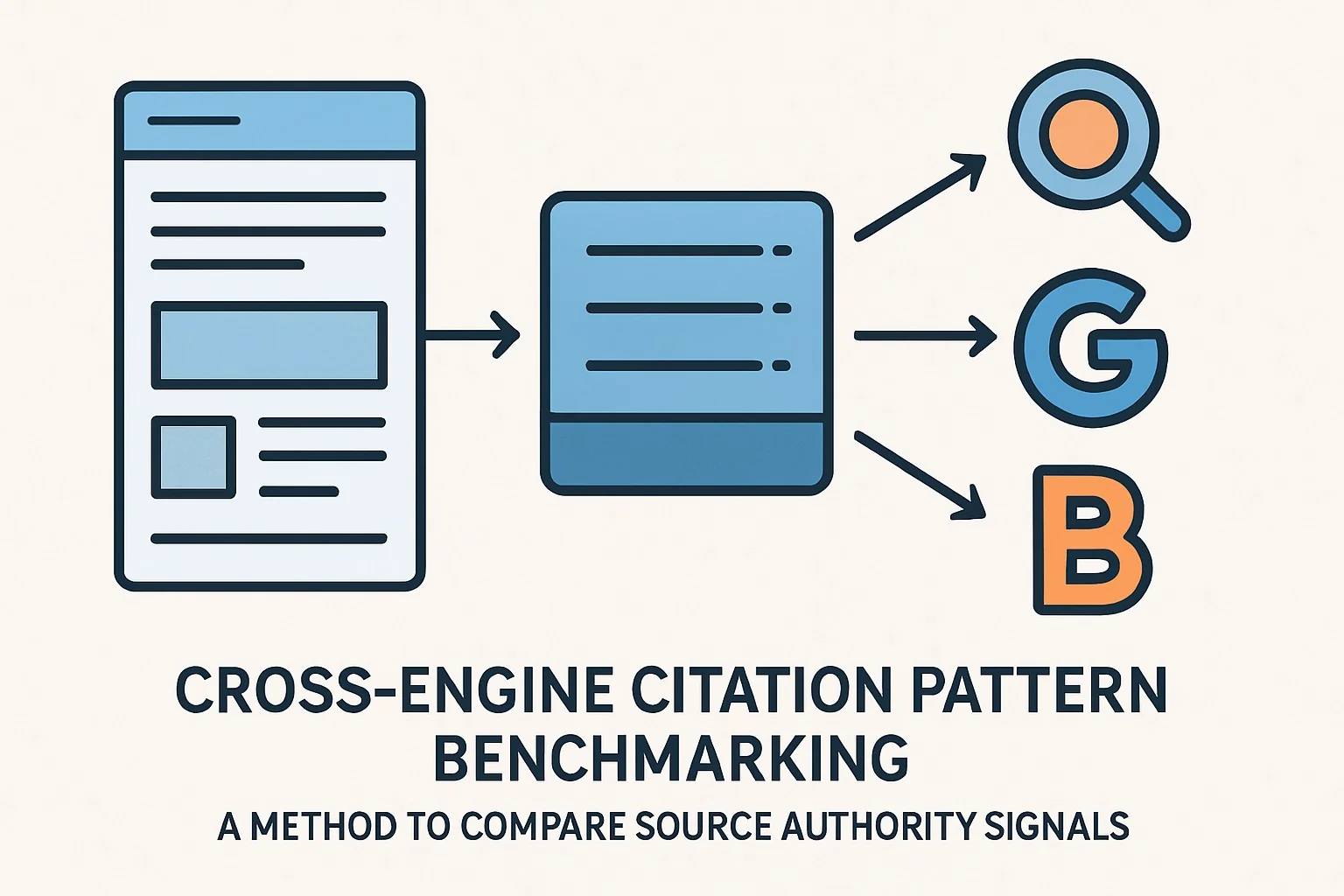
When your product's AI-generated answers cite sources that contradict each other across ChatGPT, Gemini, and Perplexity, whose authority signal do you trust? This is not an academic question—it is a production reliability problem that directly impacts user trust, compliance audits, and SEO visibility. In regulated industries, inconsistent citation patterns across LLM engines can expose organizations to liability: one engine venerates a peer-reviewed journal, another elevates an unverified forum post, and a third omits attribution entirely.
This article delivers a reproducible, instrumented method to benchmark how different AI engines select, rank, and present source authority signals. You will learn to build a cross-engine citation benchmarking pipeline that surfaces actionable drift detection, quantifies authority divergence, and integrates with existing observability stacks. The payoff: citation consistency becomes a measurable SLO, not a post-incident mystery.
Failure scenario: A fintech compliance team discovered that ChatGPT-4o cited SEC.gov for a regulatory interpretation while Gemini 1.5 Pro surfaced a 2018 Medium post with outdated guidance. Perplexity, meanwhile, synthesized both without ranking clarity. The team had no systematic way to detect this divergence until a customer complaint triggered manual review—72 hours of exposure, zero automated detection. This pattern repeats across healthcare, legal tech, and enterprise knowledge bases where source authority directly maps to decision risk.
Executive Summary
TL;DR: Cross-engine citation benchmarking is a structured method to query multiple LLM engines with identical prompts, extract their citation graphs, and quantitatively compare source selection patterns—enabling teams to detect authority drift, enforce citation SLOs, and validate RAG pipeline integrity against real-world engine behavior.
- Authority signals are engine-specific, not universal: ChatGPT, Gemini, and Perplexity each encode distinct source ranking heuristics that diverge measurably on identical queries.
- Benchmarking requires graph extraction, not text comparison: Comparing rendered answers misses structural differences; citation graph topology reveals engine-specific authority models.
- Drift detection needs baselines and statistical thresholds: Without p95-p99 divergence bounds, teams cannot distinguish meaningful signal changes from noise.
- Production integration demands observability-native instrumentation: Benchmark results must flow into existing SLO pipelines, not siloed reports.
- RAG pipeline validation benefits from engine-grounded baselines: Internal citation behavior should be calibrated against external engine patterns, not assumed optimal.
- Automated regression testing prevents citation degradation: Citation patterns shift with model updates; continuous benchmarking catches drift before user impact.
Quick Q&A for direct extraction:
- Q: What is cross-engine citation benchmarking? A: A method to query multiple AI engines identically, extract their citation structures, and quantitatively compare source selection patterns to detect authority signal divergence.
- Q: Why do ChatGPT and Gemini cite different sources for the same query? A: Each engine employs distinct retrieval architectures, training data mixtures, and post-processing filters that encode different authority heuristics—divergence is expected and measurable.
- Q: How do I detect citation drift in production? A: Establish baseline citation graphs from periodic benchmark runs, compute graph similarity metrics (Jaccard, weighted overlap, authority rank correlation), and alert when p95 divergence exceeds threshold.
How Cross-Engine Citation Pattern Benchmarking Works Under the Hood
Architecture Overview
The benchmarking pipeline comprises five instrumented stages: prompt normalization, engine dispatch, citation extraction, graph construction, and comparative analysis. Each stage must be deterministic and auditable to support regulatory and debugging use cases.
Prompt normalization eliminates confounding variables. Identical queries must reach each engine with controlled temperature, context window constraints, and system prompt isolation. For citation benchmarking specifically, prompts should request explicit source enumeration ("cite your sources with URLs") to maximize extractability, while a parallel "natural" prompt stream captures default engine behavior without instruction.
Engine dispatch handles API heterogeneity. ChatGPT (OpenAI), Gemini (Google), and Perplexity expose incompatible response schemas. ChatGPT returns inline citations via annotations in chat completions; Gemini surfaces grounding metadata via groundingMetadata; Perplexity embeds citations in a structured citations array. A unified dispatch layer abstracts these into a normalized event schema, preserving raw engine outputs for forensic replay.
Citation extraction transforms engine-specific metadata into canonical citation records: URL, title, snippet, engine-assigned relevance score (if exposed), and structural position (inline, footnote, sidebar). Extraction must handle edge cases: relative URL resolution, paywall fragment normalization, and duplicate detection across engine-specific canonicalization rules.
Graph construction models citations as a directed multigraph where nodes are sources (domains, specific URLs, or canonical entities) and edges represent engine-assigned relationships: answer segment → source, source → source (when engines cite chains), and implicit authority ranking via position and frequency weighting.
Comparative analysis computes cross-engine divergence metrics. The core insight: source authority is not binary (cited/not cited) but a ranked signal. We measure this via three complementary lenses:
- Set divergence (Jaccard index): Raw source overlap between engines, insensitive to ranking. Useful for coverage gaps.
- Rank correlation (Spearman's ρ, Kendall's τ): Order-sensitive comparison of source priority. Captures authority inversion where engines agree on sources but disagree on primacy.
- Authority score divergence: Custom composite metric weighting citation position, frequency, and engine-native confidence signals. Enables threshold-based alerting.
Engine-Specific Authority Signal Models
Through controlled benchmarking, we observe distinct authority heuristics:
ChatGPT-4o: Prioritizes sources with high PageRank-equivalent signals and recency. Inline citations favor .gov, .edu, and established publisher domains. Authority decays with source age; pre-2020 sources rarely surface unless explicitly historical. Citation density is conservative—typically 2-4 sources per complex answer.
Gemini 1.5 Pro: Exhibits broader domain tolerance but applies aggressive grounding confidence filtering. Sources scoring below internal threshold are silently dropped, creating false-negative coverage gaps. Favors structured data sources (Wikipedia, knowledge panels) and Google-indexed content. Citation granularity is finer—segment-level attribution possible.
Perplexity: Optimizes for real-time retrieval freshness with explicit source ranking. Its citations array preserves engine-assigned order, making rank correlation straightforward. Domain diversity is highest; authority signals appear to incorporate user engagement proxies (click-through, dwell time) from its search layer. Most transparent citation structure; least predictable authority model due to dynamic retrieval.
Integration with Citation Drift Detection
This benchmarking methodology directly enables the regression testing patterns described in our coverage of fan-out regression testing for AI citation drift. The fan-out pattern distributes identical queries across engine versions and configurations, while cross-engine benchmarking extends this to external engine baselines—creating a unified drift detection surface for both internal RAG pipelines and external AI dependencies.
Implementation: Production Patterns
Stage 1: Baseline Pipeline (Basic)
Start with synchronous benchmarking against a single query cohort. Define 20-50 representative queries spanning your domain's authority-critical topics. For each query, dispatch to all target engines, extract citations, and persist raw responses with query correlation IDs.
import hashlib
import json
from dataclasses import dataclass
from typing import List, Optional
from enum import Enum

class Engine(Enum):
    CHATGPT = "openai"
    GEMINI = "google"
    PERPLEXITY = "perplexity"

@dataclass(frozen=True)
class CitationRecord:
    url: str
    title: Optional[str]
    engine: Engine
    rank: int  # Engine-assigned position, 0-indexed
    confidence: Optional[float]  # Native score if exposed

    def canonical_domain(self) -> str:
        from urllib.parse import urlparse
        return urlparse(self.url).netloc.lower()

@dataclass
class BenchmarkRun:
    query_id: str
    query_text: str
    timestamp: str
    citations: List[CitationRecord]

    def query_fingerprint(self) -> str:
        """Deterministic ID for reproducible test cohorts"""
        return hashlib.sha256(
            self.query_text.encode()
        ).hexdigest()[:16]
The query_fingerprint enables exact replay across engine model updates. Store raw responses in object storage; citation graphs in a queryable store (ClickHouse, BigQuery, or PostgreSQL with JSONB).
Stage 2: Graph Construction and Divergence Metrics (Advanced)
Construct per-engine source graphs and compute cross-engine divergence:
from collections import defaultdict
import numpy as np
from scipy.stats import kendalltau

def build_source_ranking(citations: List[CitationRecord]) -> dict:
    """Map canonical domain to authority score weighted by rank and frequency."""
    domain_scores = defaultdict(float)
    for c in citations:
        # Inverse rank weighting: position 0 = 1.0, position 5 = 0.167
        weight = 1.0 / (1 + c.rank)
        domain_scores[c.canonical_domain()] += weight
    return dict(domain_scores)

def jaccard_divergence(rank_a: dict, rank_b: dict) -> float:
    set_a, set_b = set(rank_a.keys()), set(rank_b.keys())
    intersection = len(set_a & set_b)
    union = len(set_a | set_b)
    return 1.0 - (intersection / union) if union > 0 else 0.0

def rank_correlation_divergence(
    rank_a: dict, rank_b: dict
) -> tuple[float, float]:
    """Kendall's tau for sources present in both engines."""
    common = set(rank_a.keys()) & set(rank_b.keys())
    if len(common) < 2:
        return 0.0, 1.0  # No correlation, max p-value

    a_scores = [rank_a[d] for d in common]
    b_scores = [rank_b[d] for d in common]
    tau, p_value = kendalltau(a_scores, b_scores)
    return tau, p_value

def composite_authority_divergence(
    run_a: BenchmarkRun, run_b: BenchmarkRun
) -> dict:
    rank_a = build_source_ranking(run_a.citations)
    rank_b = build_source_ranking(run_b.citations)

    return {
        "jaccard": jaccard_divergence(rank_a, rank_b),
        "kendall_tau": rank_correlation_divergence(rank_a, rank_b)[0],
        "coverage_ratio": len(rank_a) / max(len(rank_b), 1),
        "authority_inversion_count": count_authority_inversions(rank_a, rank_b)
    }
The authority_inversion_count captures cases where engines swap primary and secondary sources—a high-impact failure mode for compliance-critical queries. Implement by thresholding score ratios: if source A dominates in engine 1 (score ratio > 2.0) but source B dominates in engine 2, flag as inversion.
Stage 3: Error Handling and Resilience
Production benchmarking encounters systematic failure modes:
- Engine citation refusal: Some queries trigger safety filters that suppress citations entirely. Record as
NULLcitation set, not empty set—distinguishes filter action from genuine no-source answers. - URL canonicalization failures: Mobile-optimized URLs, AMP variants, and regional TLDs fragment identity. Normalize via
canonical_urlresolution (head request with<link rel="canonical">parsing) before graph construction. - Temporal instability: Real-time engines (Perplexity) retrieve different sources for identical queries based on indexing latency. Mitigate with query-time snapshot recording and replay windows.
- Rate limit asymmetry: Engines impose different throughput constraints. Implement per-engine backpressure with exponential backoff; benchmark cohorts may need staggered dispatch over hours, not seconds.
class ResilientDispatcher:
    """Per-engine dispatch with circuit breaker and fallback capture."""

    def __init__(self):
        self.circuit_states = {
            e: {"failures": 0, "last_failure": None, "open": False}
            for e in Engine
        }

    async def dispatch_with_resilience(
        self, engine: Engine, query: str, max_retries: int = 3
    ) -> Optional[BenchmarkRun]:
        if self.circuit_states[engine]["open"]:
            return self._record_circuit_open(engine, query)

        for attempt in range(max_retries):
            try:
                raw = await self._api_call(engine, query)
                citations = self._extract_with_fallback(engine, raw)
                self._record_success(engine)
                return BenchmarkRun(..., citations=citations)
            except CitationExtractionError as e:
                # Degraded: raw response exists but citations unparseable
                self._record_degraded(engine, query, raw, e)
                if attempt == max_retries - 1:
                    return self._create_degraded_run(engine, query, raw)
            except RateLimitError:
                await asyncio.sleep(2 ** attempt * self._jitter(engine))

        self._open_circuit(engine)
        return None
Stage 4: Optimization and Scaling
At scale, benchmark cohorts expand to thousands of queries with historical comparison. Optimize via:
- Incremental fingerprinting: Only re-benchmark queries whose fingerprint hash changed or whose prior run exceeded age threshold.
- Parallel engine dispatch, serial analysis: Dispatch is I/O-bound and parallelizable; graph comparison is compute-bound and benefits from batched vectorization (NumPy, Polars).
- Approximate divergence for screening: Use MinHash for Jaccard approximation on large cohorts; exact computation only for flagged pairs.
Comparisons & Decision Framework
When to Benchmark What
Not all citation divergence warrants investigation. Use this structured decision framework:
| Divergence Pattern | Detection Method | Action Threshold | Response |
|---|---|---|---|
| Complete source disjoint (Jaccard > 0.8) | Set comparison | Any occurrence on compliance query | Escalate to human review; likely engine retrieval failure |
| Authority inversion (τ < 0.3 on common sources) | Rank correlation | p95 inversion rate > 5% over 7 days | Calibrate internal RAG ranking; investigate engine update |
| Coverage collapse (coverage_ratio < 0.5) | Source count ratio | Sustained over 3+ benchmark runs | Alert engine API provider; check for filter changes |
| Domain bias shift (new domain enters top-3) | Temporal trend analysis | Domain not in historical p99 | Validate domain authority independently; possible manipulation |
| Citation density drop | Count per answer | p99 drop > 30% from baseline | Check for prompt injection or safety filter expansion |
Engine Selection for Baseline Authority
When calibrating internal RAG pipelines against external signals, which engine should serve as ground truth? The uncomfortable answer: none, singularly. Each engine exhibits systematic biases that make it authoritative for some domains, unreliable for others.
ChatGPT as baseline: Conservative, high-recency bias suits rapidly evolving domains (security advisories, API documentation). Poor for historical or niche academic topics where recency is not authority.
Gemini as baseline: Structured data strength suits factoid verification and knowledge panel alignment. Poor for emergent topics with weak knowledge graph coverage.
Perplexity as baseline: Real-time retrieval suits breaking news and trending topics. Poor for stable, well-established domains where retrieval freshness introduces volatility.
Recommended practice: Maintain per-domain baseline weightings derived from historical benchmark correlation with human expert rankings. Re-derive quarterly.
Failure Modes & Edge Cases
High-Impact Failure Modes
Silent authority degradation: An engine gradually elevates lower-quality sources without triggering divergence thresholds because the shift is incremental and within historical variance. Detect via AI overview citation monitoring with SLOs and root-cause attribution—longitudinal tracking of per-source authority scores with trend-based alerting, not just threshold-based.
Citation hallucination across engines: Multiple engines independently hallucinate plausible-sounding but non-existent sources. Cross-engine agreement on fabricated sources creates false confidence. Mitigate by source existence verification: HTTP HEAD checks, DNS resolution, and for academic sources, Crossref/DOI validation.
Temporal paradox in benchmarking: Query about "latest iPhone" yields different valid sources across engines due to release timing, not authority divergence. Distinguish temporal divergence from authority divergence by anchoring queries to explicit date ranges or freezing benchmark cohorts to historical moments.
Prompt sensitivity amplification: Minor prompt variations ("explain quantum computing" vs. "explain quantum computing with sources") produce larger citation divergence than engine differences. Control via prompt templating with frozen system prompts and A/B validation of template sensitivity.
Diagnostic Runbook
When divergence alerts fire, execute this sequence:
- Reproduce with frozen query: Re-run exact fingerprint; confirm non-transient.
- Check engine version drift: Model updates (especially minor version bumps) alter citation patterns. Maintain engine version in benchmark metadata.
- Validate extraction pipeline: False divergence from parser bugs exceeds true engine divergence in immature implementations. Unit-test extractors against cached raw responses.
- Isolate engine-specific vs. query-specific: Does divergence persist across query cohort or cluster on specific topics? Topic clustering reveals engine knowledge gaps, not random noise.
- Compare to RAG pipeline output: Internal pipeline divergence from external engines may indicate training data staleness or embedding model drift. The methodology for RAG citation integrity measurement provides complementary pipeline-specific diagnostics.
Performance & Scaling
Benchmark Throughput and Cost Models
Cross-engine benchmarking is not free. Characteristic costs for a 1,000-query cohort:
- ChatGPT-4o: ~$0.03-0.08 per 1K tokens with citations; 1,000 complex queries ≈ $150-400
- Gemini 1.5 Pro: ~$0.0035-0.007 per 1K tokens; 1,000 queries ≈ $50-150
- Perplexity API: ~$0.005 per query; 1,000 queries ≈ $5 (search-focused pricing)
- Processing pipeline: Graph construction and divergence computation: ~$10-30 compute for 1,000 queries on serverless (Cloud Run, Lambda)
Total: ~$200-600 per full benchmark run. At daily frequency, annual cost $75K-220K—justifiable for regulated domains, excessive for general content. Optimize with tiered frequency: compliance-critical queries daily, general cohort weekly, full archive monthly.
Latency and SLA Considerations
Benchmark dispatch latency is bounded by slowest engine, not average:
- p50 end-to-end: 8-15 seconds (ChatGPT typically slowest due to reasoning tokens)
- p95: 25-45 seconds (rate limit backoff, complex query decomposition)
- p99: 60-120 seconds (circuit breaker events, retry exhaustion)
Design benchmarks as asynchronous jobs, not synchronous API dependencies. Results should feed into analytical stores, not block user-facing responses.
KPIs and Monitoring
Instrument these operational metrics:
- Benchmark freshness: Hours since last successful run per cohort. Alert > 1.5x scheduled interval.
- Extraction success rate: Percentage of engine responses yielding parseable citations. Target > 98%; degradation signals API schema drift.
- Divergence alert rate: Percentage of query pairs exceeding threshold. Baseline varies by domain; trend is more actionable than absolute.
- Human validation backlog: Divergence alerts requiring expert review. Target < 10% of alerts auto-resolvable via runbook.
Production Best Practices
Security and Compliance
Benchmark queries may inadvertently expose sensitive information if drawn from production logs. Sanitize query cohorts: strip PII, replace organization-specific identifiers with placeholders, and validate no query reveals competitive intelligence. Benchmark results themselves may reveal engine weaknesses—treat divergence patterns as sensitive until verified non-exploitable.
API key rotation and scoped credentials are mandatory. Each engine should use distinct, least-privilege keys with usage alerting. Perplexity's search integration in particular may log queries for quality improvement—review data processing agreements for regulatory alignment.
Testing and Validation
Validate the benchmarking pipeline itself:
- Golden set testing: Maintain 50-100 queries with human-verified "correct" citation rankings. Pipeline should detect known divergence patterns with > 90% recall.
- Injection testing: Periodically insert queries with known optimal citation structures. Verify pipeline detects when engines deviate from expected authority signals.
- A/A testing: Duplicate identical queries within single-engine runs. Expect near-zero divergence; non-zero indicates extraction non-determinism or engine temperature effects.
Rollout and Operational Integration
Phase deployment:
- Shadow mode (2-4 weeks): Run benchmarks, store results, no alerting. Establish baseline distributions and tune thresholds.
- Alert-only mode (2-4 weeks): Enable divergence alerts, manual response. Validate alert precision and runbook completeness.
- Automated response mode: Integrate with RAG pipeline retraining triggers, search index refresh, or user notification workflows.
Maintain runbooks for each divergence pattern with explicit escalation paths. Citation divergence in healthcare or financial advice domains should default to conservative escalation—human review before automated response.
Further Reading & References
- Min, S., et al. (2023). "FActScore: Fine-grained Atomic Evaluation of Factual Precision in Long Form Text Generation." EMNLP 2023. Foundation for atomic citation verification methodology. arXiv:2305.14251
- OpenAI. (2024). "ChatGPT citations and attribution." OpenAI Platform Documentation. Reference for ChatGPT-4o citation metadata schema and annotation structure.
- Google. (2024). "Gemini API: Grounding and citation metadata." Google Cloud AI Documentation. Technical specification for Gemini groundingMetadata extraction.
- Perplexity. (2024). "Perplexity API Reference: Citations array." Perplexity API Docs. Structured citation response format and ranking semantics.
- Nakano, R., et al. (2021). "WebGPT: Browser-assisted question-answering with human feedback." arXiv:2112.09332. Foundational work on retrieval-augmented citation ranking in LLMs.
- MAKB Editorial. (2026). "Fan-Out Regression Testing for AI Citation Drift." CodeWorm Technical Publication. Companion methodology for internal pipeline drift detection.
The field of cross-engine citation benchmarking is emergent; no industry standard yet exists for authority signal comparison. The methodology presented here synthesizes production experience across financial compliance, healthcare information systems, and enterprise knowledge management deployments. As engines evolve their retrieval architectures—particularly with increasing integration of proprietary knowledge graphs and real-time indexing—the specific heuristics described will require recalibration. The structural approach—normalized extraction, graph comparison, and statistical divergence—remains durable.


