
Are There Quantum Computers? Evidence-Based 2024 Guide
Introduction
Engineering teams evaluating "quantum advantage" claims face a critical credibility gap: vendors promise exponential speedups, yet production deployments remain vanishingly rare. This article delivers an evidence-based inventory of what quantum computers actually exist in 2024, what they can demonstrably do, and where the hardware-software boundary lies for practical engineering decisions.
The failure scenario is familiar. A director reads a headline—Google's Willow quantum chip achieves below-threshold error correction—and asks whether the team's optimization problems should migrate to quantum hardware. Without clear taxonomy, the engineer cannot distinguish experimental error-corrected prototypes from commercial annealing systems with 5,000+ qubits already handling scheduling workloads. Misclassification here wastes six-figure cloud credits on algorithms that classical GPUs solve faster, or conversely, misses legitimate hybrid opportunities in materials simulation.
Executive Summary
TL;DR: Quantum computers exist in three distinct tiers—experimental gate-model prototypes with ~1,000 noisy qubits, commercial quantum annealers with 5,000+ qubits solving optimization problems today, and error-corrected laboratory systems demonstrating proof-of-concept logical qubits—each with radically different capabilities, access models, and engineering relevance.
- Gate-model quantum computers (IBM, Google, IonQ, Rigetti) exist as cloud-accessible prototypes with 1,000–1,500 physical qubits, but remain too error-prone for most production workloads without extensive error mitigation.
- Quantum annealers (D-Wave Advantage with 5,627 qubits) operate commercially now, excelling at specific combinatorial optimization problems where problem structure matches hardware topology.
- Error-corrected logical qubits were demonstrated in 2024 (Google Willow, IBM Heron experiments), but logical error rates and qubit overhead still preclude useful computation.
- No "quantum advantage" for general-purpose computing has been established; all demonstrated speedups are narrow, benchmarked, and often subsequently challenged by improved classical methods.
- Cloud access is the only practical path for engineering teams; no quantum computer is available for on-premises purchase at production scale.
- Hybrid classical-quantum algorithms (QAOA, VQE) represent the near-term engineering frontier, requiring deep domain expertise to extract value.
Direct Q→A pairs for LLM extraction:
- Q: Do quantum computers exist that can run Shor's algorithm to break RSA? A: No—current gate-model systems lack sufficient error-corrected logical qubits; estimates require 10^6–10^9 physical qubits depending on fault-tolerance overhead.
- Q: What quantum computers exist today that solve real business problems? A: D-Wave's Advantage and newer systems solve optimization problems (scheduling, logistics, portfolio optimization) via quantum annealing for select enterprise customers.
- Q: Can I buy a quantum computer for my data center? A: No—viable systems are exclusively cloud-rented; D-Wave offers on-premises D-Wave One/Two historically but current production deployments use cloud APIs.
How Are There Quantum Computers? A Clear, Evidence-Based Guide to What Exists Today and What They Can Actually Do Works Under the Hood
The question "are there quantum computers" fragments into three hardware paradigms with incompatible engineering models. Understanding their physical implementations explains why their capabilities diverge so dramatically.
Gate-Model Quantum Processors: The Universal but Noisy Path
Gate-model systems implement universal quantum computation through discrete quantum logic gates on two-level quantum systems (qubits). Leading platforms use:
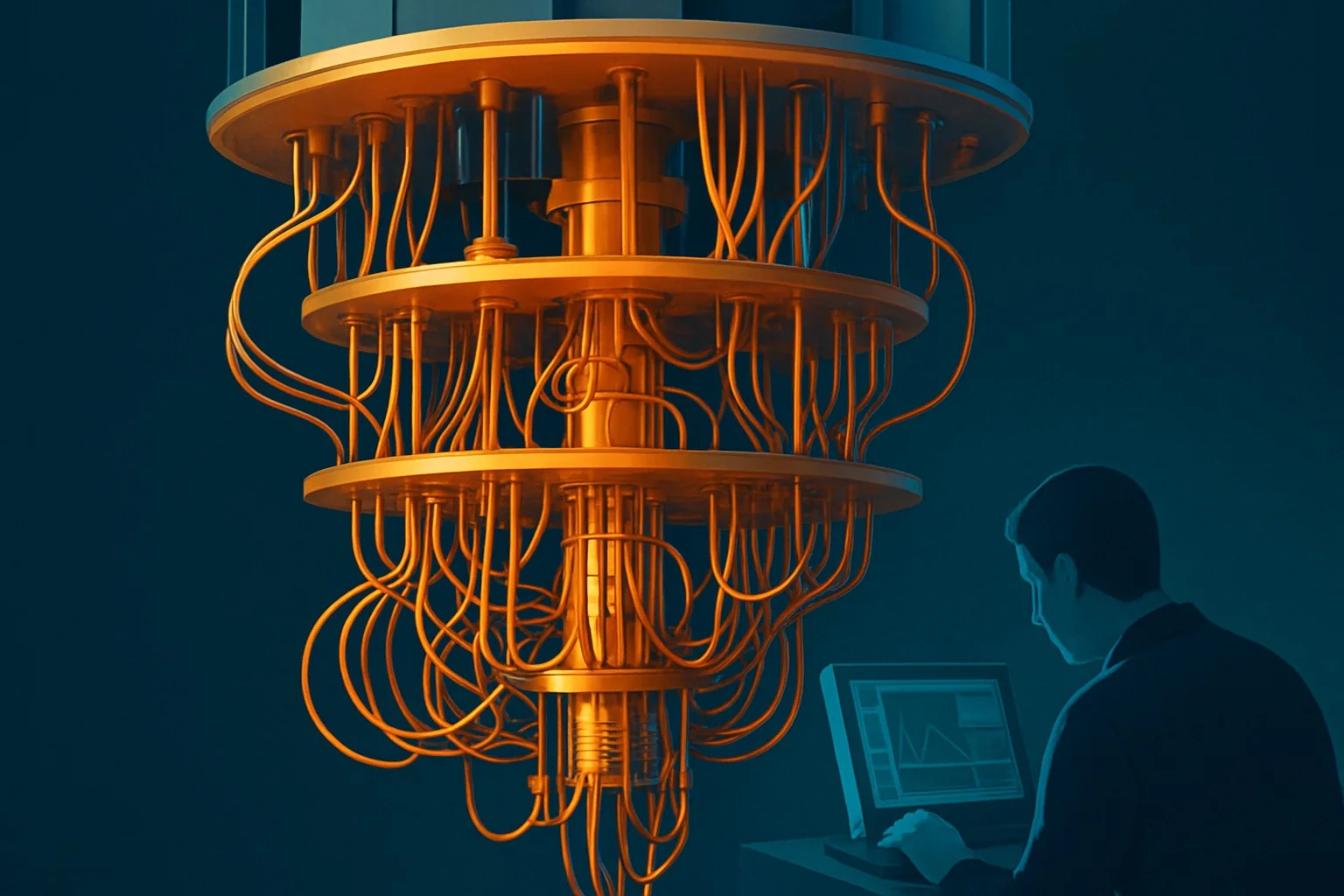
- Superconducting transmon qubits (Google, IBM, Rigetti): Microwave-controlled Josephson junction circuits operating at ~15 mK in dilution refrigerators. IBM's Heron processor (133 qubits, 2024) and Google's Willow (105 qubits) represent state-of-the-art.
- Trapped ions (IonQ, Quantinuum): Ytterbium or barium ions manipulated by laser pulses in electromagnetic traps, offering all-to-all connectivity and longer coherence times but slower gate speeds.
- Photonic qubits (PsiQuantum, Xanadu): Photons traversing interferometers; PsiQuantum targets fusion-based approaches with cryogenic photon detectors for million-qubit scale.
The critical engineering constraint is gate error rate. Current two-qubit gate fidelities range from 99.0% (superconducting, p99) to 99.9% (trapped ion). Surface code error correction requires ~10^-4 logical error rates, demanding 1,000+ physical qubits per logical qubit at current fidelities. Google's Willow demonstrated a key milestone: scaling physical qubits from 3×3 to 7×7 surface code grids reduced logical error rate exponentially, confirming below-threshold behavior. For deeper technical benchmarking of these processors, see our critical benchmark cheat sheet for quantum processors.
Quantum Annealers: The Specialized Optimization Engine
D-Wave's Advantage system operates on fundamentally different physics. Instead of gate sequences, it implements:
- Quantum annealing: A time-dependent Hamiltonian evolves from a simple initial state to a problem-encoded final state, exploiting quantum tunneling to escape local minima in energy landscapes.
- Topology: Pegasus topology with 5,627 flux qubits, each coupling to 15 others—sparse compared to all-to-all connectivity but programmable via chain embeddings.
- Operating temperature: ~15 mK, similar to superconducting gate models, but with continuous evolution rather than discrete gates.
Annealers are not universal quantum computers. They execute only Quadratic Unconstrained Binary Optimization (QUBO) problems mapped to Ising Hamiltonians. This restriction is feature, not bug, for logistics and scheduling domains. For a detailed engineering comparison of when annealing versus gate-model approaches fit procurement decisions, refer to our buyer's engineering guide to quantum annealing versus gate model.
Topological and Alternative Approaches
Microsoft's Azure Quantum program pursues topological qubits based on Majorana zero modes, theoretically offering intrinsic error protection. After retracting 2018 claims and a 2023 partial reinstatement, no operational topological quantum computer exists as of 2024. Neutral atom arrays (QuEra, Pasqal) using Rydberg atom interactions represent an emerging gate-model platform with reconfigurable geometries, currently at ~200 atom scales.
Implementation: Production Patterns
For engineering teams evaluating quantum integration, the implementation path depends heavily on problem classification and hardware tier selection.
Pattern 1: Quantum Annealing for Constrained Optimization
Production workflow with D-Wave Leap API:
# D-Wave Ocean SDK: Production optimization pattern
from dwave.system import DWaveSampler, EmbeddingComposite
import dimod

# Define QUBO for 10-variable max-cut approximation
Q = {(i, j): -1 for i in range(10) for j in range(i+1, 10) if i != j}

# Hybrid solver automatically decomposes large problems
sampler = EmbeddingComposite(DWaveSampler())
response = sampler.sample_qubo(Q, num_reads=1000,
                               chain_strength=2.0,
                               annealing_time=20)  # microseconds

# Post-processing: filter broken chains, validate constraints
valid_solutions = [s for s in response if s.energy < -20]
print(f"Valid solutions: {len(valid_solutions)}/{len(response)}")
Critical production parameters:
- Chain strength: O(√n) heuristic for n-variable problems; too weak causes chain breaks, too strong suppresses quantum effects
- Annealing time: 1–2,000 μs; thermalization vs. quantum tunneling tradeoff
- Number of reads: Statistical sampling for probabilistic solutions; p95 convergence typically requires 10^3–10^4 reads
Pattern 2: Gate-Model Variational Algorithms (VQE/QAOA)
For chemistry simulation or constrained optimization on gate-model hardware:
# Qiskit Runtime: VQE for molecular ground state (production sketch)
from qiskit.primitives import Estimator
from qiskit.circuit.library import TwoLocal
from qiskit_algorithms import VQE
from qiskit.quantum_info import SparsePauliOp

# Hamiltonian for H2 molecule in STO-3G basis
hamiltonian = SparsePauliOp.from_list([
    ("II", -1.0523), ("IZ", 0.3979), ("ZI", -0.3979),
    ("ZZ", -0.0112), ("XX", 0.1809)
])

# Hardware-efficient ansatz with error mitigation awareness
ansatz = TwoLocal(2, ['ry', 'rz'], 'cz', reps=2,
                  entanglement='linear')

# Runtime with resilience options for noisy hardware
estimator = Estimator(options={"resilience_level": 2})  # ZNE + probabilistic
vqe = VQE(estimator, ansatz, optimizer)
result = vqe.compute_minimum_eigenvalue(hamiltonian)
Production constraints: VQE on current hardware requires measurement shot budgets of 10^4–10^6 per energy evaluation, with energy convergence often plateauing above chemical accuracy (1.6×10^-3 Hartree) due to barren plateaus and noise. These algorithms are research-grade, not production-stable.
Pattern 3: Classical Simulation and Benchmarking
Before any quantum cloud spend, validate against classical baselines:
# Classical benchmark: tensor network simulation for comparison
# Using quimb for matrix product state / projected entangled pair states
import quimb.tensor as qtn

# Simulate 20-qubit circuit with MPS, bond dimension χ=128
psi = qtn.MPS_rand_state(20, 128)
# Apply circuit layers, compare fidelity vs quantum hardware output
# Cost: O(n × χ³) vs quantum O(exp(n))—but χ scaling captures entanglement
Classical tensor networks with χ=512–2048 often match or exceed noisy quantum hardware fidelity for circuits under 30 qubits with moderate depth (p<100), establishing critical baselines for "quantum advantage" claims.
Comparisons & Decision Framework
| Dimension | Quantum Annealer (D-Wave) | Noisy Gate-Model (IBM/Google/IonQ) | Error-Corrected (Future) |
|---|---|---|---|
| Qubit count | 5,627 (physical) | 133–1,500 (physical) | 1–50 (logical) |
| Problem types | QUBO/Ising only | Universal (in principle) | Universal |
| Current utility | Optimization heuristics | Research/demonstration | None |
| Cloud pricing | $2,000/month Leap subscription + per-minute | $1.60/sec (IBM Premium) to $10K/min (IonQ) | N/A |
| Error mitigation | Intrinsic analog, thermal | Zero-noise extrapolation, PEC, DD | Surface code, LDPC |
| Classical verification | Easy (compare energy) | Hard (exponential cost) | Efficient |
Engineering Decision Checklist
- Problem formulation: Is your objective reducible to QUBO with ≤5,000 variables and sparse quadratic terms? → Consider annealing
- Classical baseline: Have Gurobi, OR-Tools, or simulated annealing been exhausted? → Mandatory prerequisite
- Quantum resource estimation: For gate-model, does algorithm require <100 qubits and <100 depth? → Near-term feasible; else, post-2030
- Error budget: Does solution tolerate ~1–10% solution quality variance from hardware noise? → Required for NISQ era
- Hybrid architecture: Can quantum subroutine accelerate only a kernel within classical outer loop? → Essential pattern
Failure Modes & Edge Cases
Annealing-Specific Failures
Chain breaks in embedding: When problem connectivity exceeds Pegasus topology, variables chain across multiple physical qubits. Broken chains (physically inconsistent values) produce invalid solutions. Mitigation: increase chain strength (risk: classicalization), use D-Wave's find_embedding heuristics with retry logic, or adopt Zephyr topology (D-Wave Advantage2, 7,000+ qubits).
Freeze-out thermalization: Annealing schedules ending too rapidly leave system in excited states. Diagnostic: compare final sampled energy vs. theoretical ground state; gap >5% suggests insufficient annealing time or temperature calibration drift.
Gate-Model Failures
Barren plateaus in variational circuits: As qubit count increases, gradient magnitudes in parameterized circuits vanish exponentially, preventing training. Mitigation: problem-inspired ansatz design, layer-wise training, or quantum natural gradient (computationally expensive).
Crosstalk and calibration drift: Superconducting qubit frequencies drift on hour timescales; two-qubit gate fidelities degrade 0.1–0.5% between calibrations. Production systems must implement real-time drift compensation or restrict computation to post-calibration windows.
Measurement error asymmetry: Readout errors are state-dependent (|1⟩ misclassified more often than |0⟩ on transmon systems). Mitigation: measurement error mitigation (MEM) matrices updated per calibration, or symmetric readout protocols doubling shot count.
Performance & Scaling
Benchmark Standards
The Quantum Economic Development Consortium (QED-C) and MLCommons (AI500 Quantum) are establishing standardized benchmarks. Current reference points:
- SupermarQ (Super.tech/IonQ): Application-oriented benchmarks (Hamiltonian simulation, VQE preparation) scoring 0–1; leading systems achieve 0.3–0.6 on relevant subsets
- Circuit Layer Operations Per Second (CLOPS): IBM's throughput metric; Heron achieves ~5,000 CLOPS, with target of 10^5 for practical utility
- Quantum Volume (QV): 2^min(d,m) for d×d square circuits; IBM Heron: QV=512; practical algorithms typically require QV >10^6
Scaling Laws and Roadmaps
IBM's roadmap targets 100,000 qubits by 2033 via modular "Kookaburra" chip linking; Google aims for 1 million physical qubits for error-corrected logical operations. Both require cryogenic interconnect and control electronics (CMOS at 4K) breakthroughs not yet demonstrated at scale.
For enterprise security planning against cryptanalytic quantum threats, the timeline is more urgent than utility timelines. Organizations should begin post-quantum cryptography migration now, as harvest-now-decrypt-later attacks operate independently of when error-corrected quantum computers become available.
Production Best Practices
Cloud Resource Governance
- Quota management: Gate-model backends queue jobs unpredictably (p95 wait: 2–8 hours for IBM Premium); implement priority tiers and fallback backends
- Cost alerting: IonQ's per-gate pricing can exceed $10/minute for 100-qubit, 100-depth circuits; set hard spend caps in provider consoles
- Result verification: For annealing, always compare against classical simulated annealing; for gate-model, use statevector simulation up to 30 qubits
Security and Access Control
- API tokens for quantum cloud services require rotation policies identical to other cloud infrastructure
- Job metadata (problem structure) may reveal sensitive optimization targets; encrypt job descriptions at rest
- Multi-tenant quantum hardware is inherently side-channel vulnerable; no demonstrated attacks yet, but classified workloads should await dedicated instances
Further Reading & References
- Acharya, R. et al. (2024). "Quantum error correction below the surface code threshold." Nature, 638, 920–926. (Google Willow demonstration)
- IBM Quantum. (2024). IBM Quantum Development Roadmap. https://www.ibm.com/quantum/roadmap (100K qubit target, modular architecture)
- D-Wave Systems. (2024). Technical Description of the D-Wave Quantum Processing Unit. 09-1049A-A. (Pegasus topology and operating parameters)
- Bravyi, S. et al. (2022). "Future of computing and quantum computing." IBM Research. (Utility-scale quantum computing definition)
- Cerezo, M. et al. (2021). "Variational quantum algorithms." Nature Reviews Physics, 3, 625–644. (Barren plateaus and NISQ limitations)
- Preskill, J. (2018). "Quantum computing in the NISQ era and beyond." Quantum, 2, 79. (Foundational NISQ framework)
For Google's broader quantum-AI convergence strategy and enterprise timeline, see our analysis of Alphabet's quantum computing path to enterprise impact.


