
Edge Computing Strategies for IoT Battery Life
Introduction
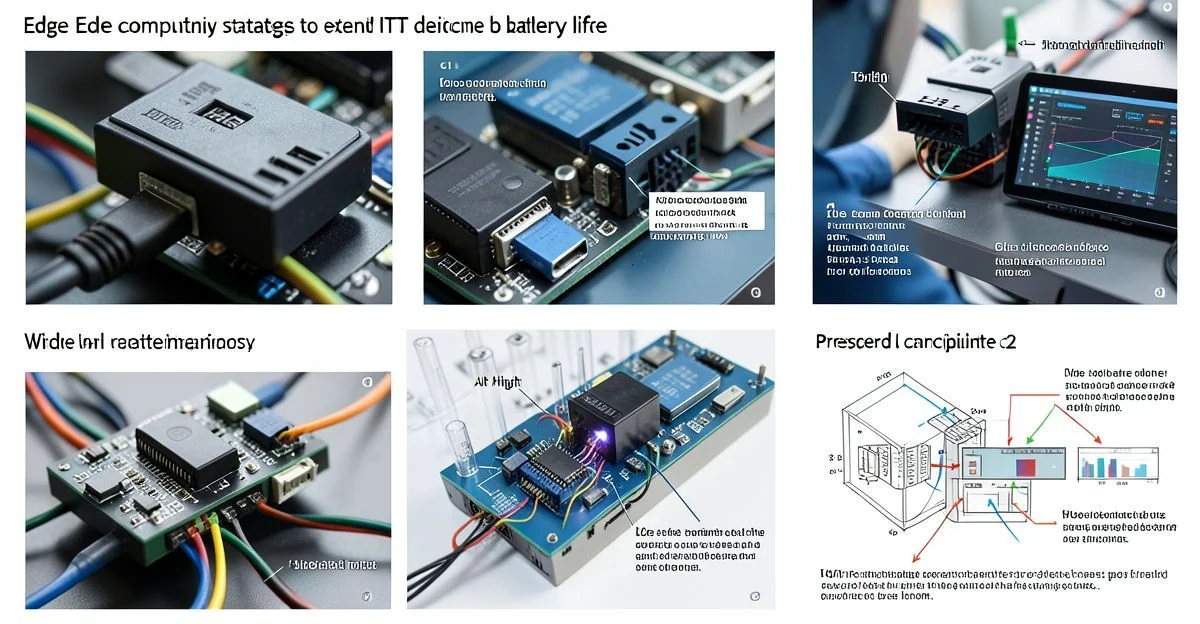
In production IoT deployments, the fastest path to “mysterious low battery” is not radio hardware—it’s inefficient compute and networking decisions: chatty protocols, always-on telemetry, and cloud-roundtrips that force devices to wake more often than necessary. This article delivers edge computing strategies to extend IoT device battery life with practical, engineering-grade patterns: when to process locally, how to minimize wake time, and how to validate gains with p95/p99 metrics.
Failure scenario (common in the field): A fleet ships with a “simple” design—devices publish sensor data every 30 seconds and the cloud runs anomaly detection. Within weeks, the battery reports start diverging: some devices last as expected, others drop 40–60% faster. Engineers find the root cause: the device spends more time awake handling retries (Wi‑Fi/LTE or mesh retransmissions), plus the cloud processing latency forces long network sessions. By the time analysts see data gaps, the battery curve is already broken.
Executive Summary
TL;DR: To extend battery life, move work to the edge and redesign communications around wake windows—so devices spend more time sleeping and less time transmitting or waiting.
- Wake-time is king: Minimize the time radios are on by batching, using event-driven triggers, and shortening protocols.
- Compute where it reduces transmissions: Filtering, feature extraction, and TinyML inference can replace “send everything to the cloud.”
- Schedule sleep with confidence: Use deterministic sleep windows and adaptive backoff so you don’t extend wake duration under loss.
- Compress safely: Apply payload reduction (quantization, delta encoding) without breaking telemetry semantics.
- Measure p95/p99, not averages: Battery drain correlates with tail behaviors—retries, long wake sessions, and queue growth.
Likely Q→A (direct extraction)
- Q: How does edge computing improve IoT battery life? A: It reduces radio-active time by filtering/aggregating data locally and only transmitting when events or confidence thresholds require it.
- Q: What is the best sleep strategy for battery-powered IoT devices? A: Use sleep scheduling with short, deterministic wake windows plus adaptive backoff on failures to prevent long sessions under poor connectivity.
- Q: Why use TinyML battery optimization on edge devices? A: TinyML enables local inference so you send compact results (or small features) rather than raw streams, reducing network energy by orders of magnitude.
How edge computing strategies to extend IoT device battery life Works Under the Hood
Battery life is dominated by energy per cycle: E_total ≈ E_wake + E_compute + E_radio + E_retries + E_idle. In almost all low-power IoT designs, E_radio and retries outweigh compute. That makes the edge strategy clear: shift compute earlier in the pipeline, so the device transmits less and spends less time waiting. If you want a field-oriented walkthrough of end-to-end tuning (including power profiling and message behavior), see Edge computing IoT battery life: Practical tactics.
1) Energy model you can actually use
Start with measurable components. For each wake cycle, capture:
- Radio ON duration (ms): from association/session start until disconnect/idle.
- Tx/Rx volume (bytes) and retransmissions.
- Compute time (ms) and peak CPU current (or active-mode current).
- Retry outcomes (HTTP/MQTT publish success, ACK latency, CoAP confirm timeouts).
A practical heuristic:
Compute is “cheap” if it saves radio airtime. If your local inference adds 50–200ms CPU time but reduces a transmission by seconds or eliminates repeated retries, the net energy wins.
This is why the most effective edge computing for low-power IoT is often not “run a full model”—it’s run the smallest decision logic that reduces traffic.
2) Architecture patterns that save energy
Think of the pipeline as: Sense → Preprocess → Decide → Communicate → (Optionally) Learn. Edge strategies target two places: decide and communicate.
Pattern A: Local filtering + event-driven reporting
Instead of periodic “send raw data,” compute lightweight features at the edge and only send when an event triggers.
Pattern B: Edge aggregation + batch publishing
Collect data across multiple samples during a single wake window, then transmit once (or in a compact payload).
Pattern C: TinyML inference + compact results
Replace bulk telemetry with local classification/regression and transmit a label + confidence (and maybe a small context window).
Pattern D: Protocol adaptation (MQTT/CoAP behavior)
Tune QoS, confirm/ACK strategy, keep-alives, and backoff so connectivity issues don’t inflate wake time.
Pattern E: Sleep scheduling with bounded wake windows
Use scheduled wake time slots so the device avoids “radio on while idle” and reduces contention-induced retries.
3) Where TinyML fits (and where it doesn’t)
TinyML battery optimization for edge devices is most beneficial when:
- You would otherwise stream high-frequency sensor data to the cloud.
- You can accept sending derived insights (labels, anomalies, feature vectors under a threshold).
- Your model fits in memory and compute budgets (e.g., MCU-class systems with optimized inference kernels).
It can be counterproductive when:
- The model runtime is long relative to the saved radio time.
- You still transmit raw streams “for safety,” nullifying the traffic reduction.
- Retraining/updates require frequent high-cost connectivity.
If you want a deeper, engineering-tactical view on MQTT/CoAP behavior, Cortex-M constraints, and field-proven tactics, see our guide to practical edge tactics for IoT battery life.
Implementation: Production Patterns
This section is written to be actioned in an engineering backlog. The goal is not “more edge”—it’s less radio time and fewer failed sessions.
Step 1: Measure your current battery-to-radio relationship
Before changing architecture, quantify:
- Average and tail distribution of radio-on duration per wake (p50/p95/p99).
- Publish latency (time to success/ACK).
- Retry count and timeout settings.
- Bytes per message and message frequency.
Implement instrumentation that logs these counters locally and periodically ships summaries (or transmits during maintenance windows).
Step 2: Introduce sleep scheduling for battery-powered IoT devices
A common mistake is “sleep whenever.” Production devices need scheduled wake windows with bounded work so connectivity uncertainty can’t extend active time indefinitely. For additional MCU- and protocol-aligned scheduling guidance, refer to Edge computing IoT battery life: Practical tactics.
Baseline approach:
- Wake every T seconds for a window of W seconds.
- Within W: sample sensors, run edge decision logic, attempt publish, then power down.
- If publish fails, retry within the same window using exponential backoff—then abandon and wait for the next window.
Why it works: you convert unpredictable network delays into bounded energy costs. Tail energy drops dramatically.
Minimal pseudo-code
// Parameters (tune per link budget / power profile)
const uint32_t T = 300;     // wake interval seconds
const uint32_t W = 12;      // wake window seconds

loop {
  sleep_until(next_wake_time());
  uint64_t window_deadline = now_ms() + W*1000;

  // 1) Sense + preprocess
  sample_sensors();
  features = compute_features();

  // 2) Decide (edge logic)
  payload = decide_and_pack(features);
  bool should_send = payload.should_send;

  if (should_send) {
    // 3) Attempt transmit with bounded retries
    int attempt = 0;
    while (now_ms() < window_deadline && attempt < MAX_RETRIES) {
      attempt++;
      if (publish_with_ack(payload, ACK_TIMEOUT_MS)) {
        break; // success
      }
      backoff_delay_ms(attempt); // short, bounded
    }
  }

  // 4) Always power down at deadline
  power_down_to_sleep();
  schedule_next_wake(T);
}
Step 3: Replace periodic telemetry with event-driven reporting
Edge computing strategies to extend IoT device battery life succeed when you stop sending data blindly. Implement local triggers:
- Threshold triggers: send when a metric crosses an absolute or relative threshold.
- Rate-of-change triggers: detect anomalies from derivatives (e.g., vibration spikes).
- Change-point triggers: only transmit when the signal differs from a baseline model.
- Confidence triggers: for TinyML, transmit only when confidence ≥ θ.
Production tip: keep a small ring buffer of recent samples so when an event triggers, you can include context without sending the whole stream.
Step 4: Do local preprocessing that shrinks payloads
When you must send data, don’t send raw. Common reductions:
- Quantization: map floats to fixed-point (e.g., Q format) with known error bounds.
- Delta encoding: send deltas from last sent value.
- Run-length / bitpacking: especially for discrete sensors.
- Delta + timestamp compression: send fewer timestamps or transmit “sample count” instead of absolute times.
Editorial discipline: define acceptable telemetry error budgets upfront. Don’t “compress and hope”—validate with reconstruction error on a captured dataset.
Step 5: TinyML for battery optimization—use it as a traffic reducer
Two effective TinyML battery optimization strategies:
- Classification: Send (class, confidence) rather than full feature streams.
- Anomaly scoring: Run a lightweight anomaly model; only transmit a snapshot when score > θ.
Practical workflow:
- Collect representative datasets under real power/network conditions.
- Label “events that matter” (not everything that happens).
- Train a model that fits your MCU target constraints (flash/RAM/latency).
- Quantize the model and measure inference runtime on-device.
- Verify the energy win: energy per decision vs energy per avoided transmission.
If you’re aligning this with specific MCU stacks (e.g., Cortex-M) and message patterns (MQTT/CoAP), refer to edge computing IoT battery life tactics for an end-to-end implementation perspective.
Step 6: Tune messaging (MQTT/CoAP) to prevent tail energy blowups
Most “battery surprises” happen under poor connectivity because retries extend radio-on time. Do two things:
- Bound retries: never allow retries to exceed the wake window.
- Choose the right acknowledgment semantics: For MQTT, QoS 0 avoids ACK overhead; QoS 1 ensures delivery but increases traffic and tail latency. For CoAP, consider confirmable vs non-confirmable based on event criticality.
Rule of thumb: make “loss tolerance” explicit per message type:
- Non-critical telemetry: allow loss (QoS 0 / non-confirmable).
- Critical alerts: require delivery (QoS 1 / confirmable) but keep payloads minimal and windows bounded.
Implementation note: if you batch data, you may prefer fewer, larger messages. But ensure the larger payload doesn’t increase airtime beyond the saved wake cycles—measure p95.
Step 7: Add edge-side queue discipline (don’t let buffers force long sessions)
Queue growth is a hidden battery killer. If the device buffers too much when connectivity is poor, it will eventually wake, try to drain a large queue, and keep the radio on for a long time.
Use:
- Hard caps: max queued messages or max buffered samples.
- Drop policies: drop oldest non-critical telemetry first.
- Summarize on overflow: replace buffered raw samples with a summarized value (min/max/mean) so energy doesn’t spiral.
Step 8: Feedback loops—measure, then adjust thresholds and schedules
Edge strategies should evolve. Create a periodic “fleet health” check:
- For each device group (RSSI buckets, geographic regions), compare battery drain vs radio errors.
- Adjust thresholds θ for event triggers to hit a target report rate.
- Adjust wake interval T and window W based on observed publish success within W.
This is where disciplined tuning beats guesswork.
Comparisons & Decision Framework
You’re balancing three levers: local compute, communication frequency, and reliability level. Use the framework below.
Edge decision matrix
- If your device currently sends frequent raw data: prioritize local filtering → event-driven reporting → payload shrinking → only then consider TinyML.
- If events are rare but critical: keep long sleep and use bounded confirmable transmissions for alerts; allow loss for routine telemetry.
- If connectivity is unreliable: invest in sleep scheduling with bounded wake windows and aggressive queue discipline before adding heavier compute.
- If you have enough local data to classify: TinyML is a strong candidate because it can reduce traffic to labels/confidence.
Checklist: choose the smallest edge change that saves the most energy
- Can you reduce wake frequency? Increase sleep interval only if it doesn’t miss required event detection windows.
- Can you reduce radio-on time? Batch within windows; bound retries; avoid long TCP/HTTP sessions.
- Can you reduce bytes? Quantize, delta encode, and pack payload fields.
- Can you reduce message count? Send aggregated snapshots, not per-sample telemetry.
- Can you reduce “send events that aren’t important”? Add confidence/threshold gating and local change detection.
- Is TinyML worth it? Only if model inference cost is smaller than the network traffic it prevents.
Trade-offs you should explicitly account for
- False negatives vs battery: confidence thresholds reduce transmissions but can miss marginal events; tune with domain tolerance.
- False positives vs battery: noisy triggers cause extra wake cycles; improve feature robustness.
- Security vs energy: message authentication and encryption add compute overhead; mitigate with session reuse, efficient cryptography, and minimal payloads.
- OTA updates vs lifetime: firmware updates can dominate energy if frequent; schedule during charging/maintenance.
Failure Modes & Edge Cases
Battery life problems are rarely one-dimensional. Below are the failure modes that show up after “successful prototypes.”
1) Retries that escape your wake window
Symptom: battery drains faster only in poor coverage areas; logs show many long “publish attempts.”
Mitigation: enforce a hard deadline tied to sleep scheduling; abandon publish at window end.
2) Queue buildup forces “catch-up” sessions
Symptom: devices work fine until network loss lasts; then they wake and spend minutes draining buffers.
Mitigation: cap queue size; drop or summarize; track backlog size and gate transmission length.
3) Over-aggressive event thresholds
Symptom: fewer transmissions but also missing alarms; customer reports “silent” failures.
Mitigation: validate on realistic datasets; use separate thresholds for “report” vs “store locally.”
4) TinyML model drift
Symptom: battery might initially improve, then trigger rate rises due to degraded model performance (noise or environment changes).
Mitigation: monitor inference confidence distributions; periodically recalibrate thresholds; schedule model updates off-cycle.
5) Payload compression breaks downstream assumptions
Symptom: backend parsing errors or analytics drift due to quantization artifacts.
Mitigation: define schema contracts and reconstruction error bounds; version payload formats.
6) Time synchronization assumptions fail
Symptom: sleep scheduling based on incorrect time leads to missed wake windows or bursty contention.
Mitigation: use robust time sources (network time on join only, monotonic RTC) and tolerate schedule drift with resynchronization intervals.
Performance & Scaling
Edge optimizations must be validated with tail metrics. “Average battery life” can look great while p99 wake energy still kills devices.
Key KPIs to track (by device group)
- Energy per wake cycle (estimated from current profiles and measured durations).
- Radio-on time per publish (p50/p95/p99).
- Publish success rate within wake window (W-bound success).
- Retry count distribution and timeout rates.
- Event trigger rate vs battery drain.
Benchmark guidance (how to design your experiments)
When comparing two designs (baseline vs optimized), evaluate at least:
- 10–30 devices per representative link quality bucket (RSSI/SNR classes).
- At least 7–14 days to capture day-night patterns and network variability.
- Report p95/p99 radio-on duration—battery drain correlates strongly with tails under retransmissions.
Practical benchmark experiment: hold compute constant, change only communication cadence and payload size. Then hold communication constant and add edge inference. This isolates which lever produces the energy win for your environment.
Production Best Practices
Security without wasting wake time
Security should not turn every wake into an expensive handshake. Best practices:
- Minimize handshakes: use session resumption where the protocol supports it; prefer persistent connections only when they don’t increase idle radio time.
- Encrypt small payloads: smaller data reduces crypto overhead and radio airtime.
- Key management discipline: rotate keys on maintenance intervals; avoid forcing rekey on every wake.
Testing strategy that catches battery killers early
- Network impairment testing: simulate loss and latency; confirm that retries remain bounded by wake window.
- Queue overflow tests: disconnect devices and observe backlog behavior on reconnection.
- Model inference load tests: measure actual inference latency distribution, not just mean.
- Power profiling: validate peak current and active durations against your energy model.
Operational runbook items
- Alert when publish success within wake window falls below threshold.
- Alert when p99 radio-on time increases—this often precedes battery alarms.
- Track event trigger rate—if it spikes, battery will follow.
Further Reading & References
- MQTT QoS semantics and delivery guarantees (official MQTT documentation / spec resources).
- CoAP confirmable vs non-confirmable message behavior (IETF CoAP documentation).
- ARM guidance on Cortex-M power optimization and low-power modes (vendor documentation).
- TinyML / model compression concepts (general TinyML and quantization references).
- Field-proven tactics for edge battery life optimization: edge computing IoT battery life practical tactics and additional edge battery optimization tactics.
Closing editorial note: The best edge computing strategies to extend IoT device battery life are the ones that prove themselves in tail metrics—bounded wake windows, fewer transmissions, smaller payloads, and confidence-based reporting. If you instrument those four things, you’ll find the true energy sinks fast.


