
Edge computing IoT battery life: Practical tactics
Introduction
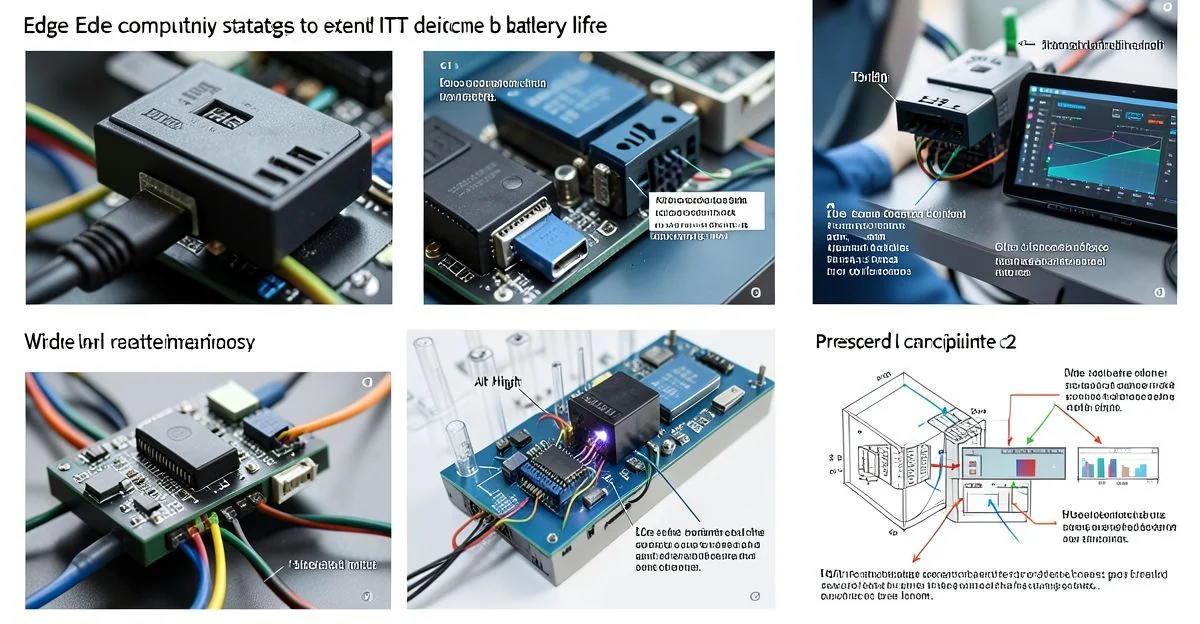
Problem statement: Battery constraints are the dominant limiter for long-lived IoT edge devices; see our Edge Computing IoT Battery Life Strategies for case studies and recipes; adding edge compute and local intelligence often increases peak and baseline power if not architected deliberately.
Promise: This article gives engineers concrete, production-ready strategies — from protocol choices and Cortex‑M sleep modes to TinyML scheduling and telemetry (Practical Strategies) — to extend real-world battery life for IoT edge devices by 2–10x in realistic deployments.
Failure scenario: A logistics sensor fleet starts with 18 months of expected life on a 2400 mAh battery. After adding local anomaly detection and higher sampling rates, operating life drops to 3 months. Diagnostics show long MCU awake time, frequent radio retransmits, and unbounded sensor polling. The team must identify what layer (sensing, compute, comms, or power control) caused the regression and apply systematic fixes — retraining models for sparsity, shifting inference windows, using CoAP with DTLS session reuse, and enforcing deep-sleep entry paths on the Cortex‑M to recover the fleet to acceptable battery life. See the operational checklist in Edge computing IoT battery life optimization — Practical Guide for runbooks and recovery steps.
Executive Summary
TL;DR: Use edge compute to reduce radio transmissions and enable adaptive sensing, but minimize awake time with event-driven TinyML practical optimizations, Cortex‑M deep sleep states, and low-power protocols to maximize battery life.
- Shift computation to edge only when it reduces radio duty cycle; local inference is energy‑useful when it prevents >1–2 cloud roundtrips per detection.
- Optimize the full duty cycle: sensing duty, MCU active time, model execution time, radio on‑time, and retransmit strategy.
- Use Cortex‑M STOP/Standby modes and verify wake latency vs. energy trade-offs for your sampling cadence.
- Prefer MQTT-SN or CoAP with Observe/blockwise and reduced keep-alive intervals for constrained radios; minimize handshakes and use session reuse.
- TinyML models must be pruned/quantized and scheduled sparsely; use feature extraction on ADC/DMA to reduce CPU load.
- Measure — instrument current at p95/p99 events, track battery fuel gauge trends, and baseline with automated tests before rollout.
Three quick Q→A for direct answers
- Q: When is doing inference on the edge energy‑efficient? A: When local inference prevents >1–2 radio transmissions per detection, or when it reduces transmission payload by >80% for periodic sensors.
- Q: Which Cortex‑M mode gives the best power without losing millisecond wake responsiveness? A: STOP/DeepSleep (implementation-specific) typically gives the best µA baseline with wake-latency in 1–10 ms; Standby gives lower µA but higher wake latency.
- Q: MQTT or CoAP for low power? A: Use CoAP for constrained devices and lossy networks (UDP, smaller headers); MQTT-SN or MQTT with reduced keep‑alive works when brokers and intermediaries require persistent sessions.
How Edge computing strategies to extend IoT device battery life Works Under the Hood
At system level, battery life is determined by the average current draw across the device duty cycle. Edge strategies reduce energy by (a) reducing the frequency and duration of high-power events (radio on, MCU active), and (b) shifting compute vs. communications so local work avoids costly network roundtrips.
Key components and their roles:
- Sensors & front-end DSP: Hardware filtering, DMA, and event detectors (interrupts) offload the MCU; e.g., wake on threshold crossing rather than continuous sampling.
- MCU & power manager: Use low-power states (sleep/stop/standby), clock gating, peripheral gating, and fast wake paths. The choice of mode is a trade-off between baseline current and wake latency.
- TinyML / local inference: Compact models (quantized, pruned) operate in milliseconds to seconds; schedule inference to minimize active CPU time and reduce downstream transmissions.
- Network layer: Protocols and retransmit policies determine radio on-time. Prefer protocols that reduce handshake overhead and support low-power patterns (e.g., CoAP Observe, MQTT with session persistence, adaptive retransmit backoff).
- Power & fuel sensing: Coulomb counters and impedance tracking let you compute battery state and detect regressions early.
Architecture text diagram (conceptual):
Sensor hardware (DMA + IRQ) → Minimal wake ISR → Event queue → TinyML classifier (if queued) → Decision: store locally / batch transmit / immediate alert → Low-power network stack with session reuse and scheduled TX windows → Power manager returns device to deep sleep
Implementation: Production Patterns
We present a ladder of implementation patterns — basic to advanced — with code examples and hardening advice.
Pattern 1 — Baseline: Duty-cycle sensor sampling + batched telemetry
- Use ADC/DMA to sample into a circular buffer.
- Wake MCU only on buffer full or threshold interrupt.
- Batch writes and send one packet per period; use QoS0 for noncritical telemetry to avoid retransmit energy.
// Pseudocode: DMA-based sampling and wake on threshold
void dma_callback() {
  signal_processing_task(); // minimal ISR: notify
}

void signal_processing_task() {
  process_buffer(); // run short DSP or feature extract
  if (event_detected) {
    run_inference_or_flag();
  }
  enter_deep_sleep();
}
Pattern 2 — Event-driven TinyML inference
Only perform inference on meaningful events. Combine cheap prefilters (threshold, spectral energy) with TinyML only when prefilter fires.
// Pseudocode: prefilter + TinyML invocation
if (prefilter_energy > energy_threshold) {
  // allocate arena for TF Lite Micro if needed
  tflm_invoke(model, input_features);
  if (model_output_confident) transmit_minimal_event();
}
Important: Use persistent scratch arena and avoid heap allocations at runtime — TF Lite Micro is designed for static arena allocation. Reuse memory buffers across inferences to avoid heap churn and unexpected wake time from OS activity.
Pattern 3 — Scheduled radio windows and session reuse
For LPWAN or constrained radios, schedule transmissions in known windows and reuse DTLS/TLS sessions where possible to avoid full handshakes. Use CoAP blockwise transfers for larger payloads to resume after constrained retransmission windows.
# Example: MQTT keep-alive and last-will settings
mqtt_connect(client, broker, keepalive = 120); // longer keepalive reduces radio polls
mqtt_publish(topic, payload, qos=0); // qos0 avoids ack roundtrip cost
Trade-off: Longer keepalive reduces connection establishment cost but increases periodic radio wake for keepalive; choose a value based on expected event inter-arrival time.
Pattern 4 — Adaptive sampling and model sparsity
Adjust sampling frequency and model complexity based on battery state and environment. If battery is low or device idle, move to a lower sampling rate and a smaller model or a sparsified path. Use a two-stage classifier: small fast model as gate, larger model when gate indicates high probability.
// Two-stage classifier pseudocode
if (gate_model(in_features) > gate_threshold) {
  run_heavy_model();
  transmit_if_needed();
} else {
  // skip heavy model, stay asleep longer
}
Error handling and robustness
- Implement bounded retries and exponential backoff for network operations; record fail counts to avoid repeated energy drain in low-connectivity areas.
- Fail-safe: if battery < X% persist critical mode (minimal sampling) and log a usage flag so fleet manager can decide maintenance.
- Watchdog: allow watchdog reset to recover from stuck peripherals that keep the radio or MCU awake.
Comparisons & Decision Framework
Below is a compact decision checklist and trade-off matrix to help choose patterns for a given use case.
When to do inference at the edge vs cloud
- Edge inference recommended when: (a) each detection would otherwise cause an expensive radio transmission, (b) you need low-latency local actuation, or (c) network cost is high/unreliable.
- Cloud inference recommended when: (a) you need heavy compute infrequently; (b) model updates are frequent and devices cannot be OTA updated easily; (c) radio cost is low compared to MCU active cost.
Protocol checklist
- Use CoAP with Observe for frequent small updates and UDP-friendly networks.
- Use MQTT-SN or MQTT with QoS0 for best TX energy but accept potential data loss.
- Prefer DTLS/TLS session reuse; avoid full TLS handshakes for short bursts.
Hardware/MCU mode tradeoffs
- Standby/Shutdown: Lowest idle current, slower wake (seconds). Use for multi-minute+ sleep cycles.
- Stop/DeepSleep: µA-level current, ms-level wake. Good for frequent wakeups (sub-second to few-second intervals).
- Sleep/LightSleep: Fast wake, higher baseline. Use only when latency constraints are strict.
Failure Modes & Edge Cases
Practical failure modes with diagnostics and mitigations:
- MCU never enters deep sleep: Symptoms: battery drains quickly, MCU active time high. Diagnostics: instrument with toggles around sleep calls; sample GPIO or use energy profiler to see baseline current. Mitigation: audit interrupt sources, disable periodic OS ticks, ensure peripheral clocks are gated.
- High retransmit rate due to bad link: Symptoms: repeated radio TX, high p95 current. Diagnostics: count L2 retries and packet error rates; monitor RSSI/SNR. Mitigation: increase backoff, reduce payload, use local filtering to avoid sending low-value data, or switch to a different connectivity technology.
- Memory or heap fragmentation from TinyML: Symptoms: infrequent stalls, longer wake times. Diagnostics: profile memory allocations and snapshot heap. Mitigation: use static memory arenas, pre-allocate tensors, avoid dynamic allocations during inference.
- OTA update kills battery: Symptoms: large immediate drop during firmware rollout. Diagnostics: correlate battery drops with update windows. Mitigation: throttle OTA rollout, use multicast/differential updates, schedule updates when device connected to mains or with high battery.
- Clock drift prevents scheduled radio windows: Symptoms: missed comm windows, retransmits. Diagnostics: check RTC drift and synchronization behavior. Mitigation: use low-power RTC calibration or lightweight sync beacons.
Performance & Scaling
KPIs to monitor:
- Average current (µA): baseline across sleep + duty peaks.
- Active time per period (ms): total MCU active time per measurement window.
- Radio on-time per day (s): aggregate airtime.
- Battery life median/p95/p99: expected vs worst-case.
- Transmission success rate and retransmit counts.
Battery life estimation formula (engineer-friendly):
# battery life in hours
battery_life_hours = (battery_capacity_mAh * 1000) / avg_current_uA

# Example: 2400 mAh battery, measured avg current 200 uA
battery_life_hours = (2400 * 1000) / 200 = 12,000 hours ≈ 500 days
Note: avg_current_uA must include p95/p99 spikes. Use a weighted average: avg = (T_sleep*I_sleep + Σ T_event_i * I_event_i) / T_total. For p95/p99 target planning, model event bursts (firmware update, failed attach loops) explicitly and compute worst-case battery life.
Benchmark guidance
- Baseline idle currents: Well-engineered Cortex‑M designs can achieve 1–10 µA in standby; targets: 5 µA for sensor nodes is reasonable.
- Active inference: small TinyML models (quantized CNNs or DNNs < 100 KB) can run in 1–50 ms on Cortex‑M4/M7, consuming 3–30 mA during compute depending on clock frequency.
- Radio TX event: Wi-Fi BT are hundreds of mA for tens of ms; LoRaWAN is 50–300 mA for hundreds of ms. Always compute airtime energy for each transmission and use it to justify on-device compute cost.
Production Best Practices
- Automated energy regression tests: run nightly battery life simulations using measured current profiles and synthetic event bursts. Reject PRs that regress avg_current > X%.
- Telemetry & canaries: send downsampled energy metrics (e.g., daily average current, battery voltage, recent retransmit counts) to a fleet manager to detect regressions early.
- OTA safety: stage rollouts, start with a small canary group, monitor battery telemetry and abort if regression thresholds exceed limits.
- Security: protect keys and session material but balance crypto cost. Use lightweight secure elements and session reuse to avoid full ECDSA/TLS handshakes frequently.
- Runbooks: include steps to recover devices with unexpectedly low battery — e.g., remote config to enter ultra-conservative mode, firmware rollback, or disabling feature flags that increase sampling.
Further Reading & References
Authoritative sources and practical docs:
- TensorFlow Lite for Microcontrollers — guidance on TF Lite Micro arena allocation and model optimization.
- RFC 7252 — The Constrained Application Protocol (CoAP) — protocol patterns for low-power devices.
- MQTT specification and MQTT-SN variants — session and QoS trade-offs for constrained devices.
- ARM Cortex‑M Sleep Modes — reference for STOP/Standby/Sleep behavior and wake latency.
- TinyML resources and model compression patterns — practical model size/perf tradeoffs.
Also see our related hands-on articles with Cortex‑M power recipes and TinyML deployment notes: for Cortex‑M-focused power recipes and real-world case studies, consult our Edge Computing IoT Battery Life Strategies article, and for practical TinyML and TF Lite Micro optimizations in production see the practical strategies walkthrough. For an operational checklist and additional optimization tactics, refer to Edge computing IoT battery life optimization — Practical Guide.
Appendix: Example Cortex‑M deep-sleep entry and TinyML static arena
Small STM32-like deep sleep example (HAL) — ensure you audit all wake sources before calling sleep:
/* Configure clocks, peripherals are previously initialized */
void enter_deep_sleep(void) {
  // disable SysTick if OS, disable periodic timers
  HAL_SuspendTick();

  // ensure peripherals are in low-power state
  HAL_UART_DeInit(&huart1);

  // Set wakeup sources (GPIO, RTC)
  HAL_PWR_EnableWakeUpPin(PWR_WAKEUP_PIN1);

  // Enter STOP mode
  HAL_PWR_EnterSTOPMode(PWR_LOWPOWERREGULATOR_ON, PWR_STOPENTRY_WFI);

  // On wake, reconfigure clocks and peripherals
  SystemClock_Config();
  HAL_ResumeTick();
  HAL_UART_Init(&huart1);
}
TinyML static arena pattern (C) — allocate once in .bss and reuse:
// static arena for TF Lite Micro
static uint8_t tensor_arena[64 * 1024]; // size tuned to model

void init_inference(void) {
  static tflite::MicroInterpreter* interpreter = nullptr;
  if (!interpreter) {
    interpreter = new (&arena) tflite::MicroInterpreter(
      model, resolver, tensor_arena, sizeof(tensor_arena), error_reporter);
    interpreter->AllocateTensors();
  }
}
Closing notes from MAKB
Edge compute can be a net win for battery life when you treat energy as a first-class resource across sensing, compute, and comms. Prioritize measurable regressions, instrument aggressively, and choose low-level Cortex‑M power recipes and protocol patterns that match your device's event characteristics. Small changes — batching, session reuse, prefilters, and static memory for TinyML — compound into large gains at fleet scale.
If you need a production checklist tailored to your stack (Cortex‑M variant, radio technology, and TinyML model size), I can produce a focused runbook with measurable targets and test scripts for CI-based energy regression testing; also see our practical tactics and checklists for additional examples.


