
Edge computing IoT battery life: Practical tactics
Introduction
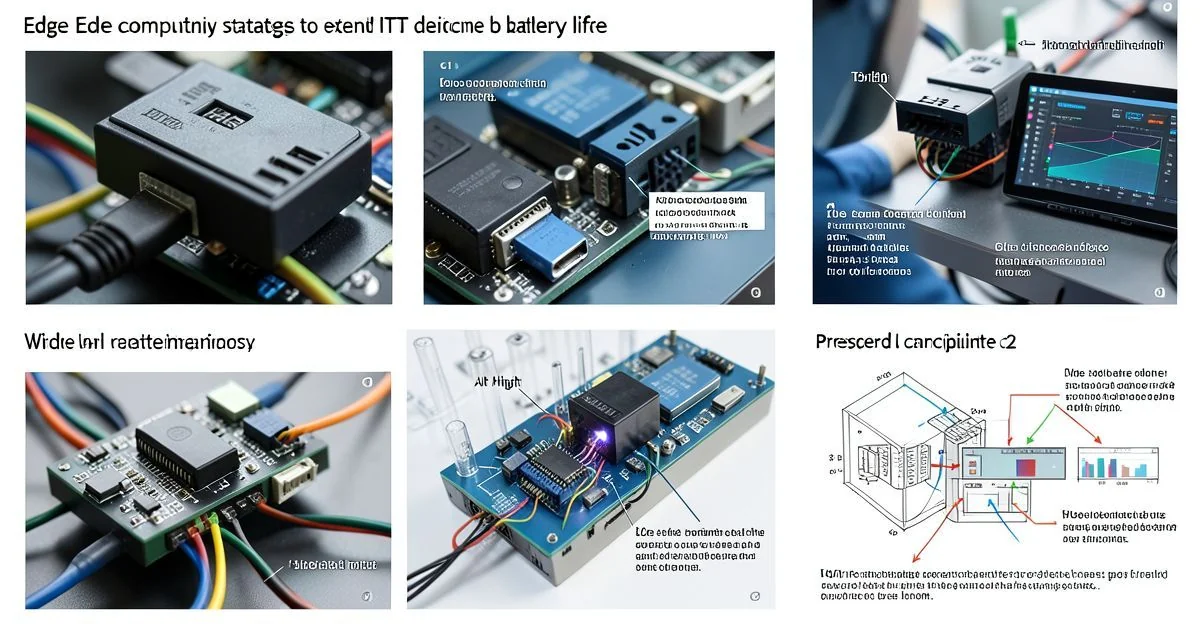
Problem statement: Battery-powered IoT sensors routinely fail to meet multi-year lifetime targets when telemetry, local compute, and wireless I/O are naively configured.
Promise: This article gives production-tested edge computing strategies that materially extend IoT device battery life — with architectures, stepwise implementation patterns, diagnostics, and pragmatic code examples suitable for Cortex-M and similar constrained platforms.
Failure scenario: A fleet of environmental sensors in a remote deployment reports frequent battery replacements after 6–9 months despite claims of ‘2+ years’. The root causes are a mix of excessive sampling, chatty network behavior, always-on inference, and suboptimal sleep transitions. Teams often miss the systemic interaction: a TinyML model running on-device reduces cloud bill but increases active time; aggressive retransmit on poor RF links doubles average current; misconfigured ADC sampling prevents deep sleep. This article targets those production pitfalls and shows how to trade compute, networking, and sensing to get predictable, repeatable battery life.
Executive Summary
TL;DR: Use edge compute to move decision-making into extremely short active windows, minimize wireless radio duty cycle, and adopt adaptive sampling plus batching to reduce average device current into the low-µA range—this can turn months into multiple years of battery life.
- Profile first: measure baseline average current and wake counts; you can't optimize what you don't measure.
- Move simple decision logic to the edge (thresholds, event detection) and use TinyML selectively for high-value filtering.
- Batch and compress network traffic; prefer CoAP/DTLS or MQTT-SN with adaptive backoff for constrained links.
- Use event-driven wake sources (interrupts, RTC alarms) and design sensors to avoid polling when possible.
- Introduce hierarchical compute (sensor-level, gateway-level, cloud) and pick the split that minimizes radio on-time for target QoS.
- Continuously validate with KPIs: average current (µA), wake events/day (p95,p99), and energy per packet (mJ).
Three one-line Q→A pairs (direct answers)
- Q: How do I extend IoT sensor battery life using edge compute? A: Shift simple filtering and event detection to the device, reduce radio on-time via batching, and use adaptive sampling tied to meaningful events.
- Q: When should I use TinyML on-device vs. gateway inference? A: Use TinyML when the model reduces transmission frequency enough to offset its active compute energy; otherwise perform inference at a gateway.
- Q: What is the fastest win for battery life? A: Reduce radio duty cycle by grouping transmissions and moving from always-on telemetry to event-driven updates.
How Edge computing strategies to extend IoT device battery life Works Under the Hood
At its core the problem is energy accounting: total energy consumed by a device is the integral of current draw over time across three dominant domains — sensing, compute, and networking. Edge strategies rearrange where and when compute happens, reducing the high-cost operation: radio transmissions and long CPU-active periods.
Architectural building blocks (textual diagram):
- Sensor Layer: physical sensors + analog front-end, often driven by ADC/DMA. Wake via threshold comparators or periodic RTC.
- Edge Inference Layer: microcontroller (Cortex-M family) executing TinyML or rule engine. Optimized for short, infrequent active windows.
- Connectivity Layer: low-power radio (BLE, LoRaWAN, NB‑IoT, 802.15.4). Most energy per byte; scheduling and batching are critical.
- Gateway & Cloud: higher-latency heavy compute for long-term analytics and model updates.
Key algorithms & protocols
- Event-driven sampling: use interrupts/analog comparators to avoid periodic polling.
- Adaptive sampling: increase sampling rate on detected events; otherwise remain at low-rate monitoring.
- On-device filtering / classification: thresholding, matched filters, or TinyML to suppress uninteresting telemetry.
- Batching + backoff: accumulate payloads and send on schedule or when threshold exceeded; apply exponential backoff on failures.
- Compressed payloads and binary encoding (CBOR, protobuf-lite) to reduce airtime.
Trade: compute energy vs. saved radio energy. The microcontroller often uses orders of magnitude less energy for brief computes than the radio for a single packet. That ratio is the decision criterion for moving logic to the edge.
Implementation: Production Patterns
Below are staged patterns with code examples focused on Cortex-M class devices and lightweight stacks.
Basic: Measure, baseline, and event-driven sleep
Step 1: Instrument the device to capture:
- Average current (external ammeter or built-in ADC sampling shunt resistor).
- Number of wake events per day, time spent in active vs sleep states.
- Energy per transmission (estimate from radio TX time and current).
Step 2: Replace polling with interrupts/analog comparator where possible. Use RTC for scheduled wake only.
// Pseudocode: event-driven sleep loop (C)
while (1) {
  enter_deep_sleep(); // MCU in µA-range sleep
  // wake on comparator or RTC
  if (comparator_triggered()) {
    handle_event(); // read ADC, possibly run small rule
  } else if (rtc_alarm()) {
    perform_housekeeping(); // periodic heartbeat
  }
}
Implementation notes:
- Disable unused peripherals and clocks before sleeping.
- Use DMA for ADC to avoid CPU polling when temporarily active.
Intermediate: On-device filtering and batching
Pattern: run quick rules/TinyML to decide whether to transmit; accumulate events into a buffer and send a single packet periodically or on fullness.
// Pseudocode: lightweight buffer + transmit
buffer = []
on_event(e) {
  if (simple_filter(e) || tinyml_detect(e)) {
    add_to_buffer(e)
  }
  if (buffer_full() || time_to_flush()) {
    radio_wake();
    send_batched(buffer);
    buffer_clear();
    radio_sleep();
  }
}
Code hints:
- Use CBOR or compressed binary; avoid JSON for constrained radios.
- Keep batch size bounded to meet latency SLAs; e.g., 10–100 events.
Advanced: TinyML with energy gating and model cascading
Use cascade TinyML models — very cheap early filter followed by a more expensive model only if needed. Example: a 1–2 kB signal-energy detector followed by a 20–30 kB CNN only on positive early-exit.
// Pseudocode: cascading TinyML (C)
if (lightweight_detector(input) == POSITIVE) {
  // enable FPU or higher-frequency clock only for expensive model
  set_cpu_perf_mode(HIGH);
  result = expensive_tinyml_infer(input);
  set_cpu_perf_mode(LOW);
  if (result == TRUE) add_to_buffer(...);
}
Energy optimization tips:
- Quantize models (8-bit) and use TF Lite Micro kernels optimized for Cortex-M.
- Keep model memory footprint below available TCM/SRAM to avoid flash page thrash.
- Use single-shot inference and immediately return to deep sleep.
For reference, see our more detailed discussion on TinyML patterns and Cortex-M optimizations in the practical strategies article on TinyML, TF Lite Micro and Cortex-M.
Error handling and robustness
Failure to handle poor RF quality or repeated reboots kills battery life. Implement:
- Exponential backoff with jitter for faulty transmissions; track retransmit counts per hour.
- Watchdog-aware state saving: persist minimal state before network updates to avoid repeat transmit storms after reset.
- Telemetry of error rates and battery voltage in each uplink for fleet monitoring.
Comparisons & Decision Framework
When making the compute split decision use this checklist and trade-offs.
Decision checklist
- Does on-device processing reduce packet count significantly? If yes, prefer edge compute.
- Is the model inference energy < energy saved from avoided transmissions? (Estimate mJ per inference vs mJ per TX.)
- Are latency/availability requirements strict? If yes, some decisions may need local inference.
- Do you have secure OTA model update and telemetry? If not, consider gateway inference to simplify updates.
- Is memory and compute capacity available for TinyML? If constrained, use cascading detectors or compressed models.
Trade-offs (structured)
- On-device TinyML: Higher code complexity and local energy cost for inference; lower network traffic and latency, greater privacy.
- Gateway inference: Simpler device firmware, less on-device energy use, but higher radio cost and potential latency; requires reliable gateway coverage.
- Pure rule-based: Lowest complexity; may produce more false positives and higher traffic compared to ML-backed filters.
Failure Modes & Edge Cases
Common failure modes with diagnostics and mitigations:
- Transmission storms after reset: Diagnostics: spike in TX count, persistent high current. Mitigation: persist sequence and backoff state; randomize reconnect windows; implement exponential backoff and capped retries.
- Battery voltage sag under RF transmit: Diagnostics: voltage dips logged during TX, occasional brownouts. Mitigation: add small bulk capacitor, stagger transmissions across nodes if concurrent, reduce TX power or airtime, use adaptive data rates (ADR) for LoRa/nb-IoT.
- Always-on peripherals: Diagnostics: high baseline current when idle. Mitigation: audit and disable unused clocks/peripherals; ensure DMA rather than CPU polling for sensors.
- Model-induced CPU hang: Diagnostics: thermal events, watchdog resets after inference. Mitigation: run models in tight timeouts, enforce perf-mode qualification and watchdog-friendly preemption.
- Misconfigured sampling preventing deep sleep: Diagnostics: frequent short wake events every few seconds. Mitigation: consolidate timers, use event combiner hardware where available.
Performance & Scaling
KPIs to monitor and target:
- Average device current (µA) — derived from logged active time fractions and currents in each state.
- Wake events/day (p50, p95, p99) — track distribution, not just mean.
- Energy per packet (mJ) — useful to quantify ROI of on-device compute.
- Battery life estimate (months/years) = battery_capacity_mAh * 3600 / (average_current_mA * 1000)
Benchmarks & guidance (practical ranges):
- Baseline: naive sensor with frequent TX may draw 1–10 mA average — lifetime in months on typical coin or AA cells.
- Optimized: event-driven + batching can reduce average current into 10–200 µA range — multi-year life possible depending on battery.
- TinyML ROI rule-of-thumb: if a single inference costs <10% of the energy saved from avoiding a packet, it’s usually worth it. Calculate using local current * time vs radio energy per packet.
Examples of p95/p99 thinking:
- Design for p95 behavior rather than mean: plan for the 95th percentile of wake frequency to ensure SLA; otherwise a subset of devices will exhaust batteries early.
- Track tail latencies for cloud-driven model updates; failures in p99 may trigger remote reboots that shorten life.
Production Best Practices
- Security: Use OSCORE/DTLS for constrained protocols, sign OTA images, and enforce least-privilege for radio stacks to avoid energy-costly compromise.
- Testing: automate power-profile regression tests in CI: run firmware in a hardware-in-the-loop bench to measure average current over a representative day.
- Rollout: Use canaries for firmware that changes duty cycle or inference behavior; slowly roll to monitor battery telemetry before fleetwide release.
- Runbooks: Create playbooks for diagnosing battery complaints: (1) capture lifetime curve, (2) pull wake counts and TX counts, (3) check boot logs for resets, (4) inspect RF quality metrics.
Operational tip: embed a minimal, infrequently-sent health packet that contains cumulative wake counts, average_tx_energy, model_version, and last_reset_reason. This makes fleet-level diagnostics feasible without continuous telemetry.
Further Reading & References
Primary sources and docs to consult:
- ARM Cortex-M power management application notes and vendor datasheets (e.g., ST, NXP, Nordic) — for sleep/current figures.
- TensorFlow Lite for Microcontrollers repo and documentation — for TinyML optimization and 8-bit quantization guidance.
- IETF CoAP and OMA LwM2M specs — for low-overhead telemetry protocols suitable for constrained devices.
- LoRaWAN/ADR docs and NB‑IoT radio power profiles — to calculate energy per transmission precisely.
- Academic surveys on TinyML energy trade-offs (search for TinyML energy benchmarking papers) — for comparative model costs.
Suggested targeted reading on this site: for an in-depth walk-through of edge-first approaches and Cortex-M TinyML optimizations, see our practical strategies article covering TinyML with TF Lite Micro and Cortex-M, and for a complementary operational checklist and optimization walkthrough see the edge computing battery life strategies post.
Appendix: Concrete code examples and measurement recipes
1) RTC + external comparator wake pattern (C, HAL-agnostic sketch)
#include 'hal.h'

int main(void) {
  hal_init();
  // configure comparator to trigger on sensor threshold
  comparator_config(SENSOR_PIN, THRESHOLD);
  // configure RTC wake every 24 hours for heartbeat
  rtc_config_wake(24 * 3600);

  while (1) {
    enter_deep_sleep(); // vendor call; wake sources: comparator, rtc
    if (comparator_triggered()) {
      // short active window: sample ADC via DMA, run small filter
      start_adc_dma();
      wait_for_adc_dma();
      if (energy_filter_pass()) {
        buffer_event();
      }
    }
    if (rtc_alarm()) {
      flush_buffer_if_needed();
      send_heartbeat();
    }
  }
}
2) TinyML early-exit pattern (conceptual pseudocode)
// lightweight detector: energy or RMS-based
bool lightweight_detector(samples) {
  float energy = compute_energy(samples);
  return energy > ENERGY_THRESHOLD;
}

// expensive tinyml model only invoked if detector positive
if (lightweight_detector(window)) {
  set_cpu_perf_mode(HIGH);
  inference_result = tinyml_infer(window); // TF Lite Micro
  set_cpu_perf_mode(LOW);
  if (inference_result == TRUE) buffer_event();
}
3) MQTT-SN style batching with exponential backoff (pseudo)
max_retries = 6
retry = 0
while (retry <= max_retries) {
  if (radio_wake_and_send(batch_data) == SUCCESS) break;
  // exponential backoff with jitter to avoid synchronized retries
  backoff_ms = base * (1 << retry) + random(0, 500);
  sleep_ms(backoff_ms);
  retry++;
}
if (retry > max_retries) {
  // persist batch to flash, schedule longer-term flush
  persist_batch_to_flash();
}
Measurement recipe: to produce reliable battery estimates:
- Measure sleep current with code entering deep sleep for an extended window; use a precise ammeter (<1 µA resolution).
- Measure active currents for each operation: ADC sample, inference, TX, RX, and flash writes.
- Compute average_current = (Σ active_current_i * active_time_i + sleep_current * sleep_time) / total_time.
- Project battery life using battery_capacity (mAh): life_hours = battery_capacity_mAh / (average_current_mA).
Concluding note (MAKB persona): As a senior engineer, my recommended operational sequence is simple but disciplined: measure first, apply event-driven minimization, move cheap logic to the edge, batch radios, and monitor p95 tail behavior. Small changes in average current compound across thousands of devices — a 2× reduction in average current is often worth the engineering effort. Use the patterns here as starting points and iterate with fleet telemetry.
Related in-depth guides: For more implementation patterns and detailed Cortex-M TinyML optimization, consult our practical optimizations article which expands on inference quantization and MCU power modes.


