
Google News approval 2026: Publisher Center Checklist & Pitfalls
Introduction
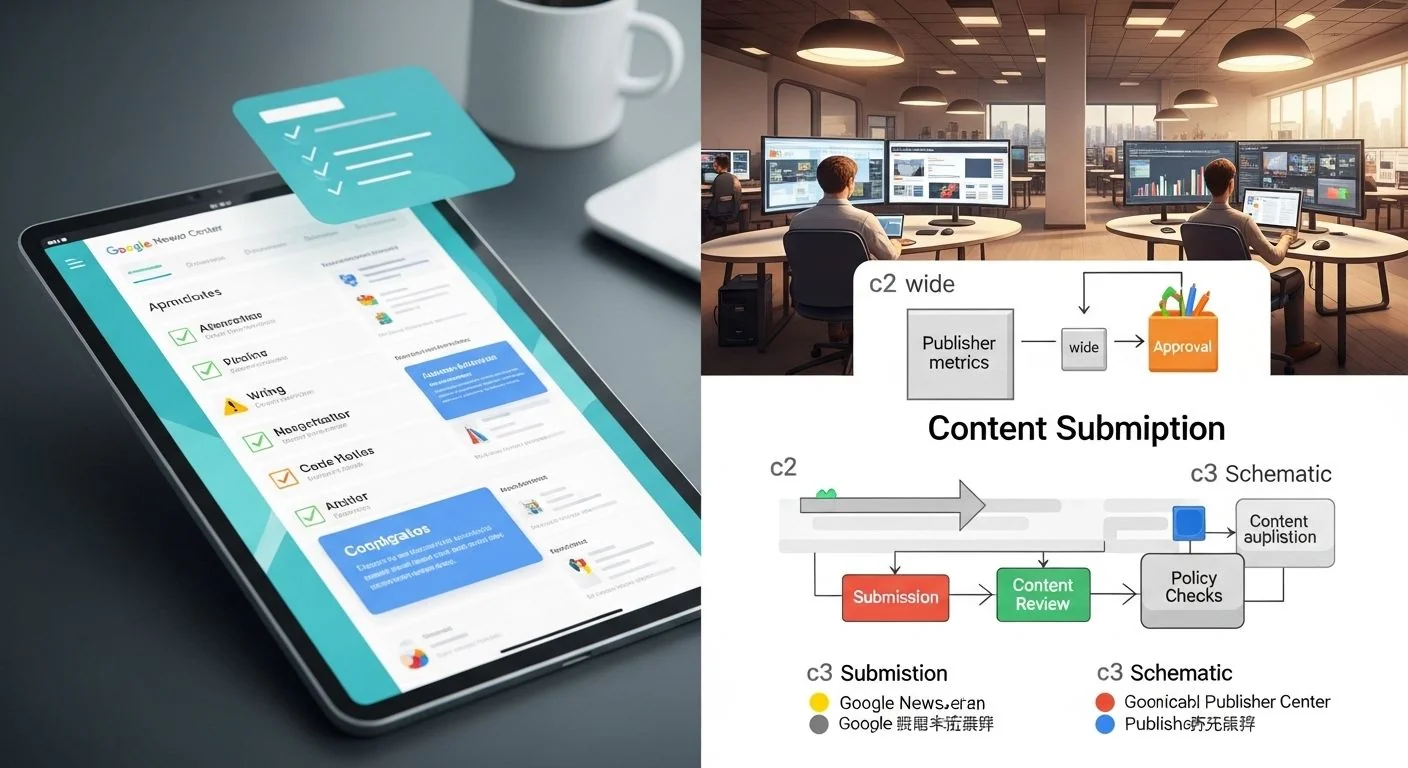
Problem statement: Getting a publication approved in the Google News Publisher Center in 2026 is no longer a one-click process — it requires precise metadata, schema alignment, and operational telemetry to satisfy automated and human reviewers.
Promise: This article gives an operational, step-by-step approval checklist, examples of compliant structured data (NewsArticle and ClaimReview schemas for 2026), a decision framework for feed types, and diagnostics for the most common failure modes so your engineering and editorial teams can get approved and stay approved. For editorial alignment and AI policy considerations, see our Google AI content guidelines for tech publishers.
Failure scenario: A mid‑size tech publisher submits their site and RSS/sitemap feed, receives a rejection with a terse message about "insufficient content quality," and then spends two weeks chasing editorial changes. Meanwhile indexing drops by 60% because of schema mismatches and duplicate canonical signals. This guide prevents that by combining the Publisher Center workflow with production engineering checks and monitoring.
Executive Summary
TL;DR: Follow a three-stage pipeline: verify domain & ownership -> fix canonical, robots & structured data -> submit Publisher Center with clean feed and monitoring; expect 3–21 days for approval if you pass automated checks.
- Prepare authoritative publisher identity (organization metadata, contact verification, and a verified logo) before submission.
- Ship valid NewsArticle schema 2026 JSON‑LD on every article and ClaimReview schema for fact-check pieces; validate with both Schema.org validators and Google’s Rich Results test.
- Choose the right ingestion type (sitemaps for scale, Indexing API for high‑priority updates, Publisher Center feed for curated sections) and follow the checklist per type.
- Instrument feed performance and errors (p95/p99 latency, error-rate per 1K URLs) and set runbooks for common rejection signals (duplicates, paywall, low E‑E‑A‑T signals).
- Expect automated scoring that factors in article freshness, author reputation (linked profiles), and structured data completeness — correct these proactively.
Three one-line Q→A pairs
- Q: How long does Google News approval 2026 usually take? A: If automated validations pass, approvals commonly finish in 3–21 days; failures extend this as you iterate.
- Q: Do I need NewsArticle schema 2026 everywhere? A: Yes — every indexed news article should include valid NewsArticle JSON‑LD for maximum compatibility and feature eligibility.
- Q: When should I use ClaimReview schema? A: Use ClaimReview for fact‑checks and corrective reporting to enable special handling and credibility signals in Google News.
How Google News Publisher Center 2026: Step-by-Step Approval Checklist & Common Pitfalls Works Under the Hood
At a high level, the Publisher Center manifests as a control plane and ingestion pipeline. Understanding the pipeline clarifies why specific checks matter:
- Control plane: Publisher metadata (org name, logo, contact), sections (site, labels), and access control (IAM roles) — stored and surfaced in Publisher Center UI and API.
- Ingestion pipeline: Feeds (sitemap, RSS, Publisher Center feed, Indexing API) are fetched, syntactically validated, then passed to content classification and ranking stacks.
- Validation and scoring: Automated validators check structured data (NewsArticle/ClaimReview schemas), canonical/rel=canonical correctness, robots and X‑Robots tags, paywall detection, and duplication. Signals feed into a content quality model that outputs accept/reject likelihood and a priority bucket for human review.
- Human review: Reserved for edge cases (policy flags, high-profile outlets, content flagged by users). Reviewers see the metadata and a short audit trail with validation errors.
Diagram (text): Publisher Center UI/API → Metadata store → Ingestion fetcher → Syntax validators → Schema validators → Content classifier & ranking → Approval decision + human review queue.
Implementation: Production Patterns
This section runs from basic validation to advanced operational patterns. Use the checklist as gates before you press Submit.
Basic: Pre-submission checklist (engineering + editorial)
- Domain verification: Verify the exact publisher domain you will use (publisher.example.com vs example.com) via Search Console. Publisher Center ties approval to verified ownership.
- Organization metadata: Provide legal name, public contact, and a high-res logo (512×512 PNG/SVG recommended). Logos are used for brand displays and must match the site branding.
- Canonical stability: Ensure every article has a single rel=canonical URL (no query-string alternates). Canonical mismatches are a leading cause of rejection.
- Robots & crawlability: Confirm robots.txt allows Googlebot-News if present and that no X‑Robots: noindex tags exist on published articles you expect indexed.
- Structured data: Add NewsArticle schema 2026 JSON‑LD to every article and validate.
- ClaimReview: If you publish fact checks, include ClaimReview schema for each fact‑check article.
- Sitemaps & feeds: Publish a news sitemap or use the Publisher Center feed. Keep sitemaps under 50,000 URLs per file and split by date or section.
Code: example NewsArticle 2026 JSON‑LD
{
  "@context": "https://schema.org",
  "@type": "NewsArticle",
  "headline": "New cache allocator reduces tail latencies",
  "image": ["https://example.com/images/cache-alloc.png"],
  "datePublished": "2026-02-21T12:00:00Z",
  "dateModified": "2026-02-21T12:00:00Z",
  "author": {
    "@type": "Person",
    "name": "Jane Engineer",
    "url": "https://example.com/authors/jane-engineer"
  },
  "publisher": {
    "@type": "Organization",
    "name": "Example Tech",
    "logo": {
      "@type": "ImageObject",
      "url": "https://example.com/logo-512.png"
    }
  },
  "mainEntityOfPage": {
    "@type": "WebPage",
    "@id": "https://example.com/articles/cache-allocator"
  }
}
Validate this shape with Schema validators and Google's Rich Results test. Missing publisher.logo or author fields is a common rejection cause.
Code: example ClaimReview schema (Google News)
{
  "@context": "https://schema.org",
  "@type": "ClaimReview",
  "claimReviewed": "Company X's product caused data loss",
  "reviewRating": {
    "@type": "Rating",
    "ratingValue": "False",
    "bestRating": "True",
    "worstRating": "False"
  },
  "author": {
    "@type": "Organization",
    "name": "FactCheck Daily",
    "url": "https://factcheck.example.com"
  },
  "datePublished": "2026-01-17T08:30:00Z",
  "itemReviewed": {
    "@type": "CreativeWork",
    "author": "Source Publication",
    "datePublished": "2026-01-15T00:00:00Z"
  }
}
Advanced: Production feed strategies
Decide between three common ingestion types and their tradeoffs:
- Sitemaps (news-specific) — Best for scale (10k–100k articles/day). Use date‑segmented sitemaps. Good p95 ingestion stability. Downside: discovery latency is tied to sitemap update frequency.
- Publisher Center feed — Good for curated sections and brand control (labels and sections). Better for category-level management, but limited for ultra-high volume.
- Indexing API — Use for urgent updates or pages behind dynamic change (breaking news, corrections). Has lower latency but stricter quotas; typically reserved for prioritized content.
Choose feeds based on volume and latency needs. For many publishers, combining a sitemap for bulk indexing and an Indexing API for high-priority articles yields the best p95 freshness. For techniques to reduce p95/p99 latency in rendering and inference, consult the CXL 4.0 AI inference latency benchmarks and checklist.
Error handling and automation
Build an automated pre-flight that runs on every publish and update:
# Pseudocode: preflight checks run in CI/publish pipeline
checks = [
  validate_jsonld(article_html),
  verify_canonical(article_html),
  test_indexable_headers(url),
  ensure_author_profile_exists(article.author)
]
if any(check.failed for check in checks):
  block_publish_and_report(checks)
else:
  publish()
This stops the most common causes of rejection before they reach Google’s pipeline.
Comparisons & Decision Framework
When selecting the right path for Google News approval 2026, evaluate on four axes: scale, latency, control, and complexity.
- Scale — If you publish >10k items/day, sitemaps + segmented pipelines are necessary.
- Latency — If you need sub‑hour updates for breaking news, use the Indexing API selectively.
- Control — If you need curated sections and branding, the Publisher Center offers better section-level controls and label mapping.
- Complexity — Publisher Center UI is simpler; programmatic Indexing API and dynamic sitemaps require more engineering effort.
Decision checklist:
- If daily volume < 500 articles and you want tight editorial curation → Publisher Center feed.
- If volume > 5000/day and you prioritize scale → date-segmented sitemaps and batching.
- If certain articles must appear instantly (breaking news) → Indexing API for those URLs only.
Failure Modes & Edge Cases
Concrete diagnostics and mitigations for common rejection signals.
- Validation failures (JSON‑LD)
- Symptom: Rich Results test fails or Publisher Center reports "missing publisher.logo".
- Diagnostics: Run schema validators, check HTTP fetch of the logo URL and MIME type, ensure HTTPS and correct certificates.
- Mitigation: Serve logos with stable URLs, add CORS headers if blocked, and include ImageObject in publisher.logo.
- Canonical conflicts and duplicate content
- Symptom: Many articles are filtered as duplicates; traffic drops.
- Diagnostics: Check rel=canonical, server-side redirects, URL parameters, and site-level syndication partners.
- Mitigation: Normalize URLs, ensure canonical points to the canonical article and not an index page, add self-referential canonical.
- Paywall & partial content detection
- Symptom: Rejection for "insufficient content" or ranking penalty for snippets-only pages.
- Diagnostics: Verify visible content for the crawler; check structured data includes headline, image, and fullText if you provide it.
- Mitigation: Use structured data that indicates paywall behavior (if allowed) and provide at least summary markup where necessary; prefer staggered content for subscribers.
- Author & E‑E‑A‑T signals missing
- Symptom: Manual review comments about "low author reputation" or "insufficient expertise."
- Diagnostics: Inspect article templates for missing author profile links and bylines; check author pages for credentials and archives.
- Mitigation: Link author name to a canonical author page with bio, social proof, and contact; canonicalize author pages and include author@type Person in JSON‑LD.
- Feed processing timeouts & rate limits
- Symptom: Intermittent fetch errors and partial ingestion.
- Diagnostics: Check server logs for 429/503 responses, TCP handshake errors, and TLS renegotiation delays.
- Mitigation: Use CDN + stable origin, pre-generate sitemaps, and stagger fetch times (exponential backoff on 5xx). Consider using a static hosting endpoint for sitemaps to reduce origin load.
Performance & Scaling
Targets and KPIs you should instrument. These numbers reflect pragmatic goals for a production publisher integration in 2026.
- Approval latency (business metric): aim p50 < 7 days, p90 < 21 days (from first submission to approval) if automated checks pass.
- Feed processing latency (operational metric): p95 < 1 hour for Indexing API; p95 < 24 hours for sitemaps in normal operating windows; p99 < 72 hours for large batches.
- Error rate: keep validation error-rate < 0.5% per 1k published articles.
- Server-side: sitemap generation O(N) per write; pre-generate static fragments to keep generation near O(1) for new articles (append-only index files).
Monitoring recommendations:
- Instrument validation pipelines with histograms for latency and counters for each validation error type.
- Track coverage metrics: percent of published articles that are eligible and indexed by Google News (daily).
- Set alerts for spikes in 4xx/5xx from Googlebot and for publisher center feed fetch failures > 5% in 1 hour.
Production Best Practices
Security, testing, rollout, and runbooks that matter for publishers at scale.
- Security: Use HTTPS everywhere, HSTS, and valid certs. Protect Publisher Center accounts with enforced 2FA and use institutional Google Workspace accounts for admin access.
- Testing: Create a staging subdomain that mirrors production and register it as a test publisher to validate schema and crawling behaviour without impacting production signals.
- Rollout: Ship schema changes behind feature flags and toggle gradual rollout by section. Keep a compatibility shim that emits older schema shapes for older consumers where needed.
- Runbooks: Maintain a short runbook for the top 5 failures (logo fetch error, JSON‑LD parse error, sitemap 5xx, X‑Robots noindex, canonical mismatch). Include remediation steps and sample curl commands to reproduce.
Runbook snippet: diagnose JSON‑LD failure
1. curl -I https://example.com/articles/foo --header "User-Agent: Googlebot-News"
2. curl https://example.com/articles/foo | grep -i "


