
Edge Computing IoT Battery Life: Practical Optimizations
Introduction
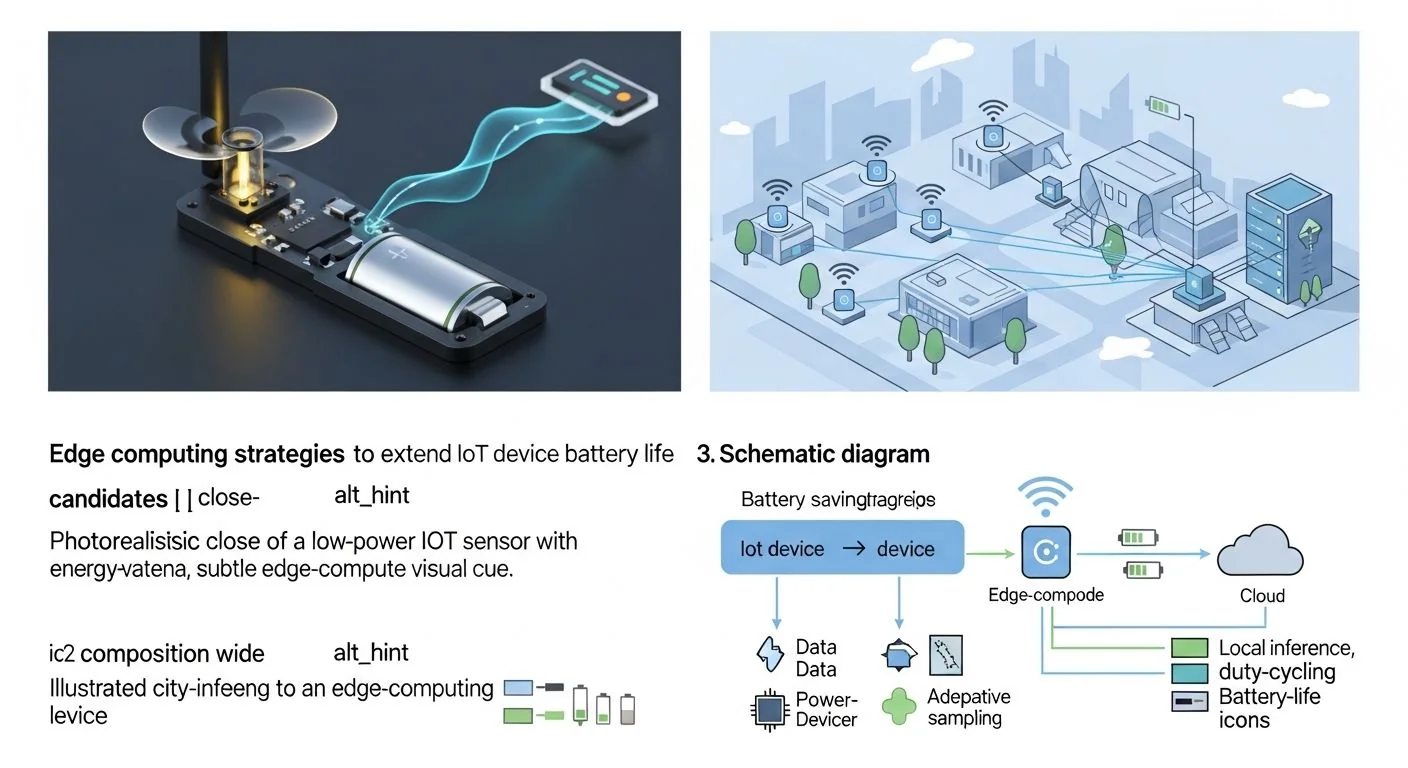
Problem statement: Battery-powered IoT endpoints are energy-constrained devices that must balance sensing fidelity, responsiveness, and lifetime in production deployments.
What this article delivers: A hands-on, production-oriented catalog of edge computing strategies that materially extend IoT battery life, with architecture patterns, implementation recipes, diagnostics, and measurable KPIs.
Failure scenario (example): A remote environmental sensor cluster deployed on AA cells starts failing after six months instead of the expected two years. Field logs show frequent RF retransmits, an always-on ML model using a full-run neural network every second, and rapid wake cycles from the MCU for housekeeping. The result is high average current draw (500+ µA baseline) and a battery drain curve far steeper than predictions. This article explains how that happened and the concrete steps to avoid it.
Executive Summary
TL;DR: Push intelligence to low-power edge nodes, reduce wake frequency and radio transmissions, use TinyML + adaptive sleep scheduling, and measure duty cycle to convert energy savings into predictable battery life gains.
- Move high-frequency decisions to the edge (TinyML, rule filters) to reduce radio usage — the radio dominates energy budget once every 10–100 transmissions.
- Optimize sleep scheduling using adaptive duty cycles and event-driven wake; design for p95/p99 latency requirements to avoid unnecessary awake time.
- Use low-power inference (TF Lite Micro on Cortex-M, quantized models), power gating of sensors/peripherals, and batched/aggregated uplinks to minimize per-sample energy.
- Profile energy by component (MCU, radio, sensors) and calculate battery life from measured duty cycles; plan for degradation and temperature effects.
- Instrument for KPIs: average current, duty cycle, transmissions/day, p95 latency, and per-inference energy (µJ–mJ).
Three one-line Q→A pairs:
- Q: Will running ML on-device save battery? A: Usually — on-device inference avoids many radio transmissions but only if the model and inference cadence are tuned to be low-power.
- Q: Which is more important: sleep current or radio efficiency? A: Depends on duty cycle; if device wakes rarely, sleep current dominates; if frequent transmissions occur, radio energy dominates.
- Q: How to estimate battery life quickly? A: Measure average current (µA) under representative duty cycle and divide battery capacity (µAh) by that number, then adjust for temperature and self-discharge.
How Edge computing strategies to extend IoT device battery life Works Under the Hood
At a high level, energy optimization at the edge reduces total energy by decreasing either the time spent in high-power states or the frequency of those states. Edge computing works through these levers: For a focused, hands-on walkthrough of protocol tuning and TinyML stacks that complements these levers, see our practical guide to protocol tuning and TinyML stacks.
- Local filtering and classification: Run lightweight classifiers (TinyML) to decide whether an event warrants radio transmission.
- Adaptive duty cycling: Modify sleep/wake schedules based on context (time of day, recent event rate, battery state).
- Power gating and peripheral control: Turn off sensors, ADCs, and radios when not needed; manage power rails where feasible.
- Aggregation and compression: Batch multiple observations into a single uplink or send deltas rather than raw samples.
- Protocol optimization: Use lightweight protocols (CoAP, MQTT-SN) and energy-aware link layers (LoRaWAN adaptive data rate, BLE connection intervals).
Architecture (text diagram):
Sensor -> MCU (ISR) -> Pre-filter (thresholds) -> TinyML model / rule engine -> Transmission aggregator -> Low-power radioEach block has a power budget and a latency cost. TinyML reduces downstream radio events but introduces compute energy. The decision point is cost of a local inference vs. cost of a transmission plus remote processing and additional wake cycles.
Cost model (simple):
E_total = Duty_cycle_sleep * I_sleep * V + N_infers * E_infer + N_tx * E_tx + E_miscWhere E_infer is energy per on-device inference, and E_tx is energy per radio transmission (including retries). The aim is to choose N_infers and N_tx (through model design and thresholds) to minimize E_total subject to latency constraints.
Implementation: Production Patterns
This section runs from practical basics to advanced patterns, including code examples for Cortex-M + TF Lite Micro and a sleep scheduler. The examples are compact, production-realistic, and designed to be adapted.
Basic pattern: event-driven edge filtering
1) Hardware: MCU with deep-sleep < 1 µA, a low-power radio (BLE/LoRa), necessary sensors. 2) ISR wakes MCU, runs deterministic threshold checks, and only runs a TinyML inference if thresholds suggest an event.
// pseudo-C ISR pattern
void sensor_isr() {
  // Minimal wake: read sensor once
  int16_t sample = sensor_read();
  if (sample > THRESHOLD) {
    schedule_work(run_inference);
  } else {
    sleep_until_next_interrupt();
  }
}

void run_inference(void) {
  // Run TinyML inference here; keep stack small and SRAM tight
  TfLiteStatus s = tflm_invoke(model_context);
  if (s == kTfLiteOk && model_predicts_event()) {
    queue_for_tx(prepare_payload());
  }
  enter_deep_sleep();
}
Notes: ISR should only do minimal work and return. Use a work-queue on the MCU to run heavier tasks after peripherals are enabled and clocks stabilized.
Advanced: adaptive TinyML + dynamic sleep scheduling
Pattern: Use a tiny confidence estimator or lightweight LRU predictor to increase or decrease inference frequency. For example, when events are rare, the model only runs every N seconds; if an event is detected, increase sampling/inference rate temporarily.
// simplified adaptive sleep scheduler (pseudocode)
struct scheduler_ctx { uint32_t base_interval_ms; uint32_t current_interval_ms; uint8_t backoff_counter; } ctx;

void update_schedule(bool event_detected) {
  if (event_detected) {
    ctx.current_interval_ms = ctx.base_interval_ms / 4; // higher fidelity
    ctx.backoff_counter = 0;
  } else {
    // exponential backoff to reduce energy
    ctx.backoff_counter = min(ctx.backoff_counter + 1, 6);
    ctx.current_interval_ms = ctx.base_interval_ms << ctx.backoff_counter;
  }
}

void main_loop() {
  while (1) {
    wake_and_sample();
    bool is_event = run_inference_or_filter();
    if (is_event) queue_tx();
    update_schedule(is_event);
    sleep_ms(ctx.current_interval_ms);
  }
}
This pattern reduces average inference frequency after long quiet periods and increases responsiveness during active windows.
Low-power inference: TF Lite Micro example
Use quantized models and TFLM interpreter. Keep memory arena tight and prefer CMSIS-NN optimized kernels when available.
// conceptual flow (not full compile-ready)
#include "tensorflow/lite/micro/all_ops_resolver.h"
#include "tensorflow/lite/micro/micro_interpreter.h"

static tflite::MicroInterpreter* interpreter;
static uint8_t tensor_arena[12 * 1024]; // tune to your model

void tflm_init(const uint8_t* model_data) {
  const tflite::Model* model = tflite::GetModel(model_data);
  static tflite::AllOpsResolver resolver;
  interpreter = new tflite::MicroInterpreter(model, resolver, tensor_arena, sizeof(tensor_arena));
  interpreter->AllocateTensors();
}

bool run_tflm_inference(float* input, int input_len) {
  float* in = interpreter->input(0)->data.f;
  memcpy(in, input, input_len * sizeof(float));
  TfLiteStatus s = interpreter->Invoke();
  return (s == kTfLiteOk) && (interpreter->output(0)->data.uint8[0] > THRESHOLD);
}
Optimization tips: quantize to int8, use CMSIS-NN acceleration, and pin model to flash. Measure per-inference energy with a shunt resistor and ADC or an energy profiler.
Radio & uplink strategies
Group messages, reduce header overhead, use binary payloads, and select link parameters for energy (e.g., LoRa spreading factor or BLE connection interval). Implement retransmit backoff and suppress noisy, repeated events via local debounce and hysteresis.
For protocol selection and tuning, the difference between CoAP and MQTT-SN is rarely the energy bottleneck; the dominant factor is airtime and transmit power. For details on practical protocols and TinyML stacks, see an article covering TinyML on Cortex-M and edge protocol patterns which complements the guidance here.
Comparisons & Decision Framework
Choose among these patterns by comparing energy cost, latency, and complexity. The checklist below turns the comparison into actionable selection criteria.
Trade-offs summary
- Always-on sensing + edge inference: Low radio usage, higher baseline compute; good when inference cost < avoided radio cost.
- Periodic sampling + server-side processing: Simpler devices, more radio energy; good when MCU is too weak to run models.
- Hybrid (wake-on-event + batched send): Best for sporadic events where energy for a short local inference prevents frequent transmissions.
Decision checklist
- Measure per-event radio energy (E_tx) and per-inference energy (E_infer) on your hardware.
- If E_infer < E_tx * expected reduction in transmissions, move the decision to the edge.
- Verify that latency constraints (p95/p99) are satisfied when the device sleeps and uses wake-up strategies.
- Confirm that model memory fits SRAM and arena with margin for runtime stack and DMA buffers.
- Plan for environmental effects: temperature reduces battery capacity; derate estimates accordingly.
Failure Modes & Edge Cases
Common failure modes, diagnostics, and fixes:
- Failure: High standby current. Diagnostic: measure current in deep sleep with power profiler. Likely causes: peripherals not powered down, debug pins enabled, capacitor charging loops. Fix: gate peripheral power rails, disable debug, reduce wake sources.
- Failure: Frequent retransmits / high airtime. Diagnostic: radio logs show retries and ACK timeouts. Fix: improve link budget (antenna, power), increase local filtering, use adaptive data rate or lower spreading factor for LoRa when SNR allows.
- Failure: Model drift or false positives causing many uplinks. Diagnostic: inspect confusion matrix or logged inference outputs. Fix: reduce model sensitivity, add hysteresis, or use two-stage detection (cheap prefilter then model).
- Failure: Memory overrun / stack corruption. Diagnostic: intermittent crashes after inference. Fix: increase arena, use static allocation, enable stack protection and runtime checks.
- Failure: Latency spikes breaking SLA. Diagnostic: p95/p99 latency measurements for end-to-end path. Fix: prioritize real-time paths, pre-warm radio or keep radio in low-power connected mode if required.
Performance & Scaling
KPIs to track in production:
- Average current (µA) under representative duty cycle — primary metric for battery life.
- Duty cycle (%) and wake-up frequency (events/hour).
- Per-inference energy (µJ or mJ) and inference latency (ms).
- Transmissions/day and retransmit ratio.
- p95 and p99 end-to-end latency (sensor → decision → acknowledgement).
Benchmarks and guidance (typical ranges):
- Deep sleep current: < 1 µA for optimized designs; realistic low-power MCUs often achieve 0.5–5 µA depending on peripherals and temperature.
- Active MCU current (Cortex-M4/M7 at runtime): 1–20 mA depending on core frequency and peripherals.
- Per-inference energy (TinyML): ~10s of µJ to low mJ. Example: small keyword-spotting int8 models running on Cortex-M4 with CMSIS-NN often consume tens to hundreds of µJ per inference; larger models or floating point can cost orders of magnitude more.
- Radio transmission energy: BLE transmissions are often single-digit mJ per burst; LoRa/LPWAN transmissions can be mJ to 10s of mJ due to long airtime. This makes even moderately expensive local inferences worthwhile if they avoid one or more transmissions.
p95/p99 guidance: target p95 latency that keeps user experience and system SLAs happy; allow p99 headroom for link-layer retries. For example, set edge-decision deadlines to 2× the median inference latency to keep p99 predictable, and pre-warm the radio if the deadline is tight (<100 ms).
Production Best Practices
- Profiling: Measure with real hardware in representative conditions. Use shunt-based current measurement or dedicated power analyzers. Log duty cycle over weeks, not minutes.
- Testing: Run long-term soak tests including temperature extremes. Include synthetic event storms to test rate limiting and backoff logic.
- Security: Use authenticated and encrypted uplinks (DTLS/OSCORE for CoAP, MQTT with TLS), but be aware crypto can add energy cost; evaluate hardware crypto accelerators to reduce CPU load.
- Rollout: Staged rollouts with telemetry to catch increased energy usage early. Provide a firmware fallback that reduces sampling/inference if battery drains unexpectedly.
- Runbooks: Have runbooks for interpreting battery telemetry: thresholds for replacing hardware vs changing server-side rules, and for handling firmware hotfixes to throttle behavior remotely.
Further Reading & References
- TensorFlow Lite for Microcontrollers documentation — best practices for TinyML on constrained devices.
- ARM Cortex-M power and architecture guides — details on low-power modes and system design.
- RFC 7252 CoAP and MQTT.org — protocol references for lightweight messaging.
- TinyML foundation — community resources and examples for on-device ML.
- Practical companion: for implementation patterns and additional TinyML deployment tips on Cortex-M with messaging patterns, see our practical strategies article covering TinyML and edge protocols.
Appendix: Battery life estimation formula and worked example
Battery life estimate (hours) = Capacity (mAh) / Average current (mA). Compute average current from measured cycles:
// Example numbers
I_sleep = 2e-6 A // 2 uA
T_sleep = 3599 s
I_active = 8e-3 A // 8 mA
T_active = 1 s
Average_current = (I_sleep * T_sleep + I_active * T_active) / (T_sleep + T_active)

// If Capacity = 2000 mAh then Battery_life_hours = 2000 mAh / (Average_current * 1000)
Worked example: with T_active 1 s every hour and numbers above, Average_current ≈ 2.01 µA -> battery life ~99,000 hours (~11 years) ignoring self-discharge; realistic adjustments for temperature, RTC power, and leakage will reduce this to a few years — still vastly different from designs that transmit frequently.
Note: For radio-heavy devices the active time and power during TX dominate; always measure per-transmission energy and factor retries into N_tx.
Closing Notes
Edge computing for battery life optimization is a set of engineering trade-offs: algorithms, hardware, radio, and firmware practices. Move work to the lowest-power compute element that can make correct decisions, stabilize wake patterns with adaptive scheduling, and measure relentlessly. Small reductions in duty cycle or radio airtime compound into large gains in operational life.
For hands-on, Cortex-M focused tutorials and example stacks that illustrate TinyML + protocol tuning in practice, consult the practical guide to edge computing and IoT battery life which provides deployment-level example code and test procedures.
— MAKB (Lead Editor & Senior Principal Engineer-Author)


