
Edge computing IoT battery life optimization: Practical strategies
Introduction
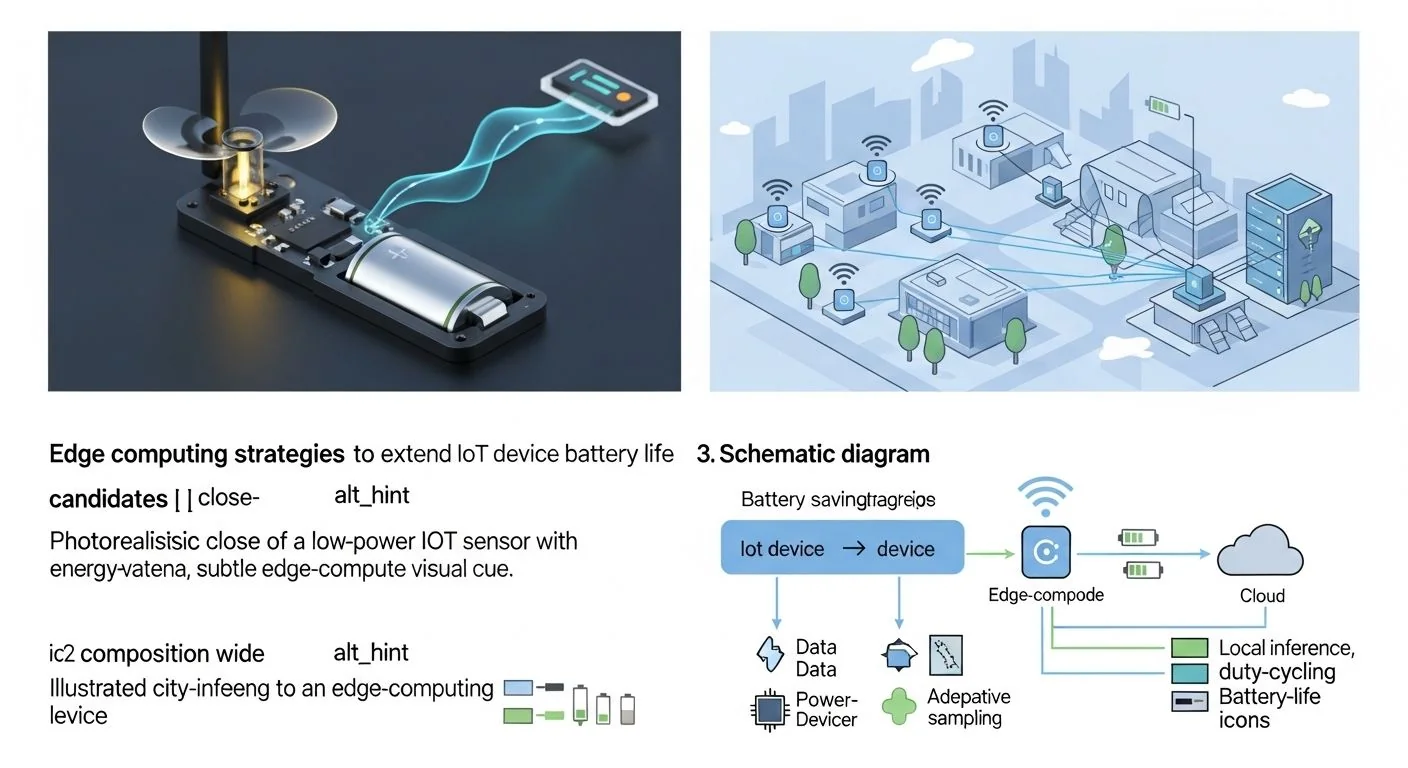
Problem statement: Battery-constrained IoT devices often spend most of their lifetime powering radios and wake cycles rather than sensing or computing, limiting deployment longevity and maintenance windows.
What this article delivers: A pragmatic, production-proven playbook for using extend IoT device battery life across hardware, software, and network layers, with runnable patterns, diagnostics, and selection checklists.
Failure scenario (example): A logistics fleet of temperature sensors designed for 5-year operation starts draining batteries after 6 months. Root cause analysis shows frequent radio reconnections, noisy sensors causing repeated wakeups, and a cloud-centric architecture that sends every sample upstream. The system lacks local filtering, adaptive sampling, and proper sleep domain control. This article tells you exactly how to avoid that outcome.
Executive Summary
TL;DR: Move the right computation to the right edge, minimize wake-ups and radio on-time, and use adaptive, event-driven TinyML and efficient protocols to extend battery life by 2–10x depending on workload.
- Right-place inference: Use TinyML on-classification tasks to reduce noisy cloud trips.
- Duty-cycle radios aggressively: batch uplinks, use lightweight protocols and push logic to gateways.
- Adaptive sensing: event-driven sampling and hierarchical sensing cut energy per useful sample.
- Hardware-aware power gating: use co-processors, deep-sleep domains, and timer-based wake for ultra-low idle current.
- Profile at system level: measure p95/p99 radio duty, wake sources, and per-inference µJ costs for realistic trade-offs.
Quick Q→A (one-line answers for common queries)
- Q: Can edge inference reduce radio energy? A: Yes—local classification can convert continuous uplinks into rare event notifications, often reducing radio energy by an order of magnitude.
- Q: When should I offload to a gateway? A: Offload when models are too large for the device or when latency bounds and network costs favor aggregated processing at a nearby, powered gateway.
- Q: Is TinyML always the best choice? A: No—use TinyML for lightweight classification/anomaly detection; for high-fidelity analytics or model retraining, use hierarchical architectures with gateway/cloud support.
How Edge computing strategies to extend IoT device battery life Works Under the Hood
At a systems level, battery optimization via edge computing relies on three orthogonal levers: reduce sampling and compute energy, reduce radio on-time, and reduce background leakage. Combining software strategies (adaptive sampling, TinyML inference, event filtering) with hardware controls (domain power gating, co-processors, RTC timers) yields compounding benefits.
Architecture patterns — described as layered components:
- Sensor layer: Configurable sampling rates, local debouncing, and hardware interrupts.
- Preprocessing layer: Lightweight DSP (e.g., envelope detection, downsampling) implemented on MCU or sensor IC.
- Inference / decision layer: TinyML models or rule engines that emit events or reduce dimensions.
- Connectivity layer: Low-power protocols (MQTT-SN, CoAP, LoRaWAN) with batching, acknowledgements tuned for energy.
- Gateway/cloud: Aggregate, retrain, and push updated models or configuration back to edge nodes.
Typical data flow text-diagram:
Sensor → pre-filter (HW/DSP) → TinyML / rule engine → event? → yes: radio wake & batch publish → gateway → cloud; no: back to deep sleep
Key algorithms & protocols:
- Adaptive sampling: dynamically change sampling frequency based on context (time-of-day, last-event time, motion detection).
- Event-driven TinyML: extremely small classifiers (binary anomaly/detect) running at microjoule inference cost.
- Sleep scheduling algorithms: RTC-aligned duty cycles, staggered group wake for mesh/gateway co-ordination.
- Radio duty cycling & batching: transmit only when there is meaningful information or at scheduled windows to minimize modem startup energy.
For an applied walkthrough and hardware-focused guidance on using TinyML and Cortex-M devices, see our practical guide to optimizing IoT battery life with edge computing, which covers TF Lite Micro and MQTT/CoAP trade-offs in depth.
Implementation: Production Patterns
Below are progressive implementation patterns from quick wins to advanced optimizations, with sample code where it accelerates comprehension.
Basic: Make radios expensive, compute cheap
- Measure baseline: log per-boot energy budget, radio TX/RX counts, MCU active time, sleep current.
- Reduce sample rate by 2–10x where signal permits.
- Implement simple threshold filtering on the MCU to suppress noise before any radio activity.
- Batch network transmissions (e.g., send 10 samples once per hour rather than every 6 minutes).
Example: minimal publish batching pseudocode (RTOS or bare-metal timer-driven)
// Pseudocode: batch sensor samples and publish every N samples or T seconds
const int MAX_BATCH = 10;
SensorSample batch[MAX_BATCH];
int idx = 0;
uint32_t last_publish = 0;

void on_sample_ready(SensorSample s) {
  batch[idx++] = s;
  if (idx >= MAX_BATCH || (now() - last_publish) >= PUBLISH_INTERVAL_MS) {
    // prepare and sleep-critical: keep radio on as short as possible
    radio_wake();
    mqtt_publish_batch(batch, idx);
    radio_sleep();
    idx = 0;
    last_publish = now();
  }
}
Intermediate: Event-driven sensing + TinyML
- Move transient detection (e.g., motion, vibration, acoustic event) to TinyML binary classifiers running on-device.
- Use sensor hubs/co-processors for wake-on-event to avoid waking the primary MCU.
- Implement hysteresis & debouncing in the decision layer to prevent flapping.
Example: TinyML inference workflow using TF Lite Micro (conceptual)
// Minimal TF Lite Micro flow (high-level)
TfLiteTensor *input = interpreter->input(0);
fill_input_from_sensor(input);
TfLiteStatus s = interpreter->Invoke();
float *out = interpreter->output(0)->data.f;
if (out[0] >= THRESHOLD) {
  // event detected: send notification
  publish_event();
}
In practice, minimize copies, use CMSIS-NN kernels where available, and prefer 8-bit quantized models for µJ-level inferences on Cortex-M4/M7.
Advanced: Hierarchical & adaptive edge architectures
- Dual-processor split: keep primary MCU in deep-sleep; use a low-power sensor hub or RTC co-processor for always-on detection.
- Dynamic model loading: small models on-device for routine inference; receive heavier models from gateway when conditions warrant.
- Context-aware sampling: combine calendar, location, and recent history to change behavior (e.g., high-frequency sampling during transit only).
Firmware update patterns: use A/B partitions with delta OTA to minimize energy and network usage for updates—send smaller binary diffs from gateway during scheduled maintenance windows.
Error handling & resilience
- Corrupted model fallback: include a minimal rule-based fallback so device still suppresses noise when model validation fails.
- Watchdogs tuned for long sleeps: watchdog timers must account for expected deep-sleep durations or be serviced by a low-power supervisor.
- Network failure modes: backoff publishing schedule exponentially, and then re-attempt during preconfigured maintenance windows.
For concrete guidance on implementing TinyML on constrained MCUs and comms options, consult our advanced techniques for TinyML on Cortex-M and efficient MQTT/CoAP integration.
Comparisons & Decision Framework
Choose between three main deployment choices: Local-only, Gateway-assisted, Cloud-centric. Use the checklist below to select the right pattern.
- Local-only edge (tiny models on device)
- Pros: minimal radio usage, low latency, robust to connectivity loss.
- Cons: limited model size, remote retraining and telemetry costs can be higher per unit feature.
- Best when: event detection, privacy, and long battery life are primary.
- Gateway-assisted
- Pros: more compute than device, aggregated uplinks, local retraining or model personalization possible.
- Cons: requires managed gateway infrastructure and may increase complexity.
- Best when: richer analytics are needed near the edge without cloud round-trips.
- Cloud-centric
- Pros: unlimited compute, easy model deployment and global analytics.
- Cons: high radio energy due to frequent transmissions, larger data transfer costs, higher latency.
- Best when: devices are mains-powered or battery is not a primary constraint.
Selection checklist (binary scoring):
- Must run ≥1 year on battery? (yes → add 2 points for local inference)
- Is per-device latency requirement <100ms? (yes → prefer local inference)
- Is data rate >100 KB/day? (yes → favor gateway aggregation)
- Privacy-sensitive data? (yes → prefer local or gateway with encryption)
- Need frequent model updates >1/week? (yes → cloud/gateway with delta OTA)
Failure Modes & Edge Cases
Below are common failures in the field and deterministic diagnostics plus mitigations.
- Symptom: Unexpected high battery drain
- Diagnostics: log radio TX/RX events, MCU wake counters, peripheral enable states, sleep current measurement.
- Common causes: un-gated peripherals (GPIO, ADC left enabled), software timers too frequent, excessive neighbor scanning for mesh.
- Mitigation: audit peripheral init/deinit, coalesce timers, use low-power hardware features (wake-on-change on GPIO).
- Symptom: Frequent false positives from TinyML model causing radio storms
- Diagnostics: confusion matrix, inference rate vs. true event rate, trace raw metric windows.
- Causes: overfitting to lab data, sensor drift, insufficient debouncing.
- Mitigation: implement debounce/hysteresis, threshold tuning on-device, and scheduled model revalidation with gateway.
- Symptom: Device never wakes after OTA
- Diagnostics: check A/B partition validity, bootloader logs, verify CRC/signature of updated image.
- Mitigation: always include a validated rollback partition and minimal factory firmware that can accept OTA images via low-power channel.
Performance & Scaling
Real-world KPIs you should measure and the p95/p99 targets to drive design decisions:
- Idle current (deep sleep): target <5 µA for 1–5 year deployments on coin cells.
- Active sampling + preprocessing: measure per-sample energy; aim for <1 mJ for periodic sensing tasks where battery is limited.
- Inference energy (TinyML): common 8-bit quantized tiny NN on Cortex-M4 can be in the low-to-mid µJ range (platform-dependent); instrument and measure on-target.
- Radio transmit energy: depends on technology; BLE advertising bursts are relatively cheap, LoRaWAN single uplink can be costly in energy but lower data volume overall.
- p95 radio on-time per day: for long-life devices aim p95 < 10s/day; p99 < 60s/day to avoid tail drains during rare network recoveries.
Scaling note: When you increase device fleet size, the gateway model becomes more favorable because you amortize gateway hardware cost and heavy compute across many devices; calculate break-even where gateway cost + maintenance < increased battery replacement cost and cloud egress of direct-to-cloud devices.
Monitoring recommendations:
- Expose per-device metrics: cumulative radio seconds, MCU active seconds, boot count, battery voltage trends.
- Set alerts on p95/p99 skew: e.g., if p99 active seconds > 2x p95, investigate tail events or stuck peripherals.
- Automate lightweight diagnostics: on detection of high drain, pull a short trace (last N wake events) to the gateway for analysis.
Production Best Practices
- Security: Protect models and OTA with signatures; encrypt stored model blobs; authenticate gateways and devices using hardware-backed keys where possible.
- Testing: Battery-in-the-loop testing with realistic duty cycles and temperature variation is essential—lab-only power profiles are misleading.
- Rollouts: Staged OTA rollout with power-aware scheduling (send updates during charger windows or scheduled maintenance) and A/B rollbacks.
- Runbooks: Provide playbooks for diagnosing drains: gather last-boot logs, radio counts, watchdog resets, and model inference rate traces.
Further Reading & References
- TensorFlow Lite Micro: https://www.tensorflow.org/lite/micro
- ARM CMSIS-NN for efficient NN kernels on Cortex-M: https://developer.arm.com/tools-and-software/embedded/cmsis
- LoRaWAN specification (for low-power wide-area links): https://lora-alliance.org
- MQTT-SN and CoAP overview for constrained devices: IETF CoAP drafts and MQTT-SN docs
- TinyML: Machine Learning on Ultra-Low-Power Devices (book/papers) — for principles and energy measurements
Also see our hands-on writeup on implementation trade-offs and TinyML on Cortex-M devices at the practical guide to optimizing IoT battery life with edge computing for additional code patterns and protocol examples.
Closing notes from MAKB
Battery optimization is not a single trick; it's a system design problem. Combine hardware controls, tightly scoped on-device intelligence, and conservative networking to achieve predictable, multi-year deployments. Measure everything, automate diagnostics, and prioritize auditability—those are the levers that separate pilot projects from reliable fleets.


