
AMD MI500: 1000x AI Performance Leap Preview
Introduction
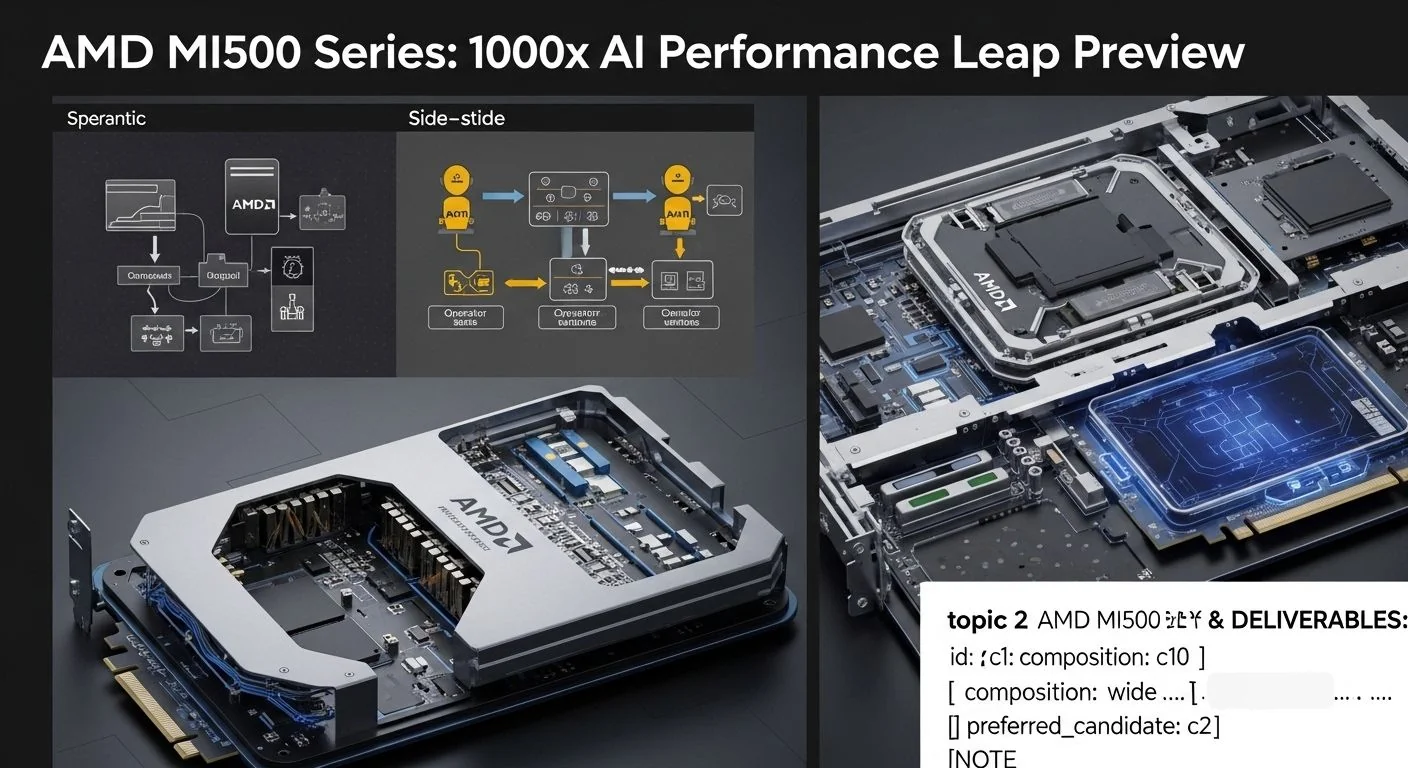
Problem statement: Production AI teams must plan compute architecture roadmaps months ahead; a rumored 1000x performance leap from the upcoming AMD MI500 family changes capacity planning, model placement, and fabric design.
Promise: This article previews how the MI500 series is expected to deliver massive generational gains, what architectural changes are responsible, and pragmatic migration and validation steps you can use today to prepare infrastructure, training pipelines, and runbooks for a post-MI400 world.
Failure scenario: Teams that assume linear performance scaling from MI400-class accelerators risk expensive integration surprises—examples include underprovisioned I/O fabrics that create p95/p99 stalls, model-precision mismatches producing numerical instability, and scheduler policies that leave HBM4-bound workloads starved. This preview identifies those high-risk failure modes and prescribes diagnostics and mitigations so you can avoid them.
Executive Summary
TL;DR: The AMD MI500 family (CDNA 6 roadmap) targets an architectural jump—new matrix-engine microarchitectures, HBM4 and fabric upgrades, and compiler/runtime revisions—that together could enable up to a 1000x throughput efficiency improvement for select AI workloads versus early MI400 silicon, but actual gains will depend on model class, precision, and system-level integration.
- Key takeaway 1: The MI500's gains are expected to be heterogeneous—extreme for low-precision dense inference and certain training kernels, modest for sparse, memory-bound transformers without fabric upgrades.
- Key takeaway 2: HBM4, expanded on-die SRAM, and tighter fabric (UALink/CXL enhancements) are the core enablers—system I/O and scheduler updates are required to realize peak throughput.
- Key takeaway 3: Expect a staged rollout (MI500 silicon → platform-optimized boards → integrated systems like Helios); plan validation gates around memory-bandwidth-limited benchmarks and p95/p99 tail-latency tests.
- Key takeaway 4: Prepare software by aligning compiler toolchains (ROCm successor), mixed-precision numerics, and operator fusion strategies to leverage new matrix units and bandwidth hierarchy.
- Key takeaway 5: Use targeted microbenchmarks and runbooks now—profiling HBM throughput, DMA latency, and fabric saturation will avoid costly retrofits after deployment.
Three likely Q→A short answers
- Q: Is the 1000x claim realistic for all AI workloads? A: No — it's realistic for highly optimized low-precision workloads and some inference stacks, not for all transformer training without system-level upgrades.
- Q: When should teams start migrating tests to MI500-class hardware? A: Begin compatibility and profiling now against MI400/Helios platforms and vendor preview SDKs; finalize migrations after the MI500 hardware validation stage and driver/runtime updates.
- Q: Will MI500 replace current fabric designs like NVLink? A: MI500 accelerators will push broader adoption of fabrics such as UALink/CXL-based topologies; full replacement depends on workload and vendor ecosystem support.
How AMD MI500 Series: 1000x AI Performance Leap Preview Works Under the Hood
This section synthesizes public signals, architectural patterns from prior AMD CDNA generations, and likely hardware/software co-design moves that could produce the reported 1000x-class effective performance improvements for certain workloads.
Microarchitecture advances (matrix engines and memory hierarchy)
CDNA 6 (the presumed MI500 roadmap) appears to prioritize three pillars:
- Revised matrix cores: Denser, higher-throughput matrix-multiply-accumulate (MMA) units with native support for narrower datatypes (e.g., FP8, BF16 variants) and improved mixed-precision accumulation paths. Expect reduced per-op energy and higher operations-per-cycle.
- On-die SRAM and register banking: Larger, lower-latency local storage to reduce HBM round trips for tiled GEMMs and convolution loops. This reduces memory-bound behavior for many kernels.
- HBM4 and improved memory controllers: Higher aggregate bandwidth and lower latency for streaming workloads; combined with smarter prefetchers and scatter-gather DMA to accelerate sparse workloads when supported.
Fabric & coherence: UALink and CXL evolution
The MI500's system-level performance will depend heavily on interconnect. For background on the fabrics direction, see our UALink 1.0 ultra-high-bandwidth fabric primer. For vendor-level CXL/HBM4 interoperability and integration data, review Quantum-AI Hybrid Accelerators: AMD‑IBM integration benchmarks. AMD has been moving beyond simple peer-to-peer fabrics toward unified fabrics. Expect:
- Lower-latency, higher-bandwidth AI fabric improvements (following the direction of UALink 2.0 and CXL 3/4 advances), enabling tighter multi-accelerator scaling.
- Better coherent memory models across host and accelerator (reducing explicit DMA and copy overheads), important for model-parallel and pipeline-parallel training.
- Integration-friendly features for system vendors to create dense racks—watch integration previews like AMD Helios MI400 series integration benchmarks and rack lessons for practical platform implications.
Compiler, runtime, and algorithm co-design
Hardware alone doesn't deliver 1000x — the full stack matters. Anticipate:
- New compiler passes that perform aggressive operator fusion and layout transforms to match on-chip SRAM tiling.
- Runtime scheduling improvements that place memory-resident tensors to exploit HBM4 locality and reduce cross-fabric transfers.
- Algorithmic adaptation: increasing acceptance of lower precision (FP8/BF16) and quantized training/inference methods that can be mapped to the new matrix units.
Implementation: Production Patterns
This section moves from architecture to practice—how to prepare your software and infrastructure for an MI500-era deployment in three progressive phases.
Phase 0 — Baseline profiling on MI400/preview systems
Begin now: establish baselines on MI400-class silicon and integrated systems so you can measure delta improvements when MI500 arrives. Use these microbenchmarks:
- Memory bandwidth: sustained HBM read/write throughput using vendor DMA probes.
- GEMM matmul throughput across precisions (FP32 / BF16 / FP8).
- End-to-end training step time for your production model at representative batch sizes, with and without gradient accumulation.
For practical integration hints, review system-level integration and HBM4 guidance from our Helios and MI400 practical guides; for example, see our practical MI400 series guide and the HBM4 benchmarks & integration guide, which include measurement patterns you should port to MI500 testbeds.
Phase 1 — Software readiness: compilers, numerics, and operator stacks
Action items:
- Pin your toolchain strategy. Expect ROCm's successor or updated compiler/runtime from AMD — allocate CI runners to test nightly toolchain candidates and gate merges on numeric parity and performance regressions.
- Implement mixed-precision fallbacks. Add automatic FP32 fallback paths for numerically sensitive ops to prevent training degradation when deploying lower-precision modes.
- Create operator-level microbenchmarks that measure end-to-end TF/PyTorch kernels (example snippet below uses PyTorch + hip):
import torch
# Example: device selection using ROCm/AMD devices
device = torch.device('cuda' if torch.cuda.is_available() else 'cpu')
# Synthetic matmul microbenchmark
A = torch.randn(4096, 4096, dtype=torch.float16, device=device)
B = torch.randn(4096, 4096, dtype=torch.float16, device=device)
torch.cuda.synchronize()
start = torch.cuda.Event(enable_timing=True)
end = torch.cuda.Event(enable_timing=True)
start.record()
C = torch.matmul(A, B)
end.record()
torch.cuda.synchronize()
print('Elapsed ms:', start.elapsed_time(end))
Notes: on AMD stacks, 'cuda' maps through ROCm-compatible backends; validate device enumeration semantics on preview drivers.
Phase 2 — System and orchestration patterns (advanced)
When MI500 hardware arrives, deploy incrementally using canary groups and staged rollouts. Recommended production practices:
- Run dedicated fabric saturation tests at deployment time to verify that p95/p99 latency for xfer-heavy calls remains acceptable under load.
- Integrate hardware-aware schedulers—place memory-bound replicas within the same NUMA/fabric domain to avoid cross-fabric tail effects.
- Adopt adaptive batch-sizing at inference time that probes real-time latency SLOs and scales batch sizes up to saturate MCU units without violating p95 SLOs.
Comparisons & Decision Framework
Not all teams benefit equally from MI500. Use this checklist to decide when to adopt MI500-first vs. a mixed fleet:
- Workload profile: Are you compute-bound (dense GEMMs, low-precision inference) or memory-bound (large-embedding lookups, sparse transformers)?
- Software maturity: Do your frameworks support the new datatypes and fusion passes required to exploit MI500 matrix units?
- Runway and capital: Can you afford to retrofit fabrics (UALink/CXL upgrades) and power/cooling for higher-density racks?
Decision outcome examples:
- If your workload is inference-heavy and uses quantized or BF16 pipelines, prioritize early MI500 adoption.
- If you're running sparse recommender systems or memory-limited models, plan a hybrid approach—keep MI400-class cards for memory-bound stages and adopt MI500 for dense compute stages.
- If you operate petascale multi-node training clusters, schedule a platform upgrade window tied to validated UALink/CXL fabric compatibility—see our discussion on fabric evolution in the UALink previews: what UALink 2.0 means for AI fabrics.
Failure Modes & Edge Cases
Here are concrete failure modes you'll encounter when integrating MI500-era hardware, with diagnostics and mitigations.
Failure: Fabric saturation creates p95/p99 tail latency spikes
Diagnostic: Use hardware counters and RDMA counters; if cross-node DMA queues show queuing growth under load, fabric is the bottleneck.
Mitigation: Co-locate strongly-coupled partitions on the same fabric domain; enable QoS on fabric flows; reduce network-based checkpoint frequency or move checkpointing to locally attached NVMe first.
Failure: Numerical instability when switching to FP8/BF16
Diagnostic: Loss spikes, NaNs in gradient; compare FP32 baseline step-by-step.
Mitigation: Add dynamic loss-scaling, keep critical accumulators in FP32, and validate with 1–2 training steps for gradient consistency before full runs.
Failure: Runtime mismatch with new compiler passes
Diagnostic: Operator fusion produces incorrect shapes or unexpected performance regressions on specific layers.
Mitigation: Maintain a pinned fallback runtime; add regression tests that run a selection of representative graphs under fused and unfused modes to detect regressions in CI.
Performance & Scaling
Without vendor microbenchmarks, we offer practical guidance on how to measure and interpret MI500-class performance claims and how to report p95/p99 metrics that matter in production.
Benchmark methodology (recommended)
- Microbenchmarks: GEMM with varying tile sizes and precisions, memory-bandwidth probes, fabric latency loops.
- Model-level: end-to-end training steps and inference SLOs for representative models and batch sizes.
- System-level: multi-node scaling tests (1→N) with instrumentation for interconnect utilization and queue depths.
KPIs and target numbers
Use these KPI categories and suggested targets when validating MI500 platforms (replace with actual measured values when hardware is available):
- Sustained GEMM throughput / theoretical peak ratio: aim for >60% on optimized kernels for dense workloads.
- HBM utilization: sustained bandwidth should approach 50–80% of peak for streaming workloads; if it's consistently below 30% you likely have compute-bound kernels or inefficient memory access patterns.
- p95/p99 latency for small-batch inference: verify that p99 meets SLOs after fabric saturation tests; if p99 rises disproportionately relative to median, investigate queueing or scheduler locality.
Scaling guidance
Expect near-linear scaling within a fabric domain for compute-bound kernels; cross-domain scaling will be sublinear unless the fabric latency and bandwidth are comparable to intra-device transfers. For model-parallel training, measure gradient synchronization cost as a fraction of step time—if synchronization exceeds 20–30% of step time, optimize communication patterns (gradient compression, asynchronous updates) before scaling further.
Production Best Practices
This section outlines practical guardrails for secure, reliable rollout of MI500-based infrastructure.
Security and governance
- Ensure signed firmware and validated driver binaries in your supply chain—accelerator firmware can be an attack surface.
- Enforce least-privilege access to device management APIs; treat fabric control planes (CXL/management) as critical infrastructure and log all configuration changes.
Testing and rollout
- Create a multi-stage rollout: lab → canary → regional → global, with automated rollback triggers based on SLO deviation and hardware errors per device-hour.
- Include hardware health metrics (temperature, ECC counts, dropped DMA descriptors) in CI/CD deployment gates.
Runbooks and monitoring
Essential runbook entries to author now:
- Fabric saturation incident response with playbook to triage and move jobs to different fabric domains.
- Numerical instability response—automatic toggling of mixed-precision modes and rerouting to safe backends.
- Device failure replacement and live migration procedures for in-flight model checkpoints.
Further Reading & References
Primary sources and related reading that add depth to the preview and help you operationalize the MI500 roadmap. For alternative fabric perspectives see our Photonic Fabric AI: Architecture, Benchmarks & Integration Guide.
- AMD public CDNA and MI400 family materials (vendor briefings and architecture notes).
- System integration and rack-level lessons: Helios MI400 integration & rack benchmarks.
- Fabric and interconnect evolution: our UALink 2.0 analysis on fabric implications and integration trade-offs.
- Technical best practices for MI400-era deployment: HBM4 benchmarks and integration guidance.
- General mixed-precision and training stability literature (papers and whitepapers from major ML frameworks).
Closing editorial note: The MI500 series—if the signals hold—represents a material inflection point requiring cross-functional coordination among hardware engineers, performance teams, model owners, and DevOps. Start with reproducible microbenchmarks today, invest in software readiness (compiler/runtime and numerics), and plan fabric and system upgrades in staged windows tied to validated MI500 silicon. Conservative preparation will convert vendor claims into reliable production wins.


