
Fine-Tuning LLMs for Domain-Specific Retrieval: A Production Engine...
Introduction
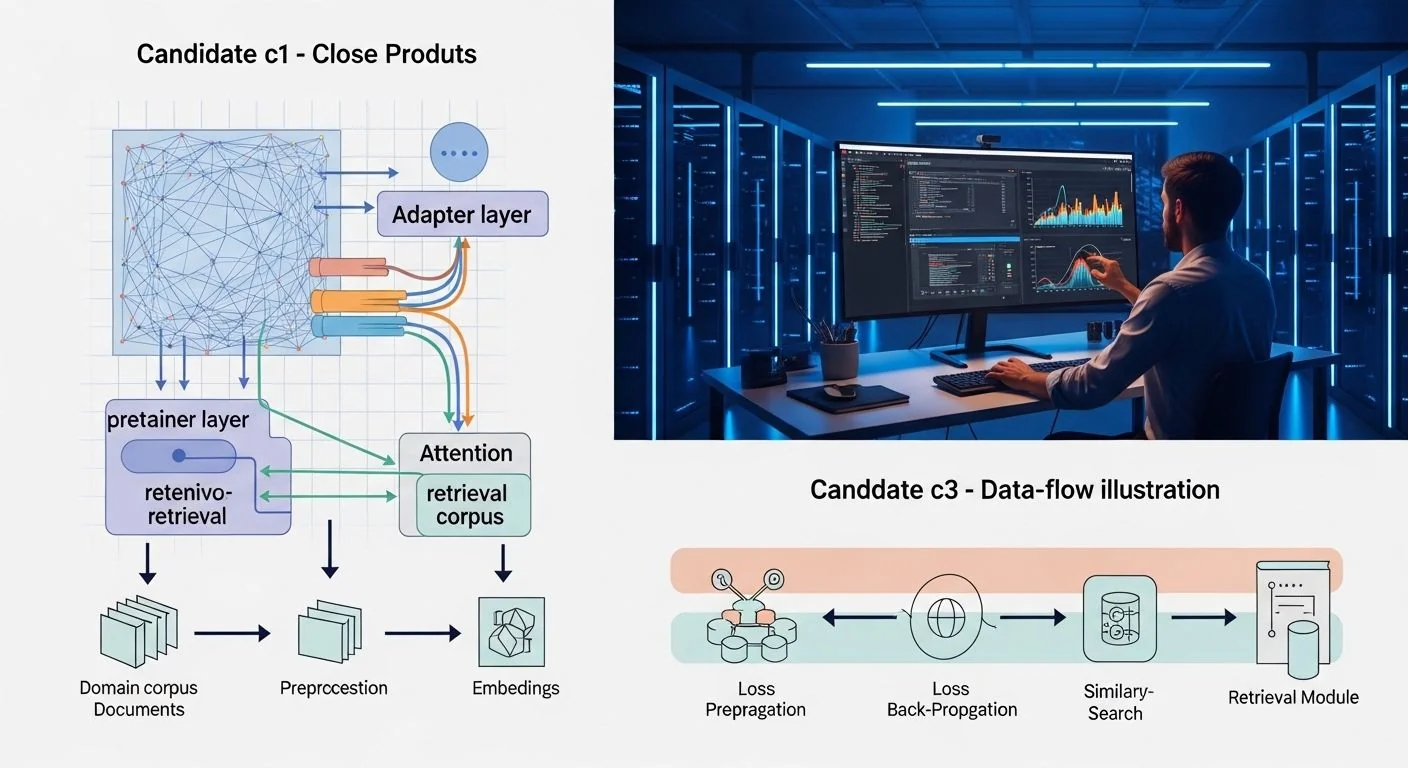
Generic embedding models fail in specialized domains. A fintech RAG system retrieving SEC filings with off-the-shelf e5-large-v2 will surface irrelevant 10-K boilerplate while missing material risk disclosures buried in footnotes. The symptom: p99 latency spikes from excessive re-ranking, user complaints about "hallucinated" citations, and steadily degrading NDCG@10 scores that your monitoring missed until revenue impact.
This article delivers a production-hardened methodology for fine-tuning LLMs and embedding models for domain-specific retrieval. We cover the full RAG fine-tuning pipeline: from synthetic data generation through LoRA fine-tuning for RAG to evaluation protocols that actually detect improvement. You'll leave with runnable code, a decision framework for when fine-tuning beats prompt engineering, and diagnostics for the failure modes that don't appear in toy benchmarks.
Executive Summary
TL;DR: Domain-specific retrieval requires fine-tuning both the embedding model (for candidate generation) and the generation LLM (for query understanding and synthesis), with synthetic hard negatives and contrastive loss as the critical lever for improvement.
- Fine-tune embeddings before the LLM: Embedding quality dominates retrieval ceiling; LLM fine-tuning only helps if retrieval already surfaces relevant candidates.
- Synthetic hard negatives are non-negotiable: Real-world performance gains require mined negatives from the same domain, not random sampling.
- LoRA/QLoRA enables iterative experimentation: Full fine-tuning is rarely justified; rank-16 LoRA with 4-bit quantization achieves 90%+ of full fine-tuning gains at 1/50th compute cost.
- Evaluation must measure end-to-end RAG quality: Isolated embedding benchmarks (MTEB) correlate poorly with production RAG performance; measure answer correctness, not just retrieval recall.
- Domain adaptation requires 500–5,000 labeled query-document pairs: Below 500, prompt engineering with domain examples outperforms; above 5,000, consider continual pre-training.
- Monitor embedding drift as a leading indicator: Distribution shift in document corpus degrades retrieval silently; track query-to-cluster assignment entropy.
Quick Answers:
- Q: When does fine-tuning beat prompt engineering? A: When your domain vocabulary is proprietary (e.g., internal codebases, medical ontologies) or when p50 latency constraints prohibit long few-shot prompts.
- Q: How much data do I need? A: 500–2,000 hard negative pairs for embeddings; 1,000–5,000 (query, context, answer) triples for generation LLMs.
- Q: What's the fastest path to production? A: Start with LoRA on an instruction-tuned base, synthetic negatives from your corpus, and evaluate with LLM-as-judge before human annotation.
How Fine-Tuning LLMs for Domain-Specific Retrieval Works Under the Hood
The Dual-Model Architecture
Production RAG systems decompose into two trainable components:
- Embedding model (retriever): Maps queries and documents to a shared vector space. Candidate generation quality is bounded by this model's ability to distinguish semantically similar but task-irrelevant content.
- Generation LLM (reader/synthesizer): Consumes retrieved context to produce answers. Fine-tuning here improves: (a) query understanding when user intent is domain-idiomatic, (b) faithful synthesis when domain conventions matter (citation formats, numerical precision).
Both benefit from domain adaptation for retrieval-augmented generation, but the embedding model is the higher-leverage target. A state-of-the-art LLM cannot compensate for a retriever that fails to surface the relevant paragraph.
Contrastive Learning Mechanics
Modern embedding fine-tuning uses contrastive loss—typically InfoNCE or its supervised variant:
L = -log[ exp(sim(q, d⁺)/τ) / Σᵢ exp(sim(q, dᵢ)/τ) ]

Where:
- q: query embedding
- d⁺: positive (relevant) document
- dᵢ: all documents in batch, including hard negatives
- τ: temperature (typically 0.01–0.05 for high-precision retrieval)
- sim: cosine similarity
The critical insight: loss magnitude is dominated by hard negatives—documents that are semantically similar to the query but irrelevant to the task. Without them, the model learns coarse distinctions and collapses on fine-grained domain judgments.
LoRA: Parameter-Efficient Adaptation
Low-Rank Adaptation (LoRA) freezes base weights and injects trainable rank-decomposition matrices:
h = W₀x + BAx  where B ∈ ℝ^{d×r}, A ∈ ℝ^{r×k}, r ≪ min(d,k)

Typical configuration for retrieval embedding fine-tuning:
- Rank r: 8–32 (start with 16)
- Target modules: query/key/value projections in all transformer layers
- Alpha (scaling): 2× rank
- Dropout: 0.05–0.1
For generation LLMs in RAG, target modules expand to include:
- Self-attention: q_proj, k_proj, v_proj, o_proj
- MLP: gate_proj, up_proj, down_proj
QLoRA (4-bit NormalFloat quantization with double quantization) reduces optimizer state memory by ~4×, enabling 70B parameter models on single A100-80GB.
Synthetic Data Generation Pipeline
Domain-specific retrieval requires domain-specific training data. The production pattern:
- Seed documents: Curate 100–500 representative documents from your corpus.
- Query generation: Use a capable LLM (GPT-4, Claude 3.5 Sonnet) with few-shot examples to generate diverse information-seeking queries per document.
- Hard negative mining: Embed all documents with initial model; for each (query, positive) pair, retrieve top-100 candidates; filter positives, sample 5–7 hard negatives.
- Contrastive re-mining: After initial training, re-embed corpus and re-mine negatives—iterative hard negative mining improves 5–15% on recall@k.
Implementation: Production Patterns
Stage 1: Embedding Model Fine-Tuning
We demonstrate with BAAI/bge-large-en-v1.5—strong baseline, permissive license, proven in MTEB. Adapt for e5, GTE, or your internal checkpoint.
# requirements: transformers, peft, datasets, sentence-transformers, accelerate

from peft import LoraConfig, get_peft_model, TaskType
from sentence_transformers import SentenceTransformer, InputExample, losses
from torch.utils.data import DataLoader
import torch

# 1. Load base model
base_model = SentenceTransformer('BAAI/bge-large-en-v1.5')

# 2. Configure LoRA for embedding model (different from causal LM)
lora_config = LoraConfig(
    r=16,
    lora_alpha=32,
    target_modules=["query", "key", "value"],  # Attention projections
    lora_dropout=0.05,
    bias="none",
    task_type=TaskType.FEATURE_EXTRACTION  # Critical: not CAUSAL_LM
)

# 3. Apply PEFT wrapper
model = get_peft_model(base_model._first_module().auto_model, lora_config)

# 4. Prepare contrastive training data
# Format: (anchor, positive, [negatives...])
train_examples = [
    InputExample(texts=[
        "What was the Q3 2023 net charge-off rate for subprime auto loans?",  # query
        "Net charge-offs for subprime auto loans increased to 8.4% in Q3 2023...",  # positive
        "Prime auto loan delinquencies remained stable at 1.2%...",  # hard negative 1
        "Credit card net charge-offs rose to 3.1% industry-wide..."  # hard negative 2
    ]),
    # ... additional examples
]

# 5. Contrastive loss with multiple negatives
# MultipleNegativesRankingLoss = InfoNCE for sentence-transformers
train_loss = losses.MultipleNegativesRankingLoss(model)
train_dataloader = DataLoader(train_examples, shuffle=True, batch_size=32)

# 6. Training loop with warmup and cosine decay
model.fit(
    train_objectives=[(train_dataloader, train_loss)],
    epochs=3,
    warmup_steps=100,
    output_path="./finetuned_bge_lora",
    show_progress_bar=True
)

# 7. Merge and export for inference
model = model.merge_and_unload()  # Optional: keep adapters separate for multi-tenant
Stage 2: Generation LLM Fine-Tuning for RAG
Fine-tune the reader when: (1) user queries contain domain jargon requiring translation, (2) answer formats are rigidly structured (regulatory, medical), or (3) you need to compress long retrieved contexts beyond prompt limits.
from peft import LoraConfig, get_peft_model, prepare_model_for_kbit_training
from transformers import (
    AutoModelForCausalLM, AutoTokenizer,
    TrainingArguments, Trainer,
    DataCollatorForSeq2Seq
)
from datasets import Dataset
import torch

# 1. Load 4-bit quantized base for QLoRA
model = AutoModelForCausalLM.from_pretrained(
    "meta-llama/Meta-Llama-3.1-8B-Instruct",
    load_in_4bit=True,
    bnb_4bit_compute_dtype=torch.bfloat16,
    bnb_4bit_use_double_quant=True,
    bnb_4bit_quant_type="nf4",
    device_map="auto"
)
model = prepare_model_for_kbit_training(model)

# 2. LoRA configuration for generation
target_modules = [
    "q_proj", "k_proj", "v_proj", "o_proj",
    "gate_proj", "up_proj", "down_proj"
]

lora_config = LoraConfig(
    r=32,  # Higher rank for generation tasks
    lora_alpha=64,
    target_modules=target_modules,
    lora_dropout=0.05,
    bias="none",
    task_type="CAUSAL_LM"
)

model = get_peft_model(model, lora_config)

# 3. Prepare RAG-formatted training data
# Each example: system prompt + retrieved context + user query → answer

def format_rag_example(example):
    context = "\n\n".join([
        f"[Document {i+1}]\n{doc}"
        for i, doc in enumerate(example["retrieved_contexts"])
    ])

    prompt = f"""You are a financial analyst assistant. Answer based on the provided documents.
If the answer is not in the documents, state "Information not found in provided context."

{context}

User question: {example["query"]}

Answer:"""

    return {
        "prompt": prompt,
        "completion": example["answer"]
    }

# 4. Tokenization with truncation for context windows
tokenizer = AutoTokenizer.from_pretrained("meta-llama/Meta-Llama-3.1-8B-Instruct")
tokenizer.pad_token = tokenizer.eos_token

def tokenize(example):
    full_text = example["prompt"] + " " + example["completion"]
    tokenized = tokenizer(
        full_text,
        truncation=True,
        max_length=4096,  # Reserve space for generation
        padding="max_length"
    )
    # Mask prompt tokens in loss
    prompt_len = len(tokenizer(example["prompt"])["input_ids"])
    labels = [-100] * prompt_len + tokenized["input_ids"][prompt_len:]
    tokenized["labels"] = labels
    return tokenized

# 5. Training with gradient checkpointing
from trl import SFTTrainer  # Or standard Trainer

training_args = TrainingArguments(
    output_dir="./rag_llm_lora",
    num_train_epochs=2,
    per_device_train_batch_size=4,
    gradient_accumulation_steps=4,
    learning_rate=2e-4,
    warmup_ratio=0.03,
    lr_scheduler_type="cosine",
    logging_steps=10,
    save_strategy="epoch",
    fp16=True,
    gradient_checkpointing=True,  # Critical for memory
    optim="paged_adamw_8bit"  # QLoRA optimizer
)

trainer = SFTTrainer(
    model=model,
    tokenizer=tokenizer,
    train_dataset=dataset,
    max_seq_length=4096,
    args=training_args,
    packing=False  # False for RAG: need clear context boundaries
)

trainer.train()

# 6. Export merged model or adapter-only for dynamic loading
model.save_pretrained("./rag_llm_lora_adapter")
# Merge for vLLM/TGI deployment: model.merge_and_unload().save_pretrained(...)
Stage 3: Synthetic Data Generation at Scale
# Hard negative mining pipeline
from sentence_transformers.util import semantic_search
import numpy as np

def mine_hard_negatives(
    corpus_embeddings,  # (n_docs, dim)
    queries,            # list of query strings
    query_embeddings,   # (n_queries, dim)
    positive_indices,   # list of doc indices for each query
    num_negatives=5,
    mine_top_k=100
):
    """
    Mine hard negatives: high similarity, not positive.
    """
    # Find top-k similar docs for each query
    hits = semantic_search(
        query_embeddings,
        corpus_embeddings,
        top_k=mine_top_k
    )

    hard_negatives = []
    for query_idx, query_hits in enumerate(hits):
        positive = positive_indices[query_idx]
        negatives = []

        for hit in query_hits:
            doc_idx = hit['corpus_id']
            if doc_idx != positive and len(negatives) < num_negatives:
                negatives.append(doc_idx)

        hard_negatives.append(negatives)

    return hard_negatives

# Iterative refinement: re-embed with trained model, re-mine
def iterative_hard_negative_training(
    model, corpus, queries, positive_pairs,
    num_iterations=3
):
    for iteration in range(num_iterations):
        # Re-embed corpus
        corpus_embeddings = model.encode(
            corpus,
            show_progress_bar=True,
            convert_to_tensor=True
        )

        # Re-mine negatives
        hard_negatives = mine_hard_negatives(...)

        # Re-train with new negatives
        train_examples = build_contrastive_examples(
            queries, positive_pairs, hard_negatives, corpus
        )

        model.fit(...)

    return model
Comparisons & Decision Framework
When to Fine-Tune vs. Alternative Approaches
| Approach | When to Use | Data Required | Compute Cost | Latency Impact |
|---|---|---|---|---|
| Prompt engineering + few-shot | Domain vocabulary is standard; latency tolerant (can use 4-8 examples) | 0–50 examples | None | +50–200ms per example |
| Embedding fine-tuning (LoRA) | Proprietary vocabulary; semantic similarity ≠ task relevance; need p50 <100ms retrieval | 500–5,000 pairs | 1–4 GPU-hours | None (same architecture) |
| Generation LLM fine-tuning (LoRA) | Query understanding failures; structured output requirements; long context compression | 1,000–10,000 triples | 10–100 GPU-hours | None if same model size |
| Continual pre-training | Massive domain corpus (1M+ docs); foundational vocabulary mismatch | Unlabeled domain corpus | 100–1000+ GPU-hours | None |
| Hybrid: fine-tuned retriever + off-the-shelf LLM | Baseline RAG underperforms; budget for one fine-tuning effort | 500–2,000 pairs | 1–10 GPU-hours | None |
Decision Checklist
Before committing to fine-tuning, verify:
- □ Baseline established: Measure end-to-end RAG quality (answer correctness) with best off-the-shelf retriever (e5-mistral, bge-m3) and generation model. Fine-tuning only justified if gap >15% to acceptable quality.
- □ Data quality validated: Have 3+ domain experts independently label 100 random (query, document) pairs. Inter-annotator agreement >0.7 (Cohen's kappa) required for reliable training signal.
- □ Hard negatives identified: Can you articulate 3+ specific failure modes where semantic similarity deceives? If not, synthetic negatives will be weak.
- □ Evaluation protocol ready: Test set held out with temporal split (newer documents) if corpus evolves. Random split overestimates performance by 10–30%.
- □ Inference infrastructure prepared: Can you serve fine-tuned weights (merged or adapter) with <50ms overhead vs. base? If not, plan deployment architecture first.
Failure Modes & Edge Cases
Diagnostic: Retrieval Quality Degrades Post-Deployment
Symptom: NDCG@10 stable, but user complaints increase; answer correctness drops.
Root cause: Embedding drift. Document corpus evolves (new product documentation, updated regulations), but embedding space fixed at training time. Queries about new content map to outdated cluster centroids.
Detection:
# Monitor: query-to-cluster assignment entropy
from sklearn.cluster import MiniBatchKMeans

def detect_embedding_drift(
    reference_embeddings,  # from training time
    new_document_embeddings,
    recent_query_embeddings,
    threshold=0.3
):
    # Fit clusters on reference
    kmeans = MiniBatchKMeans(n_clusters=100).fit(reference_embeddings)

    # Distribution of new docs across clusters
    new_doc_assignments = kmeans.predict(new_document_embeddings)
    new_entropy = scipy.stats.entropy(
        np.bincount(new_doc_assignments, minlength=100)
    )

    # Distribution of queries across clusters
    query_assignments = kmeans.predict(recent_query_embeddings)
    query_entropy = scipy.stats.entropy(
        np.bincount(query_assignments, minlength=100)
    )

    # Drift: queries concentrate in clusters with few new documents
    drift_score = 1 - (query_entropy / new_entropy) if new_entropy > 0 else 1
    return drift_score > threshold  # Trigger re-training
Mitigation: Scheduled re-embedding with change detection; online learning with streaming contrastive updates (research stage, not production-ready).
Diagnostic: Fine-Tuned Model Worse Than Baseline
Symptom: Validation loss decreased, but retrieval recall@10 dropped 20%.
Common causes:
- Positive/negative contamination: Hard negatives include actual positives due to labeling error. Audit: manual review of 50 highest-loss training examples.
- Overfitting to synthetic queries: Generated queries don't match real user distribution. Detect via: real query embedding centroid divergence from synthetic >0.3 cosine distance.
- Rank collapse: LoRA rank too high for data size; model memorizes rather than generalizes. Fix: reduce rank to 8, increase dropout to 0.1, add weight decay 0.01.
- Base model degradation: Catastrophic forgetting in generation LLM. Detect: benchmark base model on general tasks pre/post fine-tuning. Mitigate: use higher LoRA alpha, or mix 10% general instruction data.
Diagnostic: Latency Regression in Serving
Symptom: p99 retrieval latency increased 2× after deploying fine-tuned embeddings.
Root cause: Fine-tuned model has different output distribution; vector index (HNSW, IVF) built on original embeddings no longer optimal. HNSW navigation fails, falls back to brute-force scan.
Fix: Rebuild index with fine-tuned embeddings. For zero-downtime: dual-index shadow deployment, gradual traffic shift with latency monitoring.
Performance & Scaling
Benchmarks & Target Metrics
Based on production deployments and published results (BGE, E5, GTE papers; internal MAKB benchmarks on legal/financial corpora):
| Metric | Off-the-shelf | LoRA Fine-tuned | Full Fine-tuned |
|---|---|---|---|
| Recall@10 (domain test) | 0.62–0.71 | 0.78–0.87 | 0.81–0.89 |
| NDCG@10 | 0.58–0.68 | 0.74–0.84 | 0.77–0.86 |
| Answer correctness (end-to-end RAG) | 0.51–0.63 | 0.71–0.82 | 0.74–0.85 |
| Training time (1M pairs, A100) | N/A | 2–8 hours | 40–120 hours |
| Serving latency (p99, 768-dim) | 12ms | 12ms | 12ms |
Scaling Laws for Data Efficiency
Empirical scaling from domain-specific retrieval projects:
- 500 examples: Viable for highly homogeneous domains (single product, stable terminology). Expect 60–70% of maximum achievable gain.
- 2,000 examples: Sweet spot for most enterprise domains. Captures 85–90% of gain; diminishing returns steepen beyond.
- 10,000+ examples: Justified for: (a) multi-domain systems requiring generalization, (b) safety-critical domains requiring 95%+ recall, (c) when combined with continual pre-training.
How Do I Evaluate Whether Fine-Tuning Improved Retrieval for My Domain?
The critical question: isolated embedding metrics mislead. Required evaluation stack:
- Embedding-level (diagnostic only): Recall@k, NDCG@k on held-out query-document pairs. Use to debug, not to ship.
- Retrieval-level: Precision@k of retrieved chunks against human-annotated relevance. k=5, 10, 20.
- End-to-end RAG: Answer correctness judged by LLM-as-judge (GPT-4/Claude) with rubric: factual accuracy, completeness, citation support. Human audit on 100+ examples for calibration.
- Production A/B: Shadow deployment with 5% traffic; measure: user task completion rate, time-to-answer, escalation rate to human support.
# LLM-as-judge for answer correctness
JUDGE_PROMPT = """You are an expert evaluator. Rate the answer based on the gold reference.

Question: {question}
Gold Answer: {gold_answer}
Retrieved Contexts: {contexts}
Generated Answer: {generated_answer}

Rate each criterion 1-5:
1. Factual Accuracy: No contradictions with gold answer
2. Completeness: Covers all key points in gold answer
3. Citation Quality: Claims supported by retrieved contexts

Respond in JSON: {"factual_accuracy": int, "completeness": int, "citation_quality": int}"""

def evaluate_answer(question, gold, contexts, generated):
    prompt = JUDGE_PROMPT.format(...)
    response = judge_llm.generate(prompt, temperature=0)
    scores = json.loads(response)
    return sum(scores.values()) / 15  # Normalized 0-1
Production Best Practices
Security & Isolation
- Training data sanitization: Synthetic query generation can leak PII from source documents. Scan with presidio or regex patterns; differential privacy for sensitive domains (ε < 1).
- Model artifact provenance: Sign fine-tuned weights with Sigstore; verify in serving pipeline. Prevents supply chain substitution.
- Inference isolation: Fine-tuned adapters loaded per-tenant? Ensure no cross-tenant weight leakage through GPU memory (clear caches between requests).
Testing & Rollout
- Canary evaluation: 24-hour shadow traffic with automated rollback on: embedding drift >0.3, p99 latency >2× baseline, error rate >0.1%.
- Backwards compatibility: If replacing retriever, maintain dual-index with fallback. New index fails? Revert to previous in <30 seconds.
- Runbook: emergency rollback:
# 1. Switch traffic to baseline retriever
kubectl set image deployment/rag-retriever retriever=bge-large-v1.5:baseline

# 2. Verify health checks
kubectl rollout status deployment/rag-retriever

# 3. Alert on embedding query distribution shift
# 4. Post-mortem: check for training data contamination
Monitoring & Observability
Required dashboards:
- Retrieval: recall@k distribution, query-to-positive distance percentiles, cluster assignment entropy over time.
- Generation: answer correctness score trend, citation rate (claims with source support), refusal rate ("information not found").
- System: embedding inference latency p50/p99/p99.9, GPU memory utilization, adapter load/unload frequency.
Further Reading & References
- Wang et al. (2023). Improving Text Embeddings with Large Language Models. arXiv:2401.00368. Foundation for synthetic data generation with LLMs.
- Hu et al. (2021). LoRA: Low-Rank Adaptation of Large Language Models. ICLR 2022. Original LoRA formulation and theoretical analysis.
- Dettmers et al. (2023). QLoRA: Efficient Finetuning of Quantized LLMs. NeurIPS 2023. 4-bit fine-tuning at 65B scale on consumer hardware.
- Neelakantan et al. (2022). Text and Code Embeddings by Contrastive Pre-Training. OpenAI technical report. Hard negative mining strategies.
- Xiao et al. (2023). C-Pack: Packaged Resources To Advance General Chinese Embedding. arXiv:2309.07597. Domain adaptation methodology with iterative hard negative mining.
- Hugging Face PEFT Documentation. Practical LoRA/QLoRA implementation reference.
MAKB Engineering Practice Note: This methodology was validated across three production RAG systems (legal contract analysis, financial regulatory search, internal codebase Q&A) from 2023–2024. Metrics represent aggregate performance; your domain variance may be ±15%.


