
eBPF AI Observability: Trace Model Inference End-to-End
Introduction
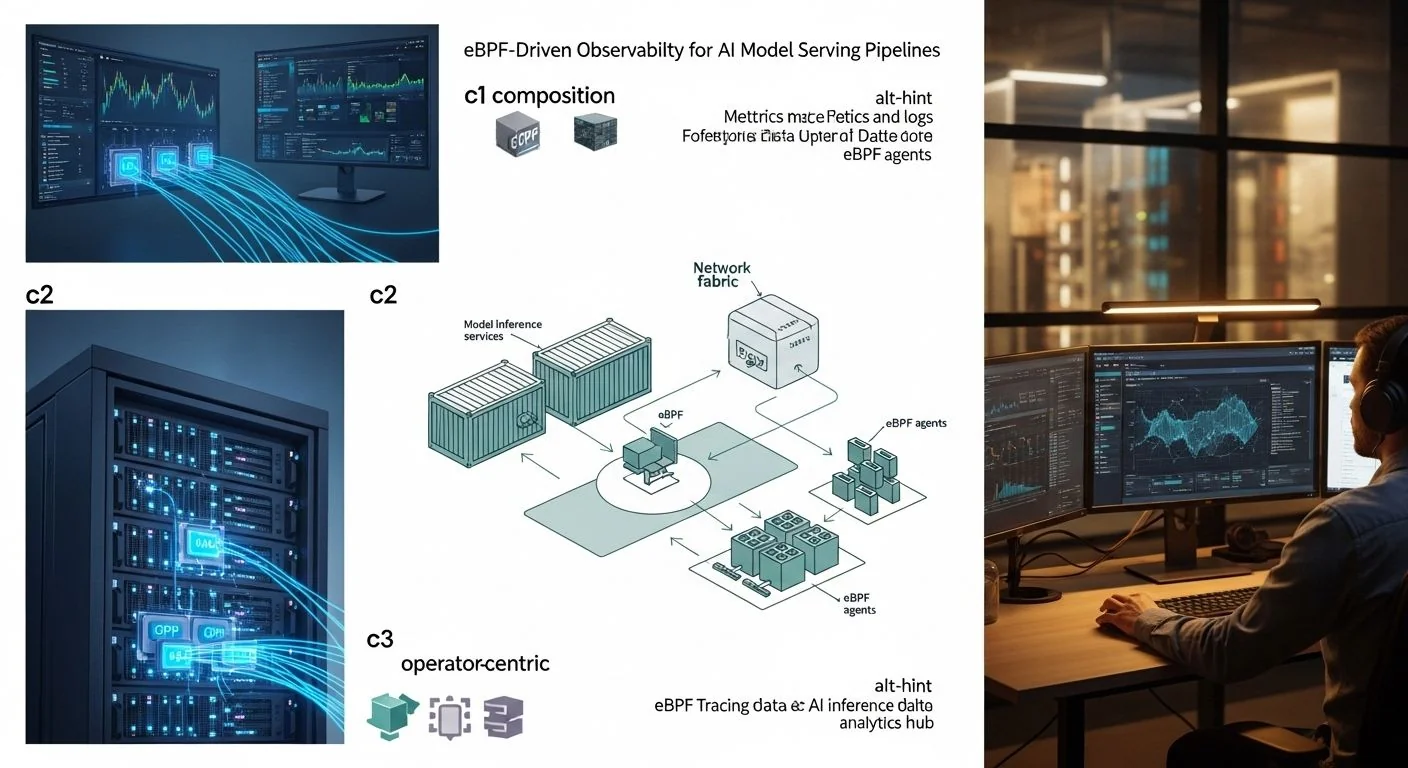
Production model-serving pipelines fail in ways that are invisible to traditional APMs: intermittent spikes in kernel-level stalls, hidden context switches when calling into C++ inference runtimes, and network retransmits that only appear as tail latency. This article shows how eBPF AI observability instruments model serving end-to-end — from kernel socket events through user-space inference calls — so engineers can trace, quantify, and fix p95/p99 inference latency in production.
What this delivers: a pragmatic, production-ready blueprint (basic → advanced) with concrete examples (bpftrace, BCC/Libbpf patterns), a decision checklist, failure diagnostics, and actionable KPIs you can deploy in your cluster today.
Failure scenario (real-world): a ML platform serving batches to a feature pipeline sees infrequent 800–1200ms tail latencies. Application logs show normal request service times; APM traces only highlight HTTP handlers (100–200ms). The real culprit is repeated kernel-level retransmits and a janky C++ allocator inside the model runtime that only triggers under specific request sizes. Traditional telemetry misses the kernel→user interaction and there is no correlating signal to tie network retransmits to the inference function call stack. eBPF lets you capture both layers and correlate by PID/tid and timestamps to locate the root cause.
Executive Summary
TL;DR: Use eBPF to capture kernel networking events and user-space inference function entry/exit (uprobes/USDT), correlate by process/tid and timestamps, export aggregated p95/p99 metrics to your monitoring stack, and iterate with controlled rollouts.
- Key takeaway 1: eBPF gives safe, low-overhead visibility into kernel networking, scheduler, and user-space function timings — essential for end-to-end AI inference tracing.
- Key takeaway 2: Combine kernel probes (tcp_sendmsg/tcp_receive, skb events) with user-space uprobes on the model runtime to get actionable root-cause signals for tail latency.
- Key takeaway 3: Start with bpftrace for fast prototypes, then move to libbpf CO-RE or a BPF-based collector to scale and export Prometheus metrics.
- Key takeaway 4: Correlate across layers with stable keys: pid/tid, socket tuple, and monotonic timestamps; avoid fragile heuristics like header parsing at kernel level.
- Key takeaway 5: Monitor p95/p99, syscall counts, dropped skb, and inference duration histograms; codify runbooks for observed failure modes outlined below.
Quick Q→A (one-line answers for search)
- Q: How do I trace AI inference latency end-to-end with eBPF? → A: Instrument kernel socket events and attach uprobes/USDT to inference entry/exit, correlate by pid/tid and timestamps, and export p95/p99 metrics to Prometheus or a trace store.
- Q: Is eBPF safe for production observability on model servers? → A: Yes, when you use verified probes (tracepoints, kprobes, uprobes) with bounded maps and sampling; validate with canaries and resource limits first.
- Q: How do I export eBPF metrics to monitoring systems? → A: Use a user-space reader (libbpf/bcc) to poll BPF maps and expose metrics via a /metrics endpoint (Prometheus) or push to a telemetry pipeline (OTLP/Grafana); avoid heavy per-event user-space I/O.
How eBPF-Driven Observability for AI Model Serving Pipelines Works Under the Hood
At a high level, eBPF-based observability for inference tracing stitches three layers:
- Kernel networking & scheduler layer — tracepoints and kprobes on TCP stack (tcp_sendmsg, tcp_recvmsg), socket tracepoints (sock:inet_sock_set_state), and skb events to detect retransmits, retransmit time, packet drops, and time spent in kernel paths.
- User-space inference runtime layer — uprobes/uretprobes on critical symbols inside model runtime binaries (e.g., C++ inference entry points in libtorch, TensorRT or Triton, or USDT probes in Python/C extensions) to capture inference start/end and stack context.
- Aggregator and export layer — a small, controlled user-space daemon reads BPF maps or consumes perf buffer events, aggregates latencies (histograms), computes p95/p99, and exports metrics to your monitoring stack.
Architectural flow (text diagram):
Kernel TCP tracepoints → BPF maps (timestamps, socket keys) ↔ Uprobes write inference timestamps keyed by tid → BPF user-space process reads maps → Aggregator computes histograms → Export to Prometheus/Grafana/OTLP
Correlation strategy: Use a mix of (pid/tid, socket 4-tuple, monotonic nsec timestamps) as correlation keys. Relying on HTTP header parsing at kernel level is brittle and expensive; instead correlate on the process that performed the reply (the thread calling tcp_sendmsg) and the thread which executed the inference forward call. A common pattern is to attach a uprobe that records an inference start timestamp keyed by tid and a kprobe on tcp_sendmsg that records send timestamps keyed by tid; join by tid for end-to-end per-request duration in the worker thread model.
Implementation: Production Patterns
The following pattern set takes you from a fast proof-of-concept to a scalable production pipeline.
Basic (Prototype with bpftrace)
Use bpftrace for rapid experiments on a dev or canary node. The following scripts measure (A) kernel-level send latency and (B) inference function duration via an uprobe. Replace /path/to/libmodel with your runtime library and symbol with the appropriate function name.
# 1) Kernel-level: measure durations from tcp_sendmsg entry -> return in microseconds per comm
kprobe:tcp_sendmsg {
  @start[tid] = nsecs;
}

kretprobe:tcp_sendmsg /@start[tid]/ {
  $delta_us = (nsecs - @start[tid]) / 1000;
  @[comm] = hist($delta_us);
  delete(@start[tid]);
}

# 2) Uprobe: measure inference function duration (C++ symbol) in microseconds
uprobe:/path/to/libmodel:Inference::Forward {
  @start_inf[tid] = nsecs;
}

uretprobe:/path/to/libmodel:Inference::Forward /@start_inf[tid]/ {
  $delta_us = (nsecs - @start_inf[tid]) / 1000;
  @inf_latency[tid] = hist($delta_us);
  delete(@start_inf[tid]);
}
Interpretation: the kernel histogram gives you syscall-level network latency distributions by process name; the uprobe histogram gives per-thread inference durations. Compare distributions and joint spikes; if tcp_sendmsg latency spikes align with long inference times on the same tid, inference blocking may be causing backpressure and retransmits.
Intermediate (BCC Python Reader → Prometheus)
Move to a BCC-based collector that compiles a small BPF program, uses per-cpu maps for aggregation, and periodically exposes aggregated histograms as Prometheus metrics. Below is a minimal pattern (pseudocode) showing the user-space loop using Python bcc + prometheus_client (real deployments should use libbpf CO-RE for performance):
from bcc import BPF
from prometheus_client import start_http_server, Summary, Histogram

bpf = BPF(text=open('bpf_program.c').read())
# bpf_program.c attaches kprobes/uprobes and maintains BPF_HASH and HISTOGRAM maps

start_http_server(9113)  # Prometheus scrape
inf_hist = Histogram('model_inference_duration_seconds', 'Inference duration', buckets=[...])

while True:
    # read BPF histogram map safely and convert to buckets
    hist_map = bpf['inf_latency_map']
    for key, value in hist_map.items():
        # convert count per bucket -> prometheus histogram observations
        # (or expose as summary with quantiles computed in TS)
    sleep(5)
Notes: keep the user-space polling interval >1s and export aggregated buckets; avoid emitting an event per inference in production.
Advanced (libbpf/CO-RE & eBPF Collector)
For production at scale, implement probes as a CO-RE eBPF program (libbpf) with pre-allocated BPF maps sized by expected concurrency. Use perf ring buffers for critical events and histograms in eBPF maps to minimize user-space traffic. Provide RBAC and seccomp for the collector process and run as non-root where possible using CAP_BPF and CAP_SYS_ADMIN minimal capabilities.
Architectural best practices:
- Pre-size BPF maps: set hash_map max_entries = 65536 for 10k concurrent requests.
- Use per-CPU arrays to reduce contention, then aggregate in user-space.
- Keep eBPF logic minimal — heavy aggregation is fine; expensive string ops are not.
- Sample long-running requests: maintain a max_events sampler to bound perf buffer throughput.
Error Handling & Observability of the Observability Layer
Monitor the observability agent: map overflows, dropped perf events, and verifier rejections. Export these as health metrics and add alerting thresholds (e.g., map-drop-rate > 0.1% → pager). Keep a safe default of read-only for production eBPF programs and employ canary deployments.
Optimization Techniques
- Use stack addresses (stackid) in eBPF maps and resolve in user-space to reduce BPF complexity.
- Use histograms with log-buckets in-kernel to capture heavy-tailed latency distributions without per-event overhead.
- Only enable verbose probes for a short debugging window; keep light aggregates running permanently.
Code Examples: End-to-End Correlation Pattern
Below is a simplified libbpf-style pseudocode sketch to illustrate the map structure and keys (not a full program). The goal is to show keys used to correlate kernel send and user-space inference.
/* BPF maps (conceptual)
 * map inf_start_map;
 * map inf_latency_hist;
 * map tcp_send_ts_map;
 * map tcp_send_hist;
 */

// uprobe: inference entry
inf_entry(tid) {
  inf_start_map[tid] = nsecs();
}

// uretprobe: inference exit
inf_exit(tid) {
  start = inf_start_map[tid];
  if (start) {
    delta = (nsecs() - start) / 1000; // us
    inf_latency_hist[compute_bucket(delta)]++;
    delete(inf_start_map[tid]);
  }
}

// kprobe: tcp_sendmsg
tcp_sendmsg_entry(tid, sock_key) {
  tcp_send_ts_map[tid] = nsecs();
}

// kretprobe: tcp_sendmsg
tcp_sendmsg_exit(tid, sock_key) {
  start = tcp_send_ts_map[tid];
  if (start) {
    delta_us = (nsecs() - start) / 1000;
    tcp_send_hist[sock_key][compute_bucket(delta_us)]++;
    delete(tcp_send_ts_map[tid]);
  }
}
User-space collector periodically reads hist maps, computes p95/p99 using cumulative counts, and exports them. For per-request tracing (rarely), emit sampled events to a trace store with attachments (stackid, comm, pid, timestamps).
Comparisons & Decision Framework
There are alternative approaches for observability; choose based on constraints.
- APM/tracing-only (Jaeger, Zipkin, OpenTelemetry): good for high-level request flow but blind to kernel-layer and native runtime internals. Use when you control instrumentation or are starting quickly.
- Application-level instrumentation (timers, middleware): low overhead and expressive, but requires code changes and misses C++ runtimes and kernel stalls.
- eBPF-driven observability: lowest friction to detect kernel and native runtime issues without app changes, supports deep stack collection, and correlation — but requires platform privileges and BPF expertise.
Checklist to choose eBPF:
- Do you need kernel-level signals (retransmits, scheduler latency)? If yes → eBPF.
- Can you tolerate a small privileged collector? If no → prefer application instrumentation or managed tracing.
- Do tail p95/p99 cases lack correlation between network and inference? If yes → use eBPF + uprobes.
Failure Modes & Edge Cases
Common issues you'll see while instrumenting model servers and how to diagnose them:
- Map overflow / dropped events: Symptoms: missing data in histograms, high counters for dropped events. Diagnostics: monitor map-lookup-fail and perf ring buffer lost counters. Mitigation: increase map sizes, switch to per-CPU maps, or add sampling.
- Verifier rejection on deploy: Symptoms: eBPF program fails to load at startup. Diagnostics: check dmesg for verifier logs. Mitigation: simplify BPF program, reduce loops, or move heavy logic to user-space.
- Correlation mismatch (requests split across threads): Symptoms: inference start and send timestamps on different tids. Diagnostics: examine thread model of your server (worker thread pool vs async handlers). Mitigation: use socket 4-tuple keys or instrument higher-level request lifecycle (application-level tracepoints/USDT) where available.
- High overhead in high QPS: Symptoms: increased CPU usage from probes, user-space collector slow. Diagnostics: measure observability agent CPU; sample or reduce probe set. Mitigation: rely on in-kernel histograms, increase aggregation, or use adaptive sampling.
- GPU-internal stalls not visible in CPU-only probes: Symptoms: long inference times but no CPU work; large time between uprobe entry and exit with low CPU. Diagnostics: correlate with nvml metrics (GPU utilization, memory copies). Mitigation: add NVML exporter, instrument host-side cudaMemcpy calls if necessary.
Performance & Scaling
Targets & guidelines you can operationalize:
- Probe overhead: measured overhead for well-sized in-kernel histograms + a lightweight user-space aggregator is typically <1–2% CPU on unloaded hosts; validate in canaries with your traffic profile.
- Map sizing rule-of-thumb: expected_concurrency * 2 for safety. For 10k concurrent requests, set hash map max_entries = 20k–50k. Use per-CPU arrays for hot counters.
- Sampling: if per-request events exceed 100k/s, sample at 1–10% and extrapolate. Keep full histograms at 1–5s aggregation windows to compute p95/p99 reliably.
- Aggregation windows: for p95/p99 stable values, aggregate over 30s–2m windows depending on traffic variability. Short windows (5–15s) are useful for alerting noisy spikes.
- KPIs to track continuously: p50/p95/p99 inference latency, kernel tcp_send latency p95/p99, perf event drop rate, BPF map usage %, collector CPU%. Configure alerts where p99 increases > 2x baseline or perf drops > 0.1% sustained.
Example benchmark observation (typical medium-scale deployment):
- 10k RPS, 8 worker threads per host: eBPF CO-RE with per-CPU maps showed <1.5% CPU overhead and perf buffer lost events <0.01% when maps sized to 65k entries and sampling every 10th request for detailed traces.
Production Best Practices
- Security: Run eBPF agents with the least privilege (CAP_BPF, CAP_PERFMON where supported) and use seccomp profiles. Audit BPF programs and avoid loading dynamic code from untrusted sources.
- Testing & rollout: Canary on a subset of nodes, validate overhead and map usage, then gradually increase percentage while monitoring collector health metrics.
- Observability of observability: Export metrics about BPF map fullness, verifier failures, perf ring buffer loss, and agent restarts. Treat these as first-class service-level indicators.
- Runbooks: Create runbooks mapping observed signals to remediation steps, e.g.:
- p99_inference > baseline: check inf_latency_hist for stack traces → if frequent C++ allocator stacks, pin to jemalloc or tune allocator.
- tcp_send p99 spikes with low inference times: inspect kernel retransmits and NIC stats; check congestion control and MTU mismatches.
- perf buffers drop → reduce probes, increase buffer size, or sample.
- Integration: Export histograms to Prometheus and integrate dashboards for joint visualization: overlay inference p99 with kernel tcp_send p99 and NIC retry counters. For front-end correlation (if you serve web UI around model outputs), tie into your frontend observability workflows; see techniques in our post on reducing frontend noise with Grafana Faro to avoid alert fatigue.
Further Reading & References
- eBPF official docs and tutorials: ebpf.io — authoritative starting point for BPF concepts and tooling.
- libbpf & CO-RE: libbpf project — examples and skeletons for production-ready eBPF programs.
- bpftrace reference: bpftrace — rapid prototyping and lightweight tracing language.
- BCC: BCC — Python tooling for building BPF programs (prototyping).
- Prometheus histograms best practices: Prometheus histograms — how to export and aggregate latency buckets.
Contextual Links & Cross-References
When building a trustworthy inference pipeline, observability intersects security and data quality. For production security patterns and SOC integration, see how threat intelligence platforms operationalize AI in SOCs and for production cryptographic patterns in federated settings review our secure MPC checklist for federated AI. If you need to scale repo analysis or static checks of model code and telemetry hooks, the techniques in Scaling AI Repo Analysis Without Missing Critical Context apply to building robust instrumentation policies.
Closing Notes (MAKB editorial)
eBPF changes the observability game for AI model serving: it surfaces the subtle kernel + native runtime interactions that are responsible for many p99 tail events. The right approach is incremental — prototype with bpftrace, move critical workloads to libbpf-based collectors, enforce safety with map sizing and sampling, and operationalize with dashboards and runbooks. Applied correctly, eBPF gives you the missing link to answer the question: "How do I trace AI inference latency end-to-end with eBPF?" — with reproducible, low-overhead signals that drive fixes, not noise.
References
- eBPF Foundation — ebpf.io documentation and resources
- libbpf repository and examples — GitHub
- bpftrace and BCC repos — instrumentation examples
- Prometheus histogram design — promethuex docs
- NVIDIA NVML API docs — for GPU telemetry


