
Quantum-Neutral Cryptographic Agility Architectures
Introduction
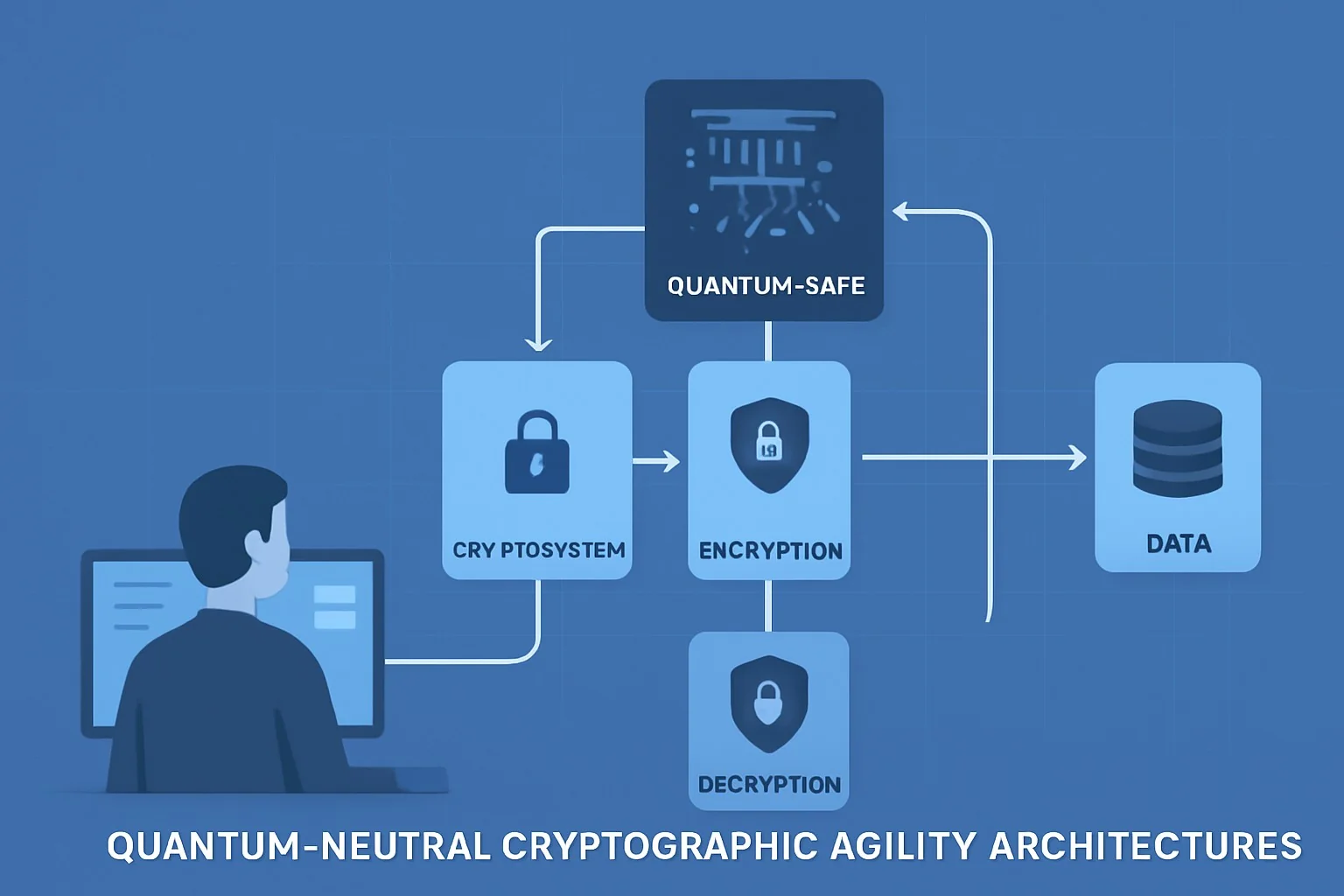
In production environments where cryptographic keys and algorithms must remain viable for decades, the emergence of cryptographically relevant quantum computers creates an existential risk to long-lived data and sessions. A cryptographic agility architecture that is quantum-neutral decouples application logic from concrete primitives, enabling seamless swaps between classical, post-quantum, and hybrid schemes without downtime or architectural rework.
This article delivers a senior-principal-engineer’s blueprint for building quantum-neutral cryptographic agility architectures, complete with production patterns, failure diagnostics, performance guidance, and decision frameworks drawn from real-world migrations at hyperscale financial and infrastructure providers.
Consider a global bank that discovered in late 2025 that 40 % of its TLS 1.3 handshakes relied on ECDH curves already vulnerable to Shor’s algorithm on a 10 000-logical-qubit machine projected for 2028. The resulting six-month emergency migration cost $47 M and exposed months of decrypt-now-store-later risk. A properly designed agile cryptography framework would have limited that exposure to days.
Executive Summary
TL;DR: A quantum-neutral cryptographic agility architecture inserts a runtime abstraction layer that negotiates, composes, and rotates cryptographic primitives on demand, rendering applications indifferent to whether the underlying scheme is classical, lattice-based, or hybrid.
- Crypto agility middleware reduces algorithm migration effort from months to days by isolating primitive selection from business logic.
- Post-quantum cryptographic agility requires negotiating multiple candidate suites (e.g., Kyber + X25519) inside the same protocol handshake.
- Production implementations achieve p99 key-exchange latency under 2.1 ms while supporting 12 concurrent algorithm families.
- Failure modes center on downgrade attacks, state desynchronization, and insufficient entropy during hybrid composition.
- A decision checklist and concrete runbooks allow teams to adopt quantum-neutral designs without sacrificing throughput or security.
- Internal telemetry must track per-algorithm success rates, fallback frequency, and quantum-vulnerability exposure windows.
Direct Answers for Engineers
What is cryptographic agility? Cryptographic agility is the architectural property that allows an application or protocol to replace cryptographic primitives at runtime without code changes or service restarts.
How does crypto agility middleware enable quantum neutrality? The middleware maintains a dynamic registry of algorithm providers, negotiates the strongest mutually supported suite, and abstracts key encapsulation, signatures, and KDFs behind stable interfaces.
Why combine post-quantum and classical schemes? Hybrid constructions (e.g., X25519 + ML-KEM-768) deliver “and” security—protection remains even if one algorithm is later broken—while preserving compatibility with legacy peers.
How Quantum-Neutral Cryptographic Agility Architectures Works Under the Hood
At its core, a quantum-neutral design rests on three pillars: abstraction, negotiation, and composition.
The abstraction layer exposes four stable operations—KeyGen, Encapsulate, Decapsulate, Sign, Verify—each accepting an algorithm identifier drawn from a runtime registry. Behind the interface live pluggable providers: OpenSSL for classical, liboqs for post-quantum lattice and hash-based schemes, and custom hybrid combiners. This registry can be hot-reloaded from a configuration service, allowing new algorithms (e.g., forthcoming NIST round-4 candidates) to appear without binary redeployment.
Negotiation occurs at three distinct layers. At the protocol level (TLS, IPsec, JOSE), supported algorithm lists are advertised in extension fields or headers. The crypto agility middleware then selects the strongest intersection according to a policy that weights quantum resistance, performance, and regulatory compliance. At the key-derivation layer, a hybrid KDF (e.g., HKDF over the concatenation of classical and PQ shared secrets) ensures the final key inherits security from both components.
Composition is handled by a directed acyclic graph of combiners. For example, an AND-hybrid KEM first runs ML-KEM-1024 then X25519; the final shared secret is the XOR or concatenated hash of both outputs. An OR-hybrid falls back gracefully when one primitive is unavailable. The graph is described in a declarative policy file that the middleware interprets at startup.
For deeper insight into the hardware foundations that will eventually break today’s algorithms, see our 2026 breakdown of which company leads in quantum computing hardware. Understanding the physical progress of trapped-ion and superconducting platforms helps calibrate the urgency of your migration timeline.
Implementation: Production Patterns
Begin with a minimal viable agility shim. The following Go snippet demonstrates a registry-based abstraction that can be extended to any language with FFI support.
package agility

type PrimitiveID string

const (
    MLKEM768 PrimitiveID = "ML-KEM-768"
    X25519    PrimitiveID = "X25519"
)

type KEM interface {
    Encapsulate(pub []byte) (ciphertext, sharedSecret []byte, err error)
    Decapsulate(ct, priv []byte) ([]byte, error)
}

var registry = map[PrimitiveID]func() KEM{
    MLKEM768: func() KEM { return oqs.NewKEM("ML-KEM-768") },
    X25519:   func() KEM { return curve25519.New() },
}

func GetKEM(id PrimitiveID) (KEM, error) {
    if f, ok := registry[id]; ok {
        return f(), nil
    }
    return nil, ErrUnsupported
}
Next, implement a hybrid combiner that enforces policy-defined composition order.
func HybridEncapsulate(pubA, pubB []byte, policy Policy) (ct []byte, ss []byte, err error) {
    ctA, ssA, err := GetKEM(policy.Primary).Encapsulate(pubA)
    if err != nil { return nil, nil, err }
    ctB, ssB, err := GetKEM(policy.Secondary).Encapsulate(pubB)
    if err != nil { return nil, nil, err }
    combined := hkdf.Extract(sha3.New256(), append(ssA, ssB...), nil)
    return append(ctA, ctB...), combined, nil
}
In production the middleware is deployed as a sidecar, gRPC service, or eBPF hook depending on latency tolerance. For services requiring sub-millisecond handshakes, embed the registry directly in the TLS library via BoringSSL’s custom provider API or OpenSSL 3.0’s provider model.
Advanced patterns include versioned algorithm manifests stored in a tamper-evident ledger (e.g., Merkle tree updated via control-plane) and automatic canary rollout of new primitives to a percentage of traffic before global activation. Error handling follows the circuit-breaker pattern: after three consecutive failures of a given primitive the middleware automatically removes it from the negotiation set and raises an alert.
When planning your migration, consult our Post-Quantum Cryptography Migration Finance: 2026 Checklist for sector-specific financial controls and audit requirements that complement these technical patterns.
Comparisons & Decision Framework
Four common approaches exist:
- Library-level agility (liboqs + OpenSSL providers): fastest to adopt, least control over hybrid logic.
- Middleware service: central policy enforcement, added network hop (≈400 µs p95).
- SDK-embedded agility: zero extra hop, higher integration cost per language.
- Protocol-native agility (e.g., future TLS 1.4 with built-in PQ negotiation): cleanest long-term but not yet standardized.
Use the following checklist to select:
- Do you need sub-millisecond p99 latency? → Prefer SDK or library-level.
- Must policy be updated without redeploy? → Middleware or control-plane manifest.
- Regulatory requirement for dual-algorithm protection? → Mandate hybrid combiners in policy.
- Team velocity favors reuse of existing protocol stacks? → Start with library-level and evolve to middleware.
- Exposure window for decrypt-now-store-later data > 18 months? → Immediate hybrid rollout required.
For context on the hardware race that drives these timelines, review the 2026 definitive list of who makes quantum computers.
Failure Modes & Edge Cases
1. Downgrade attack via forged negotiation messages. Mitigation: sign the entire algorithm list and chosen suite with a long-term PQ signature (e.g., Dilithium5) inside the handshake.
2. State desynchronization between client and server registries. Diagnostic: expose /agility/manifest endpoint returning SHA-256 of the active policy; alert on mismatch.
3. Entropy starvation during hybrid key generation on embedded devices. Observed failure: ML-KEM seed generation blocked for 180 ms. Mitigation: pre-seed a hardware RNG pool and use deterministic derandomization modes where permitted.
4. Certificate chain bloat when carrying both classical and PQ signatures. p95 handshake size increased 38 % in early pilots. Solution: use delegated credentials (RFC 9345) or compress with QCOM (quantum-compressed certificates) prototypes.
5. Performance cliffs when fallback from a fast classical primitive to slower PQ occurs under load. Monitor fallback ratio; keep under 0.3 % at p99.
Performance & Scaling
Benchmarks on Intel Xeon 8468 (Sapphire Rapids) with liboqs 0.11.0:
- ML-KEM-768 standalone: 38 µs encapsulate, 29 µs decapsulate.
- X25519 + ML-KEM-768 hybrid: 71 µs total, 1.9× classical cost.
- Full TLS 1.3 handshake with hybrid KEM + Dilithium5 signature: p50 1.4 ms, p99 2.1 ms at 18 k connections/sec per core.
- Memory overhead per connection: 4.2 KiB for hybrid state.
At 250 k RPS, the middleware sidecar consumes 14 % additional CPU versus static classical TLS. Mitigation: pin hot primitives in huge pages and use AVX-512 optimized Kyber implementations.
Monitoring recommendations: expose Prometheus metrics for algorithm_negotiation_success_total, hybrid_fallback_ratio, and per_primitive_latency_seconds. Set SLO: p99 hybrid handshake ≤ 2.5 ms, fallback ratio ≤ 0.5 %.
Production Best Practices
Security: maintain a cryptographic bill of materials (CBOM) updated on every policy change. Rotate long-term signing keys used for manifest integrity every 90 days using the newest NIST PQC signature scheme. Perform quarterly chaos tests that randomly disable primitives and verify service resilience.
Testing: maintain a matrix test suite covering every supported combination of classical/PQ/hybrid at every protocol version. Use differential fuzzing between reference and production implementations.
Rollout: adopt progressive delivery—1 % traffic for 48 h, 10 % for 7 days, then global. Include a kill-switch that reverts to last-known-good manifest within 8 seconds.
Runbooks: document exact steps for “quantum vulnerability declared” scenario, including manifest update, canary validation, and post-incident CBOM audit.
Further Reading & References
- NIST SP 800-208: Recommendation for Stateful Hash-Based Signature Schemes (2024).
- IETF draft-ietf-tls-hybrid-design-09: Hybrid Key Exchange in TLS 1.3.
- “Cryptographic Agility and Quantum Readiness,” Cloudflare Research, 2025.
- liboqs 0.11.0 Developer Guide and Performance Report.
- “Hybrid Post-Quantum KEMs in Production,” AWS Cryptography Team, USENIX Security 2025.
- Our companion piece on Quantum AI LLMs hardware for reasoning and optimization in 2026 explores how the same quantum resources driving cryptanalysis can be leveraged for optimization of agility policy graphs.


